 +7 775 858 9294
 WhatsApp
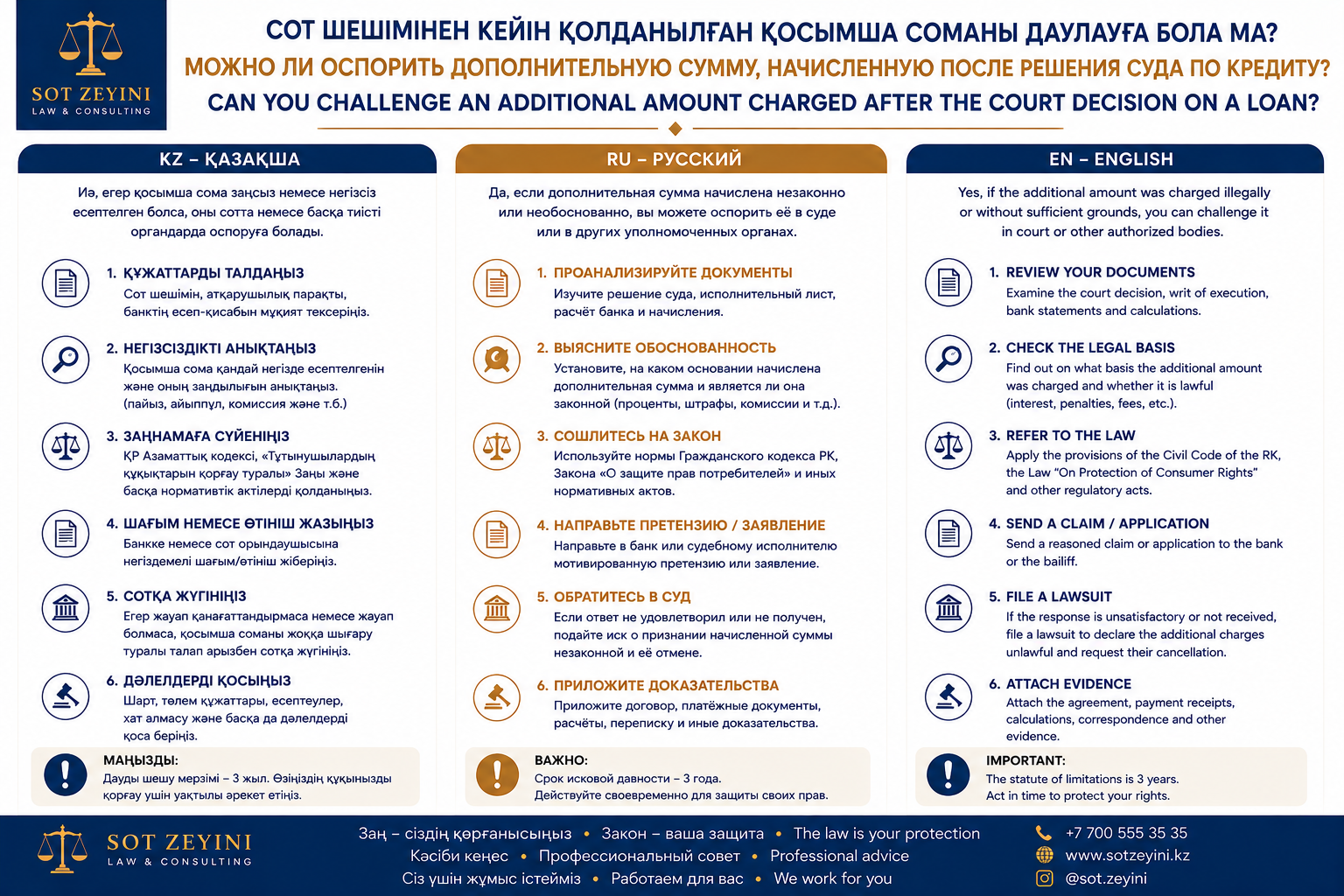
Can You Dispute an Additional Amount Charged After a Court Decision on a Loan in Kazakhstan?
Can You Dispute Extra Charges After a Loan Court Decision?
Find out whether a borrower in Kazakhstan can dispute additional amounts charged by a bank, MFO, collector, or private bailiff after a court decision on a loan.
dispute debt after court decision Kazakhstan, extra loan charges after court, bank charged debt after judgment, MFO additional interest after court, private bailiff overcollection Kazakhstan, loan debt recalculation Kazakhstan
Short answer
Yes, an additional amount charged after a court decision on a loan can be disputed. If the court has already ordered the borrower to pay a specific amount, the bank, microfinance organization, or collector cannot simply add new interest, penalties, fines, or fees without a legal basis and a clear calculation.
A court decision is not a blank check for the creditor. If a new amount appears after the judgment, the borrower should check where it came from, what period it covers, whether it is allowed under the contract, and whether it complies with the law.
What additional amounts may appear after a court decision?
After a court decision, a creditor may sometimes claim additional amounts, such as:
- interest or remuneration;
- penalties for late payment;
- fines;
- commissions;
- collection expenses;
- collector-related charges;
- private bailiff fees;
- enforcement expenses;
- remaining debt after partial repayment.
However, the fact that such an amount appears in a bank statement or collector notice does not automatically make it lawful. Every additional amount must be supported by calculation and legal grounds.
If the court decision states a fixed amount
If the court decision states that, for example, 1,200,000 tenge must be recovered from the debtor, the private bailiff should enforce the executive document. The bailiff cannot independently add new amounts that are not included in the writ of execution or the court decision.
The exception is amounts directly related to enforcement proceedings, such as private bailiff fees, enforcement expenses, and other amounts provided by law.
If the bank says after the judgment, “You owe another 400,000 tenge,” the borrower should request a full calculation and legal justification.
Can the bank file a new claim after the court decision?
In some cases, a bank, microfinance organization, or collector may file a new claim for a new period of accruals. However, the creditor must prove:
- the period for which the amount was charged;
- the contractual clause used as the basis;
- whether the amount was already included in the first court decision;
- how the principal debt was calculated;
- which borrower payments were taken into account;
- whether restrictions on interest, penalties, and fines were observed;
- why the amount should be recovered now.
Simply saying “our system calculated it” is not enough. In court, evidence matters more than software.
When can the additional amount be disputed?
Grounds for disputing the additional amount may include:
- the amount is not stated in the court decision;
- the calculation is unclear or incomplete;
- the bank does not specify the accrual period;
- the bank includes an amount already recovered by court;
- the borrower’s payments were not taken into account;
- interest was charged unlawfully;
- penalties and fines are excessive;
- the debt was transferred to a collector without a clear calculation;
- the collector does not prove the right to claim the debt;
- the bailiff is recovering more than stated in the executive document;
- the amount was charged after 90 days of overdue payment on a consumer loan in violation of restrictions;
- the creditor refuses to provide documents.
If at least one of these signs exists, the amount should be checked and, if necessary, disputed.
What should the borrower do?
If the bank, MFO, or collector demands an additional amount after a court decision, the borrower should not rush to pay. First, the borrower should request a calculation.
Recommended steps:
- Obtain a copy of the court decision.
- Obtain the writ of execution or court order.
- Request a full debt calculation from the bank or MFO.
- Ask for a breakdown of principal, interest, penalties, fines, and fees.
- Check what amounts were already awarded by the court.
- Check payments made after the judgment.
- Compare the creditor’s calculation with the executive document.
- If errors are found, submit a recalculation request.
- If refused, file a complaint or apply to court.
The key point is not to argue verbally. Documents should be requested.
What request should be sent to the bank or MFO?
The borrower may submit a request for a full calculation and recalculation of the debt.
Sample wording:
“There is a court decision against me on recovery of debt under loan agreement No. ___ dated ___. After the court decision, an additional debt amount of ___ tenge was presented to me. I request a full calculation of this amount with a breakdown of principal debt, interest, penalties, fines, commissions, and other charges, as well as the accrual period and legal basis. If unlawfully or repeatedly charged amounts are identified, I request recalculation of the debt.”
This request should be sent through an official channel: branch office, email, mobile application, personal account, or registered mail.
What if the private bailiff is recovering too much?
If the private bailiff is recovering an amount that is not included in the executive document, the borrower should request access to the enforcement case materials.
The borrower may request from the bailiff:
- copy of the executive document;
- decision to initiate enforcement proceedings;
- calculation of the recovered amount;
- calculation of private bailiff fees;
- information about amounts already recovered;
- decisions on account freezes;
- documents provided by the creditor.
If it turns out that the bailiff is recovering amounts beyond the executive document without legal grounds, the borrower may file a complaint with the Department of Justice or apply to court.
What if a collector demands additional debt?
If the debt has been transferred to a collection agency, the borrower should request:
- assignment agreement or another document confirming transfer of the claim;
- notice of transfer of the claim;
- full debt calculation;
- copy of the court decision;
- information on the amount already recovered;
- calculation of the additional amount.
A collector must prove both the right to claim the debt and the correctness of the amount. A simple “pay immediately” message is not enough.
Can interest charged after court be disputed?
Yes. Interest charged after court can be disputed if it was charged unlawfully, repeatedly, or without regard to legal restrictions. Consumer loans where the overdue period exceeds 90 days should be checked especially carefully.
If interest was charged after 90 days of overdue payment in violation of applicable restrictions, the borrower may demand recalculation.
Can penalties and fines be disputed?
Yes. Penalties and fines may be disputed if they:
- were charged without legal grounds;
- exceed permitted limits;
- are excessive;
- were charged repeatedly;
- were already included in the court decision;
- are not supported by calculation.
In court, the borrower may request reduction of penalties, exclusion of unjustified charges, or recognition of the creditor’s calculation as incorrect.
Where can the borrower apply?
Depending on the situation, the borrower may apply to:
- the bank or MFO with a recalculation request;
- the collector with a demand to provide documents;
- the private bailiff with a request to review enforcement materials;
- the Department of Justice with a complaint against the bailiff;
- the Agency for Regulation and Development of the Financial Market;
- the banking or microfinance ombudsman;
- the court.
If the dispute concerns the debt calculation, it is better to first request documents from the creditor. If the dispute concerns the bailiff’s actions, it should be handled through enforcement proceedings.
What documents are needed?
To dispute the additional amount, the borrower may need:
- loan agreement;
- payment schedule;
- court decision;
- writ of execution;
- court order, if any;
- bank or MFO calculation;
- collector notice;
- bailiff decisions;
- bank statements;
- payment receipts;
- debt certificate;
- correspondence with the creditor;
- recalculation request and response.
Without documents, the dispute is difficult. Credit disputes are won not by loud arguments, but by accurate calculations.
Conclusion
An additional amount charged after a court decision on a loan can be disputed. If the court has already awarded a specific amount, the creditor cannot demand new charges without evidence and legal grounds.
The borrower should request a full calculation, check the accrual period, compare the amount with the court decision and the executive document. If the amount is unlawful, excessive, or repeated, the borrower may demand recalculation, file a complaint with the competent authorities, or apply to court.
FAQ
Can a debt charged after a court decision be disputed?
Yes, if the amount is not supported by calculation, is not stated in the court decision, or was charged in violation of the law.
Can a bank charge interest after court?
Only if there is a legal and contractual basis. For consumer loans, restrictions after 90 days of overdue payment should be checked carefully.
Can a private bailiff recover more than stated in the writ of execution?
The bailiff must enforce the executive document. Additional amounts are possible only within the limits provided by law, such as enforcement expenses and bailiff fees.
What should I do if the bank demands a new amount after court?
You should request a full debt calculation and legal basis for the charges.
Can penalties after a court decision be disputed?
Yes, if they are excessive, charged repeatedly, or not supported by calculation.
What if a collector demands additional debt?
You should request documents proving transfer of the claim and a full debt calculation.
Where can I complain about a private bailiff?
You can file a complaint with the Department of Justice or apply to court.
Should I pay the additional amount immediately?
No. First, check the calculation and legal basis. If the amount is disputed, it can be challenged.