Articles

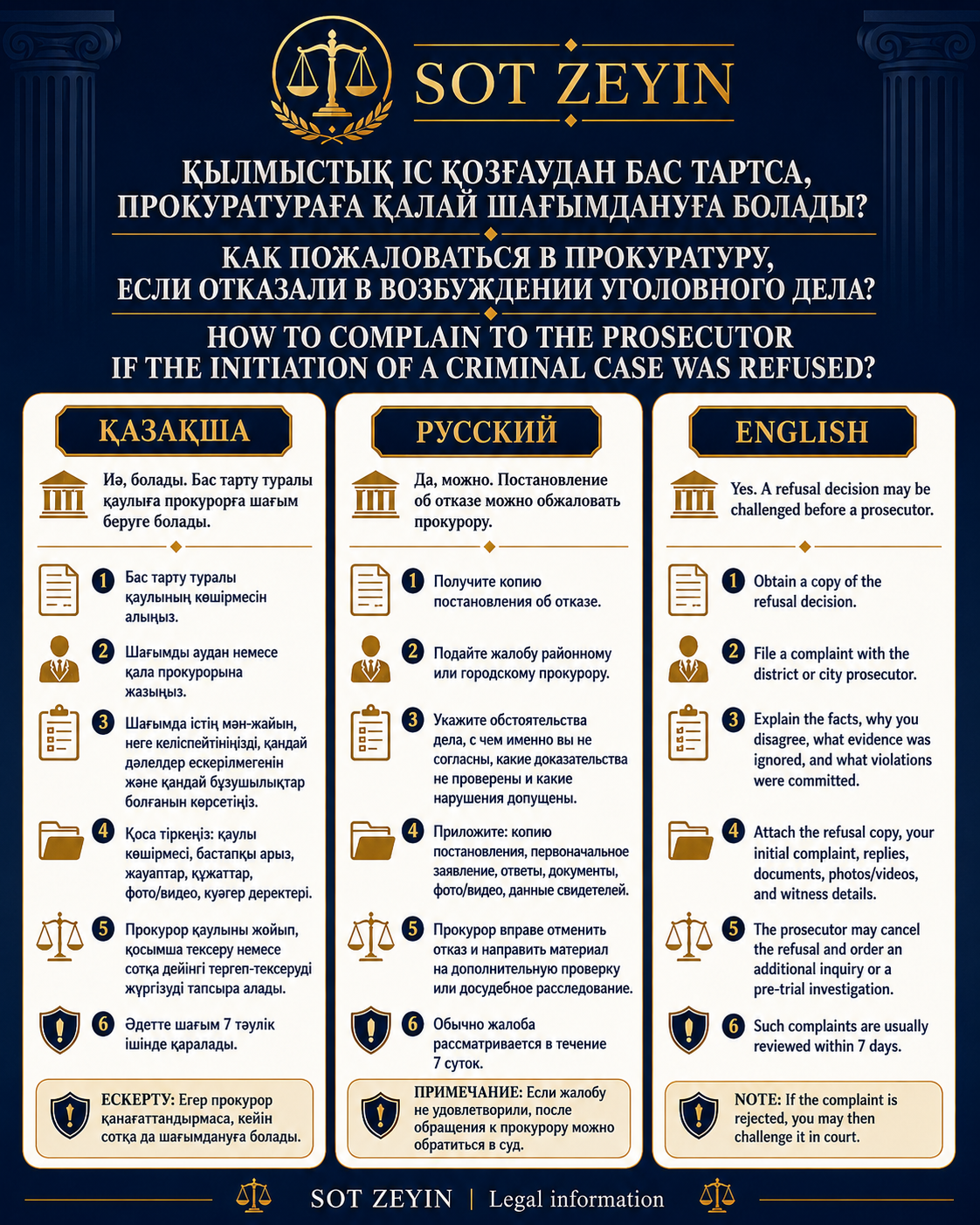
How to Complain to the Prosecutor’s Office If a Criminal Case Is Refused

How to Complain to the Prosecutor’s Office If a Criminal Case Is Refused

What Does Refusal to Open a Criminal Case Mean? People often say, “The police refused to open a criminal case.” In Kazakhstan’s current criminal procedure, it is important to understand what this may actually mean. In practice, it may mean that: the police refused to accept the complaint; the complaint was not registered in the ERDR; the material was treated as a non-criminal matter; the police replied that it was a civil dispute; the review was only formal; no pre-trial investigation was started; proceedings were terminated; the investigator or inquiry officer is inactive. These situations may be challenged. A formal police reply does not mean that the matter is over.

Read article →


How to File a Police Complaint If You Were Scammed Online

How to File a Police Complaint If You Were Scammed Online

What Is Online Fraud? Online fraud is deception through internet platforms, social networks, messengers, websites, online stores, or banking applications in order to obtain money, property, or personal data. Online fraud may happen through: WhatsApp; Instagram; Telegram; TikTok; OLX; Kaspi; fake online stores; phishing websites; fake investment platforms; job advertisements; dating platforms; fake bank calls. If a person loses money or gives personal data because of deception, they should contact the bank and file a police complaint as soon as possible.

Read article →
How to Challenge a Promissory Note Written Under Pressure

How to Challenge a Promissory Note Written Under Pressure

Can a Promissory Note Written Under Pressure Be Challenged? Yes. A promissory note, debt receipt, or written acknowledgment of debt may be challenged if it was written or signed under threats, pressure, violence, blackmail, or coercion. The key issue is whether the person acted freely. A signature alone does not always mean that the person voluntarily accepted a debt. If the document was obtained through threats or pressure, it may be disputed in court.

Read article →
Where Can You Report Threats and Pressure?

Where Can You Report Threats and Pressure?

What Counts as a Threat or Pressure? Threats and pressure are actions that create danger to a person’s life, health, property, family, privacy, reputation, or freedom of decision-making. A threat may be made: verbally; in writing; by phone; through WhatsApp; through Instagram, Telegram, or Facebook; by SMS; in person; through third parties. Examples include: “I will kill you”; “I will hurt you”; “I will burn your car or house”; “I will publish your private photos”; “I will tell everyone your private information”; “I will take your children away”; “I will destroy your business”; “I will file a false complaint against you”; “If you do not pay, you will have problems.” If the person receiving the threat reasonably feels unsafe, the situation should not be ignored.

Read article →
What Should You Do If the Police Refuse to Accept Your Complaint?

What Should You Do If the Police Refuse to Accept Your Complaint?

Can the Police Refuse to Accept a Complaint? If a person reports a possible criminal offense, the police must accept and register the complaint. A police officer should not simply say: “This is not our issue,” “This is a civil dispute,” “Go to another department,” or “Come back later.” If the complaint contains signs of a criminal offense, it should be accepted, registered, and reviewed. If the police refuse to accept or register the complaint, the applicant may file a complaint with police management, the prosecutor’s office, or the investigative court. A refusal to accept a complaint is not just an administrative inconvenience. It may affect a person’s right to protection and access to justice.

Read article →
How to Draft a Legal Services Agreement With a Client

How to Draft a Legal Services Agreement With a Client

Why Do You Need a Legal Services Agreement? A legal services agreement is the main document between a lawyer and a client. It defines what services will be provided, how much the client will pay, what documents are required, and what responsibilities each party has. Without a written agreement, disputes may arise: the client may believe the lawyer guaranteed a win; the lawyer may believe the agreement covered only document preparation; the parties may disagree about fees; court expenses may be unclear; the client may request additional services for free; refund issues may arise if the agreement is terminated. A written agreement helps make the relationship clear and professional.

Read article →
How to Draft a Franchise Agreement or Agency Agreement?

How to Draft a Franchise Agreement or Agency Agreement?

What Is a Franchise Agreement and an Agency Agreement? A franchise agreement and an agency agreement are two different legal models for business cooperation. They may look similar in practice, but they have different purposes, risks, and legal consequences. A franchise agreement allows one party to use another party’s brand, business model, standards, technology, know-how, and commercial system. An agency agreement is usually used when one party finds clients, promotes goods or services, helps conclude deals, and receives commission for that work. In simple terms, a franchise means using a ready-made business system. An agency agreement means attracting clients or sales for a commission.

Read article →
What Should You Consider When Signing an Agreement With an Investor?

What Should You Consider When Signing an Agreement With an Investor?

Why Do You Need an Agreement With an Investor? Attracting an investor can help a business grow faster: open a new branch, buy equipment, launch advertising, hire employees, or scale a project. However, if the relationship with the investor is not properly documented, the investment may turn into a dispute. The main issue is that the parties may understand the money differently. The investor may believe the money was provided as a loan and must be repaid. The entrepreneur may believe the money was invested into the business and is subject to business risk. An investor agreement helps clearly define the rights and obligations of both parties.

Read article →
How to Legally Prepare a Commercial Proposal?

How to Legally Prepare a Commercial Proposal?

What Is a Commercial Proposal? A commercial proposal is a document in which a company, entrepreneur, or professional offers goods, works, or services to a potential client under specific conditions. A commercial proposal usually includes: the product or service offered; price; payment terms; deadlines; scope of work; advantages of the company; cooperation terms; contact details and bank details. In practice, commercial proposals are used to attract clients, start negotiations, and present the main terms of a future deal. However, it is important to understand that a commercial proposal may be just an informational document, or it may have legal consequences and be treated as an offer.

Read article →
What Agreement Should You Sign When Starting a Business with a Partner?

What Agreement Should You Sign When Starting a Business with a Partner?

Why You Should Not Start a Business With a Partner Based Only on Trust Many people start a business with a friend, relative, or acquaintance without signing a written agreement. At the beginning, everything may seem clear: one person invests money, another manages the business, and someone else brings clients. But when profit, expenses, debts, or disagreements appear, verbal promises are often not enough. Without a written agreement, partners may argue about: who invested how much; who owns what share of the business; how profit should be distributed; who manages the company; who is responsible for debts; who owns the website, brand, Instagram, WhatsApp, CRM, and client database; what happens if one partner leaves the business. A written agreement is not a sign of mistrust. It is a normal legal tool that protects both the business and the partners.

Read article →
ИИ Бот