 +7 775 858 9294
 WhatsApp
How to Write a Pre-Litigation Claim to a Microfinance Organization in Kazakhstan
How to Write a Pre-Litigation Claim to an MFO in Kazakhstan
Learn how to write a pre-litigation claim to a microfinance organization in Kazakhstan: debt restructuring, penalty reduction, debt recalculation, required documents, and sample claim.
pre-litigation claim MFO Kazakhstan, microfinance debt claim, microloan restructuring Kazakhstan, MFO debt Kazakhstan, claim to microfinance organization, reduce penalties microloan, personal bankruptcy MFO Kazakhstan
Short answer
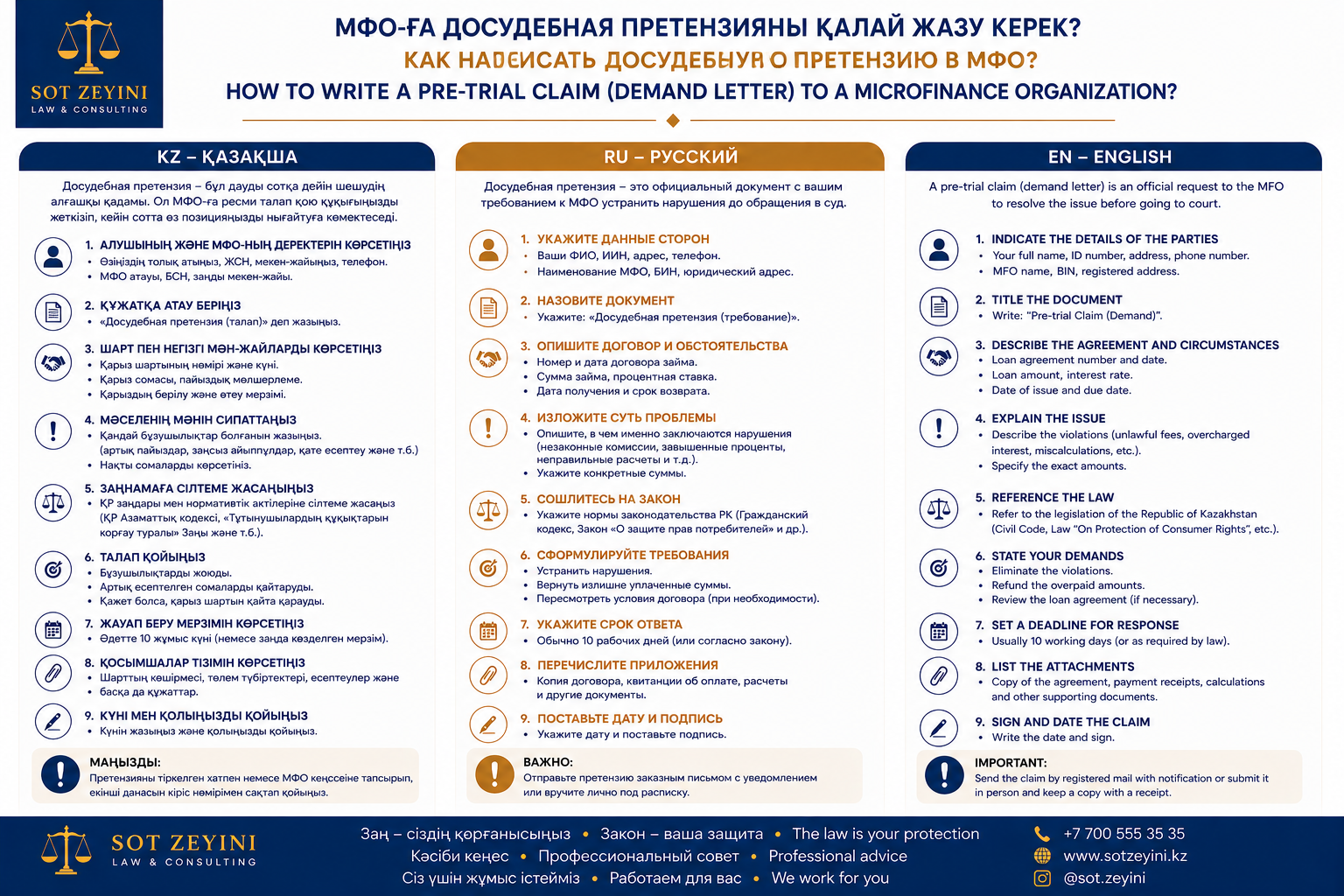
A pre-litigation claim to a microfinance organization is written in free form, but it should clearly include the borrower’s details, microloan agreement number, amount of debt, reason for overdue payment, and specific request to the MFO.
In such a claim, the borrower may request debt restructuring, a new payment schedule, reduction of penalties and fines, recalculation of the debt, a full debt statement, or temporary suspension of collection actions.
The main rule is simple: the claim should be clear, factual, and legally structured. It should not be emotional. Instead of saying “you are pressuring me,” it is better to write: “I request a review of the loan terms and a new repayment schedule.”
When should you write a claim to an MFO?
A pre-litigation claim to an MFO should be written if:
- there is an overdue microloan;
- the debt amount has increased sharply;
- penalties or fines seem excessive;
- the borrower disagrees with the debt calculation;
- the MFO has transferred the debt to collectors;
- the borrower receives frequent calls or messages;
- the borrower needs a new payment schedule;
- the borrower is preparing for bankruptcy;
- the MFO has filed or may file a lawsuit;
- the debt is already being enforced by a private bailiff.
The claim helps prove that the borrower tried to resolve the issue before court and acted in good faith.
What should be included in the claim?
The pre-litigation claim should include:
- name of the MFO;
- borrower’s full name;
- individual identification number;
- address and contact number;
- microloan agreement number and date;
- amount of the original microloan;
- current debt amount;
- date of the last payment;
- reason for overdue payment;
- specific requests to the MFO;
- list of attached documents;
- date and signature.
If the claim is incomplete, the MFO may provide a formal response or leave important issues unanswered.
What can you request from the MFO?
The borrower may request:
- a full debt calculation;
- separate indication of principal debt, interest, penalties, fines, and fees;
- debt restructuring;
- change of payment schedule;
- reduction of monthly payment;
- extension of repayment period;
- cancellation or reduction of penalties and fines;
- recalculation of the debt;
- cancellation of unlawful charges;
- temporary suspension of collection;
- suspension of transfer to collectors;
- withdrawal of the debt from a collection agency;
- a written response.
It is better to be specific. For example, “I request a monthly payment of 30,000 tenge for 12 months” is stronger than simply writing “please help me.”
What reasons can be stated?
The reasons for overdue payment should be real and supported by documents where possible. These may include:
- job loss;
- decrease in income;
- illness;
- disability;
- maternity leave;
- minor children;
- death of the family provider;
- multiple credit obligations;
- bank account freeze by a private bailiff;
- delayed salary;
- general deterioration of financial condition.
It is important not only to state the reason but also to attach supporting documents if available.
What documents should be attached?
The borrower may attach:
- copy of identity document;
- microloan agreement;
- payment schedule;
- payment receipts;
- bank statements;
- income certificate;
- unemployment certificate;
- medical documents;
- children’s birth certificates;
- documents regarding other loans;
- private bailiff decisions;
- collector notices;
- MFO debt calculation.
The more supporting documents are provided, the harder it is for the MFO to give a purely formal response.
How should the claim be submitted?
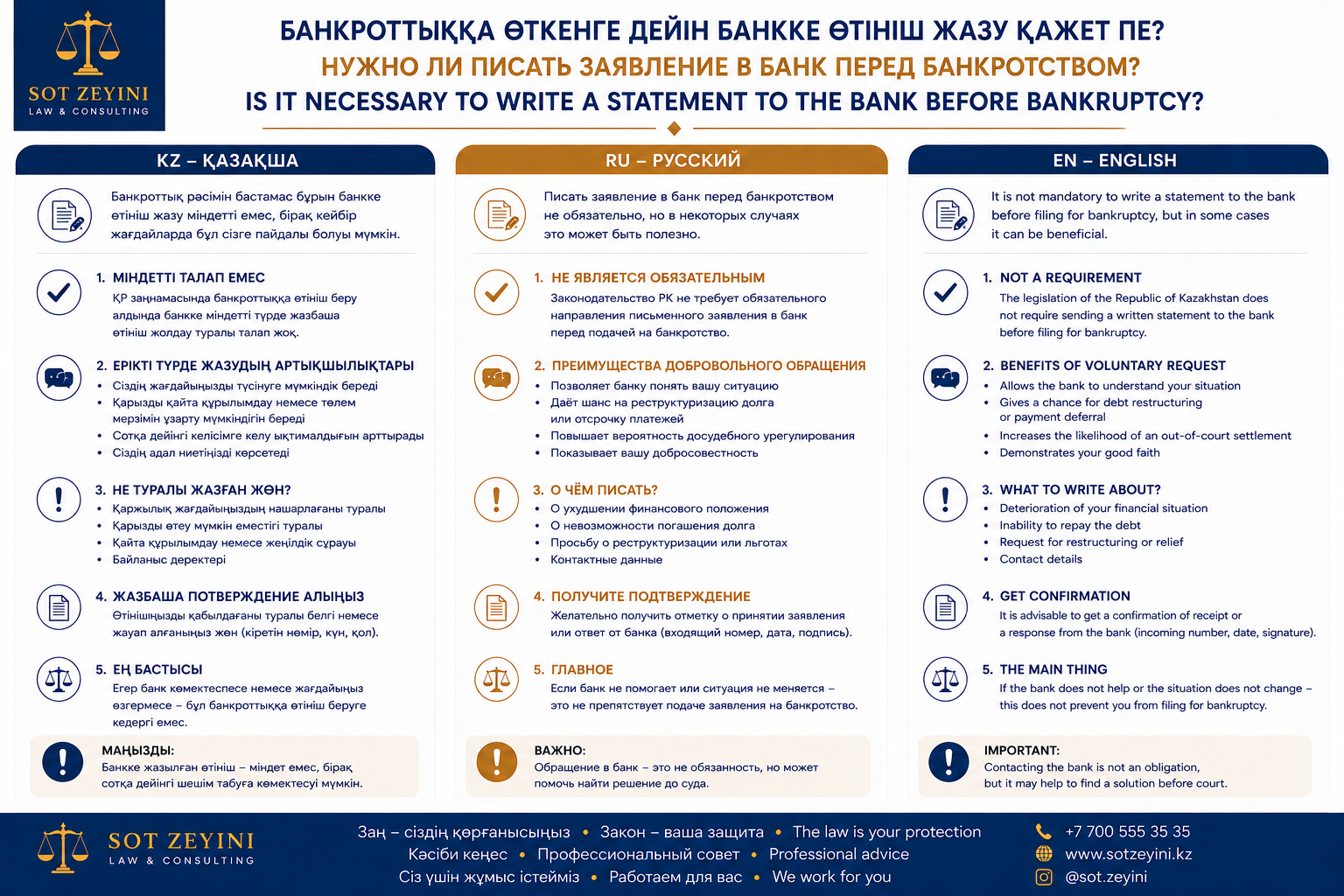
The claim should be submitted in a way that leaves proof of delivery or acceptance.
Recommended methods:
- through the MFO office with an incoming registration number;
- through the official MFO website;
- through a mobile application or personal account;
- to the official email address of the MFO;
- by registered mail;
- by courier with delivery confirmation;
- through another official channel stated in the agreement.
WhatsApp may be used additionally, but it should not be the only method. For court or bankruptcy, the borrower needs proper proof of submission, not just a message seen by a manager.
What if the MFO does not respond?
If the MFO does not respond, the borrower should keep proof of submission:
- incoming registration number;
- screenshot from the website or app;
- email confirmation;
- postal receipt;
- copy of the letter;
- delivery confirmation.
If there is no response, the borrower may file a complaint with the Agency for Regulation and Development of the Financial Market and use the claim as evidence in bankruptcy or court proceedings.
What if the MFO refuses?
If the MFO refuses to restructure or recalculate the debt, the borrower should keep the written refusal.
After refusal, the borrower may:
- file a complaint with the authorized authority;
- dispute the debt amount;
- prepare objections to the MFO’s lawsuit;
- use the refusal as evidence in bankruptcy;
- apply to court if the debt calculation is unlawful;
- consider solvency restoration or bankruptcy.
An MFO refusal is not always bad. Sometimes it becomes a useful document proving that the borrower tried to settle the matter peacefully.
Sample pre-litigation claim to an MFO
To: [Name of MFO]
From: [Borrower’s full name]
IIN: [IIN]
Address: [address]
Phone: [phone number]
Pre-Litigation Claim
on settlement of debt under a microloan agreement
I, [full name], am the borrower under microloan agreement No. [agreement number] dated [agreement date], concluded with [name of MFO].
Currently, I have overdue debt under the above agreement. The reason for the delay is the deterioration of my financial condition, namely: [state the reason — job loss, income decrease, illness, family circumstances, dependents, bank account freeze, etc.].
I do not refuse to fulfill my obligations. However, due to my current financial situation, I am unable to repay the debt under the previous terms.
For the purpose of pre-litigation settlement, I request that you:
- Provide a full debt calculation under microloan agreement No. [agreement number].
- Separately indicate the principal debt, interest, penalties, fines, and other charges.
- Consider restructuring the debt.
- Provide a new repayment schedule based on my current income.
- Reduce or cancel accrued penalties and fines.
- Suspend collection actions during the review of this claim.
- Provide a written response within the legally established period.
I attach documents confirming my financial situation.
Attachments:
- Copy of identity document;
- Copy of microloan agreement;
- Documents confirming income decrease;
- Copies of payment documents;
- Other supporting documents.
Date: ____________
Signature: ____________
Common mistakes when writing a claim
Common mistakes include:
- no agreement number;
- no specific request;
- no supporting documents;
- overly emotional wording;
- no proof of submission;
- using only WhatsApp;
- failure to keep the MFO’s response;
- not requesting a debt calculation;
- failure to explain the reason for overdue payment.
The claim should look like an official document, not a social media comment. Legal structure is not decoration — it is protection.
Is a claim needed for bankruptcy?
Yes, in many cases a claim or request to the MFO is needed to prove that the borrower attempted debt settlement before bankruptcy.
If the MFO refuses, the refusal should be attached. If there is no response, the borrower should attach a copy of the claim and proof that it was sent. This may be important when applying for out-of-court bankruptcy or during court proceedings.
Conclusion
A pre-litigation claim to an MFO should be short, clear, and supported by evidence. It should include the agreement details, debt amount, reason for overdue payment, and specific requests: restructuring, new payment schedule, penalty reduction, debt recalculation, or suspension of collection.
The most important step is to submit the claim officially and keep proof of delivery. This document can then be used in negotiations with the MFO, in a complaint, in court, or in bankruptcy proceedings.
FAQ
Do I need to write a pre-litigation claim to an MFO?
Yes, if you want to settle the debt, reduce penalties, change the payment schedule, or prepare for bankruptcy.
How long does an MFO take to respond?
The MFO should review the request and provide a response within the established period. It is important to keep proof that the claim was submitted.
Can I ask the MFO to cancel penalties?
Yes, the borrower may request reduction or cancellation of penalties and fines, especially if there are valid reasons for the delay.
Can I send the claim through WhatsApp?
It is better not to rely only on WhatsApp. The claim should be sent through an official channel that provides proof of submission.
What if the MFO does not respond?
You can file a complaint with the authorized authority and use a copy of the claim as evidence.
What if the MFO refuses?
You can challenge the refusal, prepare objections in court, or use the refusal as a document for bankruptcy.
Should documents be attached?
Yes. It is advisable to attach documents confirming income decrease, illness, children, account freezes, or other circumstances.
Can this claim be used for bankruptcy?
Yes, the claim and proof of its submission may be used as evidence of pre-bankruptcy debt settlement.