 +7 775 858 9294
 WhatsApp
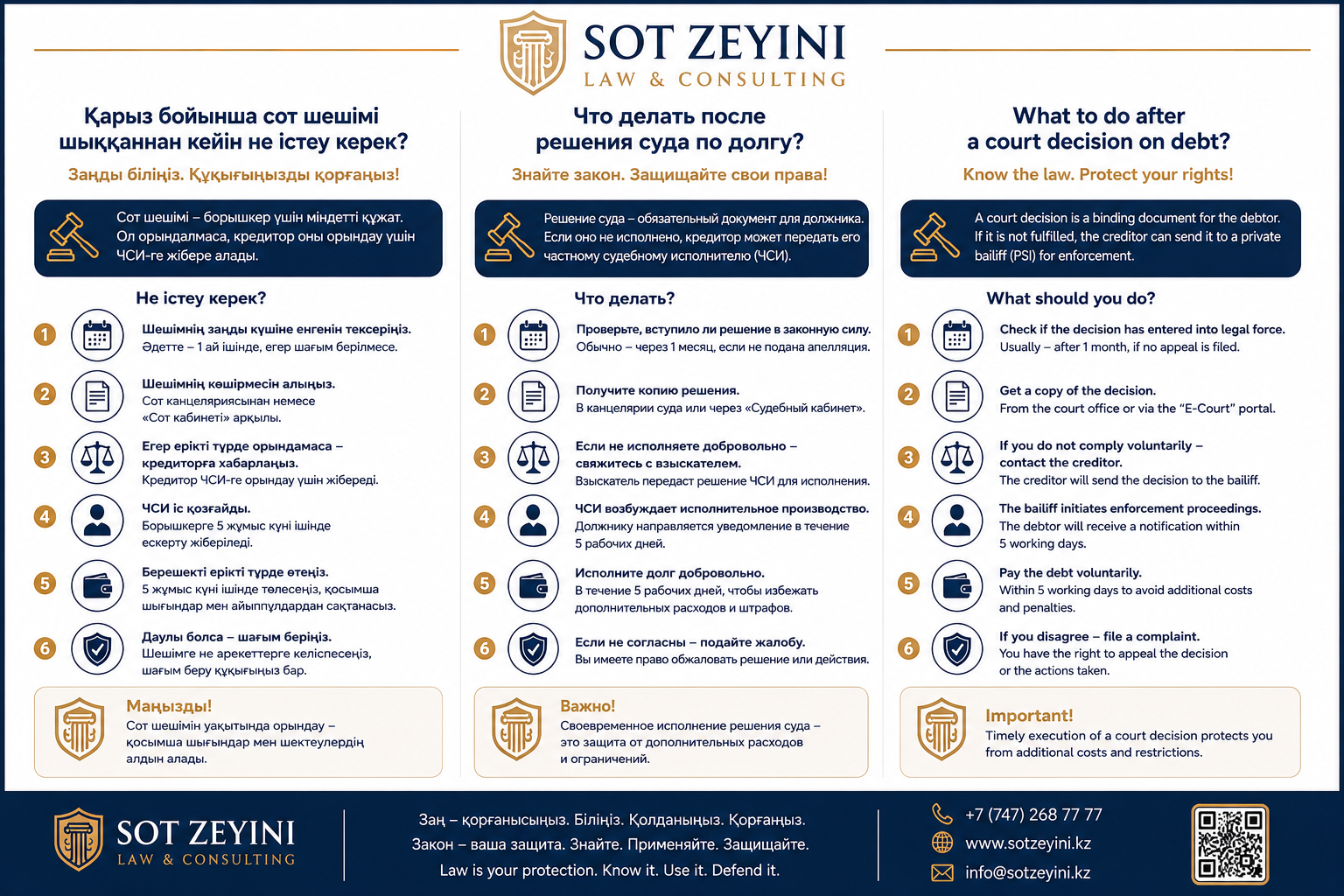
What Should You Do After a Court Decision on Debt Recovery?
When the court issues a decision to recover a debt, many people expect the money to arrive immediately. In practice, however, a court decision is not the final step. It is the basis for the next stage: enforcement.
If the debtor does not pay voluntarily, the creditor must obtain a writ of execution and submit it to a private enforcement officer.
In simple terms: winning the court case is round one. Actually getting the money is round two.
What should you do first after the court decision?
The first step is to check whether the court decision has entered into legal force. If the parties do not file an appeal, the decision enters into force after the appeal period expires.
After the decision enters into legal force, the creditor should:
- check the case status in the Judicial Cabinet;
- make sure no appeal has been filed;
- apply for a writ of execution;
- obtain the writ of execution;
- submit it to a private enforcement officer;
- monitor the enforcement proceedings.
If nothing is done after the court decision, the decision may remain only a document. A document alone does not transfer money to your bank account.
When does a court decision enter into legal force?
A first-instance court decision usually enters into legal force after the appeal period expires. If the defendant files an appeal, the decision may enter into force after the appellate court reviews the case.
After receiving the decision, it is important to check:
- whether an appeal has been filed;
- when the decision enters into legal force;
- whether a writ of execution can already be requested.
Before the decision enters into legal force, a writ of execution usually cannot be obtained, except in cases of immediate enforcement.
What is a writ of execution?
A writ of execution is an official document that allows an enforcement officer to recover money from the debtor by compulsory measures.
The writ of execution usually includes:
- name of the court;
- case number;
- creditor’s details;
- debtor’s details;
- amount to be recovered;
- information about the court decision;
- requirements to be enforced.
If there is a court decision but no writ of execution, compulsory debt recovery will be difficult.
How do you obtain a writ of execution?
To obtain a writ of execution, the creditor must submit an application to the court that issued the decision. The application can be filed through the Judicial Cabinet.
In the application, the creditor may request:
- issuance of the writ of execution;
- electronic delivery of the writ;
- a copy of the court decision with confirmation that it has entered into legal force;
- if necessary, sending the enforcement document for execution.
It is useful to include the creditor’s bank details and information about the debtor.
What should you do after receiving the writ of execution?
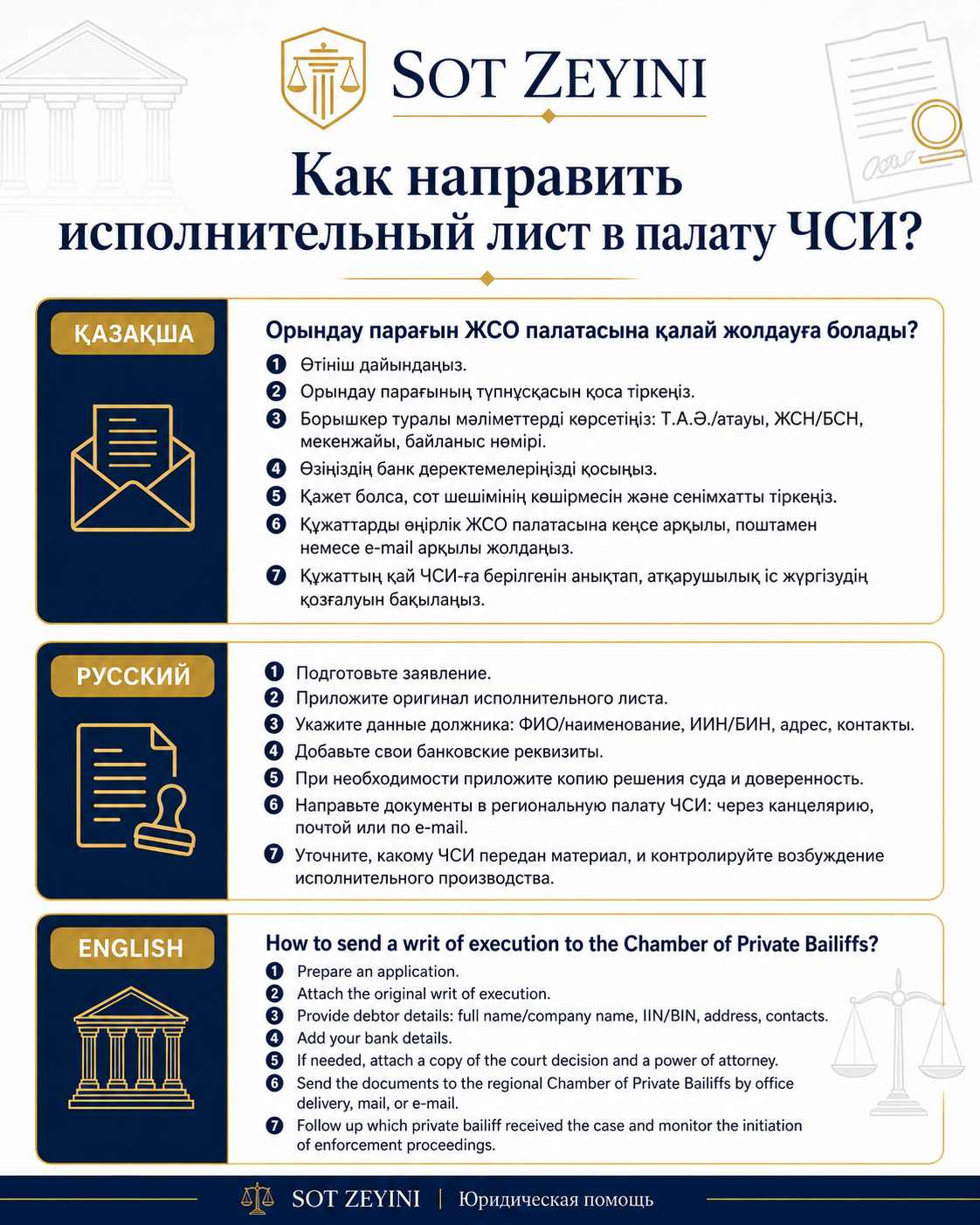
After receiving the writ of execution, it should be submitted to a private enforcement officer.
It is recommended to provide the enforcement officer with:
- writ of execution;
- court decision;
- copy of the creditor’s ID;
- creditor’s bank details;
- debtor’s details;
- debtor’s address;
- debtor’s phone number;
- debtor’s workplace, if known;
- information about bank accounts;
- information about vehicles, real estate, or other property.
The more information you provide about the debtor, the higher the chances of faster recovery.
What can a private enforcement officer do?
After initiating enforcement proceedings, the enforcement officer may apply compulsory enforcement measures.
The officer may:
- freeze the debtor’s bank accounts;
- recover money from bank accounts;
- issue an order for salary deductions;
- impose restrictions on real estate;
- freeze a vehicle;
- identify the debtor’s property;
- arrange valuation of property;
- sell property through enforcement procedures;
- include the debtor in the debtor registry;
- consider temporary travel restrictions;
- send requests to state bodies and banks.
After court, it is important not only to submit the documents but also to monitor what measures the enforcement officer actually takes.
What if the debtor is ready to pay voluntarily?
If the debtor is ready to pay after the court decision, the payment should be properly documented.
It is best to receive payment through a bank. The payment description should state:
“Payment of debt under court decision.”
If money is paid in cash, a written receipt must be prepared.
After payment, it is necessary to:
- confirm receipt of the full amount;
- notify the enforcement officer;
- obtain a resolution on completion of enforcement proceedings;
- check that all freezes and restrictions have been removed.
What if the debtor does not pay?
If the debtor does not comply with the court decision voluntarily, the creditor should request active enforcement measures.
The creditor may ask the enforcement officer to:
- send requests to all banks;
- freeze bank accounts;
- check the debtor’s workplace;
- check pension contribution records;
- identify vehicles;
- check real estate;
- impose restrictions on property;
- restrict the debtor’s travel;
- include the debtor in the debtor registry;
- arrange valuation and sale of property.
Enforcement proceedings should not be left without control. Sometimes the case is opened but does not move forward. The creditor must stay active.
What if the enforcement officer does nothing?
If a private enforcement officer fails to take action for a long time, a complaint can be filed.
A complaint may be submitted to:
- the enforcement officer;
- the regional chamber of private enforcement officers;
- the department of justice;
- the prosecutor’s office;
- the court.
The complaint should state specific failures:
- no requests were sent to banks;
- property was not checked;
- workplace was not identified;
- accounts were not frozen;
- applications were not answered;
- enforcement measures were not taken.
A general phrase like “the officer does nothing” is weak. It is better to state exactly what the officer should have done and failed to do.
What if the debtor has no property?
If the debtor has no official income, money in bank accounts, or registered property, recovery may be difficult. But the debt does not disappear.
The enforcement officer may periodically check the debtor’s financial status. If later the debtor receives salary, buys a vehicle, real estate, or has money in bank accounts, enforcement may continue.
That is why enforcement proceedings should be monitored even if the debtor currently has no assets.
Can money be deducted from the debtor’s salary?
Yes. If the debtor is officially employed, the enforcement officer may issue an order to the employer to deduct part of the debtor’s salary.
The employer will then withhold a certain amount and transfer it to the creditor.
This is one of the most effective methods of debt recovery when the debtor has official employment.
Can the debtor’s bank accounts be frozen?
Yes. The enforcement officer may freeze the debtor’s bank accounts. If there is money in the accounts, it may be used to repay the debt.
However, some types of payments may be protected or restricted from enforcement by law, such as certain social payments, benefits, and protected funds.
Therefore, the nature of incoming payments may matter when accounts are frozen.
What if the debtor owns a car or real estate?
If the debtor owns a vehicle, apartment, house, land plot, or other property, the enforcement officer may freeze it and later consider valuation and sale.
The creditor may submit an application requesting the officer to:
- identify the debtor’s property;
- send requests to registration authorities;
- impose a restriction on disposal;
- conduct valuation;
- sell the property through enforcement procedures.
If the debtor has property, it should be identified and restricted quickly so the debtor cannot transfer it to another person.
Can the debt increase after the court decision?
If the court has awarded a specific amount, enforcement is usually carried out based on that amount. However, in some cases, there may be issues of indexation, additional expenses, enforcement sanctions, or new claims.
If the debtor fails to comply with the decision for a long time, it is recommended to consult a lawyer and assess whether additional legal steps are available.
How long does recovery take after a court decision?
The duration depends on the debtor’s financial situation.
If the debtor has money in bank accounts, official salary, or property, recovery may be faster.
If the debtor has no income or property, enforcement may take longer. That is why the creditor should regularly request updates from the enforcement officer and monitor the case.
What should be done after full repayment?
After the debt is fully repaid, the creditor should:
- check receipt of the full amount;
- obtain a resolution on completion of enforcement proceedings;
- make sure bank account freezes are removed;
- check that property restrictions are lifted;
- if necessary, send requests to banks and registration authorities.
If the debt is paid but restrictions remain, the debtor’s accounts or property may still be blocked. The enforcement case should be closed properly.
Common mistakes after a court decision
Creditors often make these mistakes:
- doing nothing after the court decision;
- not obtaining the writ of execution;
- contacting the enforcement officer too late;
- not providing information about the debtor;
- not monitoring the officer’s work;
- not filing written applications;
- not complaining about inaction;
- making verbal arrangements with the debtor;
- accepting cash without a receipt.
These mistakes can significantly delay actual debt recovery.
What documents are needed for enforcement?
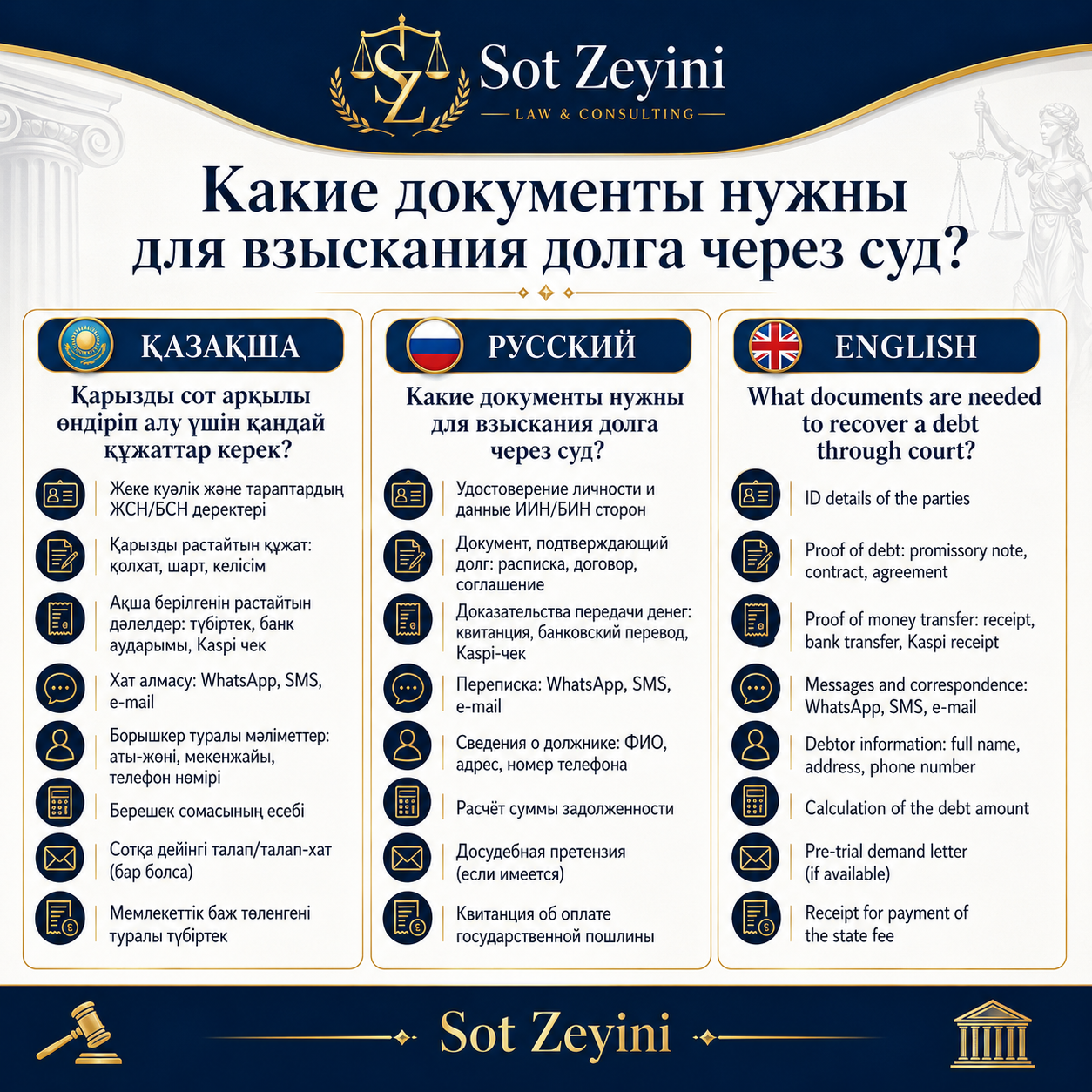
To submit the decision for enforcement, the following documents are usually needed:
- court decision;
- writ of execution;
- copy of the creditor’s ID;
- creditor’s bank details;
- information about the debtor;
- debtor’s address;
- debtor’s phone number;
- workplace information;
- property information;
- application to the enforcement officer.
The more complete the document package, the faster enforcement proceedings can begin.
Legal assistance
SOT ZEYINI law company assists with enforcement of court decisions on debt recovery in Kazakhstan.
We can help with:
- reviewing the court decision;
- preparing an application for a writ of execution;
- submitting documents to a private enforcement officer;
- preparing applications to search for the debtor’s property;
- requesting freezing of bank accounts;
- requesting salary deductions;
- filing complaints about enforcement officer inaction;
- contacting the department of justice or chamber of enforcement officers;
- monitoring enforcement proceedings;
- supporting recovery until the money is actually received.
If you already have a court decision on debt recovery but the money has not yet been collected, contact us via WhatsApp. A lawyer will review the documents and explain the next steps.
FAQ
What should I do after a court decision on debt recovery?
You should check whether the decision has entered into legal force, obtain a writ of execution, and submit it to a private enforcement officer.
Will the money be returned immediately after the court decision?
Not always. If the debtor does not pay voluntarily, the debt must be recovered through enforcement proceedings.
Where can I obtain a writ of execution?
The writ of execution is issued by the court that made the decision. The application can be submitted through the Judicial Cabinet.
What can an enforcement officer do?
The officer can freeze accounts, deduct money from salary, impose property restrictions, search for assets, and take compulsory recovery measures.
What if the debtor has no property?
The debt does not disappear. If the debtor later receives income or obtains property, recovery may continue.
What if the enforcement officer does nothing?
A complaint may be filed with the chamber of private enforcement officers, the department of justice, the prosecutor’s office, or the court.
Can money be deducted from salary?
Yes. If the debtor is officially employed, the enforcement officer may send an order to the employer.
What should be done after full repayment?
You should obtain a resolution on completion of enforcement proceedings and check that all freezes and restrictions are removed.
Conclusion
After a court decision on debt recovery, it is important to properly start enforcement. The court decision does not automatically turn into money. You need to obtain a writ of execution, submit it to an enforcement officer, and monitor the recovery process.
Winning in court is important. But the real result is actually receiving the money.