 +7 775 858 9294
 WhatsApp
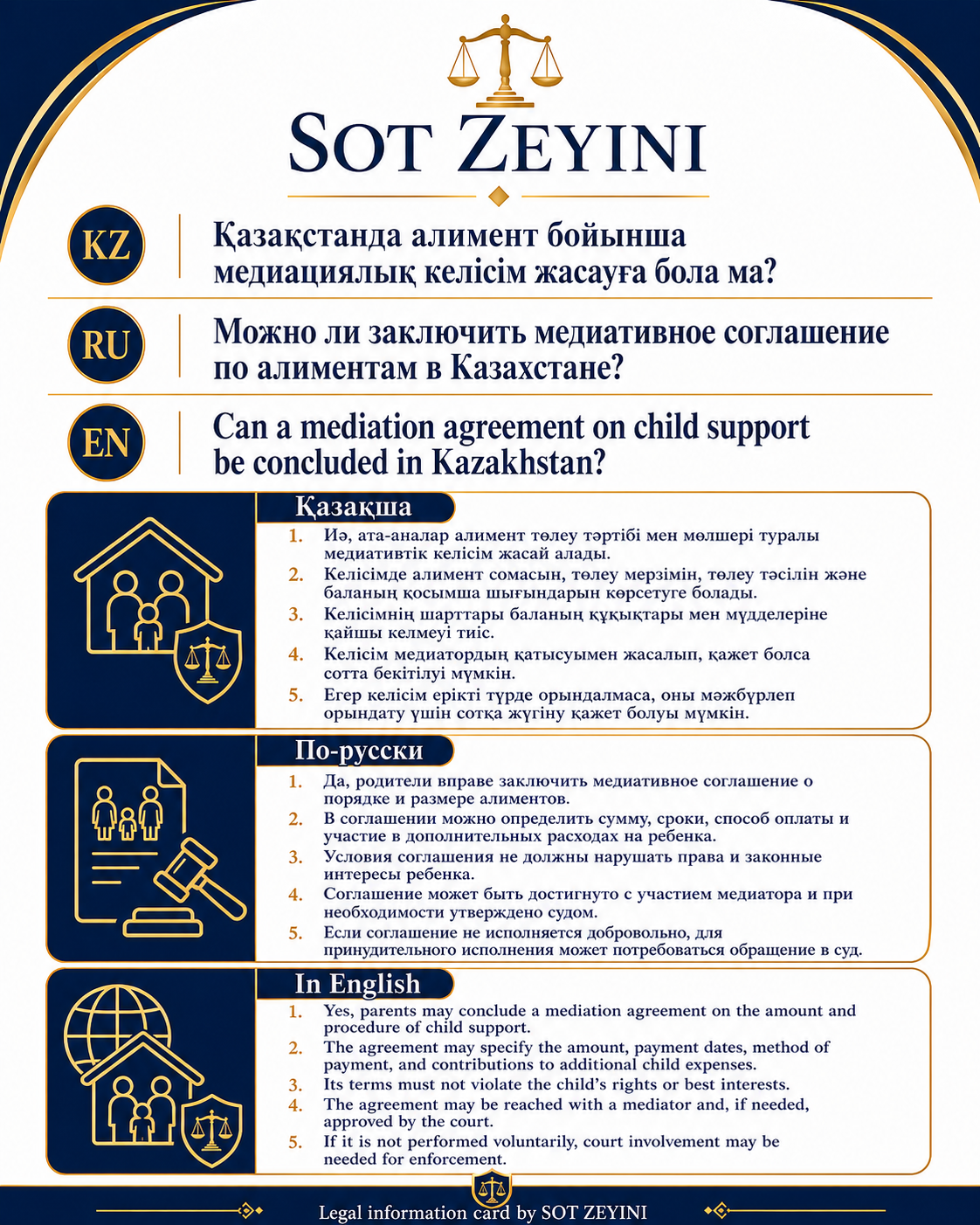
Can a Mediation Agreement Be Made for Child Support in Kazakhstan?
Can a mediation agreement be made for child support in Kazakhstan? Yes. Parents in Kazakhstan can resolve child support issues through mediation. This allows them to agree on the amount of child support, payment dates, payment method, additional child-related expenses and repayment of existing debt without a long court conflict.
However, child support is the child’s right, not just a private arrangement between parents. Therefore, the agreement must not violate the child’s interests or reduce the child’s legal right to support.
What is a child support mediation agreement?
A child support mediation agreement is a written agreement between parents reached with the help of a mediator. It sets out how one parent will financially support the child.
The agreement may include:
- the amount of child support;
- monthly payment date;
- payment method;
- bank details;
- additional expenses;
- medical, educational and kindergarten costs;
- repayment of child support debt;
- consequences of late payment;
- procedure for changing the agreement.
This document helps avoid uncertainty. It should clearly state how much is paid, when, where and for what purpose.
When is mediation useful in child support matters?
Mediation may be useful when parents want to resolve the issue peacefully and avoid unnecessary court conflict.
A mediation agreement may be helpful when:
- parents are ready to negotiate;
- payment terms must be fixed quickly;
- the payer has unstable income;
- the parties want a fixed monthly amount;
- additional expenses need to be divided;
- there is child support debt and a repayment schedule is needed;
- parents want to preserve communication for the child’s sake;
- issues of visitation, upbringing or expenses are also being discussed.
Mediation is useful when the goal is not just to win a dispute, but to create a workable arrangement for the future.
What can be included in the agreement?
A child support mediation agreement may include various terms, provided they do not violate the child’s rights.
It is usually recommended to include:
- parents’ details;
- child’s details;
- amount of child support;
- payment deadline;
- payment method;
- recipient’s bank account;
- indexation or review procedure;
- additional expenses;
- medical expenses;
- education and kindergarten costs;
- clubs, tutors, speech therapy or psychological support;
- debt repayment schedule;
- consequences of delay;
- procedure for changing the agreement;
- dispute resolution procedure.
The more specific the terms, the fewer disputes may arise later.
Can the amount be lower than the legal amount?
No. The agreement should not worsen the child’s position. If the child could receive more through court, an unreasonably low amount may become a legal problem.
For example, if the payer has stable income but the agreement sets only a symbolic amount that does not cover the child’s needs, such a term may be challenged.
When preparing the agreement, it is important to consider:
- number of children;
- payer’s income;
- standard child support shares;
- real expenses of the child;
- child’s health condition;
- education and development expenses;
- financial situation of both parents.
The main principle is simple: the agreement must protect the child, not help a parent pay less.
Can child support be set as a fixed amount?
Yes. A mediation agreement may set child support as a fixed monthly amount.
This is useful when:
- the payer has unstable income;
- the payer works unofficially;
- income changes every month;
- the parties want to avoid constant calculations;
- the child needs stable regular support.
For example, the parties may agree that the payer will transfer 150,000 KZT every month by the 10th day.
Can additional child expenses be included?
Yes. This is one of the main advantages of mediation. The agreement can separately regulate additional expenses.
These may include:
- medical treatment;
- medication;
- medical examinations;
- dentistry;
- kindergarten;
- school;
- uniforms and textbooks;
- tutors;
- speech therapy;
- psychological support;
- sports;
- creative classes;
- summer camp;
- clothes and shoes;
- other child development expenses.
For example, the agreement may state that monthly child support is paid separately, while medical and education expenses are shared equally.
Can an agreement be made for child support debt?
Yes. The parties can agree on a repayment schedule for child support debt. For example, if the debt has accumulated and the payer cannot pay it all at once, the parties may agree on monthly repayment.
The agreement may include:
- total amount of debt;
- monthly repayment amount;
- payment deadline;
- full repayment period;
- current child support separately from the debt;
- consequences of failing to follow the schedule.
Important: a debt repayment schedule should not cancel current child support. The child must receive current support, while old debt should be repaid separately.
How is a mediation agreement different from a notarized child support agreement?
A mediation agreement is reached with the help of a mediator and is aimed at peaceful dispute resolution. The mediator helps the parties find a compromise.
A notarized child support agreement is executed by a notary. It records the duty to pay child support and may provide a stronger mechanism for enforcement.
In practice, it is important to choose the correct form. If the parties need not only compromise but also stronger enforceability, they should consider whether notarization or court approval is needed.
Can a mediation agreement be approved by court?
Yes. If the dispute is already in court, the parties may conclude a mediation agreement and submit it to the court. The court checks whether it complies with the law and protects the child’s interests.
If the court approves the agreement, it has stronger procedural effect. If the agreement is later violated, enforcement may be easier.
This is especially important if one party doubts that the other will comply voluntarily.
What if the agreement is not performed?
If one party does not perform the mediation agreement, the next steps depend on how the agreement was formalized.
If it was approved by court, enforcement may be requested.
If the agreement was made outside court, it may be necessary to:
- send a written demand;
- record the breach;
- collect evidence of non-payment;
- consult a lawyer;
- file a claim in court;
- request child support through court.
That is why it is important to think about enforcement before signing the agreement.
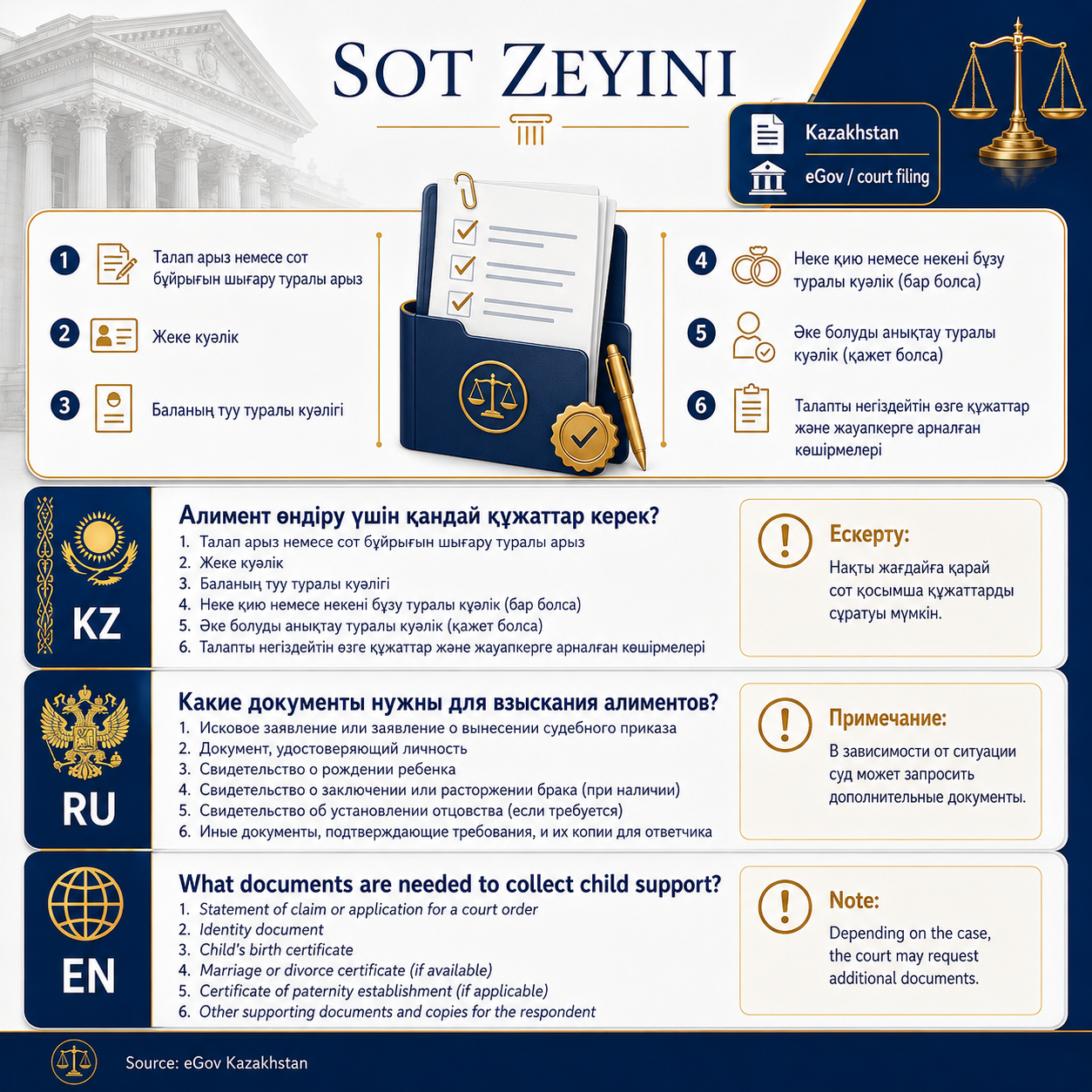
What documents are needed?
Usually, the following documents may be needed:
- parents’ IDs;
- child’s birth certificate;
- marriage or divorce certificate;
- income documents;
- bank account details;
- documents confirming child expenses;
- receipts and payment confirmations;
- kindergarten or school contracts;
- medical documents, if treatment expenses exist;
- information about child support debt;
- previous court decisions or court orders, if any.
Documents help make the agreement specific, realistic and enforceable.
What mistakes do parents often make?
Common mistakes include:
- setting an unreasonably low amount;
- not specifying the exact payment date;
- not providing bank details;
- mixing current child support with old debt;
- forgetting additional expenses;
- not stating consequences of delay;
- signing under pressure;
- not checking the document with a lawyer;
- ignoring a previous court decision;
- relying only on oral promises.
In child support matters, “trust me” works only until the first conflict. Written terms are safer.
Can the agreement be changed?
Yes. If circumstances change, the parties may amend the agreement. For example, expenses may increase, income may change, the child may need treatment, or debt may arise.
If both parties agree, they can sign a new agreement or an amendment. If they cannot agree, the matter may be resolved in court.
Can a mediation agreement release a parent from child support?
No. A parent cannot completely waive the duty to support a child. A mediation agreement may regulate the amount, payment terms and procedure, but it must not deprive the child of support.
If an agreement says that a parent is fully released from child support, such a clause may violate the child’s rights.
Is a lawyer needed?
A lawyer is recommended. A mediator helps the parties reach agreement, while a lawyer checks legal risks.
A lawyer can help to:
- check whether the agreement protects the child’s rights;
- calculate a reasonable amount;
- include additional expenses;
- check child support debt;
- draft proper wording;
- explain consequences of breach;
- advise whether court approval or notarization is needed.
This is especially important if there is debt, disputed income, a previous court decision or a risk of non-payment.
Conclusion
A child support mediation agreement can be made in Kazakhstan. It is a convenient way to peacefully regulate the amount of child support, payment terms, additional expenses and debt repayment schedule.
However, the agreement must protect the child’s interests. The amount should not be lower than what the child could receive under the law, and the terms must be clear and enforceable.
Before signing such an agreement, it is better to have it checked by a lawyer, especially if there is debt, disputed income or an existing court decision.
FAQ: Child Support Mediation Agreement
Can parents make a mediation agreement for child support?
Yes. Parents may make a child support mediation agreement with the help of a mediator.
Can the amount be lower than the legal amount?
No. The agreement must not worsen the child’s position or violate the child’s right to support.
Can child support be set as a fixed amount?
Yes. The parties may agree on a fixed monthly amount.
Can medical and education expenses be included?
Yes. Medical treatment, education, kindergarten, clubs and other child-related expenses may be included.
Can a repayment schedule for child support debt be agreed?
Yes. The parties may agree on a debt repayment schedule, but current child support should be paid separately.
Does the agreement need court approval?
If the case is already in court, the agreement may be submitted for court approval. This may make enforcement easier.
What if the agreement is not performed?
The breach should be documented. Depending on how the agreement was formalized, enforcement or a court claim may be needed.
How is it different from a notarized agreement?
A mediation agreement is reached with a mediator to resolve a dispute. A notarized agreement is formalized by a notary and may be more convenient for enforcement.
Can the agreement be changed?
Yes, if both parties agree. If there is no agreement, the issue may be resolved in court.
Can the agreement release a parent from child support?
No. A parent cannot be fully released from the duty to support a child.