 +7 775 858 9294
 WhatsApp

When can a property division claim be filed?
A property division claim may be filed:
- during marriage;
- together with a divorce claim;
- after divorce;
- when one spouse refuses to divide property voluntarily;
- when there is a risk that an apartment, car, or other property may be sold;
- when property is registered only in one spouse’s name;
- when property has already been sold without the other spouse’s consent;
- when there is a dispute involving a mortgage, car loan, business, or debts.
It is important not to wait until the property disappears. If there is a risk of sale or transfer, a motion for interim measures should be filed together with the claim.
What property can be included in the claim?
The claim may include property acquired during marriage and potentially recognized as jointly acquired marital property.
For example:
- apartment;
- house;
- land plot;
- car;
- mortgaged real estate;
- car under a loan;
- bank account funds;
- deposit;
- business assets;
- share in an LLP;
- individual entrepreneur assets;
- furniture;
- household appliances;
- jewelry;
- sold property;
- other property acquired during marriage.
The key is to describe each asset specifically. The court must understand what exactly is being divided.
What is the structure of the claim?
A property division claim usually includes:
- Name of the court.
- Claimant’s details.
- Defendant’s details.
- Third parties, if any.
- Claim value.
- State fee information.
- Title of the document.
- Factual background.
- List of disputed property.
- Legal reasoning.
- Evidence.
- Requests to the court.
- List of attachments.
- Date and signature.
The clearer the structure, the lower the risk that the court will leave the claim without movement or request corrections.
What should be written in the heading?
The top part of the claim usually includes:
Court:
For example, the district court at the defendant’s place of residence or, in certain real estate disputes, the court where the property is located.
Claimant:
Full name, identification number, address, phone, email.
Defendant:
Full name, identification number if known, address, phone.
Third parties:
A bank, if the dispute concerns a mortgage or pledged property; a registration authority, notary, or another person if their rights may be affected.
Claim value:
The value of the property share or amount claimed.
State fee:
Amount of state fee paid or a request for postponement, installment payment, reduction, or exemption if there are grounds.
How to describe the facts?
The facts should be written briefly and chronologically.
For example:
- when the marriage was registered;
- when the marriage was dissolved or whether divorce proceedings are pending;
- what property was acquired during marriage;
- whose name the property is registered in;
- what funds were used to acquire it;
- who currently uses the property;
- why the dispute arose;
- whether the parties tried to reach an agreement;
- whether there is a risk of sale or transfer of property.
There is no need to write emotionally. Instead of saying “the defendant is a terrible person,” it is better to write: “The defendant refuses to divide the property voluntarily and intends to sell the vehicle.”
How to list the property?
It is better to describe each asset separately.
Example for an apartment:
Apartment located at: Almaty, ________ Street, building ___, apartment ___.
Ownership is registered in the defendant’s name.
The apartment was acquired during marriage.
Estimated market value — KZT 45,000,000.
The claimant requests recognition of the apartment as jointly acquired marital property and determination of the claimant’s 1/2 share.
Example for a car:
Toyota Camry, year 2020, state registration number ________.
The vehicle was acquired during marriage and registered in the defendant’s name.
Estimated value — KZT 12,000,000.
The claimant requests recovery of 1/2 of the vehicle value or determination of the spouses’ shares.
Example for sold property:
The Hyundai Tucson vehicle was acquired during marriage, but the defendant sold it without the claimant’s consent.
The claimant requests determination of the vehicle’s market value and recovery of 1/2 of its value.
How to calculate the claim value?
The claim value depends on the value of the property demand.
If the claimant requests 1/2 of an apartment, the claim value is usually calculated based on the value of that share.
Example:
Apartment value — KZT 40,000,000.
Requested share — 1/2.
Claim value — KZT 20,000,000.
If the claimant requests half of the value of a car:
Car value — KZT 10,000,000.
Claimed compensation — KZT 5,000,000.
Claim value — KZT 5,000,000.
If there are several assets, the values of the claims are added together.
How to prove the value of property?
Property value may be confirmed by:
- valuation report;
- purchase agreement;
- bank documents;
- market listings;
- value certificate;
- expert opinion;
- purchase documents;
- receipts and payment documents.
If the parties dispute the value, the court may be asked to appoint a forensic expert examination.
What should be included in the legal reasoning?
The legal reasoning should explain why the property is marital property.
It may state that:
- the property was acquired during marriage;
- it was purchased using common income;
- there is no prenuptial agreement;
- the property was used for family needs;
- registration in one spouse’s name does not exclude the other spouse’s rights;
- the parties failed to reach a property division agreement.
The legal reasoning should not be overloaded. The main point is to connect the facts with the claim.
What can be requested from the court?
The request section must be as specific as possible.
The claimant may ask the court to:
- recognize property as jointly acquired marital property;
- determine the claimant’s 1/2 share;
- determine the defendant’s 1/2 share;
- leave the apartment to one spouse with compensation to the other;
- recover half of the car value;
- recover half of the value of sold property;
- consider mortgage debt;
- consider car loan debt;
- request documents from the bank;
- appoint valuation or expert examination;
- freeze property;
- prohibit registration actions;
- recover court expenses.
The request section is the heart of the claim. If it is vague, the court decision may also be difficult to enforce.
What documents should be attached?
The claim is usually supported by:
- copy of the claim for the defendant;
- claimant’s ID document;
- marriage certificate;
- divorce certificate or court decision;
- children’s birth certificates if children’s interests are mentioned;
- property documents for apartment, house, or land;
- purchase agreements;
- vehicle documents;
- mortgage agreement;
- loan agreement;
- certificate of remaining debt;
- bank statements;
- receipts;
- valuation report;
- documents confirming sale of property;
- state fee payment receipt;
- proof that the claim was sent to the defendant;
- power of attorney or lawyer’s order if represented by a lawyer.
Every important fact should ideally be supported by a document. Courts love documents almost as much as lawyers love the word “motion.”
What if the property may be sold?
If there is a risk that the defendant may sell, gift, or transfer the property, a motion for interim measures should be filed.
The court may be asked to:
- freeze the apartment;
- prohibit sale of the car;
- prohibit registration actions;
- freeze property within the claim amount;
- prohibit transfer of an LLP share;
- send the court order to the relevant authorities.
This should be done as early as possible. Once the property is sold, the dispute becomes more difficult because the claim may turn into monetary compensation instead of division of the asset itself.
If the property is registered only to one spouse
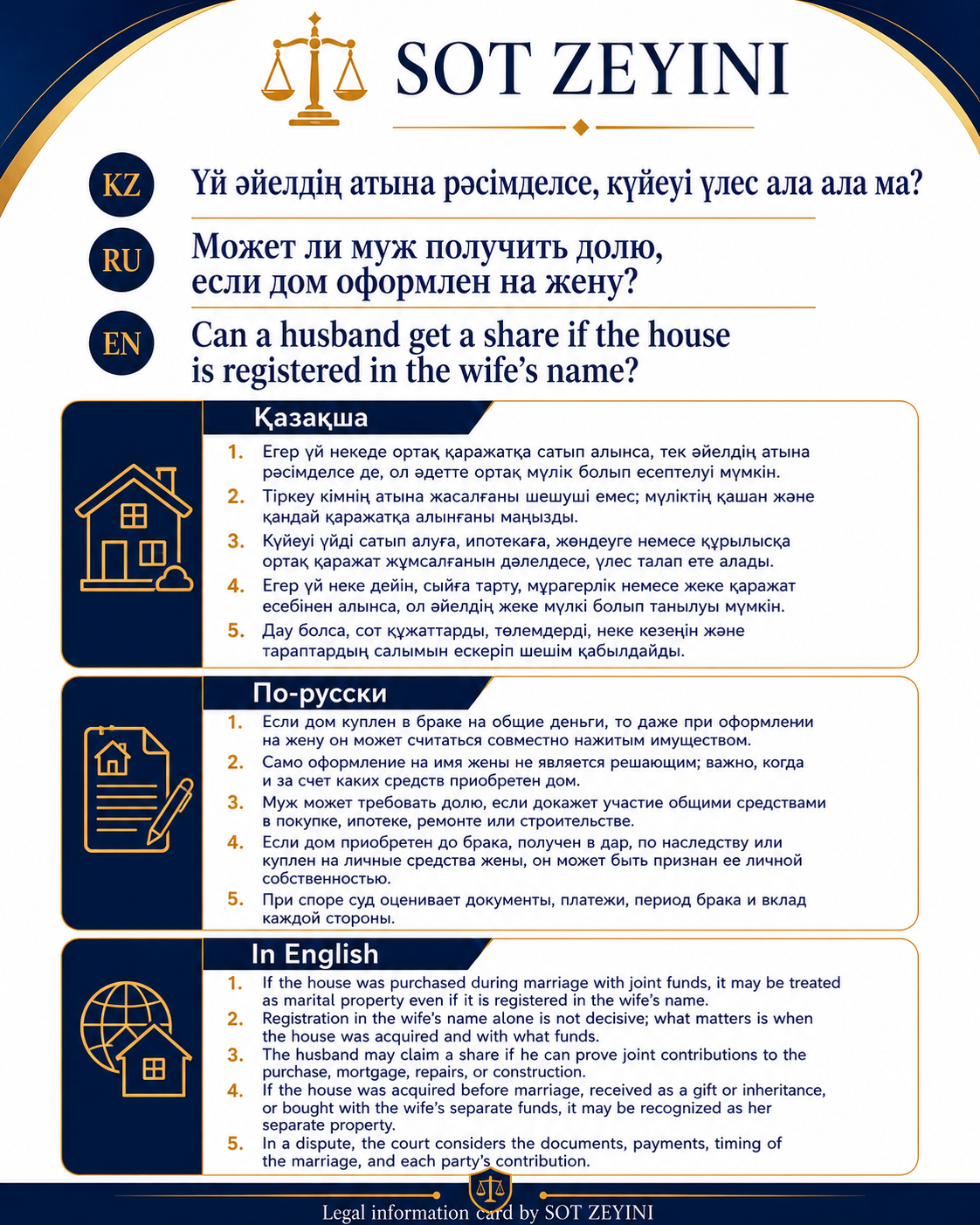
This does not prevent filing a claim. If the property was acquired during marriage, it may be considered marital property even if registered only to the husband or only to the wife.
The claim should state that:
- the property was acquired during marriage;
- the funds were common;
- the parties used the property jointly;
- there is no prenuptial agreement;
- the defendant refuses to recognize the claimant’s share.
If the property has already been sold
If the property was sold without the other spouse’s consent, monetary compensation may be claimed.
The claim should state:
- what property was sold;
- when it was acquired;
- when and to whom it was sold;
- whether the other spouse consented;
- the market value of the property;
- the amount claimed.
If the property was sold at a reduced price, the court may be asked to determine the real market value.
Claim involving a mortgaged apartment
If the dispute concerns a mortgaged apartment, the claim should state:
- apartment address;
- purchase date;
- apartment value;
- remaining mortgage debt;
- who is the borrower or co-borrower;
- who actually made the payments;
- who lives in the apartment;
- who should keep the apartment;
- how compensation should be calculated.
The bank may be involved as a third party if the court decision may affect its rights.
Claim involving a car
If a car is being divided, the claim should state:
- make;
- model;
- year of manufacture;
- state registration number;
- VIN, if available;
- purchase date;
- registered owner;
- car value;
- whether the car is under a loan;
- who uses it;
- whether the car has been sold.
Possible claims include recognition of the car as marital property, recovery of half its value, leaving the car to one spouse with compensation to the other, or prohibiting its sale.
Claim involving a business or individual entrepreneurship
If the dispute concerns a business, it is important not to simply ask to “divide the individual entrepreneur status.” Specific assets should be listed.
For example:
- equipment;
- inventory;
- cash;
- money in accounts;
- vehicles;
- LLP share;
- furniture and machinery;
- website;
- Instagram account;
- customer base;
- common funds invested in the business.
Such cases often require business valuation or expert examination.
Where should the claim be filed?
Usually, the claim is filed at the defendant’s place of residence. If the dispute concerns real estate, jurisdiction based on the location of the property may apply.
Before filing, it is important to correctly determine the court. If jurisdiction is wrong, the claim may be returned or transferred.
Common mistakes when preparing a claim
Common mistakes include:
- no claim value is stated;
- no calculation of shares;
- property is described too generally;
- property documents are not attached;
- no valuation report;
- state fee is paid incorrectly;
- third parties are not listed;
- no motion to freeze property;
- sold property is not valued;
- the request section is unclear;
- the claim is based on emotion rather than evidence.
Main rule: specific asset, specific value, specific share, specific request.
Short sample claim
To ________ District Court of ________
Claimant: full name, ID number, address, phone
Defendant: full name, ID number, address, phone
Claim value: KZT ________
Statement of Claim
for division of jointly acquired marital property
I, , was married to the defendant ________ from “” ________ 20. The marriage was dissolved on “” ________ 20__ / divorce proceedings are currently pending.
During the marriage, the parties acquired the following property:
- Apartment located at ________, registered in the defendant’s name, estimated value KZT ________.
- Vehicle ________, state registration number ________, estimated value KZT ________.
- Other property: ________.
The above property was acquired during marriage using the spouses’ common income. No prenuptial agreement was concluded. The defendant refuses to divide the property voluntarily.
Based on the above, I ask the court to:
- Recognize the apartment located at ________ as jointly acquired marital property.
- Determine the claimant’s share in the apartment as 1/2.
- Determine the defendant’s share in the apartment as 1/2.
- Recover from the defendant in favor of the claimant 1/2 of the vehicle value in the amount of KZT ________.
- Recover court expenses from the defendant.
- If necessary, apply interim measures prohibiting registration actions in relation to the disputed property.
Attachments:
- Copy of the claim;
- Copy of ID document;
- Marriage certificate;
- Divorce certificate;
- Property documents;
- Valuation report;
- Payment documents;
- State fee receipt;
- Other evidence.
Date: “_” ________ 20
Signature: __________
Conclusion
A claim for division of marital property must be accurate and evidence-based. It should clearly state what property is being divided, how much it is worth, what share is requested, and which documents support the claim.
If there is a risk that the property may be sold, the claimant should request interim measures together with the claim. If the value is disputed, a valuation report or expert examination may be needed.
A strong claim is not “please give me justice.” A strong claim is: “Here is the property, here are the documents, here is the value, here is my share.” That is easier for the court and stronger for the claimant.
FAQ — Frequently Asked Questions
1. When can a property division claim be filed?
It can be filed during marriage, together with divorce, or after divorce.
2. Which court should hear the claim?
Usually the court at the defendant’s place of residence. For real estate disputes, the court where the property is located may be relevant.
3. What should be stated in the claim?
The property, its value, purchase date, registered owner, claimant’s share, and specific court requests.
4. Is claim value required?
Yes. Claim value is needed for state fee calculation and for defining the monetary scope of the claim.
5. Is a valuation report needed?
It is recommended, especially for apartments, houses, cars, business assets, or sold property.
6. Can the wife file a claim if the property is registered to the husband?
Yes, if the property was acquired during marriage.
7. Can the husband claim property registered to the wife?
Yes, if it is jointly acquired marital property.
8. What if the car has already been sold?
The claimant may seek recovery of half of the car’s market value.
9. Can sale of property be prohibited?
Yes, by filing a motion for interim measures.
10. Can a mortgaged apartment be divided?
Yes, but remaining debt and bank rights must be considered.
11. Should the bank be involved?
If the dispute concerns a mortgage, pledge, or loan, the bank may need to be involved as a third party.
12. How are shares calculated?
Usually, spouses’ shares are equal — 1/2 each, unless there are grounds for unequal division.
13. Can a 70/30 division be requested?
Yes, but the grounds for unequal division must be proven.
14. What documents should be attached?
Marriage and divorce documents, property documents, valuation, payment documents, loan documents, state fee receipt, and proof of sending the claim to the defendant.
15. Can a person prepare the claim without a lawyer?
Yes, but if the property is expensive, mortgaged, connected to a business, already sold, or disputed in shares, legal assistance is strongly recommended.