 +7 775 858 9294
 WhatsApp
Is property acquired before marriage divided?
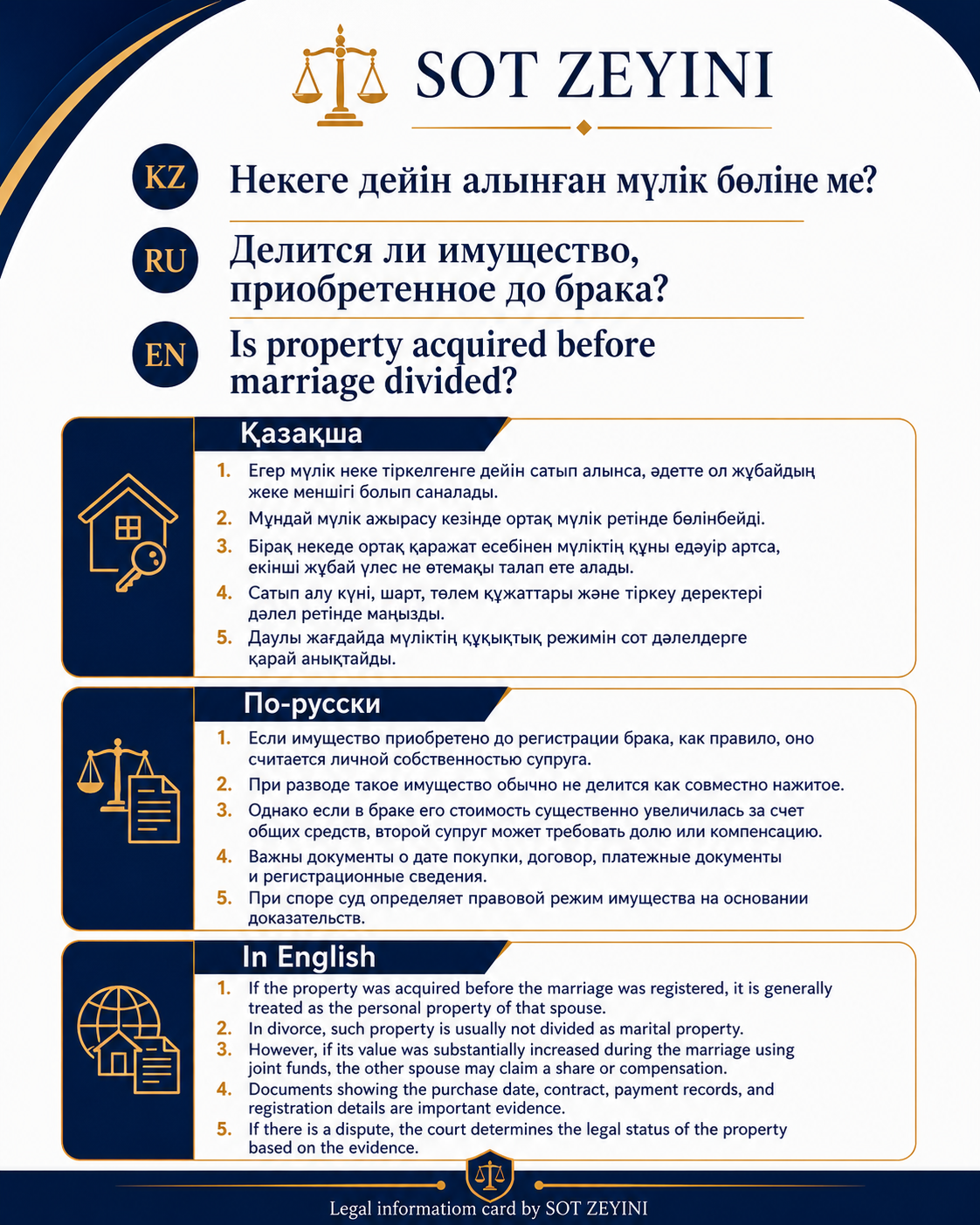
As a general rule, property acquired before marriage is not divided in divorce. It is considered the personal property of the spouse who owned it before the marriage.
For example, if a man bought an apartment before marriage and later got married, his wife does not automatically receive a 1/2 share in that apartment upon divorce. The same applies if a woman bought a house before marriage: her husband does not automatically become a co-owner.
However, there is an important exception. If during marriage joint funds, the other spouse’s personal funds, or the labor of either spouse were invested into the property and those investments significantly increased its value, the property may be recognized as joint marital property or compensation may be awarded.
In short: property before marriage usually stays personal, but serious improvements during marriage can change the legal picture.
What is property acquired before marriage?
Property acquired before marriage means property that belonged to a person before official marriage registration.
It may include:
- apartment;
- house;
- land plot;
- car;
- commercial property;
- business;
- company share;
- bank deposit;
- money in an account;
- securities;
- equipment;
- other valuable assets.
The key issue is that ownership arose before marriage. If the property was purchased, paid for, and registered before marriage, it is usually treated as personal property.
How is it different from property acquired during marriage?
Property acquired during marriage is usually considered joint marital property. Property acquired before marriage is generally personal property.
Example:
Before marriage:
The husband bought an apartment in 2020 and registered marriage in 2022. This apartment is usually his personal property.
During marriage:
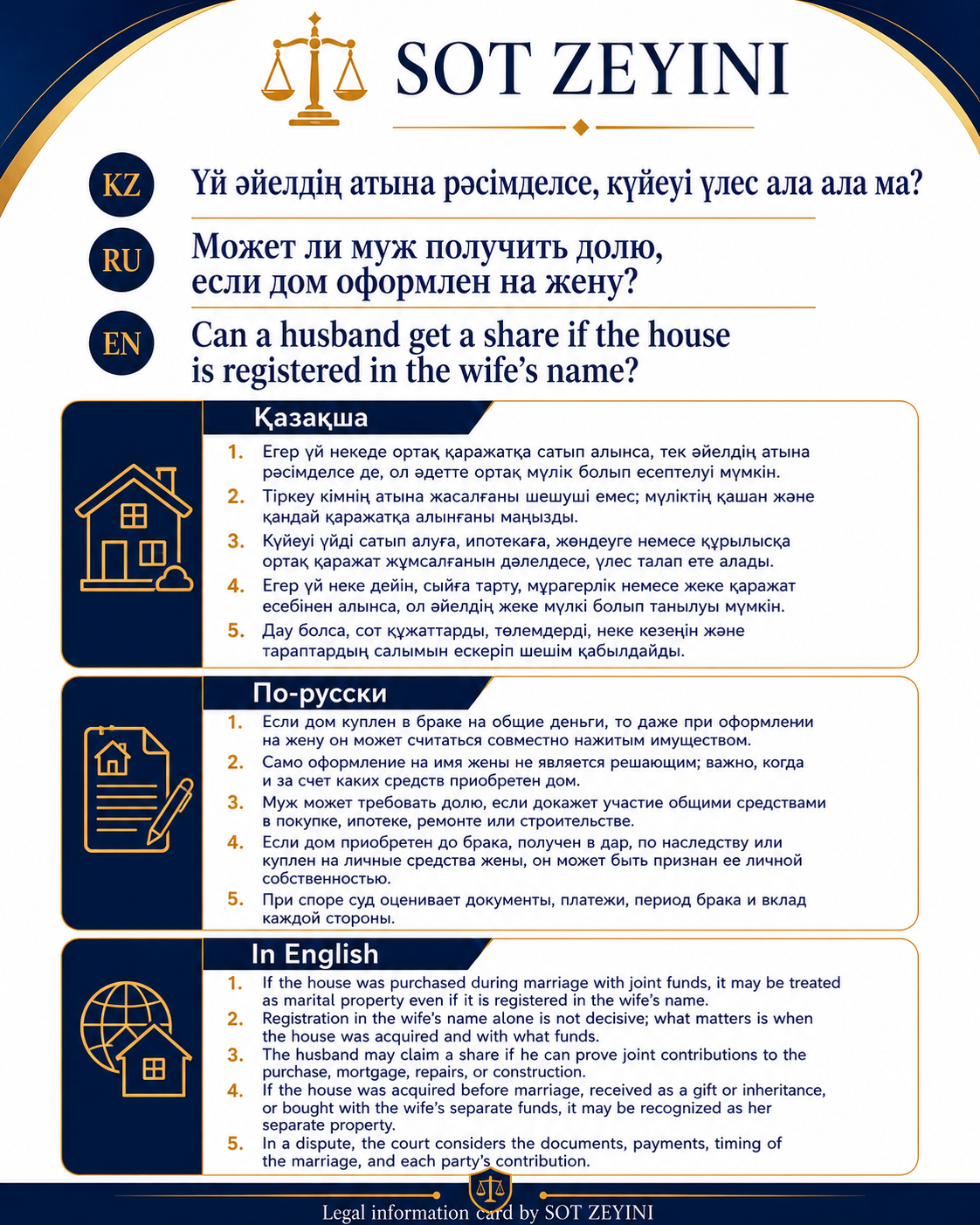
The spouses bought an apartment in 2023. Even if it is registered only in the wife’s name, it may be joint marital property.
So the main question is not only “whose name is in the documents?” but also “when and with what funds was the property acquired?”.
Is an apartment bought before marriage divided?
Usually no. If the apartment was bought before marriage and was not significantly improved during marriage, it remains personal property of the spouse who acquired it.
For example:
- the apartment was bought before marriage;
- ownership was registered before marriage;
- the price was fully paid before marriage;
- no major renovation or reconstruction was done during marriage.
In such a situation, the other spouse cannot automatically claim half of the apartment.
But if significant investments were made during marriage, such as major renovation, reconstruction, expensive remodeling, or improvements that increased market value, the other spouse may claim compensation or a share.
Is a house bought before marriage divided?
A house bought before marriage is usually not divided. However, disputes often arise with houses because spouses may rebuild, expand, repair, or improve them during marriage.
Examples:
- the house was old and was fully renovated during marriage;
- an extension was built;
- gas, water, or sewage systems were installed;
- roof, foundation, or walls were replaced;
- the area of the house increased;
- a garage or other structure was built;
- the market value increased significantly.
In such cases, the other spouse may argue that the property’s value increased due to joint funds or labor and therefore claim a share or compensation.
Is ordinary cosmetic repair enough?
Usually no. Cosmetic repair is often not enough to recognize the property as joint.
Painting walls, buying curtains, replacing small furniture, or ordinary maintenance usually does not prove significant increase in value.
The court will pay more attention to:
- major renovation;
- reconstruction;
- re-equipment;
- remodeling;
- construction of an extension;
- replacement of engineering systems;
- increase in property area;
- significant market value growth.
The key is to show not only that repairs were done, but that the property became materially more valuable.
Is a car bought before marriage divided?
A car bought before marriage is usually not divided. It remains personal property of the spouse who bought it before marriage.
However, if significant money was spent during marriage on the car, for example replacement of the engine, body, or expensive equipment, the other spouse may claim compensation for proven expenses.
In practice, cars are harder to turn into joint property because they usually lose value over time.
Is land acquired before marriage divided?
A land plot acquired before marriage is usually not divided. But if a house or other structure was built on the land during marriage, a dispute may arise.
For example:
- the land belonged to the husband before marriage;
- a house was built on it during marriage;
- construction was paid for with family funds;
- the wife or her relatives invested money;
- the spouses jointly improved the property.
In such cases, the land may remain personal property, but the house, improvements, or investments may become the subject of a court dispute.
How is a mortgage taken before marriage treated?
A mortgage taken before marriage is a common complex situation.
For example, a person took a mortgage before marriage and later got married. During marriage, mortgage payments were made from the family budget. Upon divorce, the other spouse may have a claim.
Possible outcomes:
- The apartment remains personal property of the original owner.
- The other spouse claims compensation for payments made during marriage.
- If significant investments increased property value, a share claim may be raised.
- If most payments were made before marriage, the other spouse’s claim may be weaker.
The court will consider when the mortgage was taken, how much was paid before marriage, how much was paid during marriage, what funds were used, who lived in the property, and what evidence exists.
Is a business created before marriage divided?
A business created before marriage is usually personal property. But if during marriage the business grew significantly due to joint funds or the other spouse’s labor, a dispute may arise.
Examples:
- the business was registered before marriage;
- equipment was bought during marriage;
- turnover increased;
- new assets were acquired;
- the other spouse worked in the business;
- family money was invested;
- the business value increased significantly.
In such cases, the other spouse may claim compensation, a share in the increased value, or division of assets acquired during marriage.
Accounting documents, tax reports, bank statements, business valuation, and financial expert analysis may be needed.
Is inherited or gifted property divided?
Property received by inheritance or gift is usually considered personal property. This applies whether it was received before or during marriage.
Examples:
- the wife inherited an apartment;
- the husband was gifted a house;
- one spouse received land as a personal gift;
- one spouse inherited a car.
Such property is usually not divided. However, if during marriage joint funds significantly improved it, the other spouse may claim compensation or recognition of a share.
When can the other spouse claim a share?
The other spouse may claim a share or compensation if they can prove that during marriage:
- joint funds were invested;
- the other spouse’s personal funds were invested;
- labor of either spouse was invested;
- major renovation was done;
- reconstruction was carried out;
- an extension was built;
- the area increased;
- the market value rose significantly;
- mortgage payments were made from the family budget;
- the business grew due to joint investments.
The key word is prove. Marriage alone does not automatically turn pre-marital property into joint property.
What evidence is needed?
Evidence may include:
- marriage certificate;
- divorce certificate;
- property documents;
- purchase agreement;
- date of ownership registration;
- mortgage agreement;
- bank statements;
- payment documents;
- renovation receipts;
- contractor agreements;
- completion acts;
- construction material receipts;
- before-and-after photos and videos;
- correspondence;
- witness statements;
- valuation report;
- court expert report;
- business documents if the dispute concerns a company.
The strongest evidence shows both the amount invested and the increase in property value.
How to prove increased value
Increased value can be proven through valuation or court expert assessment.
Usually, it is necessary to show:
- what the property was like before investments;
- what works were performed;
- how much money was invested;
- who paid for the works;
- how much the market value increased;
- current property value.
If increased value is not proven, the court may refuse to recognize the property as joint.
If pre-marital property was sold and new property was bought during marriage
This is a separate situation.
For example, the husband sold an apartment he owned before marriage and used the money to buy a new apartment during marriage. Formally, the new apartment was acquired during marriage. But if he proves that it was purchased with money from his personal pre-marital property, he may ask for it to be recognized as personal property.
Evidence may include:
- sale agreement for the old apartment;
- bank statement showing receipt of money;
- purchase agreement for the new apartment;
- money movement;
- short time between transactions;
- absence of mixing with joint funds.
If personal and joint funds were mixed, the court may determine proportional shares.
Is income from pre-marital property divided?
The property itself may remain personal, but income received during marriage may be considered separately.
For example, the wife owned an apartment before marriage. During marriage, it was rented out and rent was used for the family budget. The apartment remains personal, but rental income during marriage may be disputed.
The asset and its income should be analyzed separately.
What if there is a prenuptial agreement?
If the spouses have a prenuptial agreement, property is divided according to that agreement.
The agreement may state:
- pre-marital property remains personal;
- how property acquired during marriage is divided;
- who pays the mortgage;
- who keeps the business;
- who receives compensation;
- what shares belong to each spouse.
If the agreement is valid and lawful, the court will consider its terms.
What can be requested in court?
Depending on the case, a spouse may ask the court to:
- Recognize the property as joint marital property.
- Determine the spouses’ shares.
- Award compensation for investments.
- Award compensation for increased value.
- Recover part of mortgage payments made during marriage.
- Order valuation or expert assessment.
- Freeze the property or prohibit registration actions.
Sometimes it is better to claim compensation for specific investments rather than claim a 1/2 share.
How to protect the property from sale
If there is a risk that the owner may sell, gift, pledge, or transfer the disputed property, interim measures may be requested.
The court may be asked to:
- freeze the property;
- prohibit sale;
- prohibit gift transfer;
- prohibit registration actions;
- prohibit pledge.
This helps preserve the property until the case is resolved.
What is the limitation period?
A three-year limitation period may apply to division of joint property after divorce.
However, it is often counted not simply from the divorce date, but from the moment when the spouse learned or should have learned that their right was violated.
Examples:
- the other spouse says you have no rights to the property;
- the property is being sold;
- the spouse refuses to recognize your investments;
- you are being evicted;
- the property is transferred to another person.
Such events may mark the beginning of the limitation period.
Common mistakes
Avoid these mistakes:
- assuming all property is divided just because there was a marriage;
- failing to keep receipts and payment documents;
- failing to obtain valuation;
- failing to prove value increase;
- confusing cosmetic repair with major renovation;
- making the wrong court claim;
- missing the limitation period;
- failing to request interim measures;
- relying only on emotions.
The court needs facts: when the property was bought, how much was invested, who paid, and how much the value increased.
Sample court wording
A claim may state:
“The disputed property belonged to the defendant before marriage. However, during marriage, significant investments were made using joint marital funds and the claimant’s labor, including major renovation and reconstruction. As a result, the property’s value significantly increased. Therefore, I request recognition of the disputed property as joint marital property.”
For mortgage cases:
“Although the disputed apartment was acquired by the defendant before marriage through a mortgage, mortgage payments during marriage were made from the joint family budget. Therefore, I request compensation for the relevant part of payments made during marriage.”
Conclusion
Property acquired before marriage is usually not divided in divorce. It remains the personal property of the spouse who owned it before marriage.
However, if during marriage joint funds, the other spouse’s personal funds, or labor significantly increased the value of the property, the other spouse may claim a share or compensation.
The most important task is to gather evidence: documents, payments, receipts, valuation, photos, contracts, and other materials.
FAQ: Frequently Asked Questions
1. Is property acquired before marriage divided?
Usually no. It is considered personal property of the spouse who owned it before marriage.
2. Is an apartment bought before marriage divided?
Usually no, unless significant investments were made during marriage.
3. If the apartment was renovated during marriage, is it divided?
It depends. If the renovation significantly increased value, compensation or a share may be claimed.
4. Is cosmetic repair enough?
Usually no. Significant increase in market value must be proven.
5. Is a house bought before marriage divided?
Usually no. But if it was rebuilt, expanded, or substantially improved during marriage, a claim may arise.
6. Is a car bought before marriage divided?
Usually no. But compensation for major proven expenses may be claimed.
7. Is land bought before marriage divided?
Usually no. But if a house was built on it during marriage, there may be a dispute.
8. How is a mortgage taken before marriage treated?
The property may remain personal, but compensation may be claimed for payments made during marriage.
9. Is a business created before marriage divided?
Usually no. But if it significantly increased in value due to joint investments, compensation may be claimed.
10. Is inherited property divided?
Usually no. Inherited property is personal property.
11. Is gifted property divided?
Usually no, if it was a personal gift and properly documented.
12. What evidence is needed?
Receipts, bank statements, contracts, photos, valuation, expert reports, correspondence, and property documents.
13. How to prove increased value?
Through independent valuation or court expert assessment.
14. If pre-marital property was sold and new property bought during marriage, what happens?
If the new property was bought with personal funds from the sale of pre-marital property, it may be recognized as personal fully or partly.
15. Can compensation be awarded instead of a share?
Yes. Courts may award compensation for investments or increased value.
16. What if the property may be sold?
File a claim and request interim measures, such as freezing the property or prohibiting registration actions.
17. What is the limitation period?
A three-year period may apply, often starting from when the spouse learned about the violation of rights.
18. Is marriage alone enough?
No. Additional grounds and evidence are needed to divide property acquired before marriage.
19. What is most important in court?
Proving investments and significant increase in property value.
20. Is valuation needed?
Yes, especially if the claim is based on increased property value.