 +7 775 858 9294
 WhatsApp
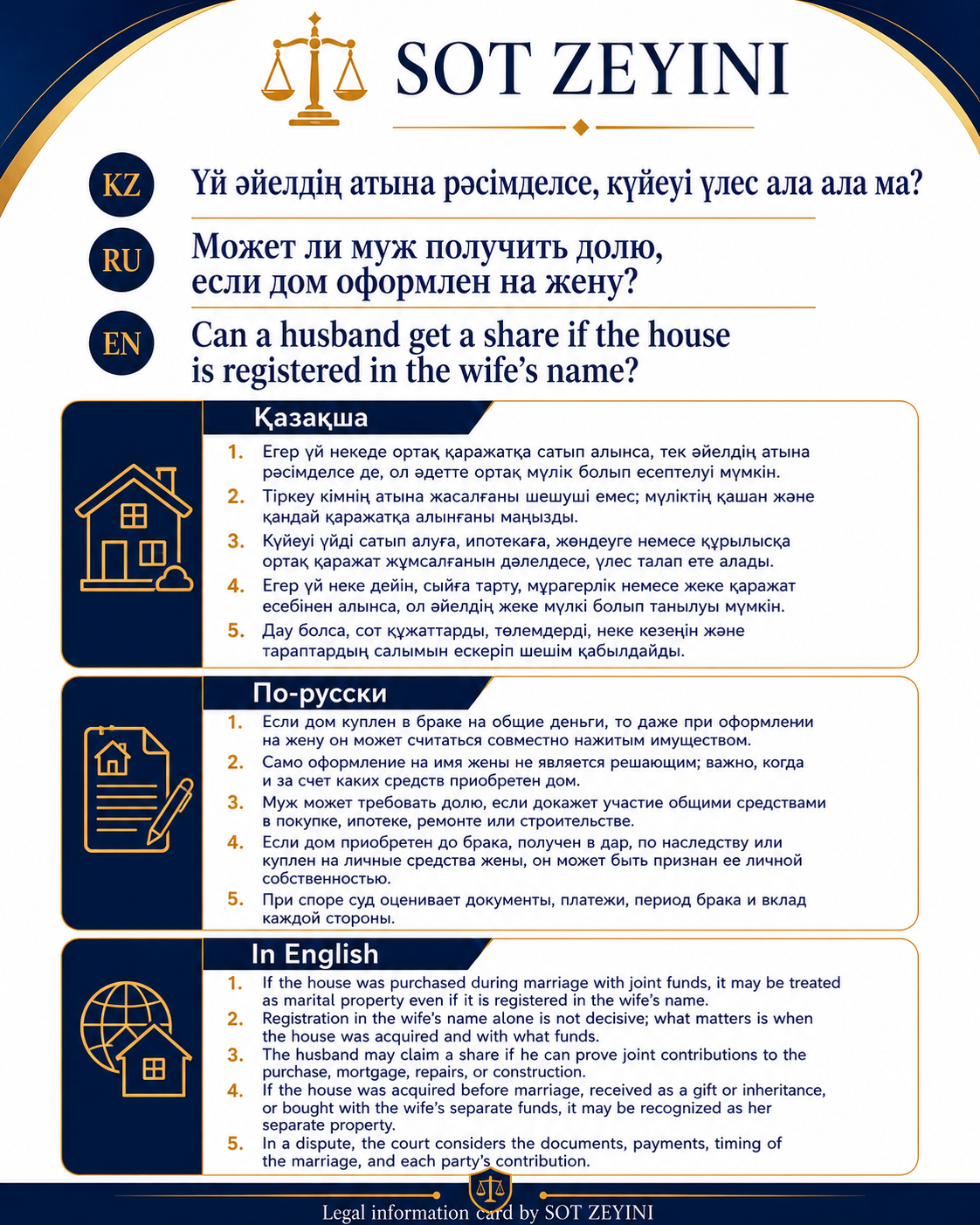
If a house or apartment is registered in the name of one spouse’s parents, it is usually not divided between the husband and wife during divorce. Legally, the owners are the parents, not the spouses.
However, there may be an exception. If the property was actually purchased with the spouses’ money but formally registered in the parents’ name, the spouses may go to court and prove the real source of funds. In such cases, it may be possible to claim recognition of the property as marital property, reimbursement of invested funds, compensation, or challenge the transaction.
In simple terms: a house registered to parents is not divided automatically. But if there is strong evidence that the property was bought with family money, legal action may be possible.
Why is a house registered to parents not divided automatically?
During divorce, only property belonging to the spouses is divided. If the house is registered to a mother, father, father-in-law, mother-in-law, or other parent, the legal owner is that person.
For example:
- the apartment is registered to the husband’s mother;
- the house is registered to the wife’s father;
- the land plot is registered to one spouse’s parents;
- the mortgage is registered to the parents;
- the spouses live in the house, but the parents are the owners on paper.
In such a situation, the court cannot simply divide the house between the spouses because legally it belongs to third parties.
Does living in the parents’ house give a spouse ownership rights?
No. Living in the house does not create ownership rights. Even if the spouses lived in the parents’ house for many years, were registered at that address, paid utility bills, or made minor repairs, this does not automatically give them a share.
Registration at an address may confirm residence, but it does not confirm ownership.
What if the house was bought with the spouses’ money but registered to the parents?
This is one of the most difficult property division scenarios. Sometimes spouses buy a house with their own money but register it in the parents’ name for various reasons.
For example:
- to hide property from division;
- due to poor credit history of one spouse;
- to obtain a mortgage through the parents;
- because of trust within the family;
- under a family agreement that the property would later be transferred;
- to avoid creditor claims;
- to prevent one spouse from claiming the property during divorce.
If it can be proven that the spouses were the real buyers, court action may be possible. However, the evidence must be strong.
What can be claimed in court?
Depending on the situation, a spouse may ask the court to:
- recognize the house as marital property;
- recognize the transaction as sham or simulated;
- recover money invested in the purchase;
- recover the value of repairs or improvements;
- award compensation for a share;
- establish that family money was invested;
- prohibit the sale or transfer of the house;
- request documents from the bank, notary, registration authority, or seller.
Choosing the correct legal claim is very important. Sometimes claiming half of the house is difficult, but recovering invested money may be more realistic.
Should the parents be involved in the court case?
Yes, in most cases. If the property is registered in the parents’ name, their rights are directly affected. They may need to be included as defendants or third parties.
If the claim is filed only against the spouse, the court may point out that the property does not belong to that spouse but to the parents. Therefore, the parties to the case must be identified correctly from the beginning.
How can a spouse prove that the house was bought with marital funds?
The most important evidence is the movement of money. The court needs to see where the money came from, who transferred it, and how it was connected to the purchase.
Useful evidence may include:
- bank transfers;
- bank statements;
- receipts;
- purchase agreement;
- mortgage documents;
- down payment documents;
- repair and construction receipts;
- WhatsApp, SMS, or email correspondence;
- negotiations with the seller;
- witness statements;
- documents showing the parents’ income;
- evidence that the parents did not have the financial ability to buy the house;
- utility payments;
- photos and videos of repairs or construction;
- valuation report.
The clearer the money trail, the stronger the legal position.
Does it help if the parents could not afford the house?
Yes, this may be important indirect evidence. If the parents had no income, savings, or financial ability to buy expensive property, while the spouses actually made the payments, this may be used in court.
However, it is not enough to simply say, “The parents had no money.” Documents are needed: statements, transfers, receipts, written agreements, and other evidence.
Can a spouse recover money spent on repairs in the parents’ house?
Yes, if the repairs were significant and increased the value of the property.
For example:
- an extension was built;
- the roof was replaced;
- heating was installed;
- a garage, sauna, or summer kitchen was built;
- major renovation was carried out;
- windows, doors, or floors were replaced;
- utilities were installed;
- the land plot was improved.
In such cases, compensation for investments or increase in property value may be claimed.
However, ordinary household expenses, minor repairs, or utility payments usually do not create a right to a share in the house.
What if the spouses paid the mortgage, but the house is registered to the parents?
This situation requires careful analysis. If the mortgage is registered to the parents, but the monthly payments were actually made by the spouses, it may be possible to claim reimbursement of the paid amounts or compensation.
The court will consider:
- who is the borrower;
- who actually paid the mortgage;
- from which account the payments were made;
- whether money was transferred to the parents;
- whether there was an agreement to transfer the property later;
- who lived in the house;
- who paid for repairs and maintenance.
Recognizing the house as marital property may be difficult, but recovering invested money may be more realistic.
What if the parents gifted the house to one spouse?
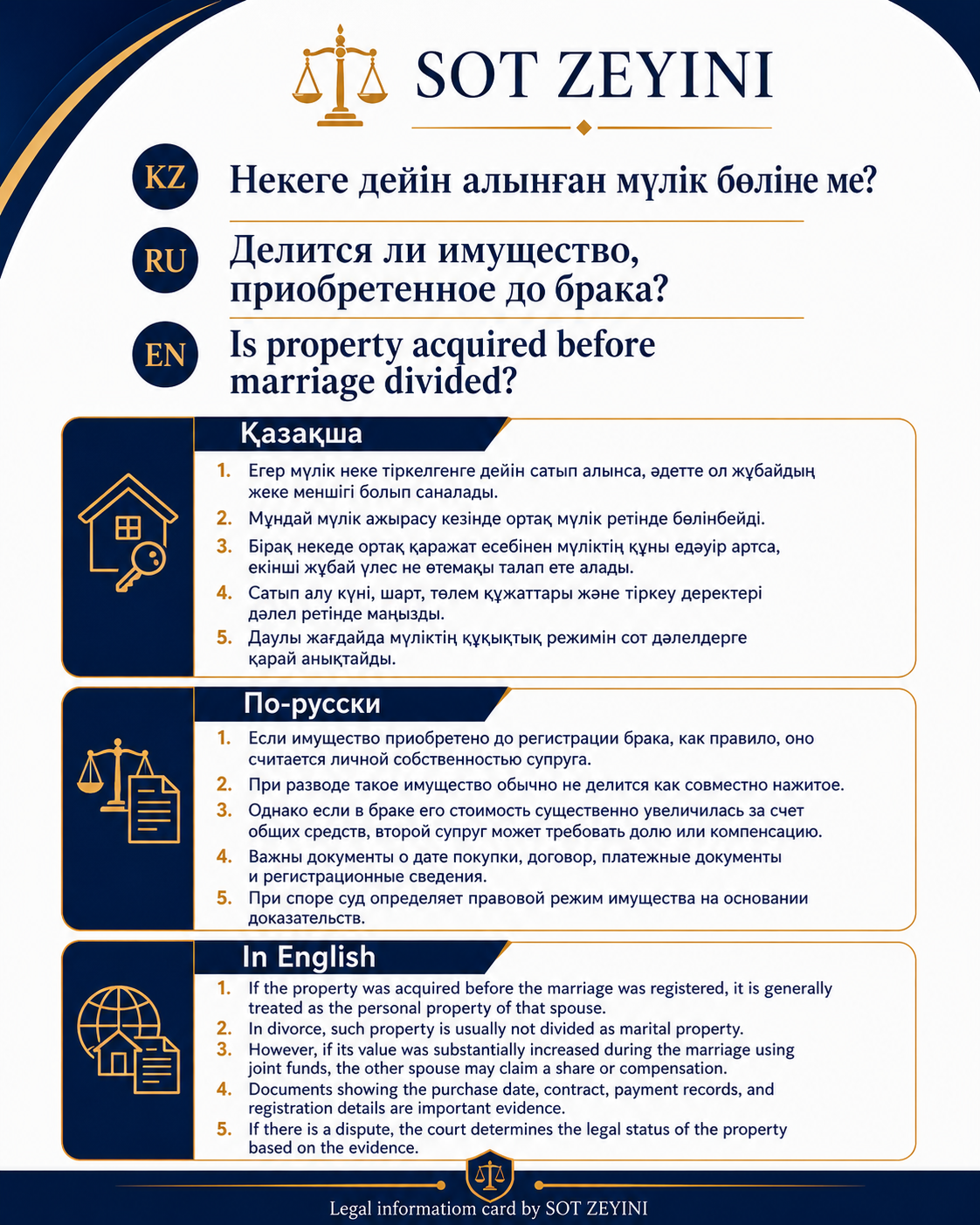
If the parents gifted the house to their son or daughter, such property is usually considered that spouse’s personal property and is not divided during divorce.
For example, the husband’s parents gifted him a house. In that case, the wife does not automatically receive half of the house. However, if significant marital funds were invested in the house during marriage and its value increased, compensation may be claimed.
What if the parents gifted the house to both spouses?
If the house was gifted to both spouses or registered in shares, it is divided according to the documents.
For example:
- the house is registered 1/2 to the husband and 1/2 to the wife;
- both spouses are listed in the gift agreement;
- the property is registered as common marital property.
In this case, the division is much clearer because ownership is confirmed by documents.
Can the sale of the house be prohibited during court proceedings?
If there is a risk that the house may be quickly sold, gifted, or transferred, the court may be asked to apply interim measures.
For example, the court may be asked to:
- prohibit registration actions;
- prohibit the sale of the house;
- prohibit gifting or transfer;
- freeze property within the claim amount;
- send the court order to the registration authority.
However, the court will consider that the property is registered to the parents. Therefore, the request must be well supported by evidence.
What if the property was intentionally registered to parents to hide it from division?
Evidence should be collected and court action should be considered. In such cases, it is important to show that the parents were only formal owners, while the real funds came from the spouses.
It may be necessary to prove that:
- the property was purchased during marriage;
- the spouses provided the money;
- the parents did not have the financial ability to buy the property;
- the spouses lived in and maintained the house;
- purchase or mortgage payments came from the spouses;
- repairs and improvements were paid for by the spouses;
- registration in the parents’ name was formal;
- one spouse intended to hide the property from division.
These cases are complex, but they may have prospects if the evidence is strong.
What documents are needed?
The following documents may be useful in disputes involving a house registered to parents:
- marriage certificate;
- divorce certificate;
- property purchase agreement;
- gift agreement;
- mortgage agreement;
- ownership registration documents;
- bank statements;
- payment orders;
- receipts;
- repair receipts;
- contractor agreements;
- construction material documents;
- utility bills;
- correspondence between spouses and parents;
- documents showing the parents’ income;
- photos and videos;
- valuation report;
- witness statements;
- responses from banks, notaries, and state authorities.
Common mistakes
The first mistake is assuming that living in the house makes it marital property. It does not.
The second mistake is filing a claim only against the spouse, even though the house is registered to the parents. The parents must usually be involved.
The third mistake is claiming “half of the house” without evidence that the property was purchased with family money. Sometimes it is more effective to claim compensation for invested funds.
The fourth mistake is waiting until the house is sold. If there is a risk of transfer, interim measures should be requested immediately.
Conclusion
A house registered in the parents’ name is usually not divided automatically during divorce. On paper, it belongs to the parents, not the spouses.
However, if the house was actually purchased with the spouses’ money, formally registered in the parents’ name, or significantly improved using marital funds, court protection may be possible. In such cases, documents are everything: bank statements, payments, receipts, correspondence, valuation reports, and correctly drafted claims.
The main rule is simple: if the house is registered to parents, the case is harder — but not necessarily hopeless.
FAQ — Frequently Asked Questions
1. Is a house registered to parents divided during divorce?
Usually not. If the house is legally registered to the parents, it is considered their property. But if the spouses prove that it was bought with their money, claims may be filed in court.
2. If the apartment is registered to the husband’s mother, can the wife claim a share?
Only if there is evidence that the apartment was purchased with marital funds or significantly improved using family money.
3. If the house is registered to the wife’s father, can the husband make a claim?
Yes, if he can prove that the house was purchased or improved with marital funds.
4. Does living in the house give ownership rights?
No. Living in the house or being registered at the address does not create ownership rights.
5. Can money spent on repairs in the parents’ house be recovered?
Yes, if the repairs were significant, increased the value of the property, and the expenses are supported by documents.
6. What if the spouses bought the house but registered it to the parents?
The spouses should collect evidence of money movement and file properly formulated claims in court.
7. Should the parents be involved in the case?
Yes, if the property is registered to them, they should usually participate as defendants or third parties.
8. Can the sale of such a house be prohibited?
Yes, the court may be asked to prohibit registration actions or freeze the property if there is a real risk of sale.
9. If the house was gifted to one spouse by parents, is it divided?
Usually not. Gifted property is generally treated as personal property. But significant improvements made with marital funds may give rise to compensation.
10. If the spouses paid the mortgage, but the house is registered to parents, can a share be claimed?
A share may be difficult to prove, but reimbursement of invested amounts or compensation may be possible.
11. Does the parents’ income matter?
Yes. If the parents formally purchased the house but could not afford it, this may serve as indirect evidence.
12. What evidence is most important?
Bank statements, transfers, receipts, agreements, correspondence, mortgage payments, and proof of actual use of the house.
13. Can the transaction be recognized as simulated?
Yes, if there is evidence that registration in the parents’ name was used to hide the real purchase by the spouses.
14. Can a spouse receive money instead of a share?
Yes. In many cases, claiming compensation for investments or improvements is more practical than claiming ownership.
15. What should be done first?
Collect documents related to the purchase, payments, repairs, correspondence, and verify who is officially registered as the owner.