 +7 775 858 9294
 WhatsApp
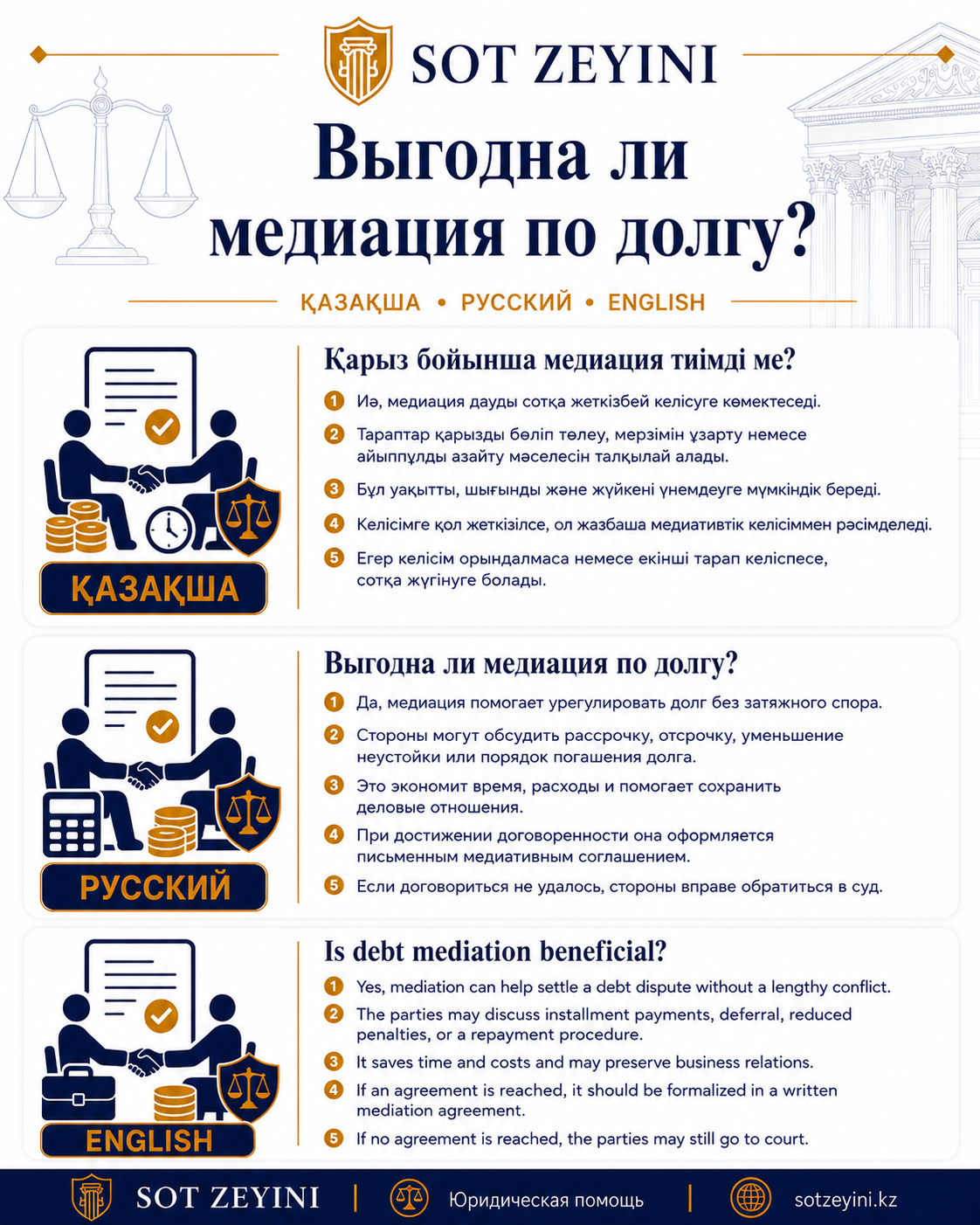
Is Mediation Effective in Debt Disputes?
In debt disputes, many people immediately think about going to court. However, in some cases, mediation may be faster, more practical, and less stressful than a full court process. This is especially true when the debtor admits the debt but cannot repay the full amount immediately.
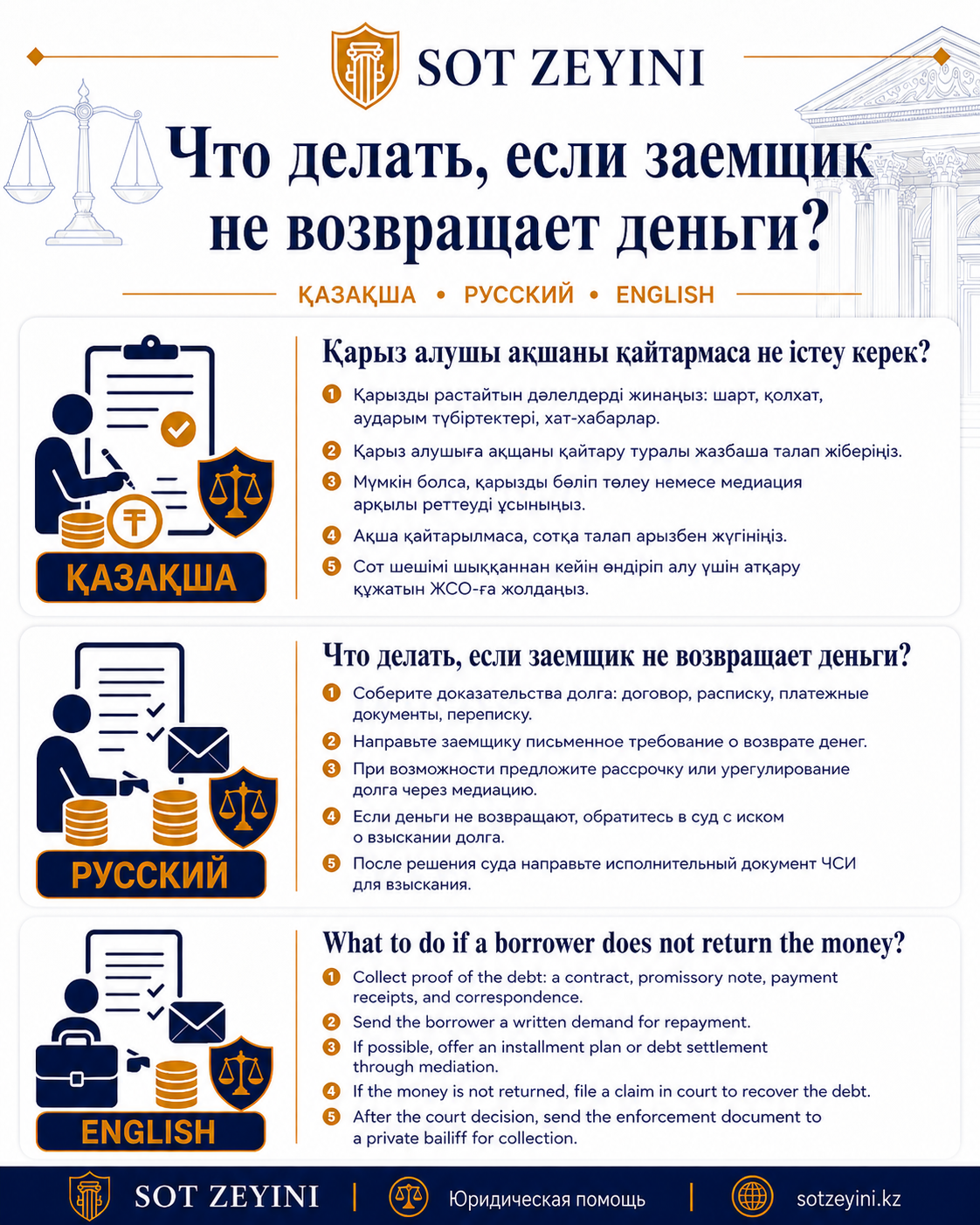
Mediation allows the parties to agree on repayment terms, create a payment schedule, and record the debtor’s obligations in writing.
In simple terms: court is a legal enforcement mode, while mediation is a negotiation mode that may help recover money faster.
What is mediation in a debt dispute?
Mediation in a debt dispute is a way to resolve a disagreement between the creditor and the debtor with the help of a mediator.
A mediation agreement may include:
- debt amount;
- repayment deadline;
- payment schedule;
- interest or penalty;
- liability for late payment;
- procedure for going to court;
- court and legal expenses.
The main purpose of mediation is to resolve the dispute without a long court process and to create clear repayment terms.
When is debt mediation effective?
Mediation may be effective if:
- the debtor admits the debt;
- the debtor is ready to pay in installments;
- the parties do not want a long court dispute;
- the creditor wants repayment to start faster;
- the debtor has income;
- the parties are ready to negotiate;
- there is no serious dispute about the amount.
If the debtor completely denies the debt, avoids communication, or uses negotiations only to delay the process, mediation may waste time. In that case, filing a court claim may be a better option.
Benefits of mediation for the creditor
1. Time saving
A court case may take several months. Mediation may help the parties reach an agreement within days or weeks.
If the debtor is genuinely ready to pay, mediation may produce results faster than court.
2. A payment schedule can be agreed
Often, the debtor cannot repay the full amount at once but can pay in installments.
In mediation, the parties can agree on:
- total debt amount;
- amount of each payment;
- date of each payment;
- payment method;
- consequences of late payment.
For example, a debt of KZT 1,000,000 may be divided into five monthly payments of KZT 200,000.
3. The debtor acknowledges the debt in writing
In a mediation agreement, the debtor may directly acknowledge the debt and the obligation to repay it.
This is important because if the debtor later violates the agreement, the creditor will have written confirmation of the obligation.
4. Costs may be reduced
Court proceedings require time, state duty, legal fees, and document preparation. Mediation may help resolve the matter at a lower cost if the debtor truly intends to pay.
However, the agreement must be drafted properly. Otherwise, it may become just another promise.
5. Relationships may be preserved
Debt disputes often arise between relatives, friends, acquaintances, or business partners. Court proceedings may permanently damage relationships.
Mediation gives the parties a chance to settle the dispute more calmly.
When is mediation not effective?
Mediation may be ineffective if:
- the debtor does not acknowledge the debt;
- the debtor avoids communication;
- negotiations are used only to delay time;
- there is a risk that the debtor may sell property;
- the debtor has many other debts;
- there are signs of fraud;
- the limitation period may expire;
- urgent freezing of accounts or property is needed.
In such cases, it may be better to prepare a court claim and, if necessary, request interim measures.
Can mediation be conducted before court?
Yes. Mediation can be conducted before filing a court claim. In this case, the parties sign a mediation agreement on repayment of the debt.
The agreement should state:
- that the debtor acknowledges the debt;
- exact debt amount;
- repayment deadline;
- payment schedule;
- bank details;
- liability for late payment;
- consequences of breach;
- signatures of the parties.
It should be a proper written document, not a verbal promise.
Can mediation be concluded during court proceedings?
Yes. If the case is already in court, the parties may conclude a mediation agreement and ask the court to approve it.
A court-approved agreement has stronger legal effect. If it is not performed, compulsory enforcement may be considered.
However, the court will approve the agreement only if it does not contradict the law and does not violate the rights of others.
What should be included in a debt mediation agreement?
The agreement should be very specific. Phrases like “will repay later” or “will pay when possible” should be avoided.
The agreement should include:
- details of the parties;
- identification numbers;
- addresses and phone numbers;
- basis of the debt;
- debt amount;
- debtor’s acknowledgment of the debt;
- repayment deadline;
- payment schedule;
- date and amount of each payment;
- payment details;
- liability for late payment;
- procedure in case of breach;
- legal and court expenses;
- signatures of the parties.
The more precise the payment schedule is, the fewer disputes will arise later.
What happens if the debtor does not comply with the mediation agreement?
If the agreement was approved by the court, the creditor may seek compulsory enforcement.
If the agreement was concluded before court and the debtor violates it, the creditor may file a court claim and request recovery of the debt, penalty, and court expenses.
That is why a mediation agreement should be drafted so that it can be used as evidence in court.
Can interest or penalties be waived in mediation?
Yes. The parties may agree that the creditor will waive part of the interest or penalty if the debtor repays the principal debt on time.
For example:
- if the debtor pays according to the schedule, interest is not charged;
- if the debt is repaid by a specific date, no penalty is applied;
- if the schedule is breached, the creditor may claim the full debt, interest, and expenses.
Such terms may motivate the debtor to pay on time.
Mediation or court: which is better?
Mediation is suitable if the debtor acknowledges the debt and is ready to pay.
Court may be better if the debtor:
- denies the debt;
- hides;
- avoids communication;
- sells property;
- delays the process;
- cannot be trusted;
- urgent interim measures are needed.
Sometimes the best strategy is to give the debtor a short opportunity for mediation and, if there is no result, immediately go to court.
What documents are needed for debt mediation?
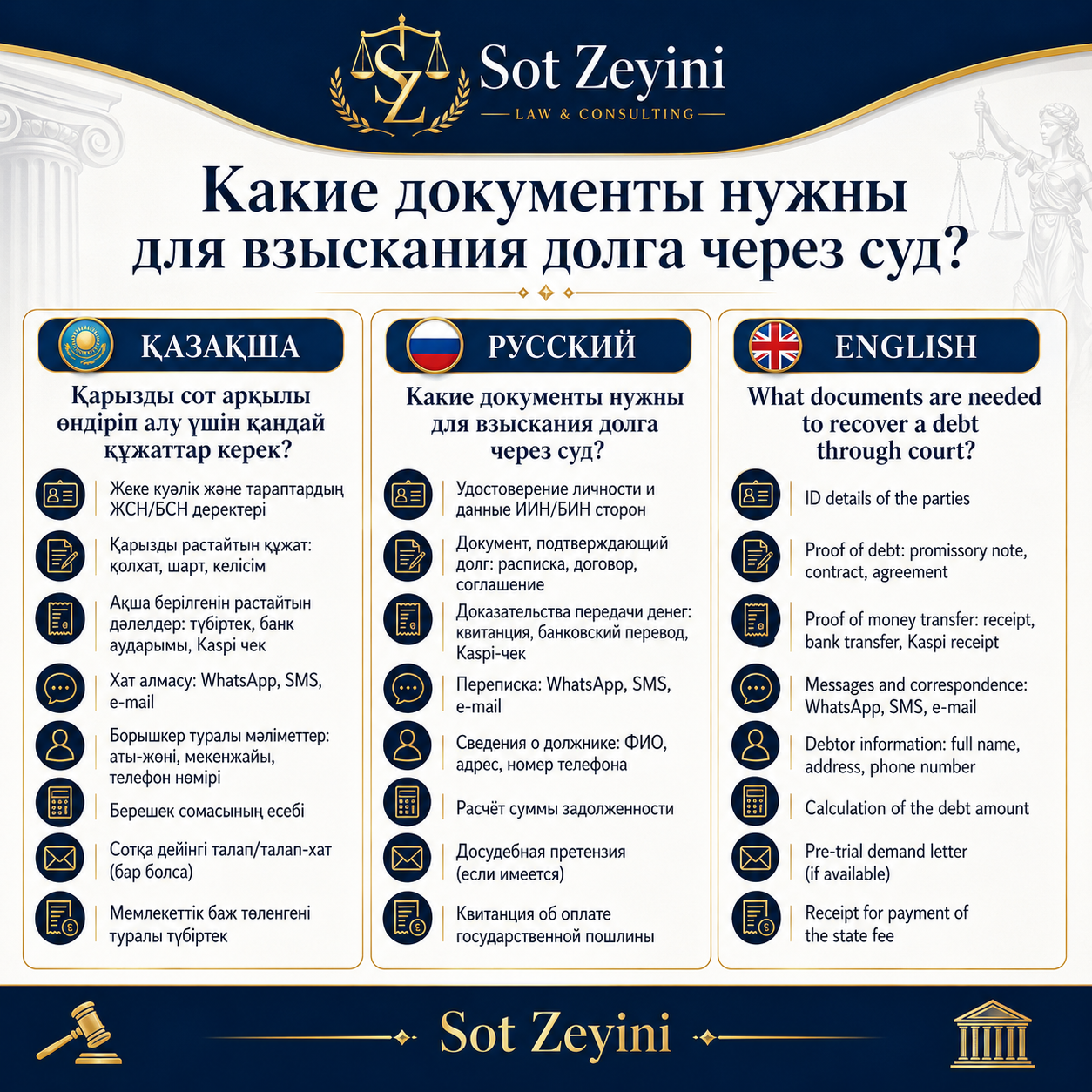
Before mediation, it is useful to prepare:
- written receipt;
- loan agreement;
- bank transfers;
- Kaspi receipts;
- WhatsApp messages;
- SMS messages;
- debt calculation;
- calculation of interest or penalty;
- debtor’s details;
- draft payment schedule;
- pre-trial demand letter.
The better the documents are prepared, the stronger the creditor’s position during negotiations.
Common mistakes in debt mediation
Common mistakes include:
- relying on verbal agreements;
- not stating the exact debt amount;
- not including a payment schedule;
- not recording acknowledgment of debt;
- not stating consequences of delay;
- not describing the court procedure in case of breach;
- giving the debtor too much time;
- not having the agreement reviewed by a lawyer.
Mediation is a useful tool, but only if the document is drafted properly.
Legal assistance
SOT ZEYINI law company assists with mediation and debt recovery in Kazakhstan.
We can help with:
- reviewing documents;
- assessing whether mediation is beneficial;
- drafting a mediation agreement;
- preparing a payment schedule;
- preparing a pre-trial demand letter;
- drafting a debt recovery claim;
- preparing an application for a court order;
- preparing a motion for interim measures;
- representing clients in court;
- sending the court decision for enforcement.
If you want to recover a debt without court or agree on a payment schedule with the debtor, contact us via WhatsApp. A lawyer will review your documents and explain whether mediation or court is the better strategy.
FAQ
Is mediation effective in debt disputes?
Yes, if the debtor acknowledges the debt and is ready to repay it. If the debtor only delays the process, court may be better.
Can a payment schedule be agreed through mediation?
Yes. The parties can agree on installment payments and include the schedule in the mediation agreement.
What should be included in a mediation agreement?
Debt amount, acknowledgment of debt, payment deadlines, payment schedule, liability for late payment, and consequences of breach.
What if the debtor violates the mediation agreement?
If the agreement was approved by court, compulsory enforcement may be considered. If it was concluded before court, the creditor may file a claim.
Can mediation be conducted before court?
Yes. Mediation can be conducted before court and during court proceedings.
Is mediation cheaper than court?
In some cases, yes. But if the debtor does not comply with the agreement, court proceedings may still be necessary.
Is a lawyer needed for mediation?
Not always, but it is recommended. A lawyer can help draft an agreement that actually protects the creditor.
Conclusion
Debt mediation can be effective if the debtor admits the debt and is ready to pay. It may help agree on a payment schedule, avoid lengthy litigation, and start repayment faster.
But if the debtor denies the debt, hides, or delays the process, filing a court claim may be the better choice.
The key is to draft the mediation agreement correctly. A good document helps recover money. A bad document creates a new dispute.