 +7 775 858 9294
 WhatsApp
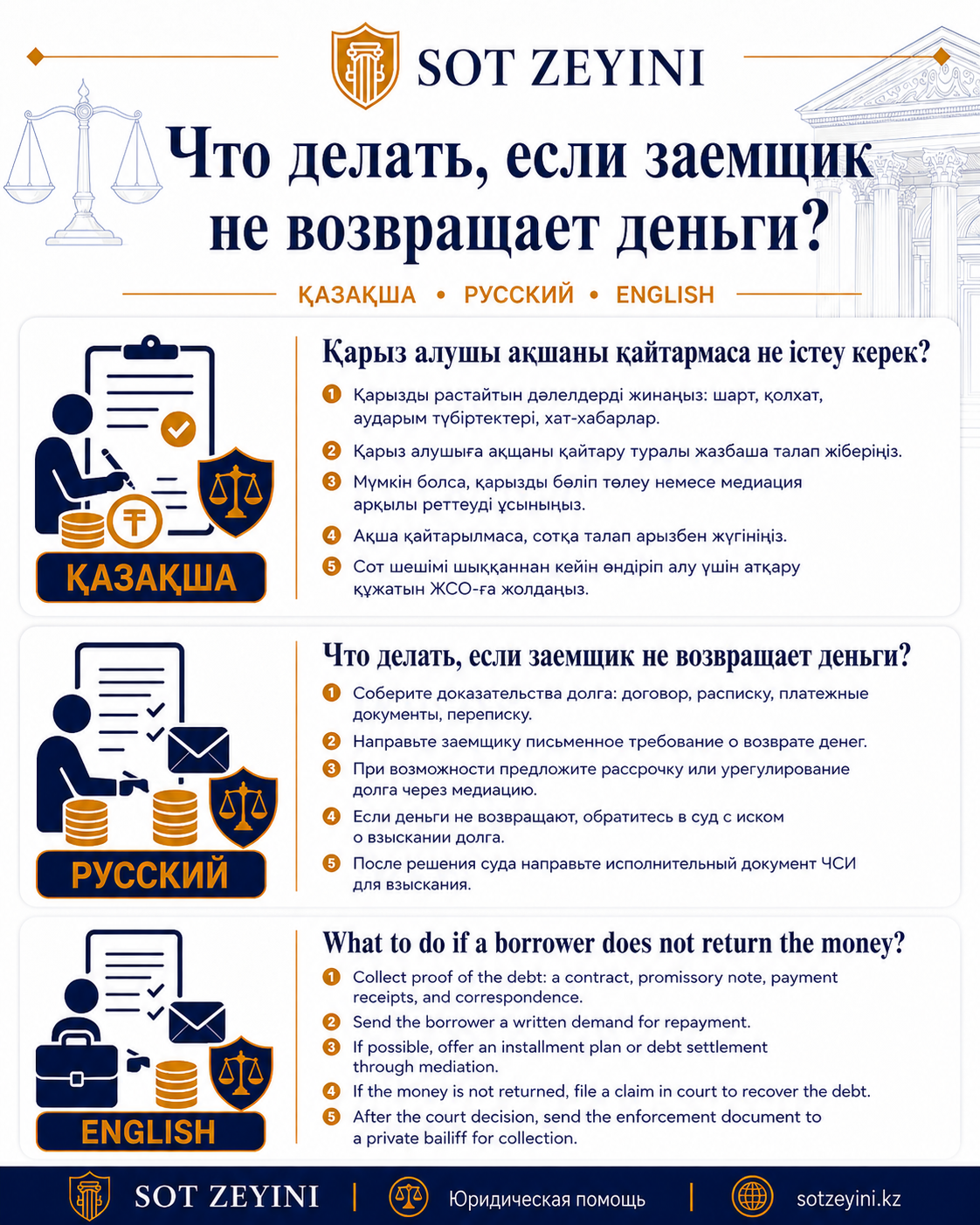
What Should You Do If the Borrower Does Not Repay the Money?
Situations where a person lends money and the borrower does not repay it on time are very common. At first, the borrower may promise to pay “tomorrow,” “after salary,” or “next week,” but later stops answering calls, ignores messages, and avoids repayment.
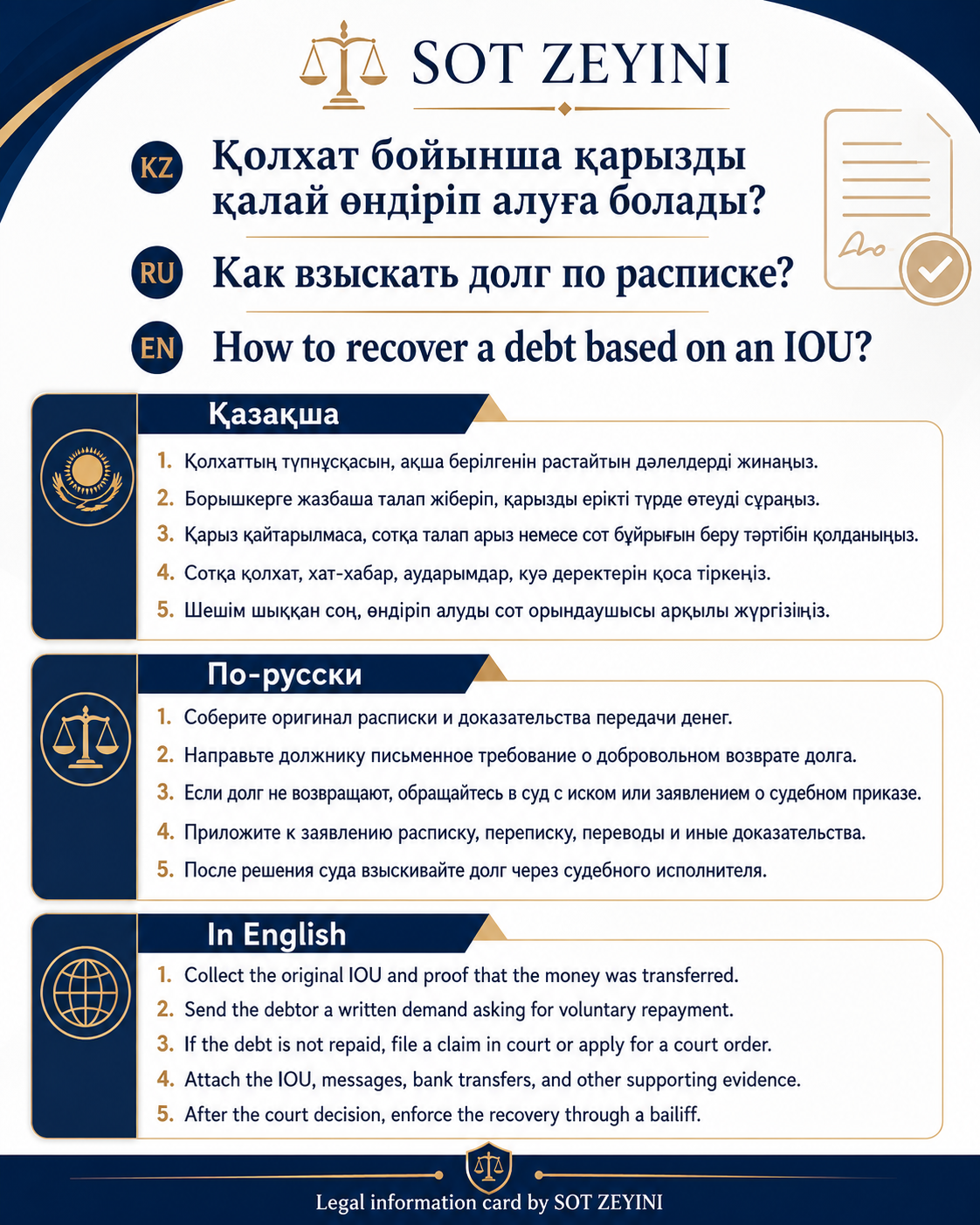
In such a situation, it is important not to act emotionally. The right approach is to collect evidence, send a pre-trial demand letter, file a court claim if necessary, and then enforce the court decision.
In simple terms: if the debt is not repaid by request, it should be recovered through documents.
What should you do first?
The first step is to check what evidence you have. In court, it is important to prove two things:
- the money was actually transferred to the borrower;
- the borrower is obliged to return it.
Evidence may include:
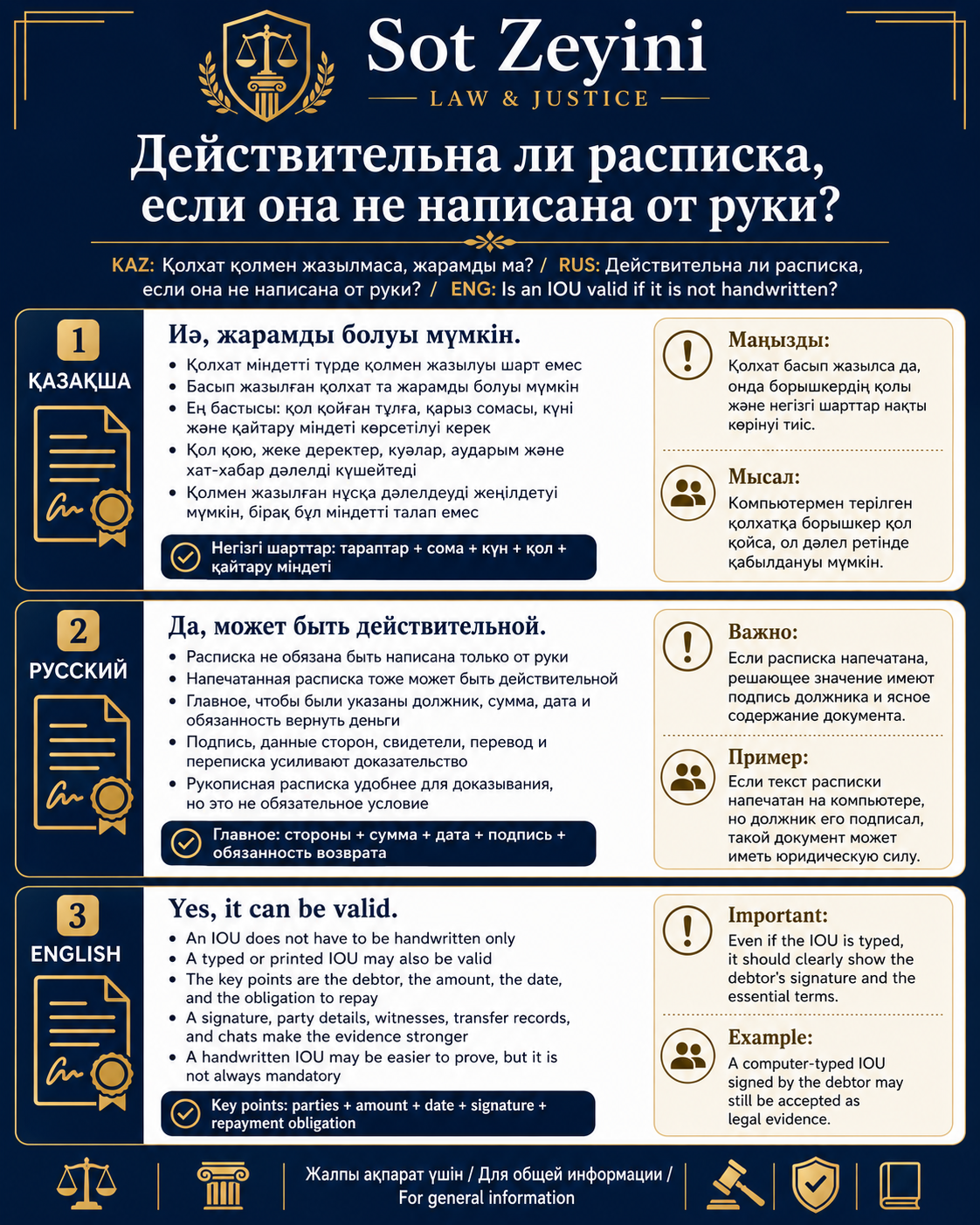
- written receipt;
- loan agreement;
- Kaspi transfer;
- bank transfer;
- WhatsApp messages;
- SMS messages;
- audio or video recordings;
- acknowledgment of debt by the borrower;
- promises to repay;
- partial repayment;
- witness information;
- pre-trial demand letter.
The more evidence you have, the higher the chance of recovering the debt through court.
What if there is a written receipt?
If you have a written receipt, it is strong evidence. The receipt should preferably include:
- borrower’s full name;
- borrower’s identification number;
- debt amount;
- date of money transfer;
- repayment deadline;
- interest, if agreed;
- borrower’s signature.
If the repayment deadline has passed, you can send a pre-trial demand letter and prepare a court claim.
If the repayment deadline is not stated, it is better to first send a written demand and set a reasonable period for repayment.
Can a debt be recovered without a receipt?
Yes, in some cases. The absence of a written receipt does not always mean that the debt cannot be recovered. However, proving the debt becomes more difficult.
The debt may be proven by other evidence:
- bank transfer;
- Kaspi receipt;
- WhatsApp messages;
- SMS messages;
- audio recording;
- acknowledgment of debt;
- partial repayment;
- witness statements.
If there is no receipt, it is important to organize all available evidence properly so the court understands that the money was given as a loan, not as a gift or payment for services.
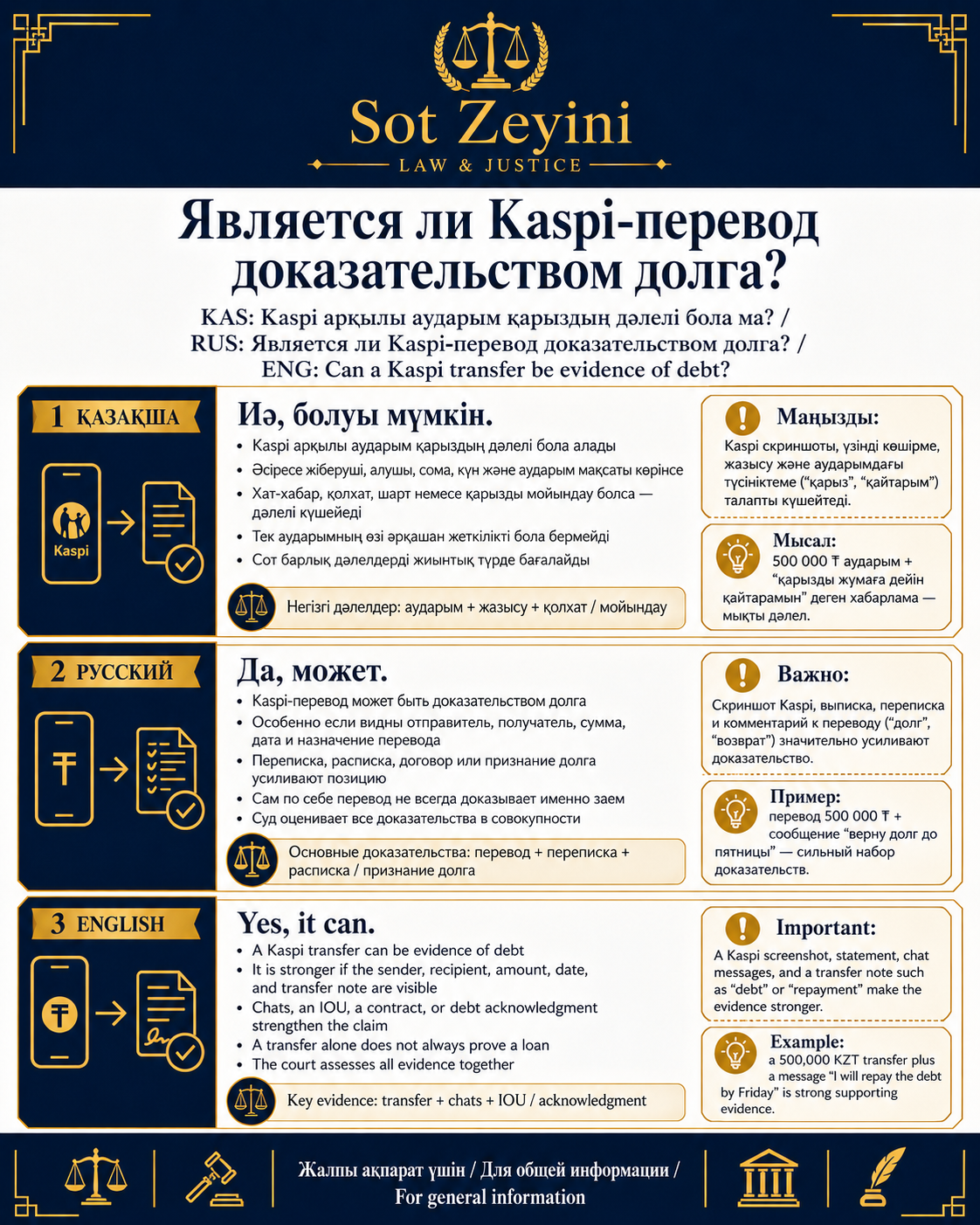
Is a Kaspi transfer proof of debt?
Yes, a Kaspi transfer may prove that money was sent. However, one transfer may not always be enough.
If the payment description does not state “debt” or “loan,” the borrower may argue that the money was a gift, payment for services, repayment of another debt, or shared expenses.
That is why a Kaspi transfer should be supported by additional evidence:
- correspondence;
- written receipt;
- acknowledgment of debt;
- audio recording;
- pre-trial demand letter.
Can WhatsApp messages be used as evidence?
Yes, WhatsApp messages may be used as evidence in court if they show that the borrower:
- received the money;
- acknowledges the debt amount;
- promises to repay;
- asks for more time;
- agrees to interest;
- offers to repay in installments.
It is important to preserve the full conversation, not only selected screenshots. The court needs context: who wrote the messages, from which number, when, and what amount was discussed.
Should you send a pre-trial demand letter?
Yes, before going to court, it is recommended to send the borrower a pre-trial demand letter.
The demand letter should include:
- debt amount;
- date of money transfer;
- repayment deadline;
- evidence of the debt;
- deadline for voluntary repayment;
- warning about court action;
- demand to reimburse state duty, legal fees, and court expenses.
The demand letter may be sent by post, WhatsApp, courier, or another method that allows you to prove it was sent.
Example of a demand letter
“On ___ ______ 2026, you received KZT ______ from me. You undertook to repay this amount by ___ ______ 2026. However, the debt has not been repaid to date.
I demand that you repay the full debt amount within 5 business days from receipt of this demand letter.
If the debt is not repaid within the specified period, I will be forced to file a court claim for recovery of the debt, state duty, legal expenses, and other court costs.”
Such a demand letter records your position and shows the borrower that the matter is no longer just a casual promise.
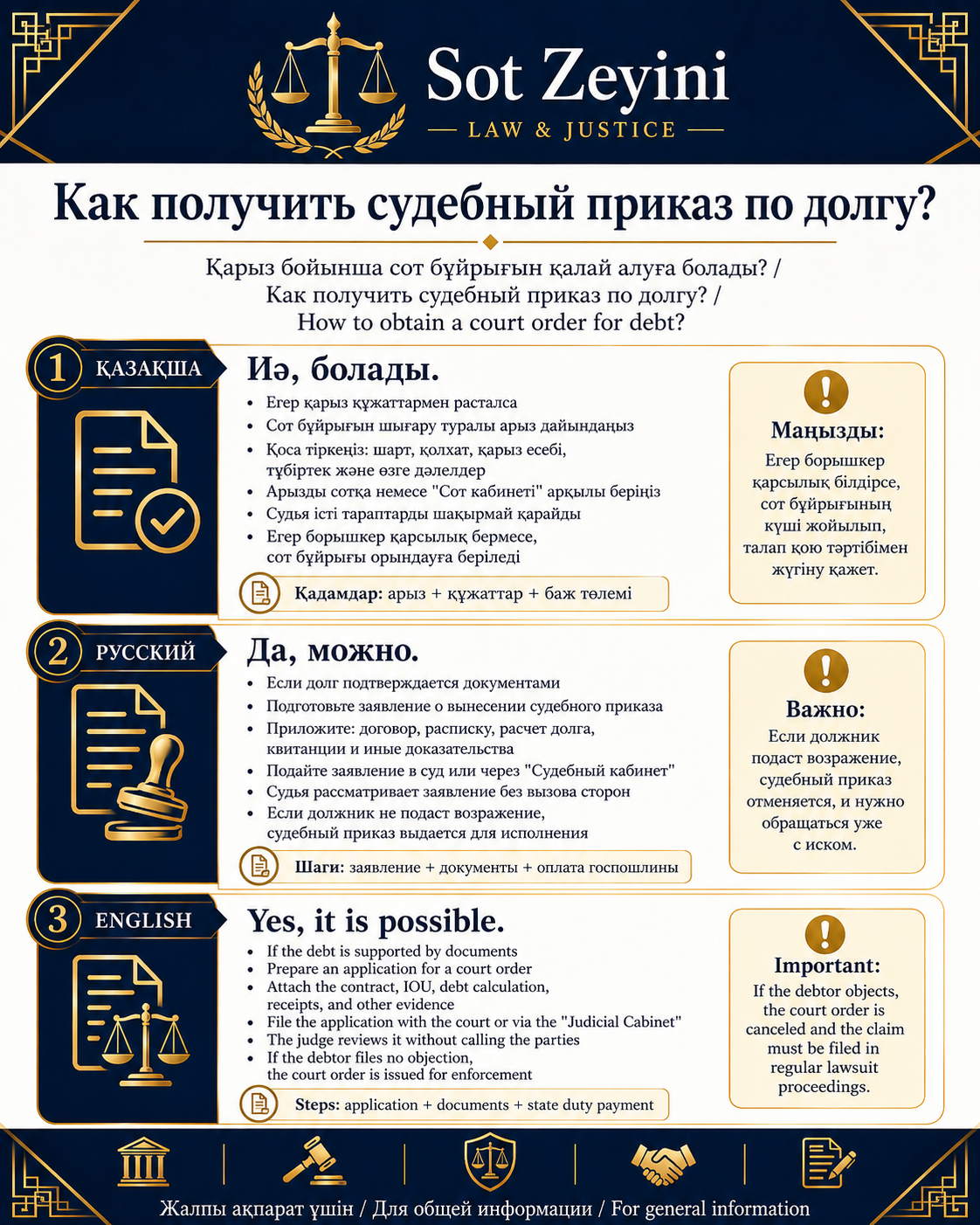
Can the debt be recovered through a court order?
If the debt is undisputed and supported by written evidence, you may consider applying for a court order.
A court order is a judicial act issued without a full trial for certain types of claims.
Advantages of a court order:
- faster than a regular lawsuit;
- state duty may be lower;
- no full court hearing may be required;
- the document may be sent for enforcement faster.
However, if the debtor files an objection, the court order may be cancelled. In that case, a regular lawsuit will be required.
When should you file a court claim?
A court claim should be filed if:
- the borrower does not acknowledge the debt;
- the borrower disputes the amount;
- the borrower refuses to pay interest;
- a court order is not suitable;
- the court order was cancelled;
- you need to recover debt, interest, penalties, and court expenses.
The statement of claim should include:
- name of the court;
- claimant’s details;
- defendant’s details;
- circumstances of the money transfer;
- evidence of the debt;
- amount claimed;
- calculation of interest or penalties;
- information about state duty;
- request to the court.
All evidence should be attached to the claim.
Which court should you apply to?
Usually, a debt recovery claim is filed with the court at the defendant’s place of residence or registration.
If the debtor’s address is unknown, it may be possible to file at the last known address, the location of the debtor’s property, or other grounds provided by law.
It is important to determine jurisdiction correctly. If the claim is filed with the wrong court, it may be returned or transferred.
What amounts can be recovered from the borrower?
Through court, you may claim:
- principal debt;
- interest under the agreement or receipt;
- penalty;
- state duty;
- legal fees;
- court expenses;
- other proven losses.
If interest or penalties are claimed, a debt calculation must be attached.
What if the debtor may sell property?
If there is a risk that the debtor may sell property, withdraw money from accounts, or make enforcement difficult, you may file a motion for interim measures.
In such a motion, you may ask the court to:
- freeze bank accounts;
- prohibit the sale of real estate;
- prohibit the sale of a vehicle;
- apply other protective measures.
The motion must be justified. The court does not apply asset freezes automatically.
What happens after the court decision?
If the court issues a decision in your favor and the debtor does not pay voluntarily, the decision must be sent for compulsory enforcement.
You need to:
- wait until the decision enters into legal force;
- obtain a writ of execution or send it electronically;
- contact a private enforcement officer;
- request measures against the debtor’s accounts, property, and income;
- monitor enforcement proceedings.
A court decision is an important step, but not always the end. Sometimes the main stage begins during enforcement.
What if the debtor has no property?
If the debtor has no official income, property, or money in bank accounts, recovery may be more difficult. But the debt does not disappear.
An enforcement officer may:
- check bank accounts;
- search for property;
- impose restrictions;
- withhold money from salary;
- check the debtor’s financial status.
Even if the debtor has no assets today, assets or income may appear later.
Can you report the borrower to the police?
If it is an ordinary civil debt, the police may recommend going to civil court.
However, if the borrower never intended to repay the money, obtained it by deception, misled the lender, borrowed from several people and disappeared, there may be signs of fraud.
In such a situation, filing a police report may be considered. It is important to distinguish a civil debt dispute from a criminal offense.
What documents are needed for debt recovery?
To go to court, you may need:
- statement of claim;
- written receipt or loan agreement;
- bank transfers;
- Kaspi receipts;
- WhatsApp messages;
- SMS messages;
- debt calculation;
- calculation of interest or penalties;
- pre-trial demand letter;
- proof of state duty payment;
- identification document;
- debtor’s details.
The better the documents are prepared, the higher the chance of successful recovery.
Legal assistance
SOT ZEYINI law company helps recover debts through court in Kazakhstan.
We can help with:
- analyzing documents;
- collecting evidence;
- preparing a pre-trial demand letter;
- calculating the debt amount;
- calculating interest and penalties;
- preparing an application for a court order;
- drafting a statement of claim;
- preparing a motion for interim measures;
- representing you in court;
- sending the judgment for enforcement;
- working with a private enforcement officer.
If the borrower does not repay your money, contact us via WhatsApp. A lawyer will review your documents and explain the best way to recover the debt.
FAQ
What should I do if the borrower does not repay the money?
You should collect evidence, send a pre-trial demand letter, and file a court claim if the debt is not repaid.
Can a debt be recovered without a receipt?
Yes, if there is other evidence: bank transfer, Kaspi receipt, WhatsApp messages, acknowledgment of debt, or witnesses.
Is a Kaspi transfer proof of debt?
Yes, but it is better to have additional evidence confirming that the transfer was a loan.
Can WhatsApp messages be used in court?
Yes, if the messages show that the borrower acknowledges the debt and the obligation to repay it.
Can I go to court immediately?
Yes, but it is recommended to send a pre-trial demand letter first. It strengthens the creditor’s position.
Can debt be recovered through a court order?
Yes, if the debt is undisputed and supported by written evidence.
Will the money be returned immediately after the court decision?
Not always. If the debtor does not pay voluntarily, the decision must be enforced by a private enforcement officer.
Can I file a police report?
Yes, if there are signs of fraud. If it is an ordinary debt dispute, it is usually resolved through civil court.
Conclusion
If the borrower does not repay the money, the most important thing is to act correctly. Collect evidence, send a demand letter, and go to court if necessary.
Debt is recovered not by emotions, but by documents. The stronger the evidence, the higher the chance of getting the money back.