 +7 775 858 9294
 WhatsApp
How is property divided in divorce?
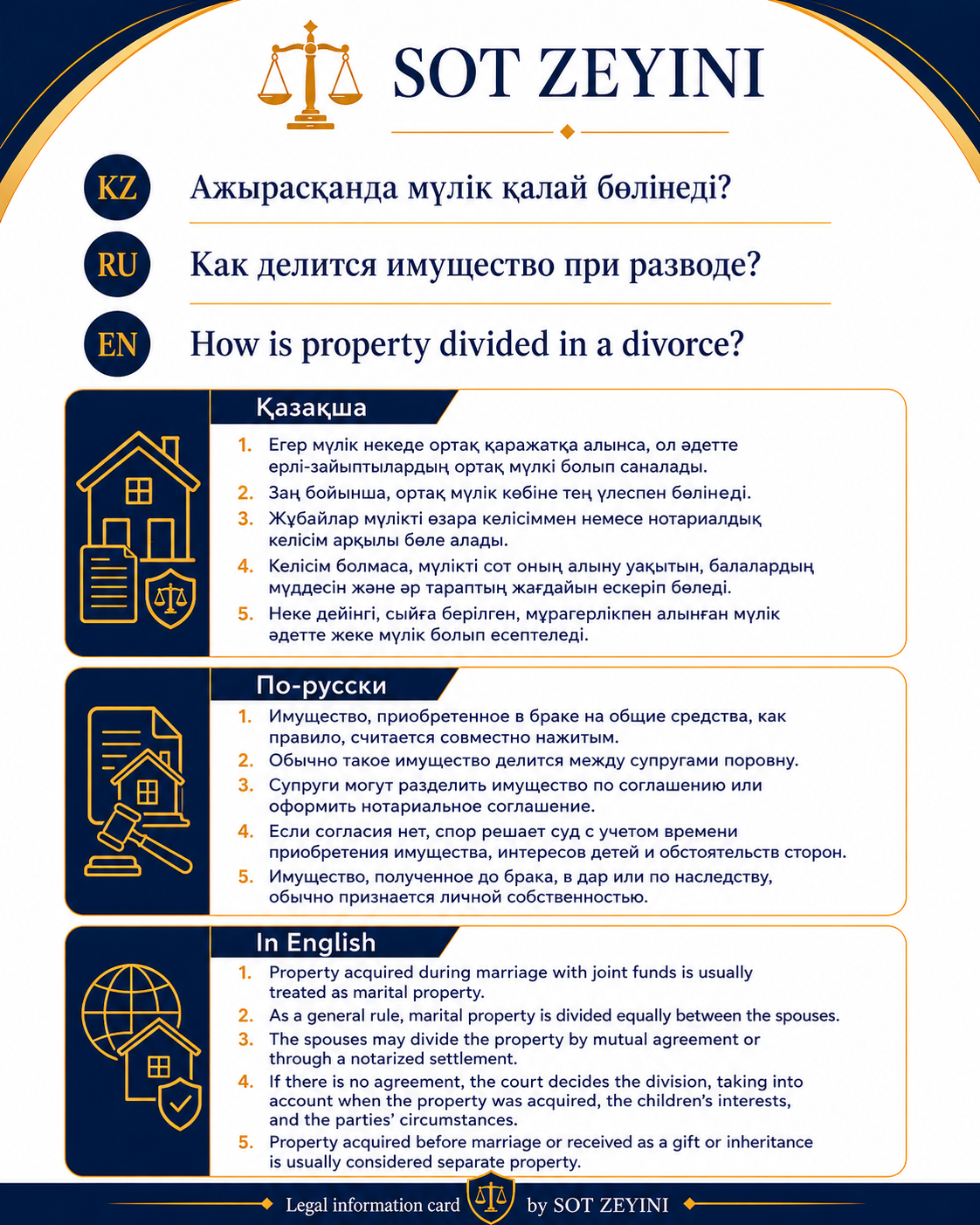
In divorce, property acquired by spouses during marriage is usually considered joint marital property and may be divided between them. As a general rule, the spouses’ shares are presumed equal.
However, property division is not always a simple 50/50 process. The court may consider when the property was acquired, what funds were used, whose name it is registered under, whether there is a prenuptial agreement, whether there are children, mortgages, loans, sold property, business assets, and other circumstances.
The key point is this: if property is registered only in one spouse’s name, that does not automatically mean it belongs only to that spouse. If it was acquired during marriage, the other spouse may also have rights to it.
What is considered joint marital property?
Joint marital property usually includes assets acquired during marriage.
Examples include:
- apartment;
- house;
- land plot;
- car;
- furniture;
- household appliances;
- money in bank accounts;
- deposits;
- employment income;
- business income;
- share in a company;
- individual entrepreneur assets;
- securities;
- commercial equipment;
- commercial real estate;
- other valuable assets.
The main question is whether the property was acquired during the marriage and whether it can be proven to be personal property of one spouse.
What property is not divided?
Not all property is divided in divorce. Some assets may be considered the personal property of one spouse.
Usually, the following are not divided:
- property acquired before marriage;
- property received by inheritance;
- property received as a gift;
- personal-use items;
- child’s property;
- money in the child’s bank account;
- items bought for the child’s education, development, or medical needs;
- property purchased with one spouse’s personal funds, if proven.
For example, if the wife inherited an apartment from her parents, that apartment is generally not divided in divorce. But if the apartment was significantly improved during marriage using joint funds, the other spouse may claim compensation or a share.
How is an apartment divided?
If an apartment was purchased during marriage, it is usually considered joint marital property, even if it is registered only in the husband’s or wife’s name.
Possible options:
- Determine 1/2 shares for each spouse.
- Leave the apartment to one spouse and award monetary compensation to the other.
- Sell the apartment and divide the proceeds.
- Divide the apartment together with other property.
- Depart from equal shares if there are serious legal grounds.
If the spouses disagree on the apartment’s value, the court may rely on a valuation report or order an expert assessment.
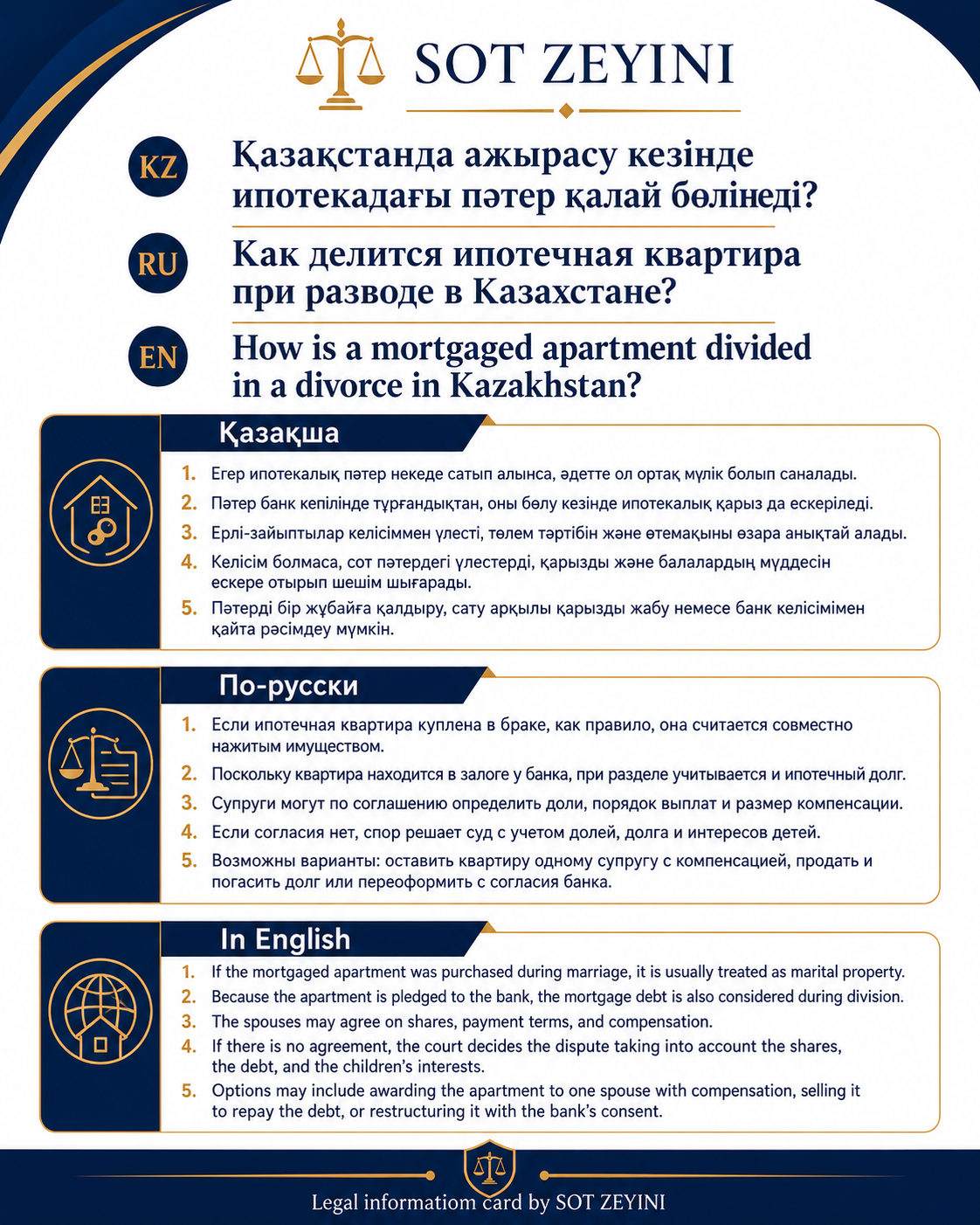
How is a mortgaged apartment divided?
A mortgaged apartment is more complex because both the property and the bank obligation must be considered.
The court may consider:
- when the mortgage was taken;
- who paid the initial payment;
- who made monthly payments;
- whether the loan was used for family needs;
- who lives in the apartment;
- which parent the children live with;
- remaining loan balance;
- the bank’s position.
Possible outcomes include:
- recognizing the apartment as joint property and determining shares;
- leaving the apartment to one spouse with compensation to the other;
- dividing mortgage obligations;
- selling the apartment, repaying the bank, and dividing the balance;
- resolving ownership after the mortgage is repaid.
Because a bank is involved, property division must also account for the loan agreement and lender requirements.
How is a car divided?
If a car was purchased during marriage, it may be considered joint marital property. It does not matter that the car is registered only in one spouse’s name.
A car may be divided by:
- leaving the car to one spouse and awarding 1/2 of its value to the other;
- selling the car and dividing the money;
- dividing several cars between the spouses;
- recovering half of the market value if the car was already sold.
If one spouse sold the car before or during the divorce process, the other spouse may claim compensation for their share.
What if one spouse sold the property?
If one spouse sold joint property without the other spouse’s consent, the transaction may be challenged or taken into account in division.
Depending on the situation, the other spouse may ask to:
- invalidate the transaction;
- recover half of the property’s value;
- consider the sold property during division;
- freeze other property;
- apply interim measures.
For example, if the husband sold a car acquired during marriage, the wife may claim 1/2 of its market value.
Are loans and debts divided?
Yes, but not all debts are automatically divided between spouses.
A loan may be treated as a joint obligation if it was taken for family needs.
Examples include:
- mortgage for a family apartment;
- loan for renovation of family housing;
- loan for a child’s medical treatment;
- loan for family expenses;
- debt used to purchase joint property.
If one spouse took a loan secretly and spent it on personal purposes, gambling, personal business risks, or third parties, the other spouse may object to recognizing the debt as joint.
The court examines not only the loan date, but also how the money was used.
How is a business divided?
If a business was created during marriage, or a business share was acquired during marriage, it may be considered joint property.
This may include:
- share in a company;
- individual entrepreneur assets;
- commercial equipment;
- business vehicles;
- retail outlet;
- business income;
- corporate rights;
- commercial real estate.
In practice, courts often do not physically split the business. Instead, they may determine the value of the business share and award monetary compensation to the other spouse.
Business division may require accounting documents, tax reports, bank statements, business valuation, and financial expert analysis.
Is children’s property divided?
No. Children’s property is not divided between spouses.
Children’s property may include:
- clothes;
- school supplies;
- toys;
- computer or tablet bought for the child;
- money in the child’s account;
- property registered in the child’s name;
- items gifted to the child;
- inherited property of the child.
Parents’ divorce must not harm the child’s property rights.
Does a non-working spouse have rights to property?
Yes. If one spouse did not work but managed the household, cared for children, or had valid reasons for not earning income, this does not deprive that spouse of rights to joint property.
For example, if the wife stayed home with children and the apartment was bought with the husband’s income, this does not automatically mean the apartment belongs only to the husband. Family contribution is not only financial.
Is property always divided 50/50?
Usually, spouses’ shares are presumed equal. However, in some cases the court may depart from equal shares.
This may happen if:
- the interests of minor children require it;
- one spouse did not earn income without valid reasons;
- one spouse spent joint property against the family’s interests;
- property was hidden or sold;
- family money was spent on gambling, alcohol, or other harmful personal purposes.
However, unequal division requires evidence. The court will not change shares only because one spouse feels it would be fair.
How does a prenuptial agreement affect division?
If spouses have a prenuptial agreement, property is divided according to that agreement.
A prenuptial agreement may specify:
- who owns the apartment;
- who keeps the car;
- how business is divided;
- who is responsible for loans;
- what property is personal;
- how property will be divided in divorce.
However, the agreement must comply with the law and must not place one spouse in an extremely unfavorable position. In some cases, it may be challenged.
Is property acquired before marriage divided?
Usually, property acquired before marriage is not divided. It is considered personal property of the spouse who acquired it.
Examples include:
- apartment bought before marriage;
- car bought before marriage;
- land plot registered before marriage;
- personal savings before marriage.
However, if the property was significantly improved during marriage using joint funds, the other spouse may claim compensation or a share.
Is inherited or gifted property divided?
Property received by one spouse by inheritance or as a gift is generally not divided.
Examples include:
- a house inherited by the husband;
- an apartment gifted to the wife;
- a car gifted personally to one spouse.
Documents are important: gift agreement, inheritance certificate, and registration documents.
If the “gift” was only formal and the property was actually bought with joint funds, the other spouse may try to prove it is marital property.
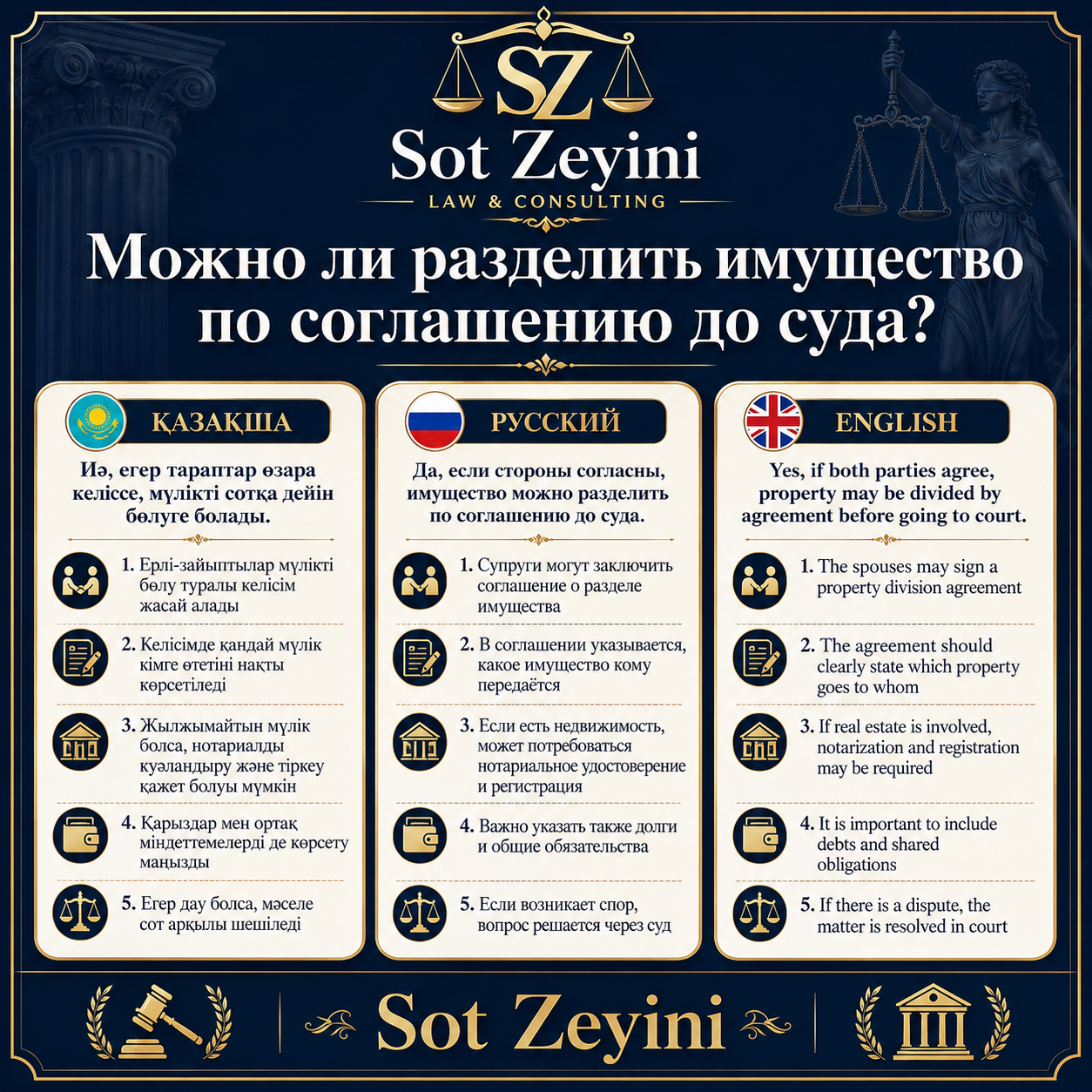
Can spouses divide property without court?
Yes. Spouses may divide property by agreement.
The agreement may specify:
- who keeps the apartment;
- who gets the car;
- who pays compensation;
- how loans are handled;
- what happens with the mortgage;
- how business is divided;
- who pays expenses;
- deadlines for transferring property or money.
An agreement on division of joint property should be made in writing and notarized.
How does court property division work?
If the spouses cannot agree, property is divided by court.
The claim should state:
- what property must be divided;
- when it was acquired;
- in whose name it is registered;
- property value;
- what share the claimant requests;
- whether there are loans;
- whether there are children;
- whether there is a risk of sale or concealment;
- what evidence is attached.
The court determines which property is joint, which is personal, the value of the assets, and the appropriate method of division.
Which court should hear the case?
A property division claim is usually filed at the defendant’s place of residence.
If the dispute concerns real estate, the claim may be filed at the location of the property.
If property is located in different regions or several claims are combined, jurisdiction must be determined carefully. Filing in the wrong court may result in return of the claim.
The claim may be filed electronically through the “Court Cabinet” system.
What documents are needed?
Documents may include:
- ID document;
- marriage certificate;
- divorce certificate;
- children’s birth certificates;
- apartment, house, or land documents;
- purchase agreements;
- vehicle registration documents;
- mortgage agreement;
- loan agreements;
- bank statements;
- receipts;
- valuation report;
- company or business documents;
- tax reports;
- correspondence;
- evidence that property was sold;
- state duty payment receipt.
The main goal is to prove that the property was acquired during marriage and has a certain value.
How is property value determined?
Property value may be determined by:
- agreement of the parties;
- valuation report;
- market value certificate;
- court expert assessment;
- purchase documents;
- comparable market offers.
Real estate may require property valuation, cars may require vehicle valuation, and business may require financial expert analysis.
How to prevent a spouse from selling property?
If there is a risk that a spouse may sell, gift, transfer, or hide property, the claimant may request interim measures.
The court may be asked to:
- freeze the apartment;
- prohibit sale of the car;
- prohibit registration actions;
- freeze the land plot;
- restrict bank accounts;
- prohibit transfer of business shares.
This helps preserve property until the court decision.
What is the limitation period?
For division of joint marital property after divorce, a three-year limitation period may apply.
However, it may not always run automatically from the divorce date. It may start from the day when the spouse learned or should have learned about the violation of their right.
For example, the spouses divorced in 2020, but both continued treating the apartment as joint property. In 2025, one spouse tried to sell it and denied the other spouse’s rights. In such a case, the limitation period may be argued to start from the moment of violation.
What if property is registered in a relative’s name?
Sometimes property acquired during marriage is registered in the name of parents, siblings, or friends. These cases are more complex.
The court may consider claims to:
- recognize property as joint marital property;
- invalidate a transaction;
- recover compensation;
- consider hidden property during division.
Evidence may include bank transfers, receipts, correspondence, witnesses, actual use of the property, and other materials.
Sample court requests
In the claim, the claimant may ask the court to:
- Recognize the property as joint marital property.
- Determine the spouses’ shares.
- Divide the property between the spouses.
- Transfer the apartment to one spouse with compensation to the other.
- Recover 1/2 of the vehicle’s value.
- Recognize a debt as a joint obligation if it was taken for family needs.
- Apply interim measures and prohibit disposal of property.
The requests must be adjusted to the specific facts of the case.
Conclusion
In divorce, not all property is divided. Only joint marital property is usually subject to division. This generally means property acquired during marriage.
Apartments, houses, cars, money, business shares, equipment, and other valuable assets may be divided. Property acquired before marriage, received by inheritance, or received as a personal gift is usually not divided.
If there is a dispute, it is important to collect documents, value the property, check loans, request interim measures if necessary, and file a properly prepared court claim.
FAQ: Frequently Asked Questions
1. How is property divided in divorce?
Property acquired during marriage is usually divided equally unless there is a prenuptial agreement or special circumstances.
2. If an apartment is registered to the husband, does the wife have a share?
Yes, if the apartment was acquired during marriage.
3. If an apartment is registered to the wife, does the husband have a share?
Yes, if it was purchased during marriage and is not proven to be her personal property.
4. Is property bought before marriage divided?
Usually no. But if it was significantly improved during marriage using joint funds, compensation or a share may be claimed.
5. Is inherited property divided?
Usually no. Inherited property is generally personal property.
6. Is gifted property divided?
If the property was personally gifted to one spouse, it is usually not divided.
7. How is a mortgage divided?
The court considers both the apartment and the loan obligation, including payments, purpose of the loan, and bank position.
8. How is a car divided?
A car acquired during marriage may be left to one spouse with compensation to the other.
9. What if one spouse sold the car?
The other spouse may claim 1/2 of its market value or challenge the transaction.
10. Are loans divided?
Yes, if they were taken for family needs. Personal debts may not be recognized as joint.
11. Is business divided?
Yes, if it was created or acquired during marriage. Often, monetary compensation is awarded.
12. Is children’s property divided?
No. Children’s property is not divided between parents.
13. Does a non-working spouse have property rights?
Yes, especially if that spouse managed the household or cared for children.
14. Can property be divided without court?
Yes, through a notarized property division agreement.
15. What documents are needed for court?
Marriage and divorce documents, property documents, purchase agreements, loan and mortgage documents, valuation reports, bank statements, and state duty receipt.
16. What is the limitation period?
A three-year period may apply, but it may start when the spouse learns about the violation of their rights.
17. How to prevent sale of property?
Request interim measures, such as freezing property or prohibiting registration actions.
18. What if there is a prenuptial agreement?
Property is divided according to the agreement, unless it is invalid or contrary to law.
19. What if a spouse hides property?
Evidence can be collected and the court may be asked to request documents, apply interim measures, or award compensation.
20. What is most important in court?
To prove that the property was acquired during marriage, is joint property, and has a specific value.