 +7 775 858 9294
 WhatsApp
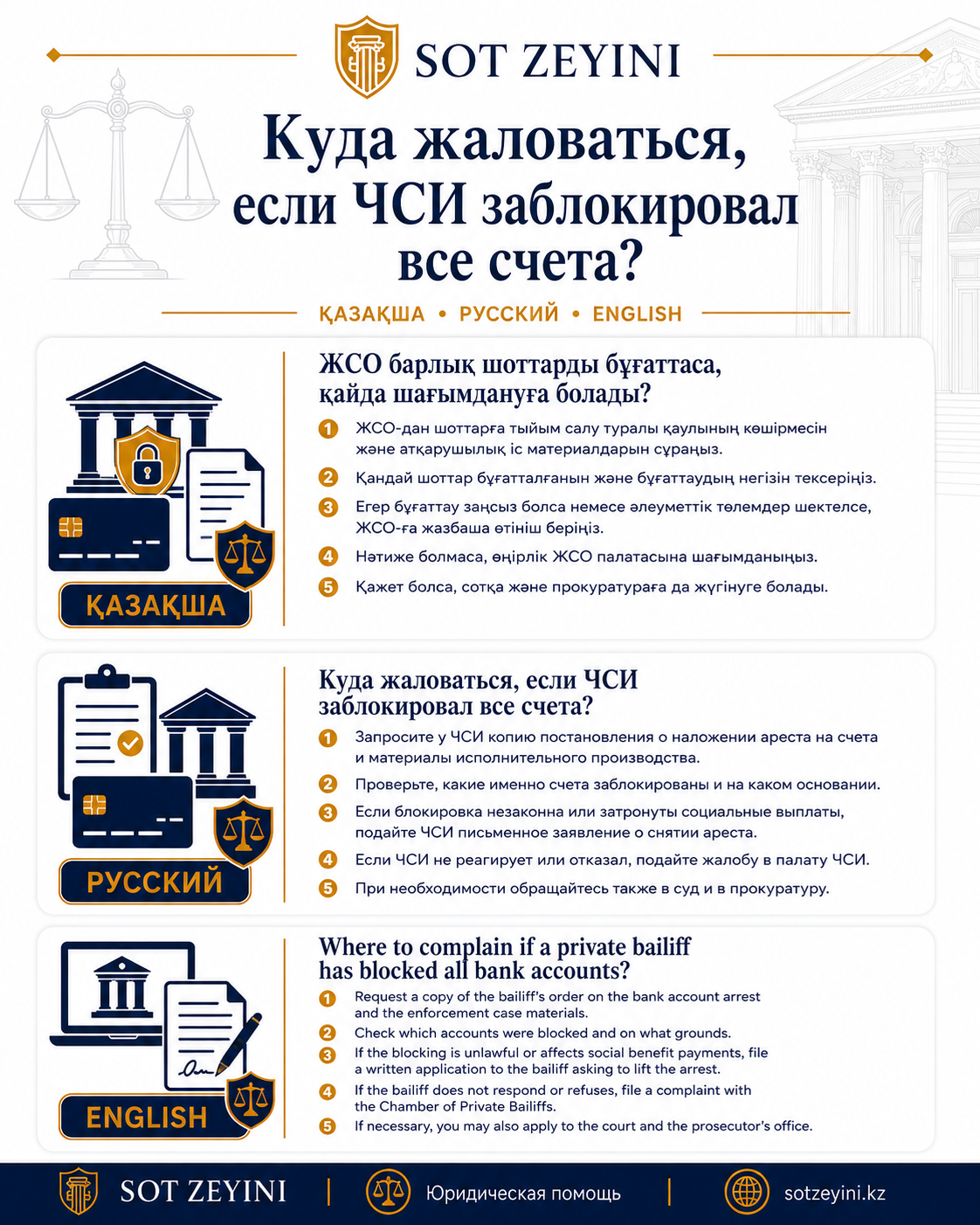
Where to Complain If a Private Enforcement Officer Has Frozen All Bank Accounts in Kazakhstan
In Kazakhstan, a private enforcement officer may freeze a debtor’s bank accounts within enforcement proceedings. However, in practice, situations occur where all accounts are blocked, including salary accounts, social benefit accounts, alimony accounts, and other accounts receiving protected funds.
If a private enforcement officer has frozen all your accounts, do not rely only on the bank. The bank usually follows the enforcement officer’s resolution. The main action should be taken through the enforcement officer. If the officer does not respond, you may file a complaint with the chamber of private enforcement officers, the department of justice, the prosecutor’s office, or the court.
In simple terms: if all accounts are frozen, you need documents, not panic.
Why can all accounts be frozen?
A private enforcement officer may freeze bank accounts when enforcement proceedings are initiated against the debtor.
The basis may be:
- court decision on debt recovery;
- court order;
- notarial writ of execution;
- alimony debt;
- bank or microfinance debt;
- administrative fine;
- tax debt;
- utility debt;
- another enforcement document.
In such situations, the bank usually does not decide the dispute. It only executes the enforcement officer’s resolution. Therefore, if the freeze was imposed by the enforcement officer, the issue must be resolved through the enforcement officer.
What should you do first?
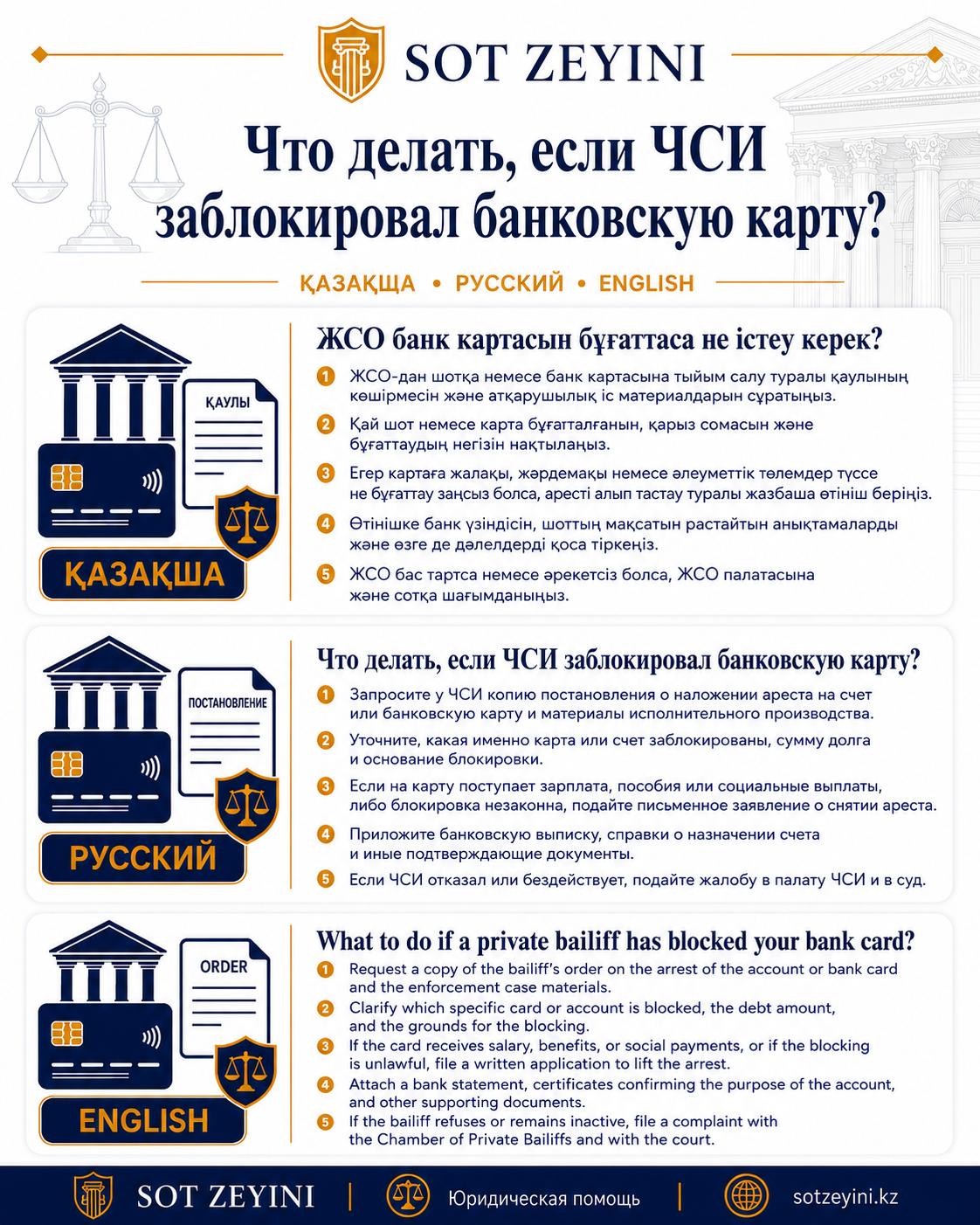
The first step is to find out who froze the accounts and on what basis.
Action plan:
- Ask the bank which enforcement officer imposed the freeze.
- Get the officer’s name and contact details.
- Find out the enforcement case number.
- Clarify the debt amount.
- Request a copy of the resolution freezing the accounts.
- Check which enforcement document was used as the basis.
- Identify which accounts were frozen.
- Check whether salary, social benefits, or alimony are paid into any of those accounts.
Without this information, a complaint will be weak. A proper complaint should include specific facts: case number, date of resolution, bank, account, debt amount, and violation.
Where can you file a complaint?
If the enforcement officer has frozen all accounts and does not resolve the issue, several legal options are available.
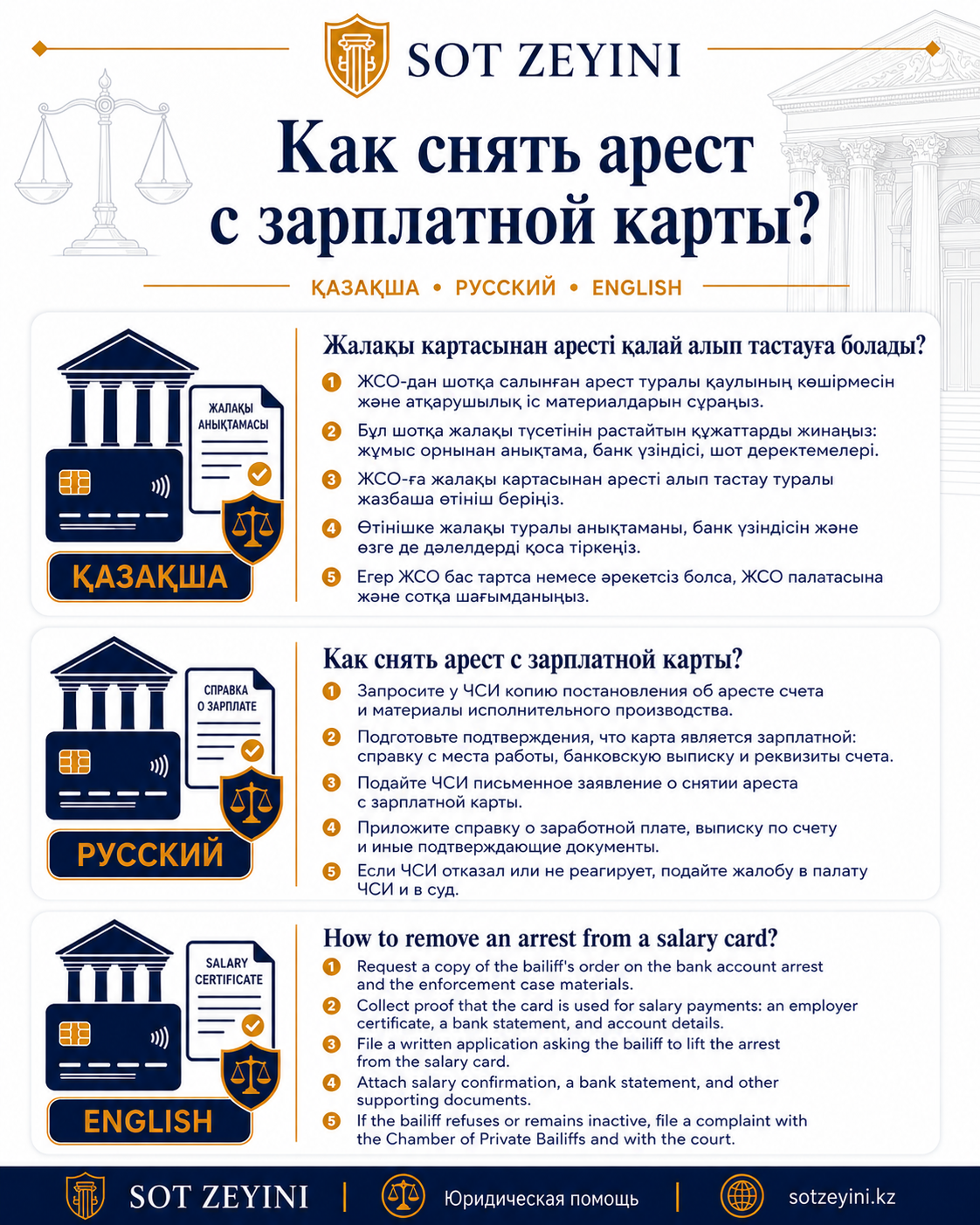
1. First, submit an application to the enforcement officer
The first step is a written application to the enforcement officer. It should state that all accounts are frozen, including accounts receiving salary, social benefits, alimony, or other protected funds.
In the application, you may request:
- review of the account freeze;
- removal of the full freeze from the salary account;
- removal of the freeze from the social benefit account;
- removal of the freeze from the alimony account;
- recovery of debt through salary deductions;
- use of measures proportionate to the debt amount;
- sending the resolution on removal of the freeze to the bank.
The application should be submitted in writing with proof of delivery or registration. A verbal conversation with the enforcement officer is difficult to prove later.
2. Complaint to the chamber of private enforcement officers
If the enforcement officer does not respond or fails to act, a complaint may be filed with the regional chamber of private enforcement officers.
The complaint should include:
- name of the enforcement officer;
- enforcement case number;
- which accounts were frozen;
- what applications were submitted;
- what documents were attached;
- what action the officer failed to take;
- what rights were violated;
- what decision you request.
The chamber may review issues related to the professional activity of the enforcement officer.
3. Complaint to the department of justice
You may also file a complaint with the department of justice.
Grounds for complaint may include:
- the enforcement officer does not respond to applications;
- all accounts are frozen without considering the nature of incoming funds;
- the salary account is fully blocked;
- social benefits are unavailable;
- alimony payments are blocked;
- the debt is paid, but the freeze remains;
- the officer does not send the resolution to the bank;
- enforcement proceedings are conducted with violations.
Attach evidence to the complaint: bank statements, copies of applications, the officer’s resolution, documents confirming salary, social payments, or alimony.
4. Complaint to the prosecutor’s office
If the enforcement officer’s actions seriously violate the debtor’s rights, a complaint may be submitted to the prosecutor’s office.
This may be relevant if:
- the person is completely deprived of access to funds for living;
- social benefits are frozen;
- child alimony is blocked;
- the enforcement officer ignores written applications;
- accounts remain frozen after full repayment;
- protected payments were unlawfully withheld.
The prosecutor’s office may review the legality of the actions and take measures if grounds exist.
5. Complaint to court
If the actions or inaction of the enforcement officer are unlawful, a complaint may be filed with the court.
In court, you may request:
- recognition of the officer’s actions as unlawful;
- recognition of the officer’s inaction as unlawful;
- obligation to remove the freeze from specific accounts;
- obligation to send the resolution to the bank;
- obligation to review the application;
- cancellation of an unlawful resolution.
Before going to court, it is recommended to have evidence that you submitted a written application to the enforcement officer and the issue was not resolved.
When should you complain?
A complaint may be necessary if:
- all bank accounts are frozen;
- the salary card is fully blocked;
- a social benefit account is blocked;
- an alimony account is blocked;
- the debt was paid, but the freeze was not removed;
- a court order was cancelled, but restrictions remain;
- a notarial writ was cancelled, but the freeze remains;
- the enforcement officer does not respond to applications;
- the freeze is disproportionate to the debt;
- the bank did not receive the resolution removing the freeze;
- protected funds were withdrawn from the account.
In these situations, the debtor has the right to protect their rights.
What if the salary account is blocked?
If one of the blocked accounts is a salary account, a separate application should be submitted to the enforcement officer.
Attach:
- employer certificate;
- employment agreement;
- employment order;
- bank statement;
- bank certificate confirming that salary is paid into the account;
- ID document.
In the application, request removal of the full freeze from the salary account and recovery of the debt through salary deductions.
Example wording:
“Salary is paid into the specified bank account. The full freeze of the account deprives me and my family of funds necessary for living. I request that the freeze of the salary account be reviewed and that the debt be recovered through salary deductions in accordance with the law.”
What if a social benefit account is blocked?
If social benefits, child benefits, allowances, or other protected payments are paid into the account, this must be confirmed with documents.
Attach to the application:
- bank statement;
- certificate confirming the social benefit;
- document confirming the type of payment;
- copy of ID.
The application should state that the account receives funds that should not be subject to enforcement and request removal of the freeze.
What if an alimony account is blocked?
Alimony belongs to the child. If the enforcement officer has frozen the account where alimony is paid, the issue should be raised immediately.
Attach:
- court decision or alimony agreement;
- child’s birth certificate;
- bank statement;
- information about the alimony payer;
- documents confirming the payment purpose.
The application should request removal of the freeze from alimony payments and state that these funds should not be used to pay the parent’s personal debt.
What if the debt is paid but the accounts remain frozen?
If the debt has been fully paid, submit an application to the enforcement officer requesting completion of enforcement proceedings and removal of all freezes.
Attach:
- payment receipts;
- bank checks;
- certificate confirming repayment;
- previous resolutions or court acts, if available.
Request the enforcement officer to:
- recognize that the debt has been paid;
- complete enforcement proceedings;
- remove freezes from all bank accounts;
- send the resolution to banks;
- provide a copy of the resolution.
If the enforcement officer does not remove the freeze after payment, complaints may be filed with the chamber, department of justice, prosecutor’s office, or court.
What should be written in the complaint?
The complaint must be specific. It is not enough to write only “the enforcement officer froze all accounts.” You need to explain why the actions are unlawful or excessive.
Complaint structure:
- Where the complaint is submitted.
- Applicant’s details.
- Details of the enforcement officer.
- Enforcement case number.
- Basis of the freeze.
- Which accounts were frozen.
- How the freeze violates your rights.
- What applications were previously submitted.
- What documents support your position.
- What you request.
Example request section:
“I request that the inaction of the private enforcement officer be recognized as unlawful.
I request that the private enforcement officer be obliged to review the application for removal of the freeze from the salary and social benefit accounts.
I request that the private enforcement officer be obliged to send a resolution to the bank removing the freeze from funds that are not subject to enforcement.”
What documents should be attached?
It is recommended to attach:
- copy of ID;
- enforcement officer’s resolution;
- information about enforcement proceedings;
- bank statements;
- salary certificate;
- social benefit certificate;
- alimony documents;
- child’s birth certificate;
- payment receipts;
- application previously submitted to the enforcement officer;
- response from the enforcement officer, if any;
- bank notifications;
- other evidence.
The more specific documents you attach, the stronger the complaint.
Should you complain to the bank?
You may contact the bank, but it is important to understand that if the freeze was imposed by the enforcement officer, the bank cannot usually remove it independently.
You may ask the bank:
- which resolution imposed the freeze;
- which accounts were frozen;
- whether a resolution removing the freeze was received;
- when the bank received documents from the enforcement officer.
However, the main request to remove the freeze should be addressed to the enforcement officer.
Common mistakes
Common mistakes include:
- contacting only the bank;
- not identifying the enforcement officer;
- not obtaining the enforcement case number;
- not submitting a written application;
- not attaching salary or social benefit documents;
- paying the debt but not requesting removal of the freeze;
- not checking whether the resolution was sent to the bank;
- not filing a complaint about inaction;
- not keeping documents.
These mistakes may keep accounts frozen longer than necessary.
Legal assistance
SOT ZEYINI law company assists when all bank accounts have been frozen by a private enforcement officer.
We can help with:
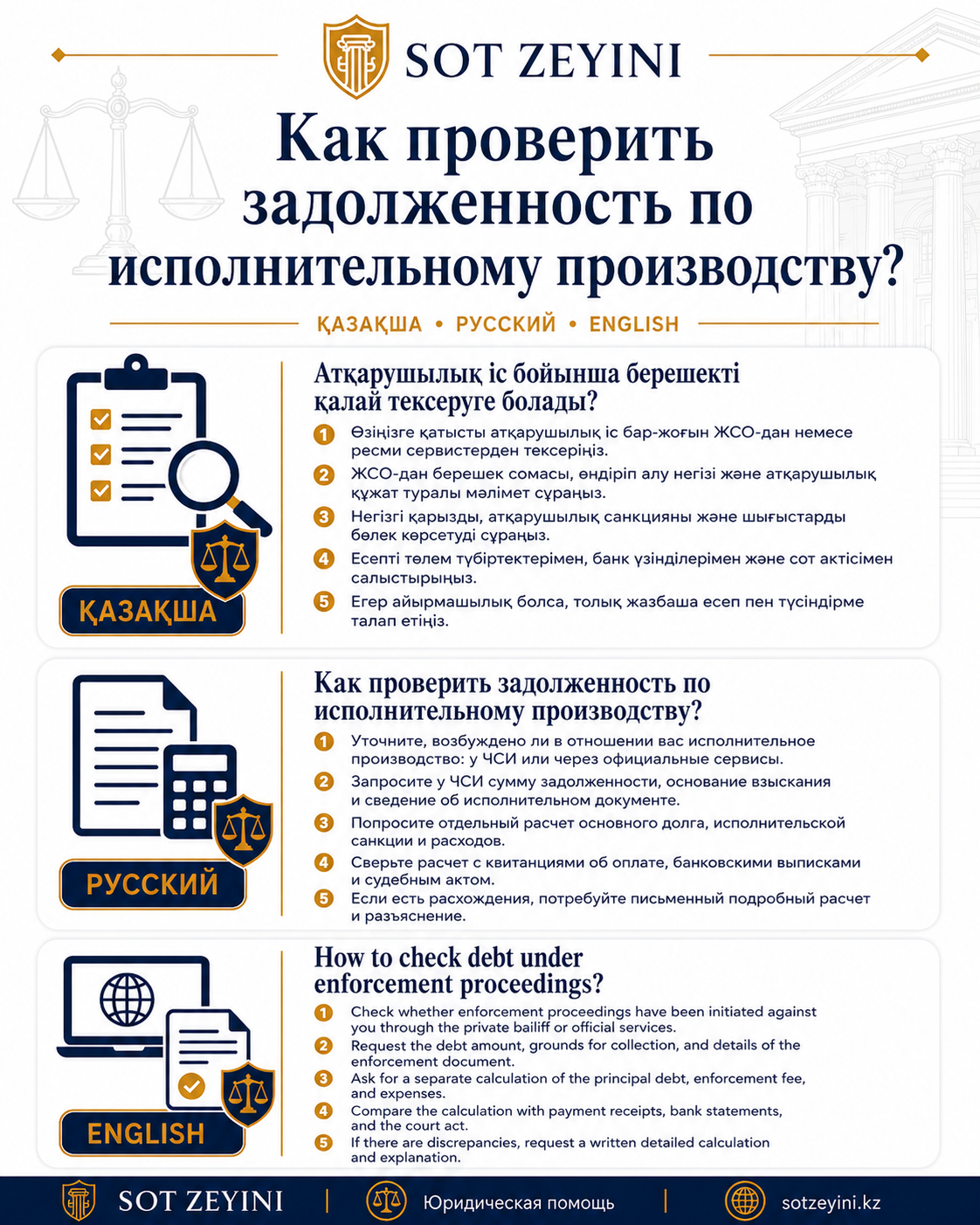
- checking enforcement proceedings;
- identifying the reason for the freeze;
- preparing an application to the enforcement officer;
- removing a freeze from a salary account;
- protecting social benefits;
- preparing an application for an alimony account;
- obtaining removal of freezes after debt repayment;
- filing a complaint with the chamber of private enforcement officers;
- preparing a complaint to the department of justice;
- preparing a complaint to the prosecutor’s office;
- preparing a court complaint;
- monitoring whether the resolution was sent to the bank.
If all your bank accounts have been frozen and you cannot access your salary, benefits, or alimony, contact us via WhatsApp. A lawyer will check the enforcement case and explain where to complain and what documents are needed.
FAQ
Where should I complain if all accounts are frozen?
First, submit a written application to the enforcement officer. If there is no result, you may complain to the chamber of private enforcement officers, department of justice, prosecutor’s office, or court.
Can the bank unblock accounts by itself?
If the freeze was imposed by the enforcement officer’s resolution, the bank usually cannot remove it independently. A resolution from the enforcement officer is required.
What if a salary card is blocked?
You need to prove that salary is paid into the account and request removal of the full freeze or recovery through salary deductions.
What if a social benefit account is blocked?
Attach documents confirming the social nature of the payments and request removal of the freeze from that account.
What if an alimony account is blocked?
Provide the court decision or alimony agreement, child’s birth certificate, and bank statement, then submit an application to the enforcement officer.
What if the enforcement officer does not respond?
You may file a complaint with the chamber, department of justice, prosecutor’s office, or court.
If the debt is paid, will the accounts be unblocked automatically?
Not always. The enforcement officer must issue a resolution removing the freeze and send it to the bank.
Can I go directly to court?
Yes, but it is better to first have a written application to the enforcement officer and evidence of unlawful action or inaction.
Conclusion
If a private enforcement officer has frozen all accounts, first identify the basis of the freeze and submit a written application to the officer. If salary, social benefits, or alimony are blocked, confirm this with documents and request a review of the freeze.
If the enforcement officer does not respond, complaints may be filed with the chamber of private enforcement officers, the department of justice, the prosecutor’s office, or the court.
The key rule is to act in writing. In disputes with enforcement officers, documents, dates, and evidence matter.