 +7 775 858 9294
 WhatsApp
What to Do If a Private Enforcement Officer Calculated the Debt Incorrectly in Kazakhstan
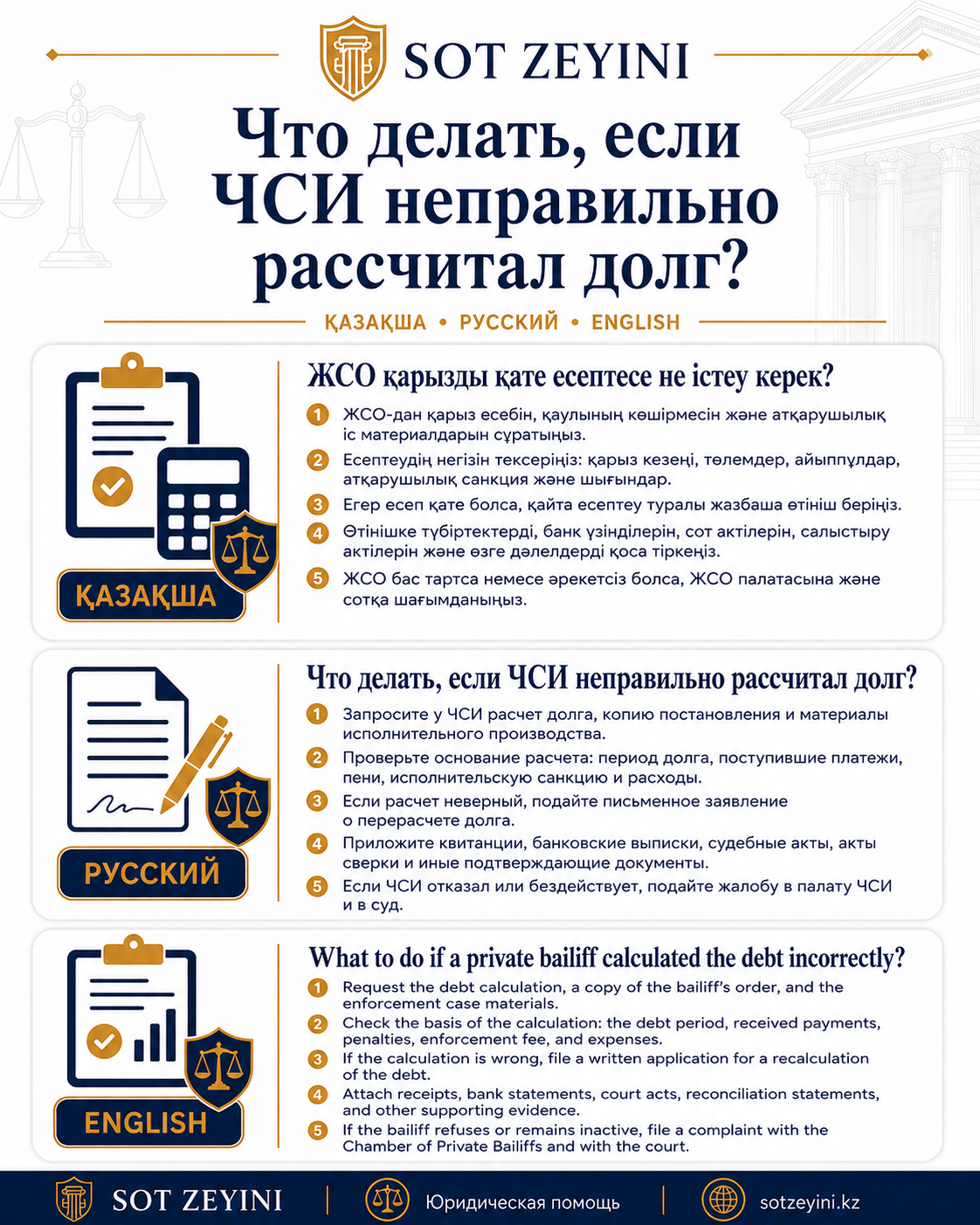
In Kazakhstan, when a debt, alimony, fine, bank debt, or court-awarded amount is being enforced, a private enforcement officer calculates the amount to be recovered. However, mistakes can happen. The officer may fail to count payments already made, add unnecessary expenses, calculate old debt twice, or incorrectly calculate alimony arrears.
If you believe the enforcement officer calculated the debt incorrectly, you should not simply pay the disputed amount. First, request a full debt calculation, compare it with your payments, collect receipts, and submit a written application for recalculation.
In simple terms: if the numbers do not add up, documents should speak.
When can the debt be calculated incorrectly?
Calculation errors may happen for different reasons: technical mistakes, incomplete data, uncounted payments, incorrect use of a court decision, or wrong calculation of enforcement expenses.
Common situations include:
- paid amounts were not counted;
- the same debt was calculated twice;
- alimony was calculated incorrectly;
- salary deductions were not reflected;
- money paid directly to the creditor was not counted;
- bank or Kaspi payments were not included;
- enforcement expenses were added without clear grounds;
- enforcement officer’s fee was calculated incorrectly;
- expenses were overstated;
- an amount not stated in the court decision is being claimed;
- a court order was cancelled, but the debt is still shown;
- a notarial writ was cancelled, but the debt and freezes remain;
- the debt is fully paid, but the enforcement case is not closed.
If the amount shown by the enforcement officer does not match your payments, the calculation must be checked.
What should you do first?
First, collect information and documents. Disputing the calculation without evidence is a weak position.
Steps to take:
- Find out the enforcement case number.
- Get a copy of the resolution initiating enforcement proceedings.
- Request a full debt calculation.
- Obtain a copy of the enforcement document: court decision, court order, notarial writ, or writ of execution.
- Collect all receipts and payment confirmations.
- Obtain bank statements.
- Check salary deductions.
- Compare the amount in the enforcement document with the amount stated by the enforcement officer.
- Submit an application for recalculation.
All communication should preferably be in writing. Verbal conversations are difficult to prove later.
What calculation should be requested?
Do not ask only “how much do I owe?” Request a full written calculation.
The calculation should separately show:
- principal debt;
- amount under the enforcement document;
- state duty;
- court expenses;
- legal fees;
- enforcement officer’s fee;
- enforcement expenses;
- amounts already paid;
- dates of payments received;
- remaining debt;
- grounds for additional amounts;
- for alimony — monthly calculation.
If the enforcement officer does not provide a detailed calculation, request it in writing.
What documents are needed for recalculation?
To obtain recalculation, you need to prove which amounts were paid or incorrectly added.
Prepare:
- payment receipts;
- Kaspi receipts;
- bank statements;
- employer certificate on salary deductions;
- documents confirming direct payments to the creditor;
- creditor’s receipt confirming payment;
- court decision;
- court order;
- writ of execution;
- notarial writ;
- enforcement officer’s resolutions;
- previous debt calculations;
- debt repayment agreement;
- history of alimony payments;
- correspondence with the creditor confirming payment.
The more documents you have, the stronger your position will be.
How to write an application for recalculation
The application should be specific. State which amount you disagree with and why.
The application should include:
- debtor’s details;
- creditor’s details;
- enforcement case number;
- debt amount stated by the enforcement officer;
- amount you disagree with;
- payments that were not counted;
- documents attached;
- request for recalculation;
- request for a new written calculation;
- if necessary, request to review freezes and restrictions.
Example wording:
“I disagree with the debt calculation under enforcement case No. ____ because payments made by me in the total amount of KZT ____ were not counted. I attach payment receipts and bank statements. I request recalculation of the debt, inclusion of paid amounts, and issuance of a new written calculation.”
What if the debt is paid but the officer still shows debt?
If the debt has been fully paid but the database, debtor registry, or enforcement officer still shows debt, submit an application to complete the enforcement proceedings.
In the application, request:
- recognition that the debt has been fully paid;
- completion of enforcement proceedings;
- removal from the debtor registry;
- removal of bank account freezes;
- removal of property restrictions;
- removal of travel ban, if any;
- sending relevant resolutions to banks and state authorities;
- copies of the resolutions.
After payment, it is important not only to keep the receipt but also to ensure the enforcement case is fully closed.
What if alimony debt is calculated incorrectly?
Alimony arrears are often more complicated than ordinary debt. They may depend on the debtor’s income, non-payment period, alimony amount, court act, and actual payments made.
Errors may occur if:
- paid alimony was not counted;
- salary deductions were not reflected;
- cash payments were not confirmed;
- change in alimony amount was not considered;
- income share was applied incorrectly;
- unemployment periods were calculated incorrectly;
- old months were included again.
In this case, request a monthly alimony calculation from the enforcement officer and submit an application for recalculation.
What to include in an alimony recalculation application
In an application for recalculation of alimony debt, state:
- the period you disagree with;
- amounts paid;
- documents confirming payment;
- salary deductions made;
- alimony amount established by court;
- exact calculation error;
- request for recalculation.
Attach bank receipts, employer certificates, statements, written receipts, and other proof of payment.
What if the enforcement officer’s fee or expenses are calculated incorrectly?
In addition to the principal debt, enforcement proceedings may include expenses and the enforcement officer’s fee. These amounts must also have a legal basis and calculation.
If the amount is unclear, request:
- how the enforcement officer’s fee was calculated;
- what legal basis was used;
- what enforcement expenses were included;
- documents confirming expenses;
- final calculation.
If the amount is excessive or unjustified, request recalculation and exclusion of unsupported charges.
What if the officer claims an amount not stated in the court decision?
The enforcement officer must enforce the enforcement document. The officer cannot arbitrarily increase the amount if it is not provided by the court act or law.
Check the calculation if:
- the court awarded KZT 1,000,000, but the officer states KZT 1,300,000 as the principal debt;
- the court did not award interest, but it appears in the calculation;
- court expenses were not awarded but are included;
- the same amount is counted twice.
Compare the court decision, writ of execution, and officer’s calculation, then submit an application to correct the calculation.
What if money was paid directly to the creditor?
Sometimes the debtor pays directly to the creditor, not through the enforcement officer. Such payments may be counted if confirmed by documents.
Proof may include:
- bank transfer;
- Kaspi receipt;
- creditor’s written receipt;
- WhatsApp correspondence;
- confirmation of receipt of money;
- payment purpose.
If the creditor received money but the enforcement officer did not count it, submit an application for recalculation and attach proof of payment.
What if the enforcement officer refuses to recalculate?
If the enforcement officer does not respond, ignores the application, or refuses recalculation without grounds, a complaint may be filed.
A complaint may be submitted to:
- the enforcement officer;
- regional chamber of private enforcement officers;
- department of justice;
- prosecutor’s office;
- court.
The complaint should be specific:
- when the recalculation application was submitted;
- what documents were attached;
- which payments were not counted;
- which amount is incorrect;
- what response the officer gave;
- what rights were violated;
- what you request.
A general statement like “the officer calculated incorrectly” is weak. State the amount, payment date, and document proving it.
How to write a complaint to the department of justice
In a complaint to the department of justice, describe the violation clearly.
Include:
- enforcement officer’s full name;
- enforcement case number;
- amount you disagree with;
- payments not counted;
- date of recalculation application;
- whether the officer responded;
- how the calculation violates your rights;
- attached documents.
The request section may state:
“I request a review of the private enforcement officer’s actions regarding debt calculation.
I request that the private enforcement officer be required to recalculate the debt taking into account the paid amounts.
I request that the private enforcement officer provide an updated written debt calculation.”
Can you go to court?
Yes. If the enforcement officer calculated the debt incorrectly, does not review the application, or unlawfully refuses recalculation, you may go to court.
In court, you may request:
- recognition of the officer’s actions as unlawful;
- recognition of the officer’s inaction as unlawful;
- obligation to recalculate the debt;
- obligation to count paid amounts;
- obligation to remove freezes or restrictions if the debt is actually paid;
- cancellation of an unlawful resolution.
Before going to court, it is better to have a written application submitted to the enforcement officer and proof of refusal or inaction.
Can freezes be removed due to incorrect calculation?
If the freeze was imposed for an excessive amount or the debt has actually been paid, you may request review of restrictions.
For example:
- the real debt is zero;
- part of the debt was paid, but the freeze remains for the full amount;
- payments were not counted and all accounts were frozen;
- the freeze exceeds the real debt amount.
In such cases, request removal or modification of freezes together with the recalculation application.
What should be checked in the calculation?
Check:
- amount in the court decision;
- amount in the writ of execution;
- principal debt;
- previously paid amounts;
- money paid directly to the creditor;
- salary deductions;
- monthly alimony calculation;
- enforcement officer’s fee;
- enforcement expenses;
- amounts that may have been added twice;
- actual remaining balance.
Even one uncounted receipt can change the final amount.
Short action plan
If the enforcement officer calculated the debt incorrectly:
- Find out the enforcement case number.
- Request a full debt calculation.
- Obtain a copy of the enforcement document.
- Collect all receipts and statements.
- Compare the calculation with your documents.
- Submit an application for recalculation.
- Request a new written calculation.
- If the officer does not respond, file a complaint.
- If necessary, go to court.
- After correction, check removal of freezes and restrictions.
All actions should be made in writing.
Common mistakes
Debtors often make these mistakes:
- paying the amount without checking the calculation;
- not keeping receipts;
- not obtaining bank statements;
- communicating only verbally;
- not proving direct payments to the creditor;
- not checking monthly alimony calculations;
- not checking the enforcement officer’s fee;
- not requesting case closure after payment;
- not checking removal of freezes;
- filing complaints too late.
These mistakes may lead to overpayment or prolonged freezes.
Legal assistance
SOT ZEYINI law company helps when a private enforcement officer calculates debt incorrectly.
We can help with:
- checking enforcement proceedings;
- analyzing the officer’s calculation;
- comparing the calculation with the court decision and writ of execution;
- checking payment documents;
- preparing an application for recalculation;
- preparing an application for alimony recalculation;
- checking enforcement officer’s fees and expenses;
- preparing an application to remove freezes;
- filing a complaint with the department of justice;
- preparing a complaint to the chamber of private enforcement officers;
- preparing a court complaint;
- helping close enforcement proceedings.
If the enforcement officer has stated an incorrect debt amount or has not counted your payments, contact us via WhatsApp. A lawyer will review the documents and explain which amount can be disputed.
FAQ
What should I do if the enforcement officer calculated the debt incorrectly?
Request a full debt calculation, collect receipts, and submit a written application for recalculation.
What documents are needed for recalculation?
Payment receipts, bank statements, court decision, writ of execution, enforcement officer’s resolutions, employer certificate on salary deductions, and other payment confirmations.
What if paid money was not counted?
Attach payment documents and submit an application for debt recalculation.
What if alimony debt was calculated incorrectly?
Request a monthly calculation, attach proof of payments, and submit an application for recalculation of alimony arrears.
Where can I complain if recalculation is refused?
You may complain to the chamber of private enforcement officers, department of justice, prosecutor’s office, or court.
What if the debt is paid but still shown?
Submit an application to complete enforcement proceedings, remove freezes, and remove the debtor from the registry.
Can the enforcement officer’s fee be disputed?
Yes, if it is unclear or calculated incorrectly. Request a calculation and submit an application for recalculation.
Can I go directly to court?
Yes, but it is better to first submit a written application to the enforcement officer and collect proof of refusal or inaction.
Conclusion
If a private enforcement officer calculated the debt incorrectly, do not rush to pay the disputed amount. First, request a full calculation, check all payments, and submit a written application for recalculation.
If the officer does not count payments, calculates alimony incorrectly, or adds unsupported expenses, the actions may be appealed.
The key rule is to act in writing and confirm every payment with documents. In enforcement proceedings, evidence wins.