 +7 775 858 9294
 WhatsApp
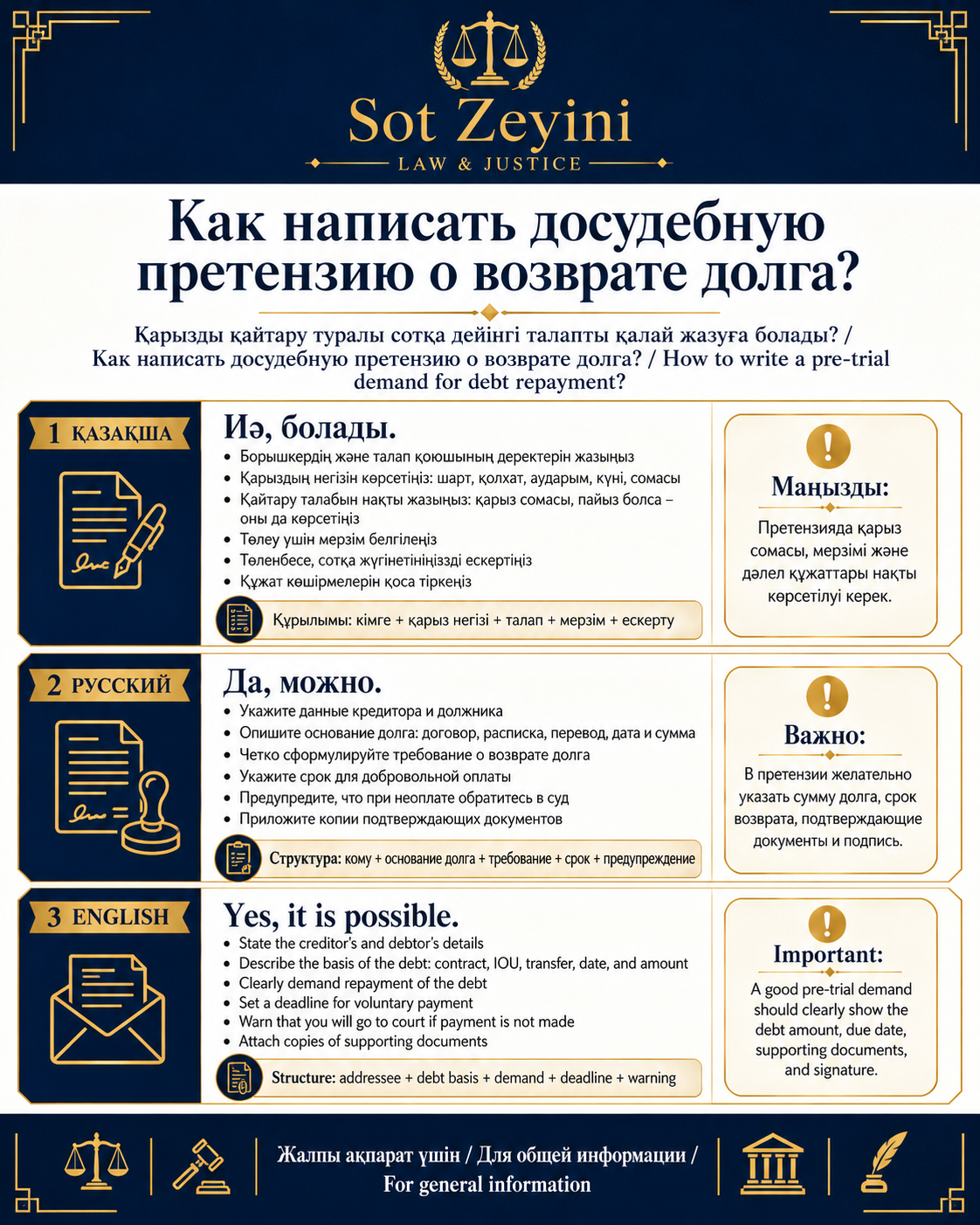
What is a pre-trial demand letter for debt repayment?
A pre-trial demand letter is a written request sent to a debtor asking them to repay the debt voluntarily before court proceedings. It usually states the debt amount, the basis of the debt, repayment deadline, available evidence, and a warning that a court claim may be filed.
In simple terms, it is a formal notice: repay the money voluntarily, or the issue may be resolved in court.
A demand letter may help recover the debt without litigation. If the debtor does not pay, the letter may be used in court to show that the creditor tried to resolve the dispute peacefully.
Is a pre-trial demand letter mandatory?
In many debt recovery cases, a pre-trial demand letter is not always mandatory. However, it is usually recommended because it:
- gives the debtor a chance to repay voluntarily;
- shows the creditor’s good faith;
- fixes the creditor’s repayment demand;
- may be used as additional evidence in court;
- helps confirm that the debtor failed to repay after being formally requested;
- may lead the debtor to admit the debt in response or correspondence.
If a contract or law requires a mandatory pre-trial procedure, the demand letter should be sent before filing a claim. Even when it is not mandatory, it remains a useful legal tool.
When should a demand letter be sent?
A demand letter should usually be sent after the repayment deadline has expired. For example, if the debtor had to repay the money by June 1, 2026, the demand letter may be sent after that date.
If the repayment deadline was not specified in a receipt or correspondence, the demand letter may set a clear deadline. For example: “I demand that you repay the debt within 7 calendar days from receipt of this letter.”
What information should be included?
A debt repayment demand letter should include:
- debtor’s full name;
- debtor’s address or contact details;
- creditor’s full name;
- amount of debt;
- date and method of money transfer;
- basis of the debt: receipt, loan agreement, Kaspi transfer, bank transfer, correspondence;
- repayment deadline;
- fact that the debt has not been repaid;
- deadline for voluntary repayment;
- payment details;
- warning about court action;
- date and signature.
The text should be formal, clear, and fact-based. A demand letter is not the place for emotions. It is where facts do the heavy lifting.
What evidence should be mentioned?
The letter may refer to evidence confirming the debt, such as:
- written receipt;
- loan agreement;
- Kaspi transfer;
- bank transfer;
- WhatsApp messages;
- Telegram or SMS messages;
- partial repayments;
- audio or video evidence, if lawfully obtained;
- witness information.
Example:
“On May 10, 2026, I transferred KZT 500,000 to you through the Kaspi application. This amount was provided as a loan, which is confirmed by the Kaspi receipt and WhatsApp correspondence where you acknowledged receiving the money and undertook to repay it.”
Structure of a pre-trial demand letter
1. Details of the parties
The top part of the document should include the debtor’s and creditor’s details.
Example:
To: Ivan Ivanov
Address: Almaty, ...
Phone: ...
From: Petr Petrov
Address: ...
Phone: ...
2. Title of the document
The title may be:
Pre-Trial Demand Letter for Debt Repayment
3. Description of the circumstances
This section should explain:
- when the money was transferred;
- in what amount;
- by what method;
- based on which document or agreement;
- when the debt had to be repaid;
- why the debt is overdue.
4. Repayment demand
The demand should be specific:
“I demand that you repay the debt in the amount of KZT 500,000 within 7 calendar days from receipt of this letter.”
5. Warning about court action
If the debtor does not repay the money, the creditor should state the possible consequences:
“If the debt is not repaid within the specified period, I will be forced to file a court claim for debt recovery. In court, I will also claim state duty, legal fees, and other court expenses.”
6. Attachments
The letter may list attached documents:
- copy of the written receipt;
- Kaspi receipt;
- bank statement;
- correspondence;
- debt calculation.
7. Date and signature
At the end, the creditor should add the date, full name, and signature.
What repayment deadline should be given?
Usually, creditors give 5, 7, 10, or 15 days for voluntary repayment. In many cases, 7 or 10 calendar days are enough.
For larger amounts, 10 business days may be used. The key point is that the deadline must be clear.
Example:
“I demand repayment within 7 calendar days from receipt of this demand letter.”
How should the demand letter be sent?
A demand letter may be sent by:
- registered mail with delivery confirmation;
- courier;
- WhatsApp;
- email;
- personal delivery against signature;
- notary;
- any other method that can confirm sending and receipt.
The safest option is to send it in a way that can later be proven in court. For example, if sent by registered mail, keep the receipt and delivery notice. If sent by WhatsApp, save screenshots showing the date, time, phone number, and delivery status.
Can a demand letter be sent through WhatsApp?
Yes, especially if the parties previously communicated through WhatsApp. However, evidence of sending must be preserved properly.
It is recommended to:
- send the letter as a PDF file;
- add a short explanatory message;
- save a screenshot showing the debtor’s phone number;
- save the date and time of sending;
- save delivery or read status, if available;
- keep the chat.
For a significant debt amount, it is better to also send the letter by registered mail. Double proof is not overkill; it is legal hygiene.
Should documents be attached?
Copies of the main evidence may be attached, such as:
- written receipt;
- Kaspi receipt;
- bank transfer confirmation;
- loan agreement;
- debt calculation;
- proof of partial repayments.
If the creditor does not want to send all evidence to the debtor, the letter may state that documents confirming the debt are available and will be submitted to court if necessary.
What if the debtor does not respond?
If the debtor does not respond and does not repay the money within the specified period, the creditor may prepare a court claim.
The following documents should preferably be attached to the claim:
- copy of the demand letter;
- proof that the letter was sent;
- written receipt or loan agreement;
- Kaspi receipt or bank transfer;
- correspondence;
- debt calculation;
- state duty payment receipt;
- documents confirming legal expenses.
No response from the debtor does not guarantee automatic success, but it confirms that the debtor failed to repay voluntarily.
What if the debtor asks for installment payments?
If the debtor asks to repay the debt in installments, it is better not to rely only on a verbal promise. A written repayment agreement should be signed.
The agreement should state:
- total debt amount;
- payment schedule;
- date of each payment;
- payment details;
- liability for delay;
- signatures of both parties.
If the debtor violates the schedule again, it will be easier to file a claim.
Can legal fees be mentioned?
Yes. The creditor may warn the debtor that if the matter goes to court, legal expenses may also be claimed.
Example:
“If I am forced to file a court claim, I will also claim state duty, legal fees, and other court expenses.”
This helps the debtor understand that delay may increase the total amount.
How should a demand letter not be written?
Avoid threats, insults, or pressure.
Incorrect:
“If you don’t return my money, you will have problems.”
Correct:
“If the debt is not repaid within the specified period, I will be forced to file a court claim for debt recovery and court expenses.”
A legal demand letter should be calm, precise, and evidence-based.
Sample pre-trial demand letter for debt repayment
PRE-TRIAL DEMAND LETTER FOR DEBT REPAYMENT
To: __________________________
Address: ______________________
Phone: ________________________
From: ________________________
Address: ______________________
Phone: ________________________
I, __________________________, transferred to you the amount of __________ KZT as a loan on “_” __________ 2026.
The debt is confirmed by: written receipt, Kaspi transfer, bank transfer, WhatsApp correspondence, or other evidence.
The repayment deadline was set for “___” __________ 2026. However, the debt has not been repaid in full to date.
Based on the above, I demand that you repay the debt in the amount of __________ KZT within ___ calendar days from receipt of this demand letter.
Please transfer the money to the following details:
Bank/card: ____________________
Recipient: ____________________
Phone: ________________________
If the debt is not repaid within the specified period, I will be forced to file a court claim for debt recovery. In that case, I will also claim state duty, legal fees, and other court expenses.
Attachments:
- Copy of the written receipt;
- Kaspi receipt;
- Copy of correspondence;
- Debt calculation.
Date: “___” __________ 2026
Signature: _______________
Full name: _______________
Conclusion
A pre-trial demand letter for debt repayment is an important document that helps record the creditor’s demand and gives the debtor a chance to repay the money without court proceedings. Even if it is not mandatory, it may strengthen the creditor’s position in court.
The letter should clearly state the debt amount, basis of the debt, repayment deadline, payment details, and consequences of non-payment.
SOT ZEYINI lawyers assist with preparing pre-trial demand letters, court claims, evidence packages, and debt recovery through court. Contact us via WhatsApp for legal consultation.
FAQ: pre-trial demand letter for debt repayment
1. Is a pre-trial demand letter mandatory?
Not always. However, it is recommended because it shows that the creditor tried to resolve the dispute before going to court.
2. Can the demand letter be sent via WhatsApp?
Yes. It is important to save proof of sending: phone number, date, time, message text, and delivery or read status.
3. What deadline should be stated?
Usually 7 or 10 calendar days are used. Depending on the situation, 5, 15, or 30 days may also be stated.
4. Should a written receipt be attached?
It is advisable to attach a copy of the main evidence, such as a written receipt, Kaspi receipt, bank transfer, loan agreement, or correspondence.
5. What if the debtor refuses to receive the letter?
If the letter was sent properly, proof of sending may be used in court. Avoiding receipt does not always prevent the creditor from filing a claim.
6. What if the debtor does not respond?
After the deadline expires, the creditor may file a court claim for debt recovery.
7. Can legal fees be recovered?
Yes, if they are confirmed by a contract and payment documents. They may be claimed in court.
8. Should the debt calculation be included?
Yes, especially if interest, penalties, or legal expenses are claimed in addition to the principal debt.
9. Can the demand letter be written in English?
It can be written in English if the parties understand it, but for court purposes in Kazakhstan, documents may need to correspond to the language of the proceedings.
10. Can a claim be filed without a demand letter?
In some cases, yes. However, sending a demand letter often strengthens the creditor’s position and shows an attempt to resolve the matter before court.