 +7 775 858 9294
 WhatsApp
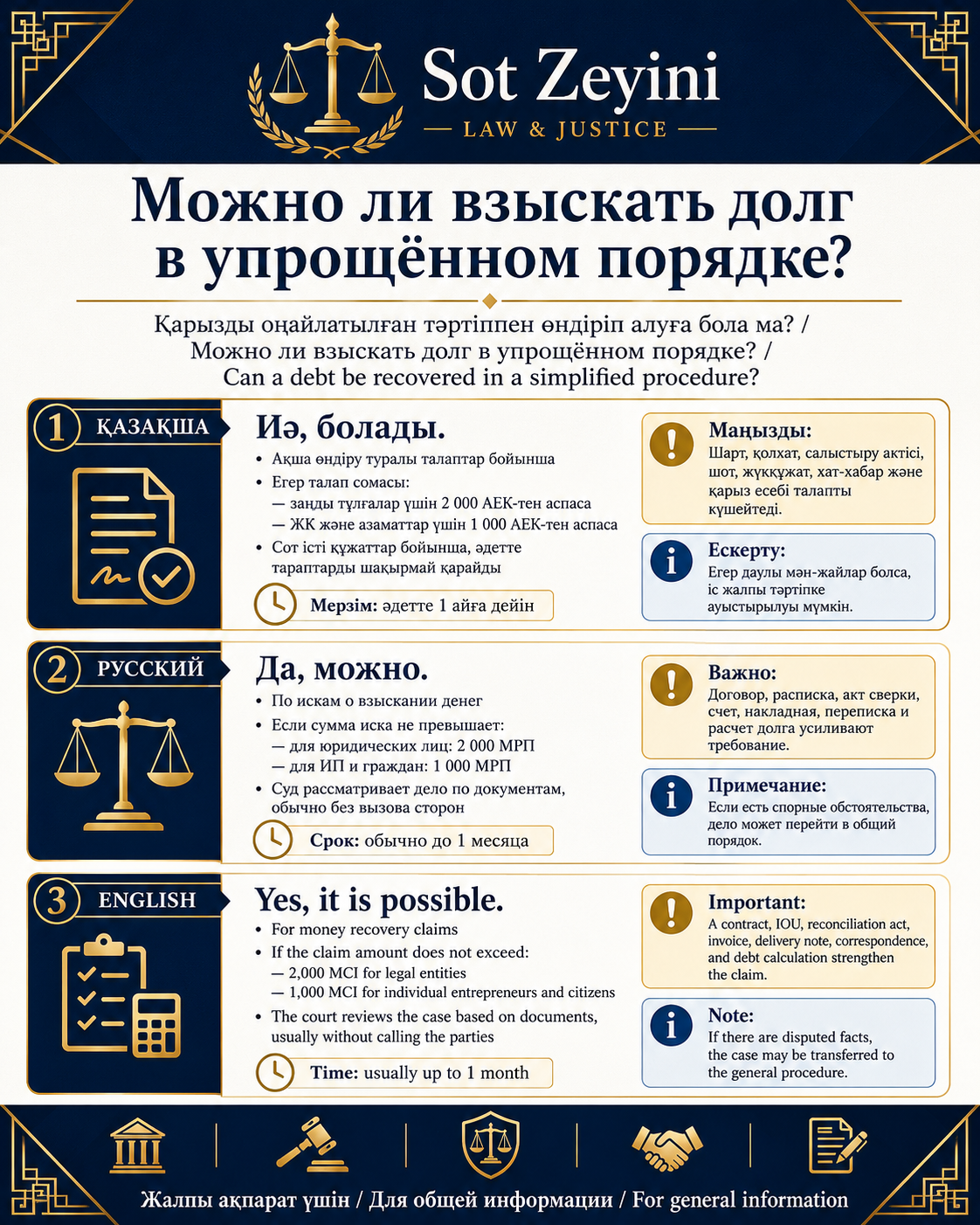
What are simplified written proceedings?
Simplified written proceedings are a form of civil court proceedings where the case is considered without a regular court hearing and without summoning the parties. The court reviews the statement of claim, response, objections, documents, and other written materials, and then issues a decision.
This procedure is used for cases that do not require a complex hearing, witness testimony, expert examination, or detailed oral proceedings.
In simple terms, simplified proceedings are a “documents speak for themselves” format. But this does not mean the court will recover the debt automatically. The evidence must still be strong and properly prepared.
Can a debt be recovered through simplified proceedings?
Yes. A debt may be recovered through simplified written proceedings if the claim concerns recovery of money and is supported by documents.
Simplified proceedings may be suitable if:
- there is a written receipt;
- there is a loan agreement;
- there is a Kaspi transfer or bank transfer;
- there are WhatsApp messages where the debtor acknowledges the debt;
- the debt amount is clearly calculated;
- the repayment deadline has expired;
- the dispute does not require expert examination or witnesses;
- the facts are clear from the documents.
If the evidence is prepared properly, simplified proceedings may help recover the debt faster than ordinary litigation.
How do simplified proceedings differ from a court order?
Many people confuse a court order with simplified proceedings. Both are faster than ordinary court proceedings, but they are different legal tools.
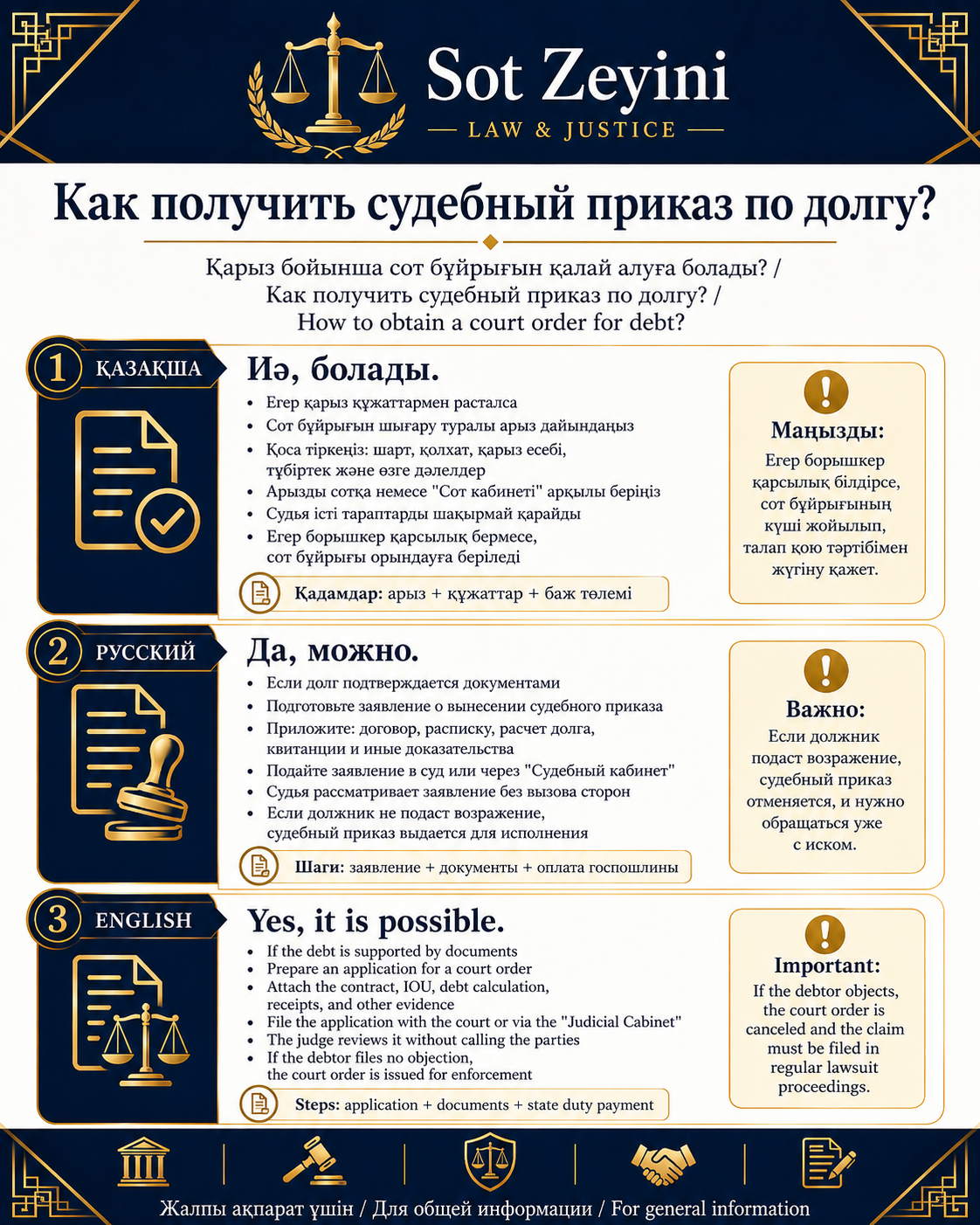
Court order:
- issued for uncontested claims;
- no court hearing is held;
- the debtor may object;
- if the debtor objects, the court order may be cancelled;
- the court order itself usually has the force of an enforcement document.
Simplified proceedings:
- start with a statement of claim;
- the court issues a judgment;
- the defendant may submit a response and objections;
- the defendant’s objection does not automatically terminate the case;
- after the judgment enters into force, a writ of execution is usually obtained;
- the court may transfer the case to ordinary proceedings if it becomes complex.
If the debt is completely uncontested, a court order may be considered. If the debtor may object but the creditor has strong evidence, simplified proceedings may be more practical.
What debts can be recovered through simplified proceedings?
Simplified proceedings may apply to monetary claims, including:
- debt under a written receipt;
- debt under a loan agreement;
- debt based on a Kaspi transfer;
- debt based on a bank transfer;
- unpaid service fees;
- unpaid goods;
- contractual debt;
- debt acknowledged by the debtor in correspondence;
- remaining debt after partial repayment.
The key point is that the claim must relate to recovery of money and be supported by written evidence.
What documents are required?
To recover a debt through simplified proceedings, it is advisable to prepare:
- statement of claim;
- written receipt or loan agreement;
- Kaspi receipt or bank transfer confirmation;
- bank statement;
- WhatsApp, Telegram, or SMS correspondence;
- evidence that the debtor acknowledged the debt;
- pre-trial demand letter;
- proof that the demand letter was sent;
- calculation of the debt amount;
- state duty payment receipt;
- documents confirming legal expenses;
- power of attorney or lawyer’s order, if represented by a lawyer.
The clearer the documents show the debt, amount, and repayment deadline, the stronger the claimant’s position.
Can a debt under a written receipt be recovered?
Yes. A debt under a written receipt may be recovered through simplified proceedings if the receipt confirms the loan relationship.
The receipt should ideally include:
- debtor’s full name;
- creditor’s full name;
- debt amount;
- date of money transfer;
- repayment deadline;
- debtor’s signature;
- statement that the money was received as a loan.
If the receipt is supported by a Kaspi receipt, bank transfer, or correspondence, the position becomes stronger.
Can a debt based on a Kaspi transfer be recovered?
Yes, but a Kaspi receipt alone may not always be enough. A Kaspi transfer confirms that money was transferred, but it does not always prove that the money was transferred as a loan.
The Kaspi transfer should preferably be supported by:
- payment purpose such as “debt,” “loan,” or “қарыз”;
- WhatsApp messages;
- written receipt;
- partial repayment;
- pre-trial demand letter;
- debtor’s acknowledgment of the debt.
For example, a Kaspi receipt plus a message saying “I received KZT 500,000 and will repay it on June 20” is much stronger than a transfer with no explanation.
Do WhatsApp messages help?
Yes. WhatsApp messages may serve as additional evidence, especially if the debtor:
- acknowledges receiving money;
- states the amount;
- promises to repay;
- asks for more time;
- requests installment payments;
- writes that they will repay “after salary” or “next week.”
The correspondence should be prepared properly. Screenshots should show the date, time, phone number, and context. It is better to collect the messages into a PDF file and attach them to the claim.
How to file a claim through simplified proceedings
The claim is filed as a regular statement of claim. At the end of the claim, the claimant may ask the court to consider the case through simplified written proceedings.
Example wording:
“Since the claim concerns recovery of money, is supported by written evidence, and does not require complex court examination, I request that the case be considered through simplified written proceedings.”
The claim may be filed:
- through the Judicial Cabinet;
- in paper form through the court office;
- through a representative under a power of attorney or lawyer’s order.
Which court should the claim be filed with?
As a general rule, a debt recovery claim is filed at the defendant’s place of residence. If the defendant is a legal entity, its registered address is usually relevant.
Before filing, it is important to check:
- defendant’s address;
- correct jurisdiction;
- claim amount;
- state duty amount;
- completeness of attachments;
- quality of evidence.
If the wrong court is selected, the claim may be returned or transferred.
How much is the state duty?
A debt recovery claim is a property claim. The state duty is calculated based on the claim amount.
For individuals, the state duty is generally 1% of the claim amount. For legal entities, a different rate may apply.
For example, if the debt amount is KZT 1,000,000, the state duty for an individual is usually KZT 10,000.
The state duty payment receipt must be attached to the claim.
How is the case considered?
In simplified proceedings, the court mainly reviews written materials. The court may:
- accept the claim;
- notify the parties;
- give the defendant time to submit a response;
- review documents;
- evaluate objections;
- request additional materials;
- issue a decision.
The parties are usually not summoned to court. Therefore, the written position must be clear, structured, and well-supported by evidence.
What happens if the defendant objects?
The defendant’s objection does not automatically terminate the case. This is one of the key differences from a court order.
The court will review the objections. If the dispute is not complex and the documents are sufficient, the court may still issue a decision through simplified proceedings.
However, if expert examination, witness testimony, a counterclaim, or additional fact-finding is needed, the court may transfer the case to ordinary proceedings.
When are simplified proceedings not suitable?
Simplified proceedings may be ineffective if:
- the debtor disputes the signature;
- handwriting examination is needed;
- witnesses must be heard;
- a counterclaim is filed;
- third-party rights may be affected;
- the debt amount or basis is seriously disputed;
- there is insufficient evidence;
- facts need to be examined in a court hearing.
In such cases, the court may transfer the case to ordinary proceedings.
What should be done after the judgment?
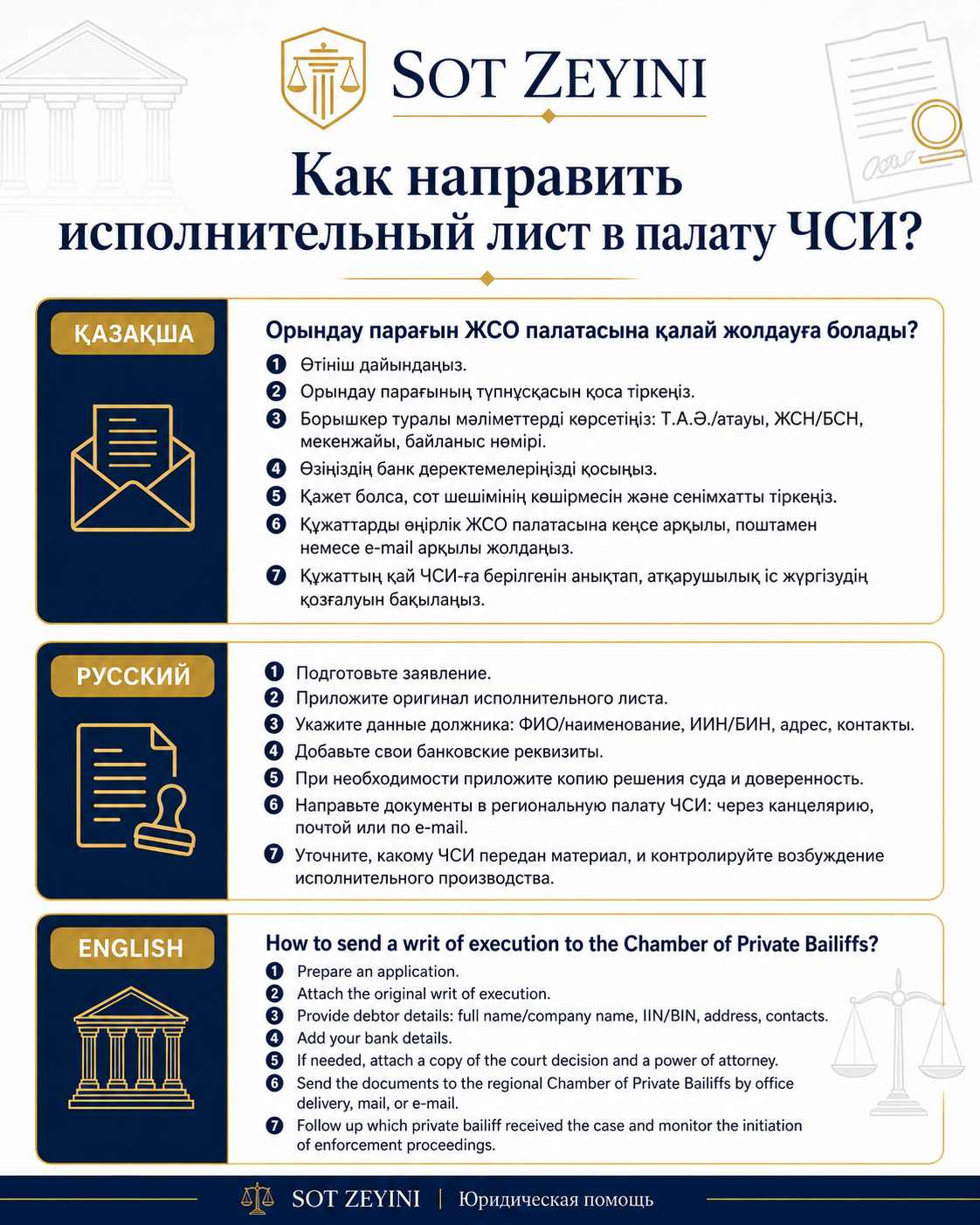
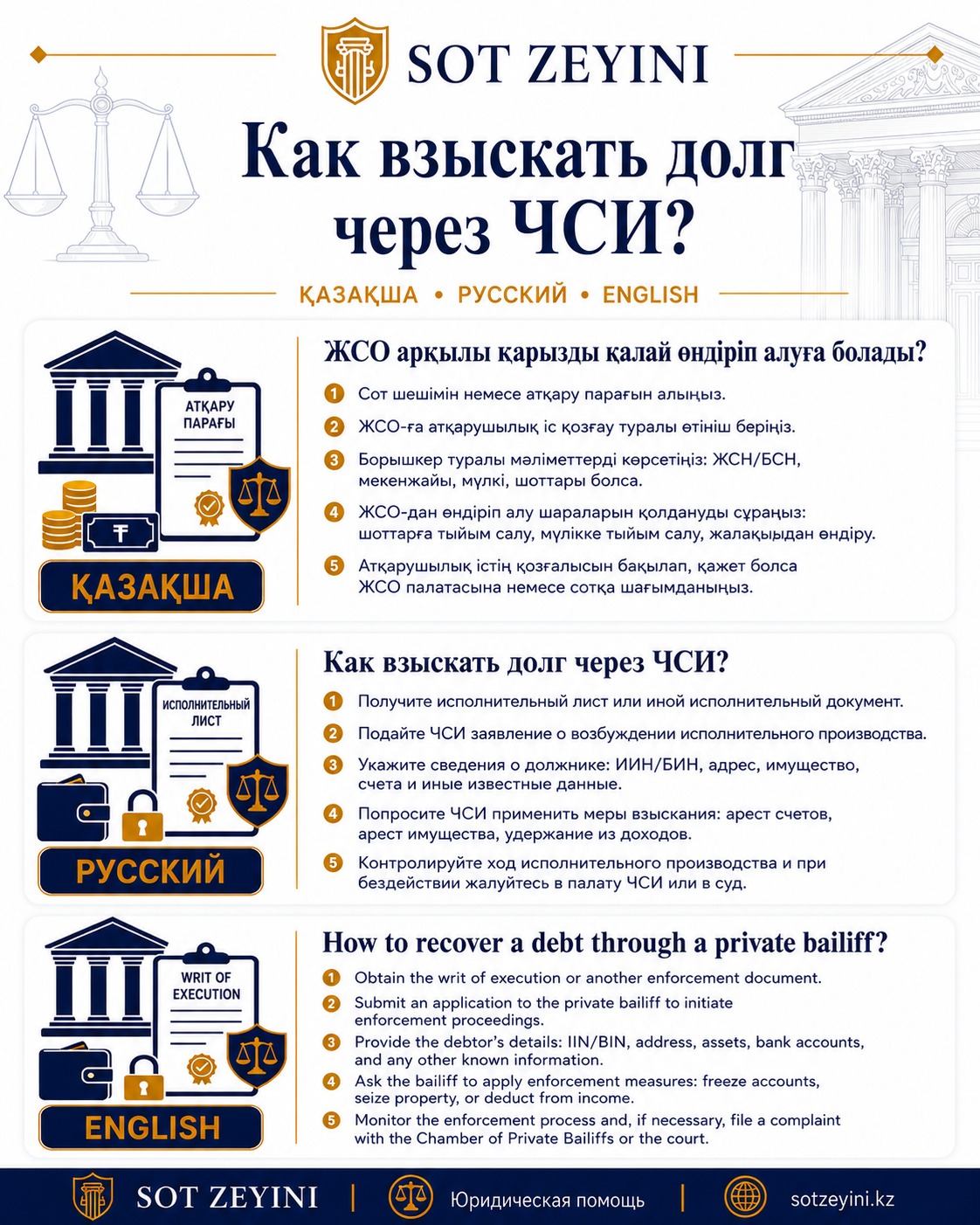
If the court satisfies the claim, after the judgment enters into legal force, the creditor should obtain a writ of execution.
Then the creditor should:
- obtain the writ of execution;
- submit it to a private or state bailiff;
- monitor the opening of enforcement proceedings;
- check enforcement measures;
- pursue actual recovery of the money.
Winning the case is only the first step. Actual recovery happens at the enforcement stage.
Short checklist before filing
Before filing the claim, check whether:
- there is a written receipt or agreement;
- there is a Kaspi receipt or bank transfer;
- the correspondence is preserved;
- the repayment deadline has expired;
- a pre-trial demand letter has been sent;
- the defendant’s address is known;
- the debt amount is calculated;
- the state duty has been paid;
- all evidence is attached;
- the request for simplified proceedings is included.
Conclusion
A debt can be recovered through simplified proceedings if the claim concerns money and is supported by documents. This procedure is useful when there is a written receipt, loan agreement, Kaspi transfer, WhatsApp correspondence, and a clear debt calculation.
Simplified proceedings may be more stable than a court order because the defendant’s objection does not automatically cancel the case. However, if the dispute becomes complex, the court may transfer it to ordinary proceedings.
SOT ZEYINI lawyers assist with preparing debt recovery claims through simplified proceedings, collecting evidence, calculating state duty, and supporting enforcement proceedings. Contact us via WhatsApp for legal consultation.
FAQ: debt recovery through simplified proceedings
1. Can a debt be recovered through simplified proceedings?
Yes, if the claim concerns recovery of money and is supported by documents.
2. How do simplified proceedings differ from a court order?
A court order may be cancelled if the debtor objects. In simplified proceedings, the objection does not automatically terminate the case; the court evaluates the arguments and evidence.
3. Can a debt under a written receipt be recovered?
Yes, if the receipt confirms the amount, repayment deadline, and debtor’s signature.
4. Can a debt be recovered only with a Kaspi receipt?
Sometimes, but additional evidence is recommended: correspondence, payment purpose, written receipt, or acknowledgment of debt.
5. Is a pre-trial demand letter required?
Not always, but it is useful. It shows that the creditor tried to resolve the matter peacefully and records the repayment demand.
6. Do the parties need to attend court?
Usually, the case is considered without summoning the parties, based on written materials.
7. What if the defendant objects?
The court reviews the objections. If the dispute is complex, the case may be transferred to ordinary proceedings.
8. How long do simplified proceedings take?
They are generally faster than ordinary proceedings and are considered within the procedural time limit set for simplified written proceedings.
9. What should be done after the judgment?
After the judgment enters into legal force, the creditor should obtain a writ of execution and submit it to a bailiff.
10. When is an ordinary lawsuit better?
An ordinary lawsuit is better if the debtor disputes the signature, amount, fact of debt, or if witnesses or expert examination are needed.