 +7 775 858 9294
 WhatsApp
What is a court order?
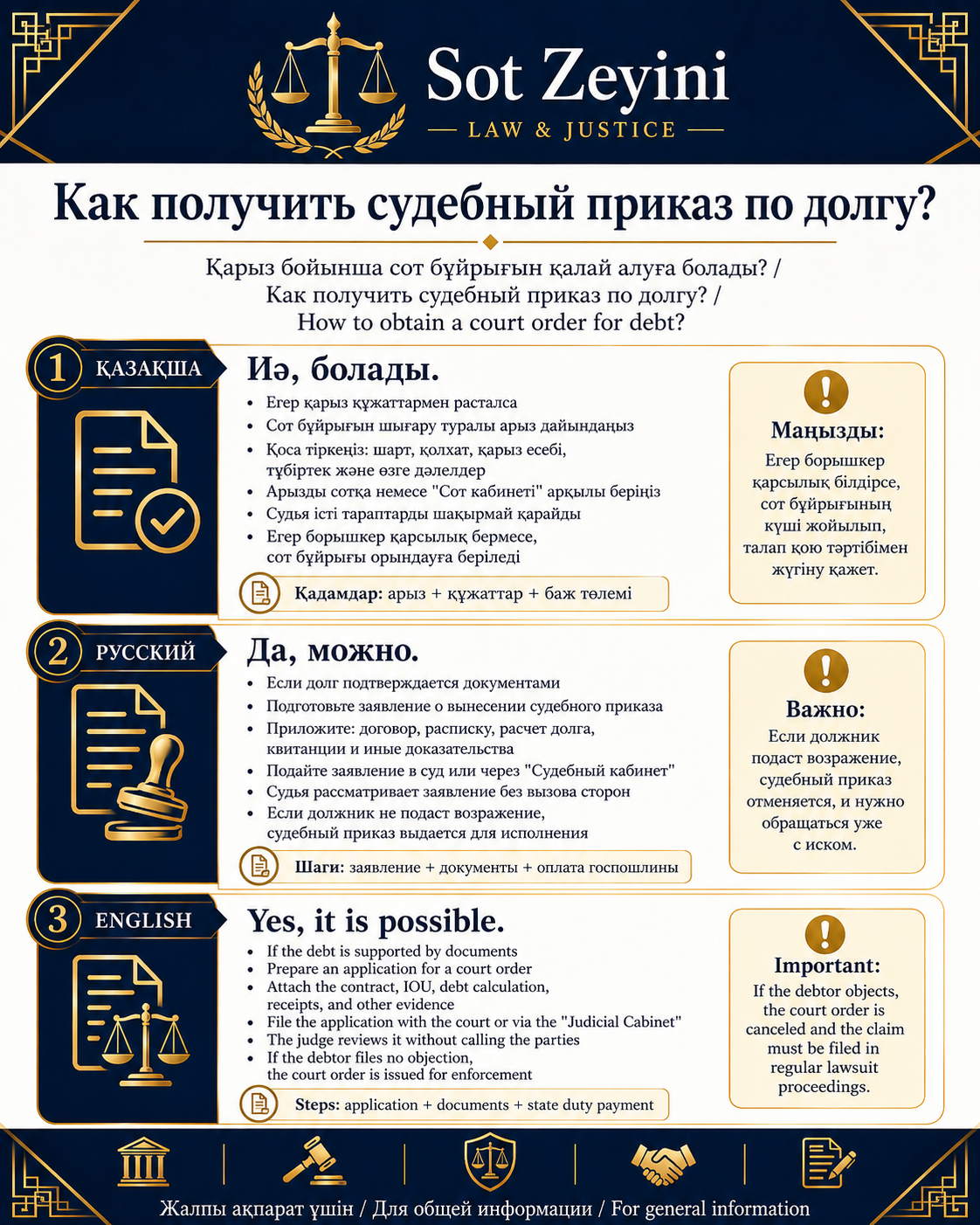
A court order is a judicial act issued by a judge for an uncontested claim. Unlike a regular lawsuit, a court order does not require a full court hearing. The court does not summon the creditor and debtor to a hearing and does not examine the dispute in the same way as in ordinary claim proceedings.
The main advantage of a court order is speed. If the debt is confirmed by documents and there is no obvious dispute, a court order may be obtained faster than a court judgment under a lawsuit.
In simple terms, a court order is a fast-track legal tool for debt recovery when the documents are clear and the debtor’s obligation is not seriously disputed.
When can a court order be obtained for a debt?
A court order cannot be obtained for every debt. It is usually available only when the claim is uncontested and supported by written evidence.
A court order may be suitable if:
- the debt is confirmed by a written receipt;
- there is a loan agreement;
- the obligation is notarized;
- the debt arises from a written transaction;
- the repayment deadline has expired;
- the amount of debt is clearly determined;
- the debtor has acknowledged the debt;
- there is no obvious dispute about the right to recover the money.
For example, if there is a written receipt, a Kaspi transfer, and WhatsApp messages where the debtor writes: “Yes, I acknowledge the debt and will repay it later,” this may strengthen the creditor’s position.
If the debtor says “I do not owe anything,” “it was a gift,” “the signature is not mine,” or “I already repaid the money,” it may be better to file a regular claim instead of applying for a court order.
What is the difference between a court order and a lawsuit?
A court order is used for uncontested claims. It is issued without a hearing and may serve as an enforcement document.
A lawsuit is used when there is a dispute between the parties. In ordinary claim proceedings, the court summons the parties, examines evidence, hears arguments, and issues a judgment. After the judgment enters into legal force, a writ of execution is usually issued.
A court order is suitable when:
- the debt is confirmed by documents;
- the amount is clear;
- the debtor has acknowledged the debt;
- a serious dispute is not expected.
A lawsuit is better when:
- the debtor denies the debt;
- there is a dispute about the amount;
- the debtor disputes the signature;
- it is unclear whether the transfer was a loan;
- witnesses, expert examination, or detailed evidence review are needed.
What documents are needed for a court order?
To obtain a court order for debt recovery, the creditor usually needs:
- application for a court order;
- written receipt or loan agreement;
- Kaspi receipt or bank transfer confirmation;
- WhatsApp, Telegram, or SMS correspondence;
- evidence that the debtor acknowledged the debt;
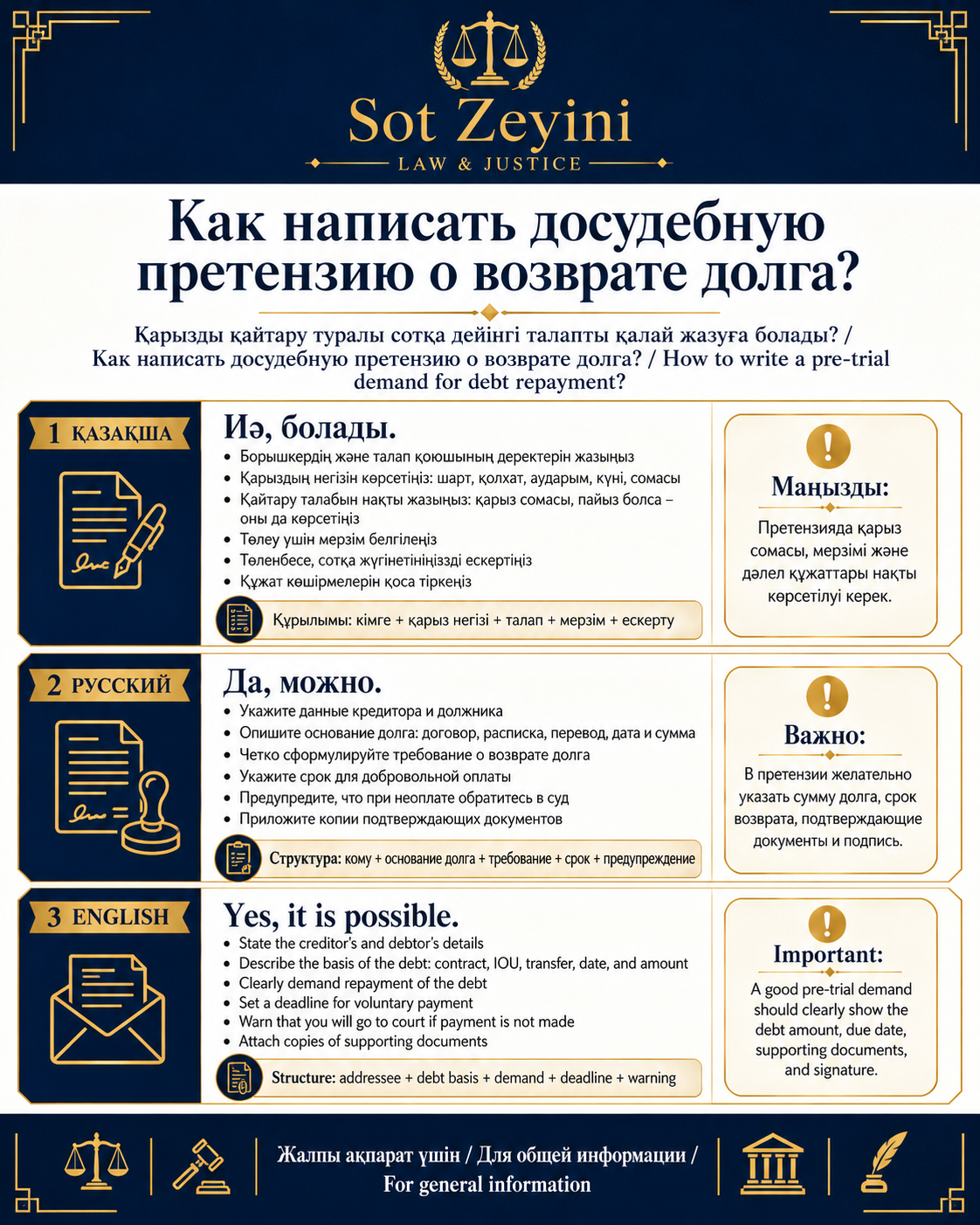
- pre-trial demand letter, if sent;
- debtor’s response to the demand letter, if any;
- debt calculation;
- state duty payment receipt;
- creditor’s details;
- debtor’s details;
- power of attorney or lawyer’s order, if the application is filed by a representative.
The stronger the documents show that the debt is uncontested, the higher the chance of obtaining a court order.
Why is the debtor’s acknowledgment important?
A court order is issued for uncontested claims. Therefore, the debtor’s acknowledgment of the debt is very important.
The debtor may acknowledge the debt through:
- a written receipt;
- a loan agreement;
- WhatsApp message;
- response to a demand letter;
- partial repayment;
- request for installment payments;
- phrase such as “I acknowledge the debt and will repay it later.”
For example, the message “I acknowledge the debt of KZT 500,000 and will repay it on June 20” may be useful evidence.
If the debtor does not acknowledge the debt or clearly disputes it, a lawsuit may be more appropriate.
Can a court order be obtained based on a written receipt?
Yes, a court order may be obtained based on a written receipt if the receipt clearly shows:
- who received the money;
- from whom the money was received;
- the amount of debt;
- that the money was received as a loan;
- repayment deadline;
- debtor’s signature.
However, a receipt alone may not always be enough, especially if there is a risk that the debtor will object. It is better to attach additional evidence such as a Kaspi receipt, bank transfer, correspondence, demand letter, or proof of partial repayment.
Can a court order be obtained based on a Kaspi transfer?
A Kaspi transfer confirms that money was transferred. However, it does not always prove that the money was transferred as a loan. For this reason, obtaining a court order based only on a Kaspi receipt may be difficult.
The creditor’s position becomes stronger if:
- the payment purpose states “debt,” “loan,” or “қарыз”;
- the debtor acknowledged the debt in WhatsApp;
- the debtor promised to repay the money;
- the debtor partially repaid the debt;
- the debtor responded to a demand letter and admitted the obligation.
A Kaspi receipt shows the movement of money, while a receipt or correspondence explains the legal meaning of that transfer.
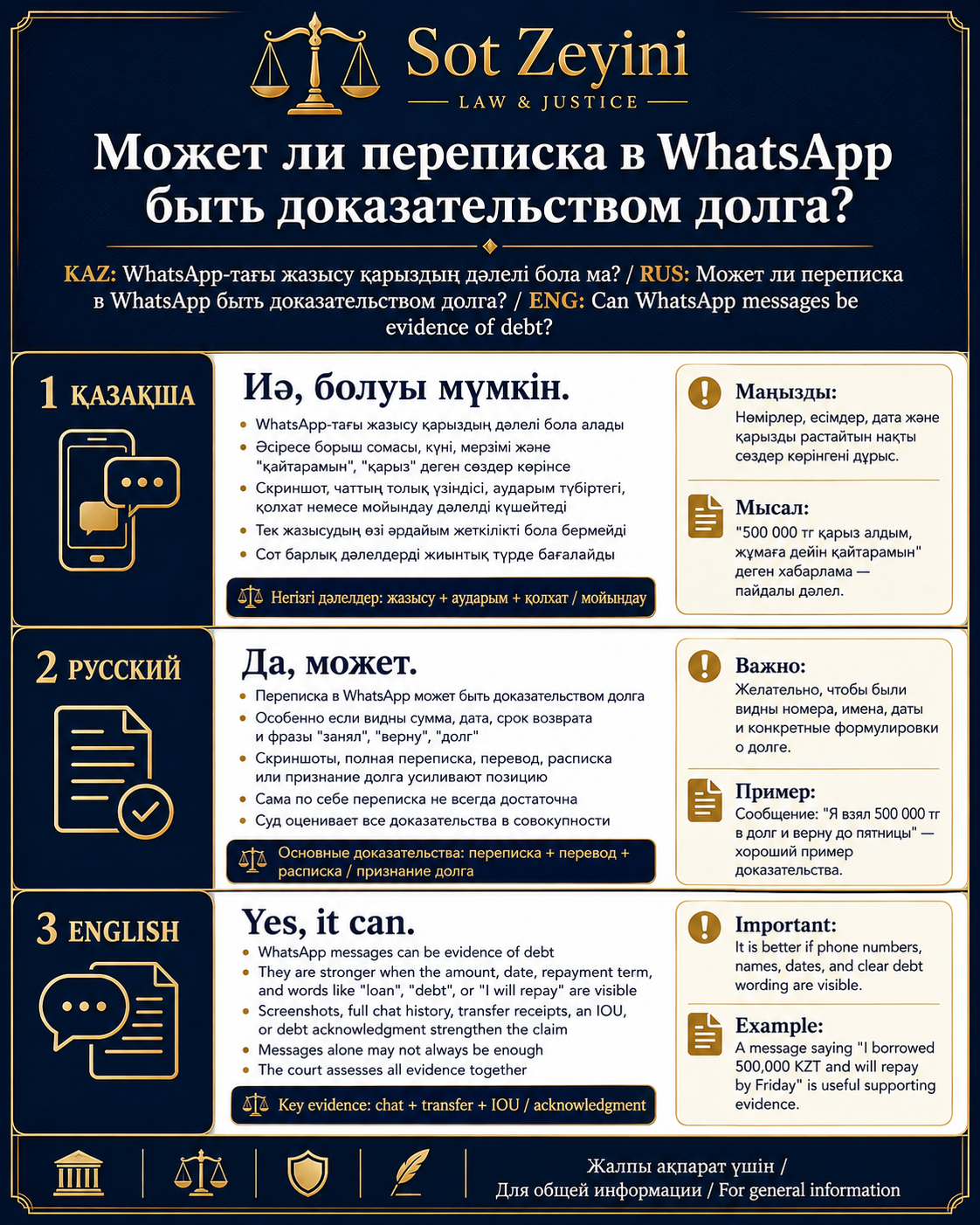
Can WhatsApp messages support a court order?
Yes, WhatsApp messages may support the application for a court order if they show that the debtor:
- acknowledged receiving the money;
- confirmed the exact amount;
- stated the repayment deadline;
- promised to repay;
- asked for more time;
- requested installment payments;
- acknowledged the debt in response to a demand letter.
The messages should be prepared properly. Screenshots should show the date, time, phone number, and full context. For large debt amounts, notarizing the correspondence may also be useful.
Where should the application be filed?
As a general rule, the application for a court order is filed with the court at the debtor’s place of residence. If the debtor is a legal entity, its registered address is usually relevant.
The application may be filed:
- through the Judicial Cabinet online system;
- in paper form through the court office;
- through a representative under a power of attorney or lawyer’s order.
Before filing, it is important to check:
- debtor’s registered address;
- correct court jurisdiction;
- completeness of documents;
- state duty payment;
- whether the claim is suitable for court-order proceedings.
What should be written in the application?
The application should be clear, short, and supported by evidence.
It usually includes:
- name of the court;
- creditor’s details;
- debtor’s details;
- basis of the debt;
- amount of debt;
- repayment deadline;
- evidence;
- amount of state duty;
- request to issue a court order.
Example wording:
“I request the court to issue a court order for recovery from the debtor Ivan Ivanov in favor of Petr Petrov of the principal debt in the amount of KZT 500,000, as well as the state duty paid by the creditor.”
The descriptive part should explain when the money was transferred, what documents confirm the debt, and why the debt remains unpaid.
How much is the state duty?
For an application for a court order, the state duty is usually paid at 50% of the rate established for the corresponding property claim.
For example, if the usual state duty for an individual’s property claim is 1% of the claim amount, the court-order state duty would be half of that amount.
Example:
- debt amount: KZT 1,000,000;
- 1%: KZT 10,000;
- 50% of this amount: KZT 5,000.
Before payment, the court details and exact amount should be checked through the Judicial Cabinet or eGov services.
How quickly is a court order issued?
A court order is issued without a court hearing and without summoning the parties. This makes it faster than ordinary litigation.
However, after the court order is issued, the debtor receives a copy and may submit objections within the legal period. If objections are filed, the court order may be cancelled.
That is why court-order proceedings are fast, but not always final.
What happens if the debtor objects?
If the debtor files an objection against the court order, the court may cancel it. In that case, the creditor does not lose the right to recover the debt, but must proceed through ordinary lawsuit proceedings.
This means the creditor will need to prepare a statement of claim, attach evidence, pay state duty as required, and go through a regular court process.
Before applying for a court order, it is important to assess whether the debtor is likely to object.
What should be done after receiving the court order?
After receiving the court order, the creditor should wait to see whether the debtor files an objection. If no objection is filed, the court order may be sent for enforcement.
A court order has the force of an enforcement document, so a separate writ of execution is generally not required.
The court order may be submitted to:
- a private bailiff;
- a state bailiff;
- electronic enforcement channels, where available.
What can a bailiff do?
After receiving the court order, a bailiff may:
- freeze the debtor’s bank accounts;
- deduct money from salary;
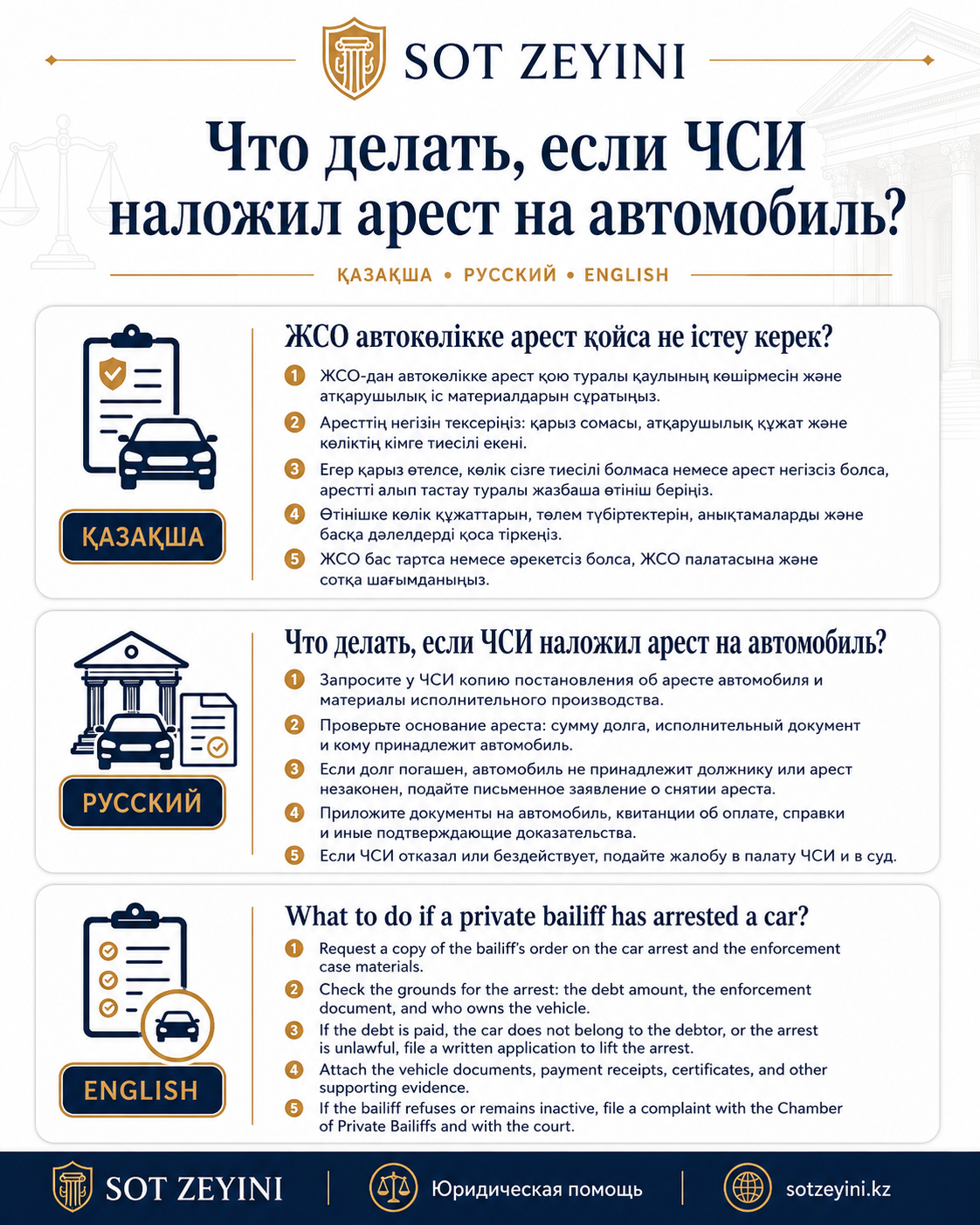
- seize a vehicle;
- seize real estate;
- send requests to identify property;
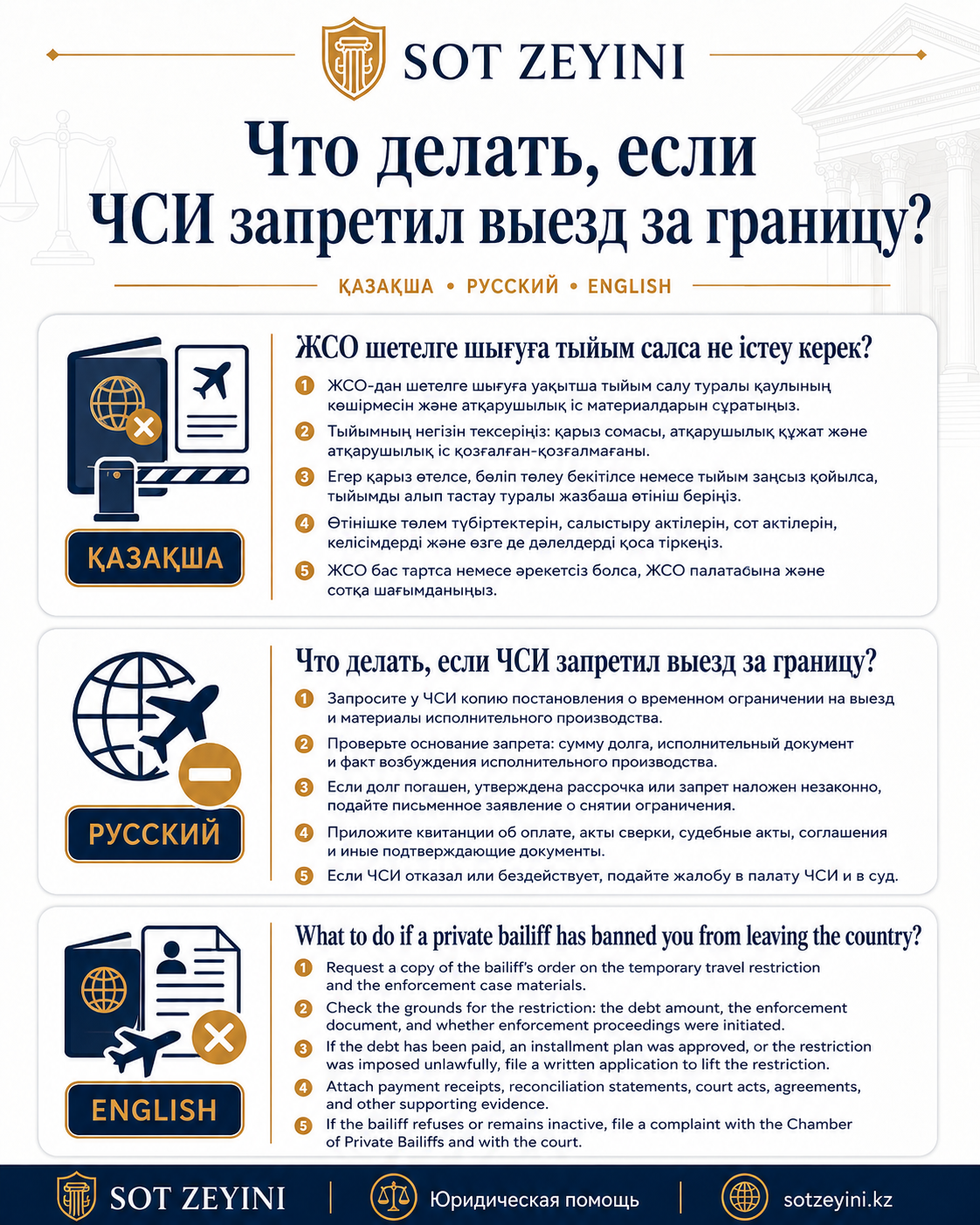
- restrict the debtor’s travel outside Kazakhstan;
- include the debtor in the debtor register.
In practice, it is important not only to obtain the court order but also to monitor enforcement.
When is a court order not recommended?
A court order may be ineffective if:
- the debtor is likely to object;
- the debt is not supported by documents;
- there is a dispute about the amount;
- the debtor disputes the signature;
- the transfer had no payment purpose;
- there is no evidence that the money was a loan;
- expert examination may be needed;
- witness testimony is required.
In such cases, it may be better to file a regular lawsuit immediately.
Short checklist before filing
Before applying for a court order, check whether:
- there is a written receipt or agreement;
- there is proof of money transfer;
- the repayment deadline has expired;
- the debtor acknowledged the debt;
- the debt calculation is clear;
- the debtor’s address is known;
- the correct court is selected;
- state duty is paid;
- documents are prepared in PDF format;
- the risk of debtor objection is low.
If most answers are “yes,” applying for a court order may be reasonable.
Conclusion
A court order for debt recovery is a fast and convenient legal tool when the claim is uncontested and supported by documents. It is suitable when there is a written receipt, loan agreement, money transfer, and acknowledgment of debt by the debtor.
However, if the debtor disputes the debt, denies the transfer, challenges the signature, or is likely to object, a regular lawsuit may be more effective.
SOT ZEYINI lawyers assist with preparing applications for court orders, collecting evidence, calculating state duty, and submitting court orders for enforcement. Contact us via WhatsApp for legal consultation.
FAQ: court order for debt recovery
1. Can a court order be obtained for debt recovery?
Yes, if the debt is confirmed by documents and the claim is uncontested.
2. Can a court order be obtained based on a written receipt?
Yes, if the receipt contains the debt amount, repayment deadline, and debtor’s signature.
3. Is a Kaspi receipt enough?
Not always. A Kaspi receipt confirms the transfer, but it may not prove that the transfer was a loan. It is better to attach correspondence or a written receipt.
4. Is a pre-trial demand letter required?
Not always, but it is useful. It may show that the creditor tried to resolve the matter peacefully and may help confirm the debtor’s position.
5. How much state duty is paid?
For a court-order application, the state duty is usually 50% of the rate established for the relevant property claim.
6. Is a separate writ of execution required?
No. A court order itself generally has the force of an enforcement document.
7. What if the debtor objects?
If the debtor files an objection, the court order may be cancelled. The creditor may then file a regular lawsuit.
8. Can the application be filed through the Judicial Cabinet?
Yes. The application may be filed electronically through the Judicial Cabinet, with documents attached in PDF format.
9. Which is faster: court order or lawsuit?
A court order is usually faster, but it is suitable only for uncontested claims.
10. When is a lawsuit better than a court order?
A lawsuit is better when the debtor denies the debt, disputes the signature, challenges the amount, or claims that the transfer was not a loan.