 +7 775 858 9294
 WhatsApp
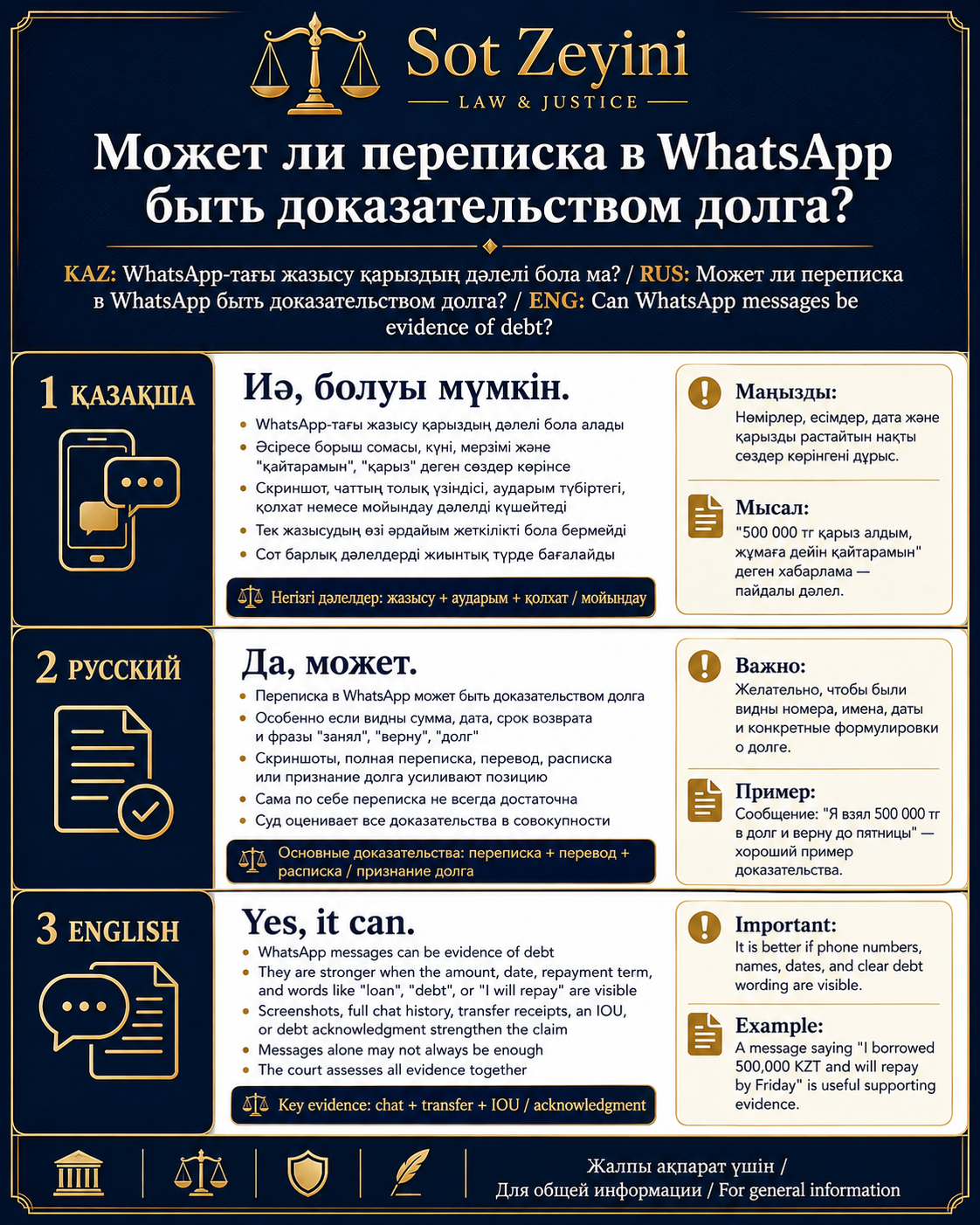
Can WhatsApp messages be used as evidence in court?
Yes, WhatsApp messages may be used as evidence in a debt recovery case. If the debtor admits receiving money, promises to repay it, asks for an extension, or confirms the amount of debt in messages, such correspondence may help prove the claim.
However, WhatsApp messages are not always enough on their own. The court usually evaluates them together with other evidence, such as a loan receipt, loan agreement, Kaspi receipt, bank transfer, written demand, or other documents.
In simple terms, WhatsApp is not a magic “win the case” button, but when properly prepared, it can significantly strengthen the creditor’s position.
When can WhatsApp messages help prove a debt?
WhatsApp correspondence is especially useful when the debtor:
- admits receiving money;
- confirms the exact amount of debt;
- promises to repay the money;
- asks for more time;
- offers to repay the debt in installments;
- says they cannot repay the money on time;
- confirms that the transfer was a loan, not a gift or payment for something else.
For example, the following messages may be important:
“Yes, I received KZT 500,000 and will return it at the end of the month.”
“I cannot repay the debt today, I will send it next week.”
“Let me repay KZT 100,000 every month.”
Such messages may confirm both the existence of the debt and the debtor’s acknowledgment of the obligation.
Are screenshots of WhatsApp enough?
Sometimes screenshots may be accepted by the court, but relying only on screenshots is risky. The debtor may argue that:
- it is not their phone number;
- they did not write the messages;
- the screenshots were edited;
- the conversation was taken out of context;
- the money was not transferred as a loan;
- the messages relate to another matter.
That is why WhatsApp correspondence should be supported by other evidence. The strongest combination is a loan receipt, bank transfer or Kaspi receipt, and WhatsApp messages where the debtor admits the debt.
How should WhatsApp correspondence be saved for court?
To increase the evidentiary value of WhatsApp messages, they should be saved and prepared correctly.
It is advisable to:
- Keep the original chat with the debtor;
- Take screenshots showing the date and time;
- Save the debtor’s phone number;
- Show the context of the conversation, not just one phrase;
- Save messages showing the amount, deadline, and admission of debt;
- Export the WhatsApp chat;
- Prepare the correspondence as a PDF file;
- Attach bank transfers or receipts;
- Consider notarizing the correspondence if the amount is significant;
- Be ready to show the phone in court.
The biggest mistake is taking one screenshot and deleting the whole chat. That can seriously weaken the evidence.
Should WhatsApp messages be notarized?
Notarization is not always required, but in some cases it is highly recommended.
Notarial certification of correspondence may be useful if:
- the debt amount is significant;
- there is no written receipt;
- the debtor denies the debt;
- the debtor may delete the messages;
- there is a risk that screenshots will be challenged;
- WhatsApp correspondence is the main evidence.
A notary may record the content of the correspondence, phone number, dates, and time of messages. This can reduce the risk of disputes about authenticity.
What messages are most useful for proving debt?
The most useful messages are those where the debtor clearly writes:
- “I received the money”;
- “I will repay the debt”;
- “I will return KZT 300,000”;
- “I cannot repay it now”;
- “I will pay after salary”;
- “Can I repay in installments?”;
- “I will send it to Kaspi”;
- “Sorry, I am delaying repayment.”
Weak messages include:
- “ok”;
- “fine”;
- “later”;
- “I remember”;
- “let’s discuss later”;
- “we will settle it.”
For the court, it is important to understand who owes money, to whom, how much, and why the money must be returned.
Can a debt be proven through WhatsApp without a written receipt?
Yes, it may be possible, but it is more difficult. Without a written receipt, WhatsApp messages must be very specific and preferably supported by other evidence.
For example:
- Kaspi receipt;
- bank statement;
- transfer to the debtor’s card;
- partial repayment;
- audio or video where the debtor admits the debt;
- witness statements;
- written demand for repayment.
If the money was transferred through a bank and the debtor admits in WhatsApp that it was a loan, the chances of successful recovery may increase.
Why may a Kaspi receipt alone be insufficient?
A Kaspi receipt shows that money was transferred. But it does not always show the purpose of the transfer. The debtor may claim that it was a gift, repayment of another debt, payment for goods, or payment for services.
WhatsApp correspondence helps explain the purpose of the transfer. For example, if after the transfer the debtor writes: “Yes, I received KZT 400,000 as a loan and will return it on the 15th,” such correspondence links the transfer to a loan.
The receipt shows the movement of money, while WhatsApp explains the reason for that movement.
Can WhatsApp voice messages be used?
Yes, WhatsApp voice messages may also be submitted as evidence. If the debtor admits the debt, amount, or repayment deadline in a voice message, it may be useful.
However, the court may need to establish:
- who the voice belongs to;
- under what circumstances the message was recorded;
- whether the audio was altered;
- whether the audio relates to the disputed debt.
If necessary, the court may order a phonoscopic examination.
How should WhatsApp messages be described in the statement of claim?
It is not enough to simply attach screenshots. The statement of claim should explain what exactly the messages prove.
For example:
“According to the WhatsApp correspondence dated May 10, 2026, the defendant acknowledged receiving KZT 500,000 and undertook to repay the amount by May 25, 2026.”
It is also useful to indicate:
- the debtor’s phone number;
- date of correspondence;
- specific messages;
- connection between the messages and money transfer;
- fact that the debt was not repaid.
This helps the court understand the relevance of the correspondence.
What documents should be attached together with WhatsApp messages?
For a debt recovery case, it is advisable to attach:
- loan receipt, if available;
- loan agreement, if signed;
- Kaspi receipt;
- bank transfer confirmation;
- bank statement;
- WhatsApp correspondence in PDF format;
- written demand for repayment;
- debt calculation;
- state duty payment receipt;
- documents confirming legal expenses;
- power of attorney or lawyer’s order.
The more the evidence supports each other, the stronger the claimant’s position.
Common mistakes when using WhatsApp as evidence
Common mistakes include:
- saving only one screenshot;
- phone number is not visible;
- date and time are not visible;
- the conversation is cut off;
- no transfer receipt is attached;
- the amount of debt is not specified;
- it is unclear who wrote the messages;
- the original chat is deleted;
- the statement of claim does not explain the meaning of the correspondence.
To avoid these mistakes, evidence should be prepared carefully and systematically.
Conclusion
WhatsApp messages can be used as evidence of debt if they show that the debtor received money, acknowledged the debt, confirmed the amount, or promised repayment. However, WhatsApp correspondence should preferably be used together with other evidence, such as a loan receipt, Kaspi receipt, bank transfer, and written demand.
If the debt is not repaid, it is important not to delete the chat, save screenshots, prepare a PDF file, and properly describe the evidence in the statement of claim.
SOT ZEYINI lawyers assist with debt recovery based on WhatsApp correspondence, Kaspi transfers, loan receipts, and other evidence. We help prepare court claims, organize evidence, and support court proceedings. Contact us via WhatsApp for legal consultation.
FAQ: WhatsApp messages as evidence of debt
1. Can WhatsApp messages be used in court as evidence of debt?
Yes. If the messages confirm receipt of money, amount of debt, or promise of repayment, they may be used as evidence.
2. Are WhatsApp messages alone enough?
Not always. It is better to attach additional evidence such as a loan receipt, Kaspi receipt, bank transfer, or written demand.
3. Should WhatsApp correspondence be notarized?
Not always, but notarization is recommended if the debt amount is significant or if there is a risk that the debtor will dispute the messages.
4. What messages are important for court?
Messages where the debtor admits the debt, states the amount, confirms the repayment deadline, or asks for an extension are especially important.
5. Can a debt be recovered without a receipt if there are WhatsApp messages?
It may be possible, but it is harder. The WhatsApp messages should be supported by a transfer, receipt, partial repayment, or other evidence.
6. What if the debtor deletes the messages?
If the messages remain on your phone, they can still be used. It is important to keep the chat, take screenshots, and save an export of the conversation.
7. Can WhatsApp voice messages be used?
Yes. A voice message may be used as evidence if it confirms the debt. If disputed, expert examination may be required.
8. How should WhatsApp messages be prepared for court?
It is better to prepare a PDF file with screenshots showing date, time, phone number, and full context of the conversation.
9. Can the debtor challenge WhatsApp screenshots?
Yes. That is why it is advisable to keep the original chat, phone number, transfer receipt, and, if needed, notarize the correspondence.
10. Can WhatsApp help if there is only a Kaspi receipt?
Yes. A Kaspi receipt shows the transfer of money, while WhatsApp messages may confirm that the transfer was a loan.