 +7 775 858 9294
 WhatsApp
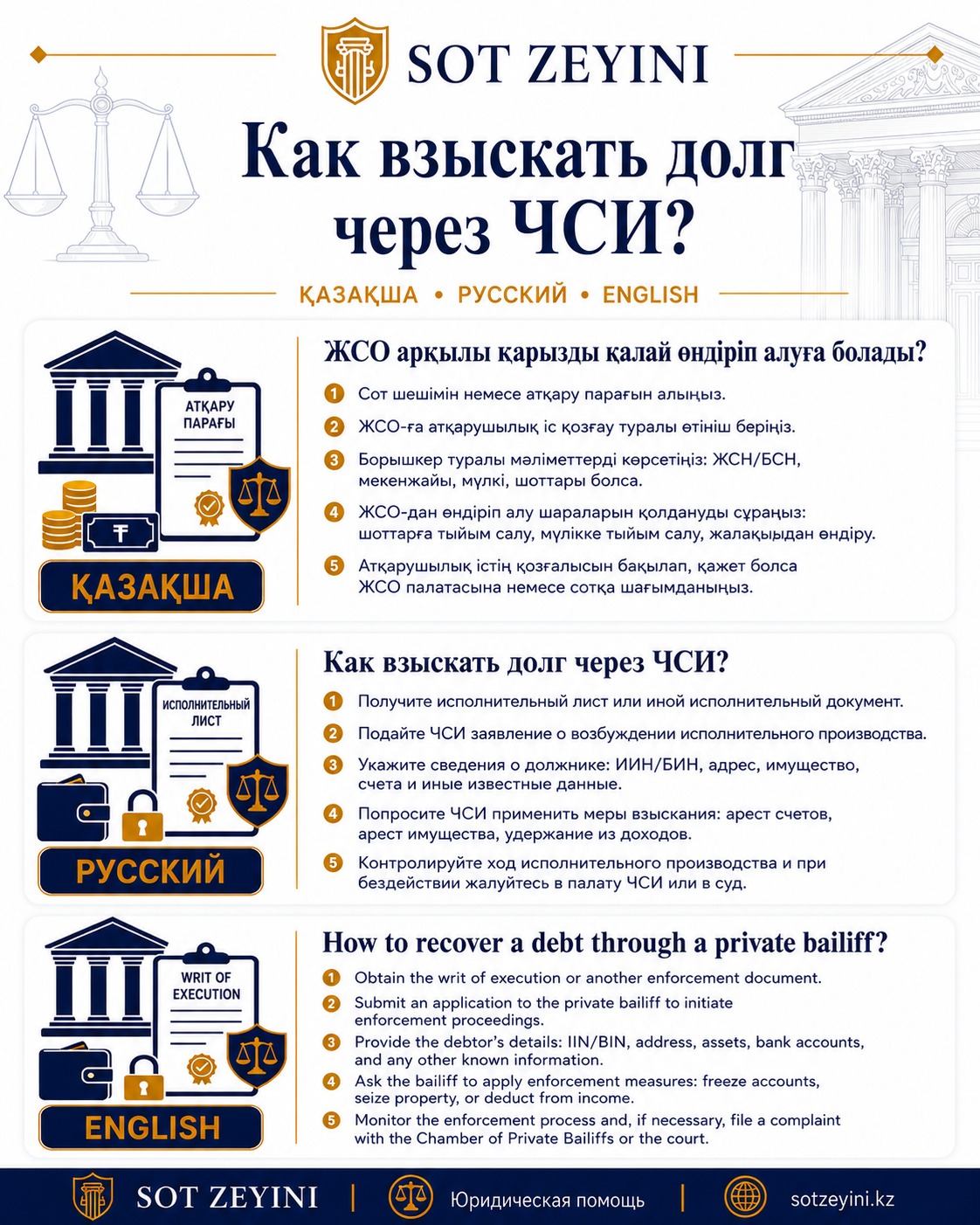
How to Recover a Debt Through a Private Enforcement Officer in Kazakhstan
After a court decision on debt recovery is issued, the money does not automatically appear in the creditor’s bank account. If the debtor does not pay voluntarily, the decision must be enforced. In Kazakhstan, this is usually done through a private enforcement officer.
Debt recovery through a private enforcement officer is the stage where a court decision turns into actual money. Winning in court is important, but proper enforcement is just as important.
In simple terms: a court decision is the key, and the enforcement officer is the mechanism that helps use it.
Who is a private enforcement officer?
A private enforcement officer is a person authorized to enforce court decisions, court orders, notarial writs of execution, and other enforcement documents.
A private enforcement officer may apply compulsory measures against the debtor, including:
- freezing bank accounts;
- recovering money from accounts;
- deducting money from salary;
- freezing a vehicle;
- restricting real estate transactions;
- searching for the debtor’s property;
- arranging valuation and sale of property;
- including the debtor in the debtor registry;
- considering travel restrictions outside Kazakhstan.
The main purpose of the enforcement officer is to ensure actual execution of the court decision.
What is needed to recover a debt through an enforcement officer?
To apply to a private enforcement officer, you need an enforcement document.
Enforcement documents may include:
- writ of execution issued based on a court decision;
- court order;
- notarial writ of execution;
- enforcement document based on a court-approved agreement;
- other documents provided by law.
If you only have a written receipt or a loan agreement, you usually cannot immediately go to an enforcement officer. First, you need to obtain a court decision, court order, or another enforceable document.
When can you apply to an enforcement officer after court?
Usually, you can apply to an enforcement officer after the court decision enters into legal force and the court issues a writ of execution.
The basic steps are:
- check whether the court decision has entered into legal force;
- apply for a writ of execution;
- obtain the writ of execution;
- submit it to a private enforcement officer;
- file an application to initiate enforcement proceedings.
If the debtor files an appeal, obtaining the writ of execution may take longer. That is why it is important to check the case status in the Judicial Cabinet.
How do you obtain a writ of execution?
The writ of execution is issued by the court that made the decision. To obtain it, the creditor must submit an application to the court.
The application may be filed through the Judicial Cabinet. In the application, the creditor may request:
- issuance of the writ of execution;
- electronic delivery of the writ;
- a copy of the decision confirming that it has entered into legal force;
- if necessary, forwarding of the document for enforcement.
After receiving the writ of execution, it can be submitted to the selected private enforcement officer.
How to choose a private enforcement officer?
When choosing an enforcement officer, it is important to consider not only location but also activity and responsiveness.
It is useful to consider:
- the debtor’s region of residence;
- the location of the debtor’s property;
- the enforcement officer’s experience;
- responsiveness;
- speed of initiating enforcement proceedings;
- willingness to take specific measures;
- a clear enforcement action plan.
Sometimes the best enforcement officer is not the closest one, but the most active one. Enforcement requires action, not waiting.
What documents should be submitted?
To recover a debt, it is recommended to provide the enforcement officer with:
- writ of execution;
- court decision;
- copy of the creditor’s ID;
- creditor’s bank details;
- debtor’s identification number;
- debtor’s address;
- debtor’s phone number;
- information about the workplace;
- information about bank accounts;
- information about vehicles, real estate, or business;
- application to initiate enforcement proceedings.
The more information you provide about the debtor, the faster enforcement actions may begin.
How does the enforcement officer start proceedings?
After receiving the enforcement document, the enforcement officer issues a resolution to initiate enforcement proceedings.
The debtor is then notified and given the opportunity to comply voluntarily. If the debtor does not pay, the enforcement officer may proceed with compulsory measures.
These measures may include:
- freezing bank accounts;
- withdrawing money from accounts;
- salary deductions;
- property restrictions;
- restrictions on the sale of vehicles or real estate;
- inclusion in the debtor registry;
- valuation and sale of property.
Can bank accounts be frozen?
Yes. A private enforcement officer may freeze the debtor’s bank accounts. If there is money in the accounts, it may be used to repay the debt.
Account freezing is one of the most common enforcement measures. However, certain social payments and protected funds may be subject to legal restrictions.
Can the debt be deducted from salary?
Yes. If the debtor is officially employed, the enforcement officer may send an order to the employer requiring salary deductions.
The employer will withhold a certain amount from the debtor’s salary and transfer it to the creditor.
If the debtor has stable official income, salary deduction may be one of the most effective recovery methods.
What if the debtor owns a car or real estate?
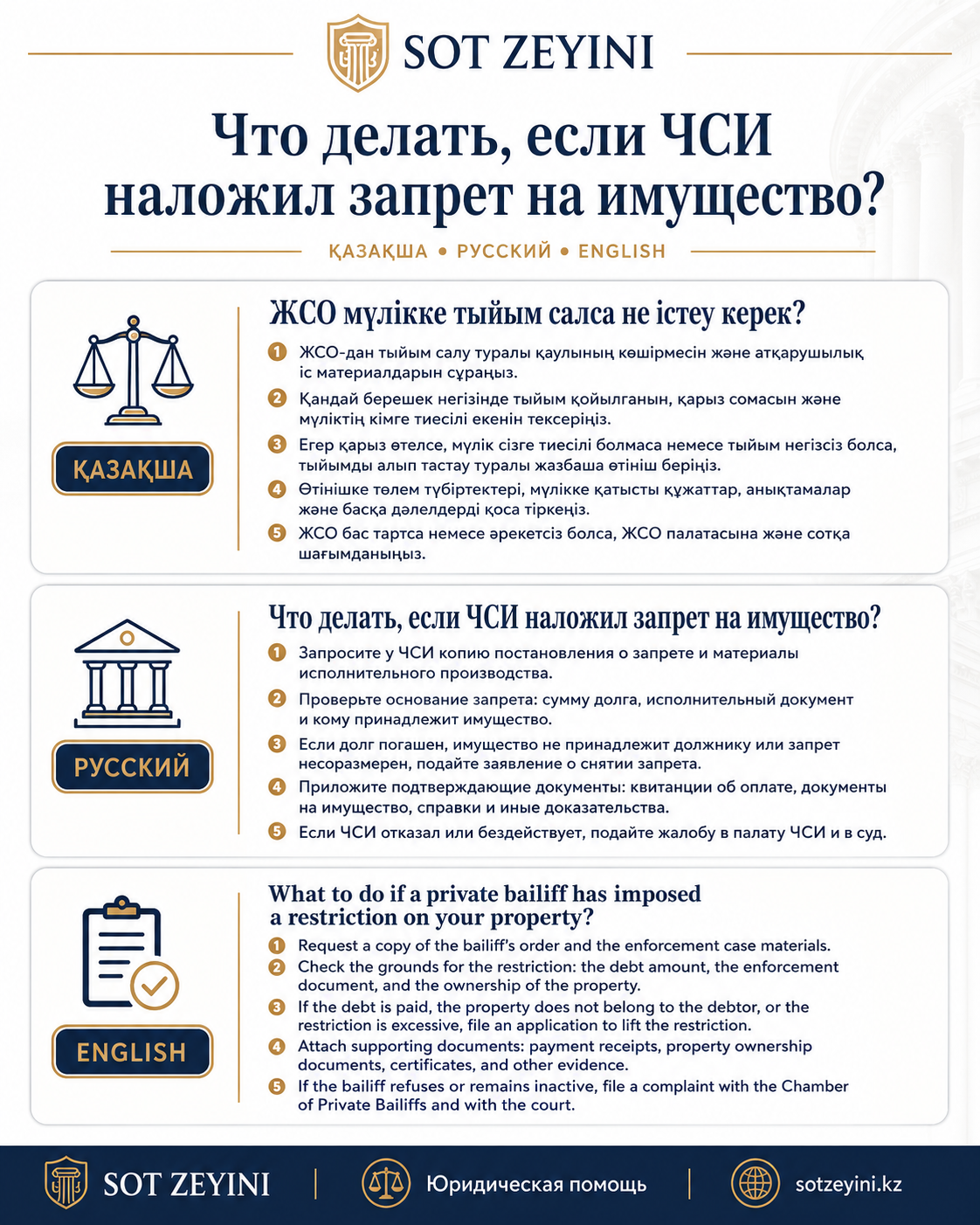
If the debtor owns a vehicle, apartment, house, land plot, or other property, the enforcement officer may impose a freeze or restriction.
The property may later be:
- identified;
- frozen;
- valued;
- sold through enforcement procedures;
- used to repay the debt.
If there is a risk that the debtor may transfer property to another person, the creditor should quickly file a written request for enforcement measures.
How can the debtor’s property be found?
The enforcement officer can send requests to banks, state bodies, and registration authorities.
However, the creditor should also be active. If you know where the debtor works, which bank the debtor uses, or what property the debtor owns, this information should be provided in writing.
Useful information may include:
- debtor’s workplace;
- known bank accounts;
- vehicle make and registration number;
- property address;
- business information;
- actual residence address;
- phone number.
The enforcement officer can search independently, but additional information from the creditor can speed up the process.
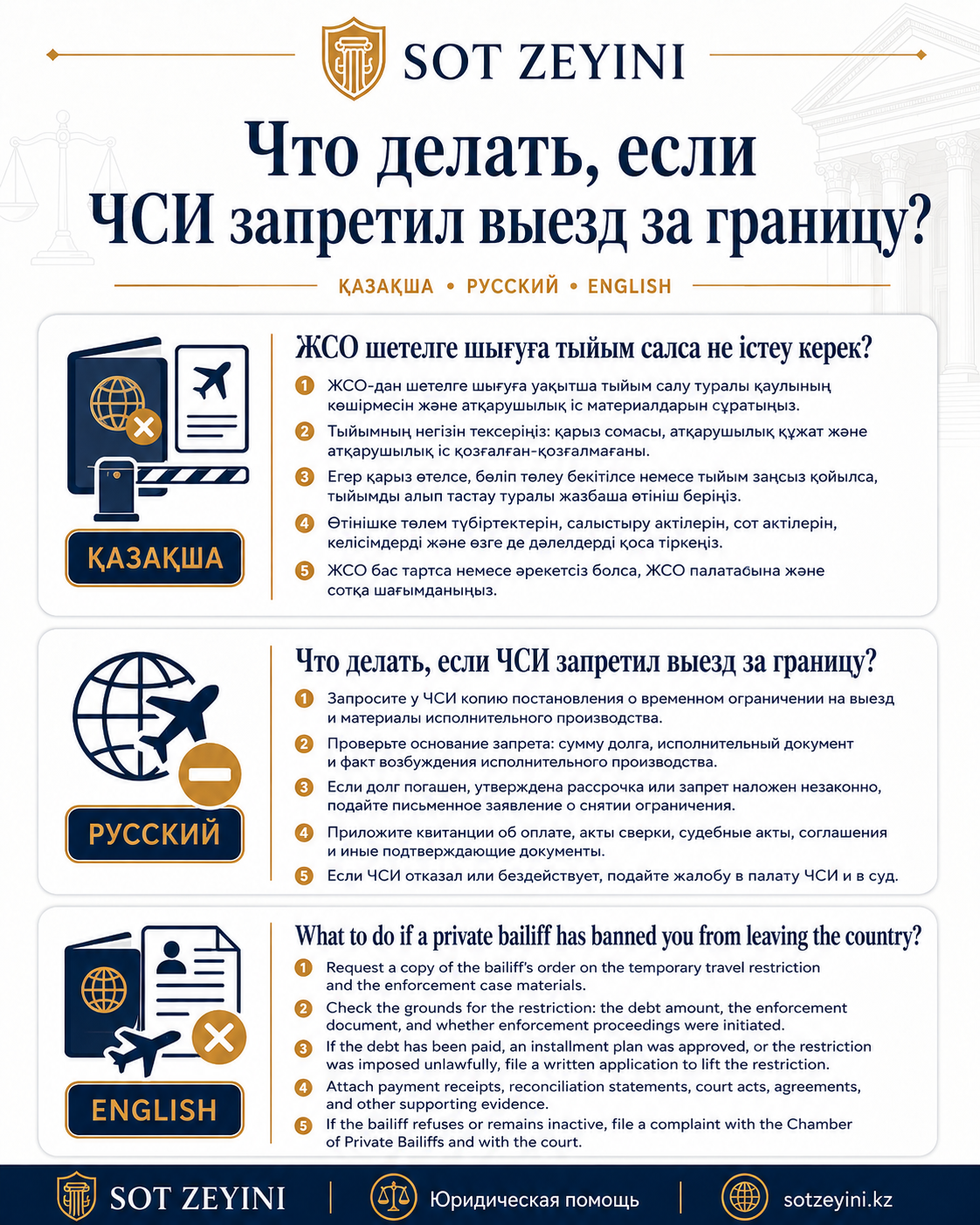
Can the debtor be restricted from leaving Kazakhstan?
If the debtor does not comply with the obligation and there are grounds for such a measure, the issue of restricting travel outside Kazakhstan may be raised.
The creditor may file a written application to the enforcement officer stating:
- the debt has not been paid;
- the court decision is not being executed;
- the debtor is avoiding payment;
- there is a risk of leaving the country.
This measure is not automatic and depends on the circumstances of the case.
What if the debtor wants to pay in installments?
If the debtor is ready to pay in installments, a payment schedule may be agreed. However, it should be recorded in writing.
The schedule should include:
- total debt amount;
- date of each payment;
- amount of each payment;
- payment method;
- consequences of delay;
- how enforcement proceedings will continue.
Verbal agreements are risky. The debtor may promise to pay today and disappear tomorrow.
What if the enforcement officer does nothing?
If the enforcement officer initiates proceedings but does not take real action, the creditor may file written applications requesting specific measures.
The creditor may request:
- bank inquiries;
- real estate checks;
- vehicle checks;
- workplace identification;
- freezing bank accounts;
- salary deduction orders;
- information about the status of proceedings.
If there is no response, a complaint may be filed.
A complaint may be submitted to:
- the enforcement officer;
- the regional chamber of private enforcement officers;
- the department of justice;
- the prosecutor’s office;
- the court.
The complaint should be specific: what applications were filed, what actions were not taken, and what deadlines were violated.
What if the debt is not recovered?
If the debtor has no official income, money in accounts, or registered property, recovery may be difficult. But the debt does not disappear.
Enforcement proceedings may continue, and the debtor’s financial status may be checked periodically. If the debtor later receives salary, buys property, or has money in bank accounts, recovery may continue.
That is why enforcement proceedings should be monitored.
Who pays the enforcement officer’s fees?
Enforcement expenses and fees may generally be recovered from the debtor. However, the exact costs depend on the enforcement actions taken and the specific case.
Before starting enforcement, it is useful to clarify possible expenses with the enforcement officer.
What should be done after full repayment?
After the debt is fully repaid, the creditor should:
- confirm receipt of the full amount;
- obtain a resolution on completion of enforcement proceedings;
- check that bank account freezes are removed;
- check that property restrictions are lifted;
- keep all documents.
If enforcement proceedings are not closed properly, restrictions may remain.
Common mistakes in enforcement
Creditors often make these mistakes:
- obtaining the writ of execution too late;
- delaying submission to the enforcement officer;
- not providing information about the debtor;
- not monitoring the officer’s work;
- making only verbal requests;
- not filing written applications;
- not complaining about inaction;
- trusting the debtor’s verbal promises;
- accepting cash without a receipt;
- not checking removal of freezes after payment.
These mistakes can significantly delay recovery.
What applications can be filed with the enforcement officer?
The creditor may file applications requesting:
- initiation of enforcement proceedings;
- freezing of bank accounts;
- search for the debtor’s property;
- restriction on vehicle disposal;
- restriction on real estate disposal;
- identification of the workplace;
- salary deductions;
- inclusion in the debtor registry;
- travel restriction;
- information about the enforcement case.
All applications should preferably be filed in writing. This creates proof that the creditor requested action.
How long does debt recovery take?
The duration depends on the debtor’s financial situation.
If the debtor has money in bank accounts, official salary, or property, recovery may be faster.
If the debtor has no assets, the process may take longer.
The key is not to leave enforcement unattended. Submitting documents is only the beginning, not the end.
Legal assistance
SOT ZEYINI law company assists with debt recovery through private enforcement officers in Kazakhstan.
We can help with:
- reviewing the court decision and writ of execution;
- preparing an application to the enforcement officer;
- initiating enforcement proceedings;
- preparing requests to freeze accounts;
- preparing requests to search for property;
- requesting salary deductions;
- filing complaints about enforcement officer inaction;
- contacting the department of justice;
- contacting the chamber of private enforcement officers;
- monitoring enforcement until the money is actually recovered.
If you have a court decision or writ of execution but the debt has not been recovered, contact us via WhatsApp. A lawyer will review your documents and explain what actions should be taken through the enforcement officer.
FAQ
How do you recover a debt through a private enforcement officer?
You need to obtain a writ of execution or another enforceable document, submit it to a private enforcement officer, and file an application to initiate enforcement proceedings.
Can I apply with only a court decision?
Usually, a writ of execution is required. The court decision confirms the debt, but compulsory enforcement is based on an enforcement document.
Can the enforcement officer freeze bank accounts?
Yes. The enforcement officer may freeze the debtor’s accounts and use available funds to repay the debt.
Can the debt be deducted from salary?
Yes. If the debtor is officially employed, the enforcement officer may send a salary deduction order to the employer.
What if the debtor has no property?
The debt does not disappear. If the debtor later receives income or obtains property, enforcement may continue.
What if the enforcement officer does nothing?
Written applications should be filed requesting specific actions. If there is no response, complaints may be submitted to the chamber, department of justice, prosecutor’s office, or court.
What should be done after full repayment?
You should obtain a resolution on completion of enforcement proceedings and check that all freezes and restrictions are removed.
Can debt be recovered quickly?
If the debtor has money, salary, or property, recovery may be faster. If there are no assets, enforcement may take longer.
Conclusion
To recover a debt through a private enforcement officer, you first need an enforceable document: a writ of execution, court order, or another document subject to enforcement. After that, it must be submitted to the enforcement officer, and the enforcement proceedings must be monitored.
The enforcement officer can freeze accounts, deduct money from salary, restrict property, and take other compulsory measures.
The most important rule is not to wait passively. In enforcement, the creditor who controls the process has a better chance of getting the money back.