 +7 775 858 9294
 WhatsApp
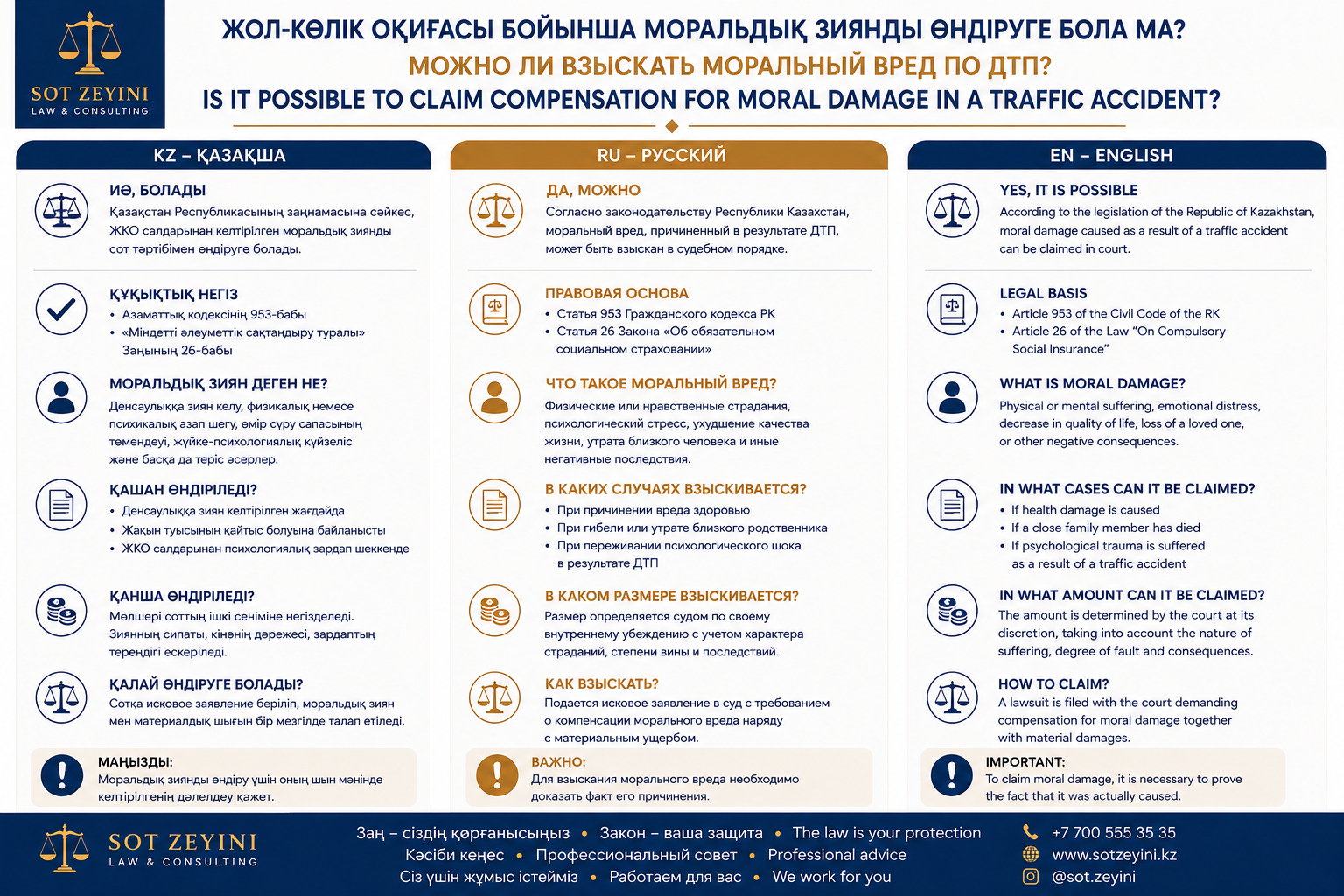
Can Moral Damages Be Recovered After a Traffic Accident in Kazakhstan?
Can Moral Damages Be Recovered After a Traffic Accident?Learn whether moral damages can be recovered after a road traffic accident in Kazakhstan, when compensation is possible, what evidence is needed, and how to file a court claim.moral damages traffic accident Kazakhstan, compensation for moral harm accident, road accident injury Kazakhstan, sue at-fault driver moral damages, emotional distress after car accident, traffic accident court claim Kazakhstan
Short answer
Yes, moral damages can be recovered after a traffic accident in Kazakhstan. However, they are not awarded automatically. The injured person must prove that the accident caused physical or emotional suffering, such as pain, stress, fear, health problems, medical treatment, disruption of normal life, or other consequences.
If the accident caused bodily injury, recovery of moral damages is usually more realistic. If only the vehicle was damaged and there was no harm to health, recovering moral damages is more difficult because property damage alone does not always prove moral harm.
In simple terms: “my car was damaged and I was upset” is weak. “I was injured, received treatment, suffered pain, and my normal life was disrupted” is much stronger.
What are moral damages?
Moral damages refer to emotional or physical suffering caused by a violation of a person’s rights or harm caused to them.
After a traffic accident, moral harm may include:
- physical pain;
- stress;
- fear after the accident;
- insomnia;
- nervous tension;
- need for medical treatment;
- temporary incapacity for work;
- movement restrictions;
- reduced quality of life;
- emotional distress caused by injuries;
- loss of a close relative;
- prolonged psychological distress.
The court evaluates not only the fact that the person was upset, but the specific circumstances and evidence.
When is it easier to recover moral damages after an accident?
The chances are higher if:
- the accident caused harm to health;
- the injured person suffered bodily injuries;
- an ambulance was called;
- the person went to hospital;
- medical treatment was required;
- there is a sick leave certificate;
- surgery was performed;
- medical records exist;
- the person could not work temporarily;
- physical pain was present;
- psychological help was needed;
- the accident affected everyday life.
For example, if a person suffered neck, back, arm, or leg injuries after the accident and has medical documents, the claim for moral damages becomes stronger.
Can moral damages be recovered if only the car was damaged?
Such a claim can be filed, but it is more difficult to win. If only the vehicle was damaged, the main claim usually concerns material loss: repair costs, towing expenses, assessment costs, and the difference between insurance payment and actual damage.
Moral damages for property damage alone are not always awarded. The claimant must prove that the accident caused real emotional, psychological, health-related, or lifestyle consequences.
For example, if the injured person consulted a doctor or psychologist after the accident, suffered documented sleep disturbance, or experienced serious nervous stress, the position may be stronger.
Who pays moral damages?
Moral damages are usually recovered from the at-fault driver.
Depending on the situation, the defendant may be:
- the driver who caused the accident;
- the vehicle owner;
- the lawful possessor of the vehicle;
- the employer, if the driver was performing work duties;
- the carrier;
- another responsible person.
It is important to identify the proper defendant. If the claim is filed against the wrong person, the court may dismiss it.
Does the insurance company pay moral damages?
Usually, moral damages are recovered not from the insurance company, but directly from the at-fault person through court.
The insurance company generally compensates property damage and health-related damage within the insurance coverage. Moral damages are personal in nature and are usually claimed against the at-fault driver or another responsible person.
Therefore, after a traffic accident there may be two separate lines of claims:
- Insurance payment — against the insurance company.
- Moral damages and uncovered losses — against the at-fault person.
How is the amount of moral damages determined?
The claimant states the amount of compensation. For example, the claim may request 500,000 tenge, 1,000,000 tenge, 3,000,000 tenge, or another amount.
However, the final amount is determined by the court. The court may consider:
- severity of accident consequences;
- degree of harm to health;
- nature of injuries;
- duration of treatment;
- age of the injured person;
- period of incapacity for work;
- psychological consequences;
- behavior of the at-fault person;
- circumstances of the accident;
- principles of reasonableness and fairness.
The court may award the full amount requested or reduce it.
What evidence is needed?
To recover moral damages, the following evidence may be useful:
- accident materials;
- court ruling or other document confirming fault;
- medical certificates;
- hospital records;
- sick leave certificate;
- treatment records;
- receipts for medication;
- psychologist or psychotherapist opinion;
- ambulance call record;
- expert report on the degree of health damage;
- photos and videos;
- witness statements;
- documents confirming inability to work;
- evidence of lifestyle changes.
Moral damages are connected to suffering, but in court they must be supported by evidence.
Should a pre-litigation demand be sent?
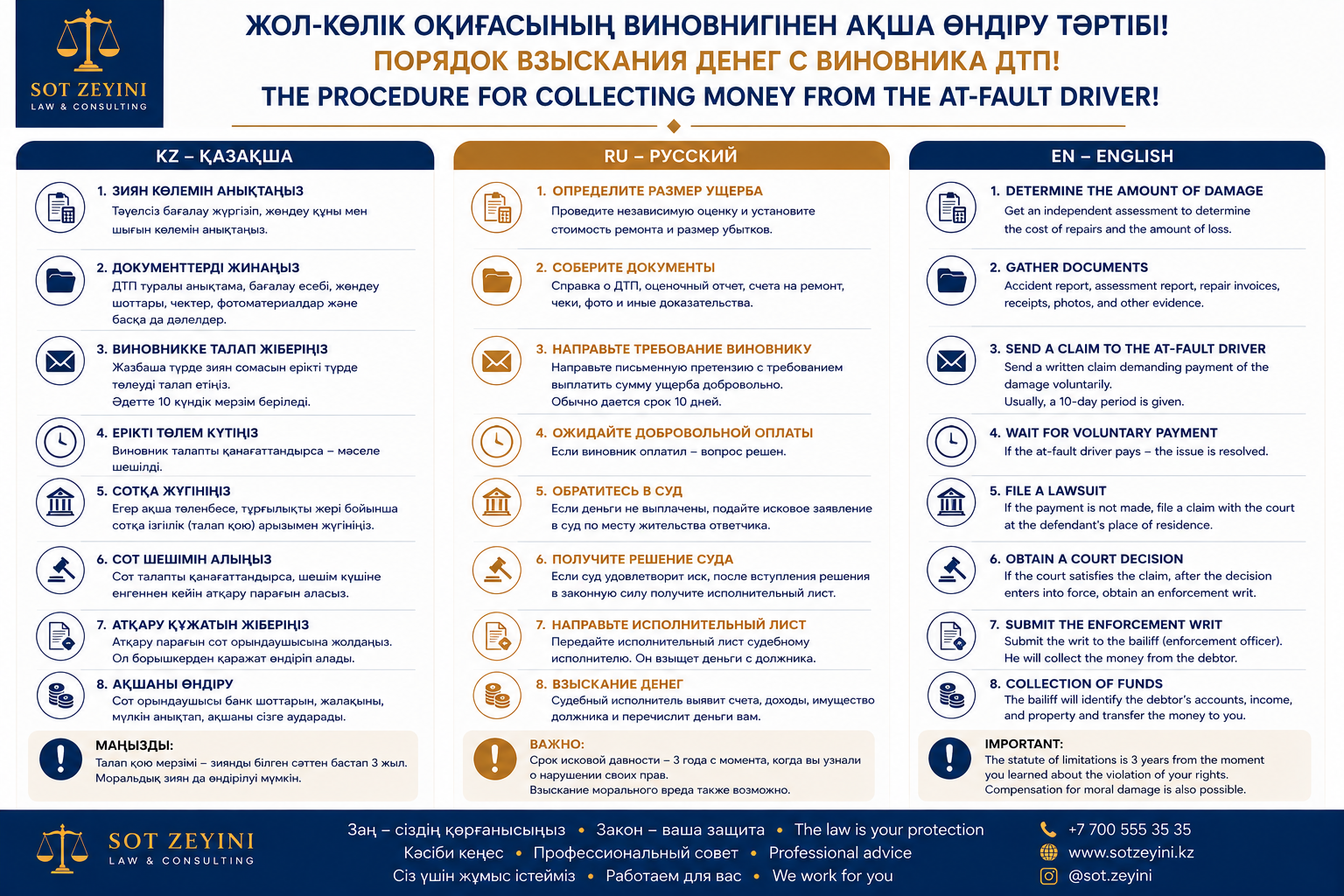
Yes, it is advisable to send a pre-litigation demand to the at-fault driver. It shows that the injured person tried to resolve the matter peacefully.
The demand should include:
- date and place of the accident;
- circumstances of the accident;
- fault of the defendant;
- harm to health;
- physical and emotional suffering;
- amount of moral damages;
- deadline for voluntary payment;
- warning about filing a court claim.
Sample pre-litigation demand
To: [Full name of at-fault driver]
From: [Full name of injured person]
Address: [address]
Phone: [number]
Pre-Litigation Demand
for compensation of moral damages caused by a traffic accident
On [date], at [place], a road traffic accident occurred due to your fault.
As a result of the accident, I suffered bodily injuries, had to seek medical assistance, and underwent treatment.
After the accident, I experienced physical pain, emotional suffering, stress, fear, and disruption of my normal life.
Your fault is confirmed by [court ruling / administrative case materials / police documents].
Based on the above, I request that you voluntarily compensate moral damages in the amount of [amount] tenge within 10 business days from receipt of this demand.
If payment is not made, I will file a court claim for recovery of moral damages, court expenses, legal fees, and state duty.
Attachments:
- Copy of accident materials;
- Copy of court ruling;
- Medical documents;
- Documents confirming expenses;
- Other evidence.
Date: ____________
Signature: ____________
How to file a court claim
If the at-fault person does not voluntarily compensate moral damages, the injured person may file a court claim.
The claim should include:
- date of the accident;
- place of the accident;
- circumstances of the accident;
- fault of the defendant;
- harm to health;
- emotional and physical suffering;
- evidence;
- amount of moral damages;
- legal grounds;
- request for compensation.
The moral damages claim may be filed separately or together with claims for material damage, medical expenses, towing costs, assessment costs, and legal fees.
What evidence is important in court?
The most important evidence includes:
- ruling confirming fault;
- medical documents;
- nature of injuries;
- duration of treatment;
- period of incapacity for work;
- expert opinion;
- explanation of the injured person;
- witness testimony;
- documents confirming psychological consequences;
- photos and videos;
- evidence of medical expenses.
The court needs to understand why the requested amount is reasonable and fair.
How much can be claimed?
There is no fixed statutory table of moral damages amounts for traffic accidents. Each case is assessed individually.
The amount may depend on:
- severity of injuries;
- length of treatment;
- degree of pain;
- consequences for life;
- age of the injured person;
- behavior of the at-fault person;
- gross negligence;
- court practice;
- strength of evidence.
For minor injuries the amount may be one level, while for serious bodily harm or death it may be entirely different.
What can be recovered together with moral damages?
The same court claim may include:
- moral damages;
- vehicle repair costs;
- difference between insurance payment and actual damage;
- towing expenses;
- parking expenses;
- independent assessment costs;
- medical expenses;
- medication costs;
- lost income;
- legal fees;
- state duty;
- court expenses.
Each amount must be supported by documents.
Common mistakes
Common mistakes include:
- no medical documents;
- late visit to a doctor;
- vague description of emotional suffering;
- excessive amount claimed without justification;
- failure to prove the defendant’s fault;
- no pre-litigation demand;
- failure to keep receipts;
- no legal reasoning;
- claim based only on emotions.
The court needs a proven connection between the accident and its consequences.
Conclusion
Moral damages can be recovered after a traffic accident, especially if the accident caused harm to health. The claimant must prove fault, accident consequences, physical or emotional suffering, and the amount of requested compensation.
If only the vehicle was damaged, recovery of moral damages is more difficult and requires additional evidence. Property damage is usually better claimed as material loss.
The most important step is to collect documents: accident materials, ruling confirming fault, medical certificates, receipts, specialist opinions, and other evidence.
FAQ
Can moral damages be recovered after a traffic accident?
Yes, especially if the accident caused injury or serious physical and emotional suffering.
Can moral damages be recovered if only the car was damaged?
A claim can be filed, but it is harder to win. Real emotional or health-related consequences must be proven.
Who pays moral damages after an accident?
Usually the at-fault driver or another legally responsible person.
Does the insurance company pay moral damages?
Usually moral damages are claimed directly from the at-fault person through court, not from the insurance company.
How much can be claimed?
The claimant states the amount, but the final amount is determined by the court.
What documents are needed?
Accident materials, ruling confirming fault, medical documents, sick leave certificate, receipts, specialist opinions, and other evidence.
Can moral damages be claimed together with vehicle repair costs?
Yes, moral damages may be claimed in the same lawsuit together with material damages and court expenses.