 +7 775 858 9294
 WhatsApp
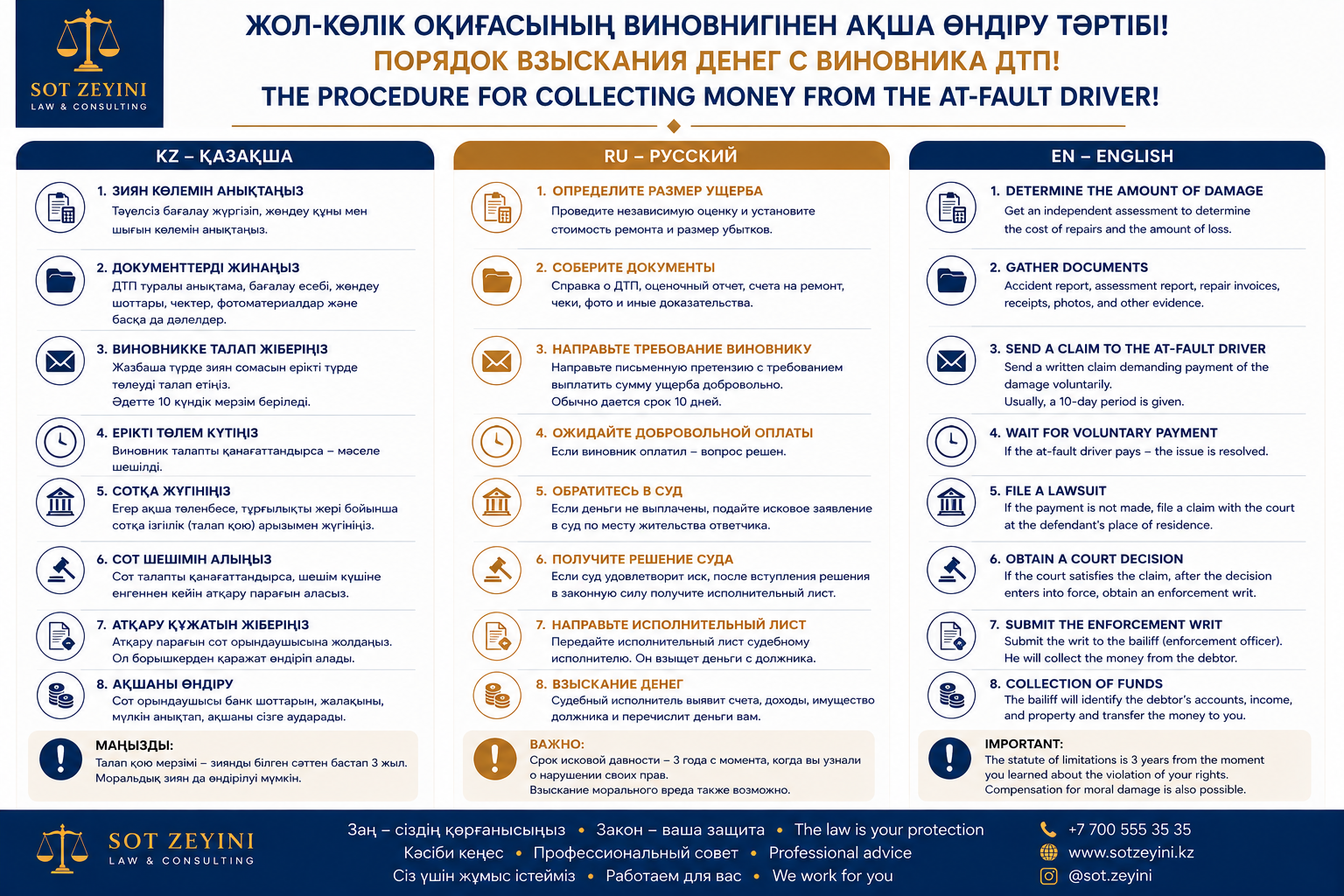
Procedure for Recovering Money from the At-Fault Driver After a Traffic Accident in Kazakhstan
How to Recover Money from the At-Fault Driver After an Accident
Learn how to recover money from the at-fault driver after a road traffic accident in Kazakhstan: accident registration, damage assessment, insurance payment, pre-litigation demand, court claim, and enforcement through a private bailiff.recover money from at-fault driver Kazakhstan, traffic accident compensation, accident damage claim Kazakhstan, insurance payment not enough, independent assessment accident, sue at-fault driver, private bailiff Kazakhstan, car accident damages
Short answer
Money can be recovered from the at-fault driver if their fault has been established, the amount of damage is supported by documents, and the insurance payment does not cover the full loss or the at-fault driver has no insurance policy.
The general procedure is:
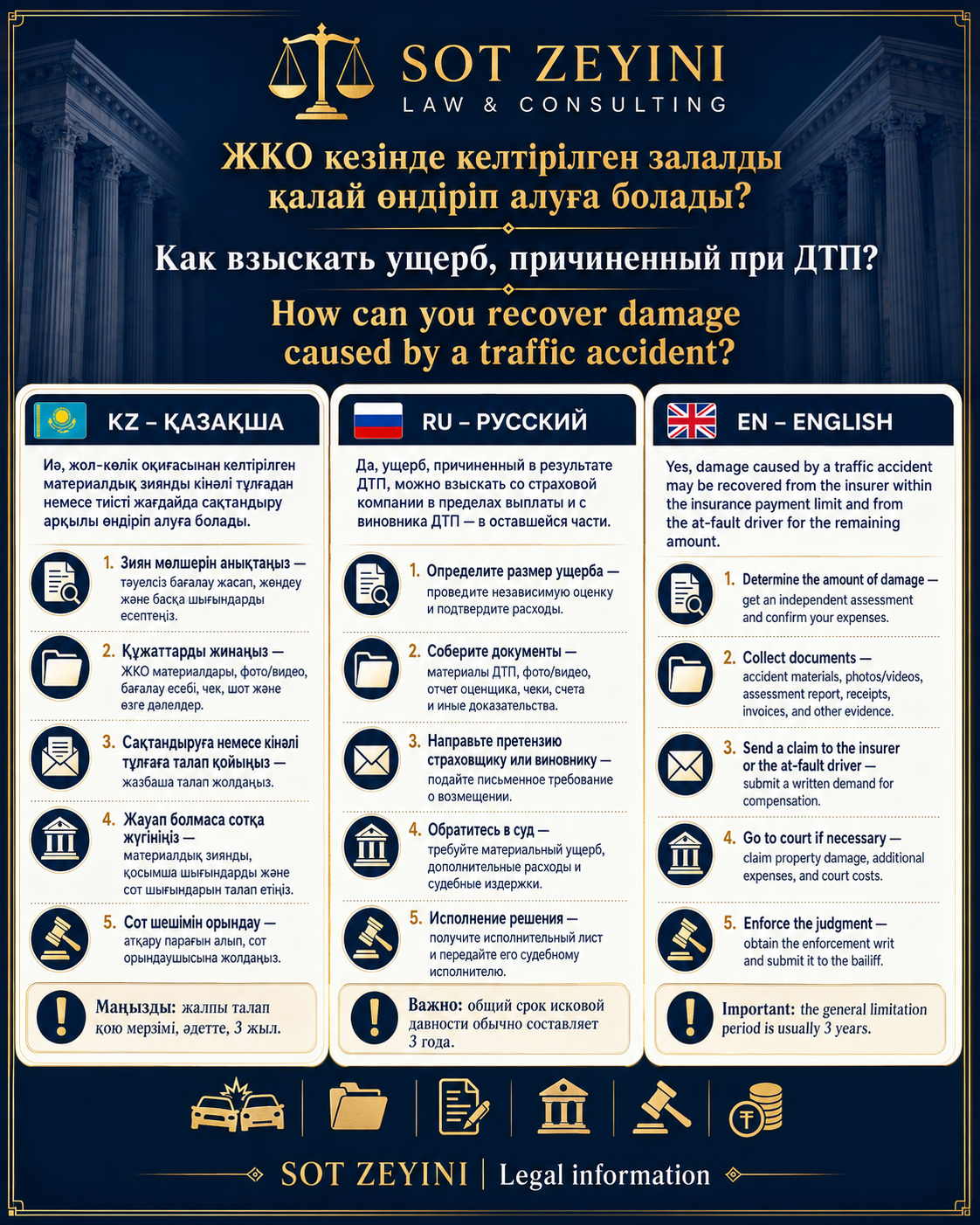
accident registration → determination of fault → damage assessment → insurance claim → pre-litigation demand to the at-fault driver → court claim → enforcement through a private bailiff.
The key elements are fault, amount of damage, and causal link between the accident and the damage.
When can money be recovered from the at-fault driver?
Money may be recovered from the at-fault driver if:
- the insurance payment does not cover the full damage;
- the at-fault driver had no insurance policy;
- the insurance company refused payment;
- the damage exceeds the insurance limit;
- an independent assessment shows a higher amount of damage;
- towing, parking, assessment, or legal expenses were not compensated;
- injury was caused;
- moral damages must be recovered;
- the at-fault driver refuses to pay voluntarily.
For example, if the vehicle repair costs 1,900,000 tenge and the insurance company paid only 1,200,000 tenge, the remaining 700,000 tenge may be claimed from the at-fault driver.
Step one: properly register the accident
To recover money, the accident must be properly registered. If the circumstances are not recorded, it may be difficult to prove fault and damage later.
After an accident, you should:
- call the police if the simplified procedure does not apply;
- photograph the accident scene;
- record vehicle positions on video;
- document all damage;
- obtain the other driver’s details;
- check the insurance policy;
- collect witness contacts;
- obtain administrative case materials;
- wait for the ruling on fault to enter into legal force.
Do not sign documents without reading them. One inaccurate sentence in an explanation may later create a serious problem in court.
Step two: establish the at-fault person
To recover money, it must be proven that a specific person caused the accident.
Fault may be confirmed by:
- administrative offense protocol;
- accident diagram;
- court ruling;
- police materials;
- explanations of the parties;
- witness statements;
- photos and videos;
- expert opinion.
If the at-fault driver does not admit fault, the issue may have to be resolved in court. Evidence should therefore be collected immediately after the accident.
Step three: determine the amount of damage
A precise calculation of damage is required. This is usually done through an independent assessment.
An assessment helps determine:
- vehicle repair cost;
- cost of spare parts;
- cost of restoration works;
- loss of vehicle market value;
- difference between insurance payment and actual damage.
If the vehicle has already been repaired without assessment, proving the amount of damage becomes more difficult. It is better to first take photos, arrange an assessment, collect documents, and only then repair the vehicle.
Step four: apply to the insurance company
If the at-fault driver has compulsory insurance, the injured party should first apply to the insurance company. The insurer pays compensation within the statutory limit.
Usually, the following documents are submitted:
- insurance payment application;
- identity document;
- vehicle documents;
- accident materials;
- ruling confirming fault;
- insurance policy information;
- bank details;
- documents confirming damage;
- assessment report.
If the insurance payment fully covers the damage, a separate claim against the at-fault driver may not be needed. If it does not cover the full amount, the difference may be claimed.
Step five: send a pre-litigation demand to the at-fault driver
Before going to court, it is advisable to send a pre-litigation demand to the at-fault driver. This shows that the injured party tried to settle the dispute peacefully.
The demand should include:
- date and place of the accident;
- details of the at-fault driver;
- circumstances of the accident;
- amount of damage;
- amount of insurance payment;
- unpaid difference;
- deadline for voluntary payment;
- warning about filing a court claim.
Sample pre-litigation demand
To: [Full name of at-fault driver]
From: [Full name of injured party]
Address: [address]
Phone: [number]
Pre-Litigation Demand
for compensation of damage caused by a traffic accident
On [date], at [place], a road traffic accident occurred involving the vehicles [specify vehicles].
As a result of the accident, my vehicle [make, registration number] sustained mechanical damage.
Your fault is confirmed by [court ruling / administrative case materials / police documents].
According to the independent assessment report, the amount of material damage is [amount] tenge. The insurance company paid [amount] tenge. The uncompensated difference is [amount] tenge.
Based on the above, I request that you voluntarily compensate the damage in the amount of [amount] tenge within 10 business days from receipt of this demand.
If payment is not made, I will be forced to file a court claim for recovery of the damage amount, assessment expenses, legal fees, state duty, and other court expenses.
Attachments:
- Copy of accident materials;
- Copy of court ruling;
- Independent assessment report;
- Document confirming insurance payment;
- Documents confirming expenses.
Date: ____________
Signature: ____________
Step six: file a court claim
If the at-fault driver does not pay voluntarily, a court claim should be filed.
The claim should state:
- date of the accident;
- location of the accident;
- circumstances of the accident;
- details of the at-fault person;
- documents proving fault;
- amount of damage;
- amount of insurance payment;
- difference to be recovered;
- additional expenses;
- request to recover money from the defendant.
The claim is usually filed according to jurisdiction rules, often at the defendant’s place of residence, unless the law provides another option.
What can be recovered from the at-fault driver?
The injured party may claim:
- difference between actual damage and insurance payment;
- vehicle repair cost;
- cost of spare parts;
- towing expenses;
- parking expenses;
- independent assessment expenses;
- expert examination expenses;
- legal fees;
- state duty;
- court expenses;
- medical expenses, if injury was caused;
- moral damages, if there are grounds.
Every amount must be supported by documents. Receipts, contracts, assessment reports, and payment confirmations are not bureaucracy — they are legal armor.
What documents are needed for court?
It is advisable to attach:
- copy of identity document;
- vehicle ownership documents;
- accident diagram;
- administrative protocol;
- court ruling;
- photos and videos from the accident scene;
- independent assessment report;
- response from the insurance company;
- document confirming insurance payment;
- pre-litigation demand;
- proof that the demand was sent;
- receipts for towing, parking, or repair;
- legal services agreement and payment documents;
- state duty payment receipt.
The stronger the documents, the stronger the claim.
If the at-fault driver has no insurance
If the at-fault driver has no insurance policy, damages are recovered directly from that person.
In this case, the insurance company does not pay compensation, and the injured party may claim the full amount of damage from the at-fault driver.
For example, if an independent assessment establishes damage of 1,500,000 tenge, the full amount may be claimed from the at-fault person.
If the at-fault driver is not the vehicle owner
Sometimes the person who caused the accident is not the owner of the vehicle. In such cases, it is important to correctly identify the defendant.
The responsible person may be:
- the driver who caused the accident;
- the vehicle owner;
- the lawful possessor of the vehicle;
- the employer, if the driver was performing work duties;
- another person who allowed use of the vehicle, depending on the circumstances.
The court will examine who drove the vehicle, on what basis, and in whose interests.
How is money recovered after a court decision?
If the court grants the claim and the at-fault driver does not pay voluntarily, the claimant should obtain a writ of execution and submit it to a private bailiff.
The bailiff may:
- freeze bank accounts;
- withhold money from salary;
- restrict registration actions with the vehicle;
- impose restrictions on property;
- take other enforcement measures.
Winning the court case is not always the end. Sometimes the real battle begins during enforcement.
Can the parties make a settlement?
Yes. If the at-fault driver is willing to pay in installments, the parties may sign a written settlement agreement or mediation agreement.
The agreement should include:
- total debt amount;
- payment schedule;
- date of each payment;
- liability for delay;
- bank details;
- signatures of the parties.
Verbal agreements are risky. Today a person promises to pay, tomorrow they say, “I never said that.” Written agreements are safer.
Common mistakes made by injured parties
Common mistakes include:
- relying on verbal promises;
- not obtaining damage assessment;
- not checking the insurance payment;
- failing to record all damage;
- not sending a pre-litigation demand;
- not keeping receipts;
- filing a claim without evidence;
- naming the wrong defendant;
- repairing the vehicle before assessment;
- not monitoring the bailiff after judgment.
In traffic accident claims, evidence decides everything. Not emotions, not chat messages, but documents.
Conclusion
To recover money from the at-fault driver after an accident, the accident must be properly registered, fault must be proven, the amount of damage must be calculated, and documents must be collected. If the insurance payment does not cover the full damage, the difference may be claimed from the at-fault driver.
It is advisable to first send a pre-litigation demand. If the at-fault driver does not pay, a court claim should be filed. After a court decision, money is recovered through a private bailiff.
The most important evidence includes photos, assessment report, insurance documents, receipts, court ruling, and proof that the demand was sent.
FAQ
Can money be recovered from the at-fault driver after an accident?
Yes, if their fault is proven and the damage is supported by documents.
What if insurance did not cover the full damage?
The difference between actual damage and the insurance payment may be recovered from the at-fault driver.
What if the at-fault driver refuses to pay voluntarily?
A pre-litigation demand should be sent first, and then a court claim may be filed.
What expenses can be recovered?
Vehicle damage, assessment costs, towing, parking, legal fees, state duty, and other documented expenses.
Can moral damages be recovered?
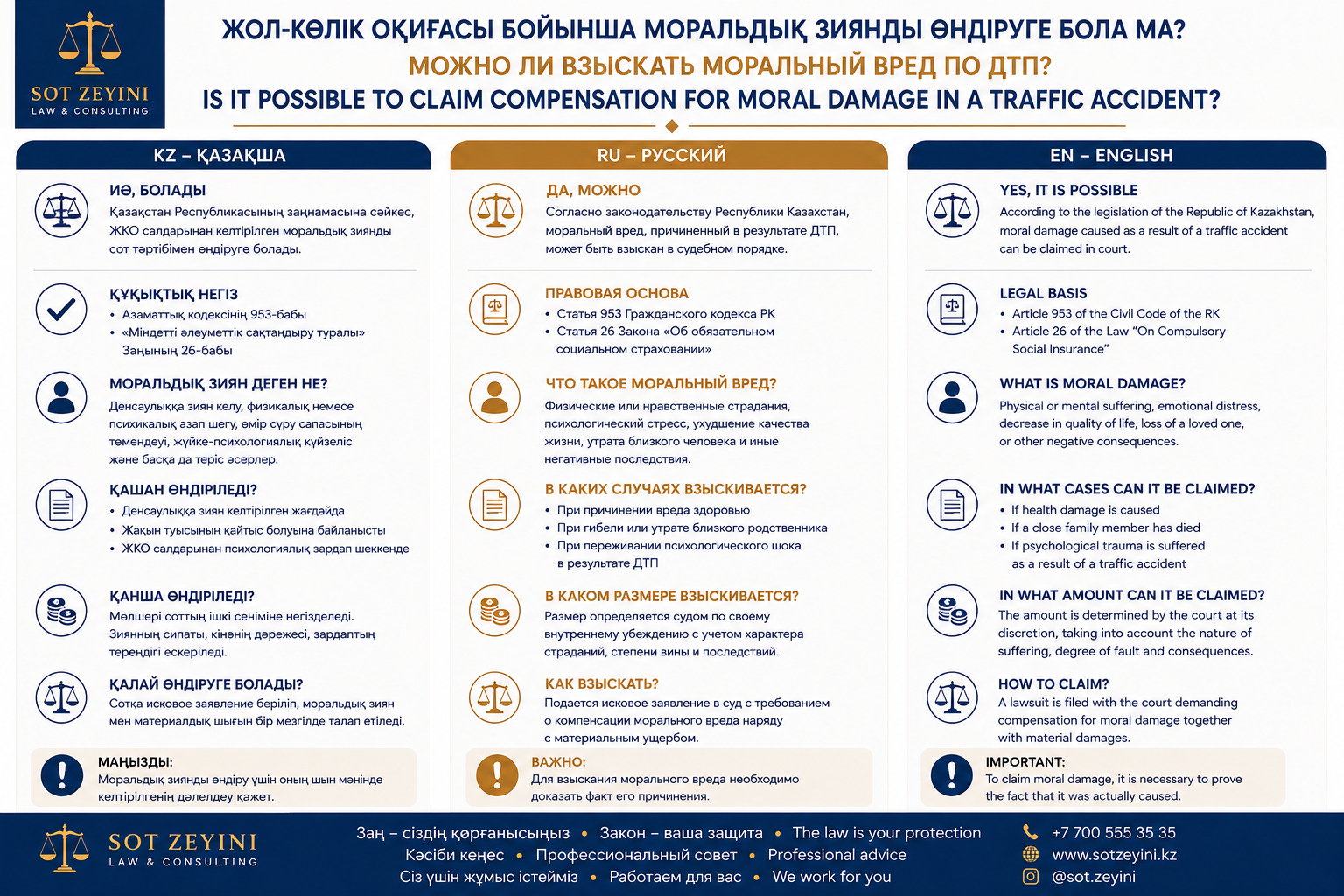
Yes, if there are grounds, especially in cases involving injury or serious consequences.
What if the at-fault driver has no insurance?
In that case, damages are recovered directly from the at-fault driver.
If the at-fault driver is not the vehicle owner, who should be sued?
It depends on the circumstances. The defendant may be the driver, owner, lawful possessor, or employer.
How do you receive money after court?
A writ of execution should be obtained and submitted to a private bailiff for enforcement.