 +7 775 858 9294
 WhatsApp
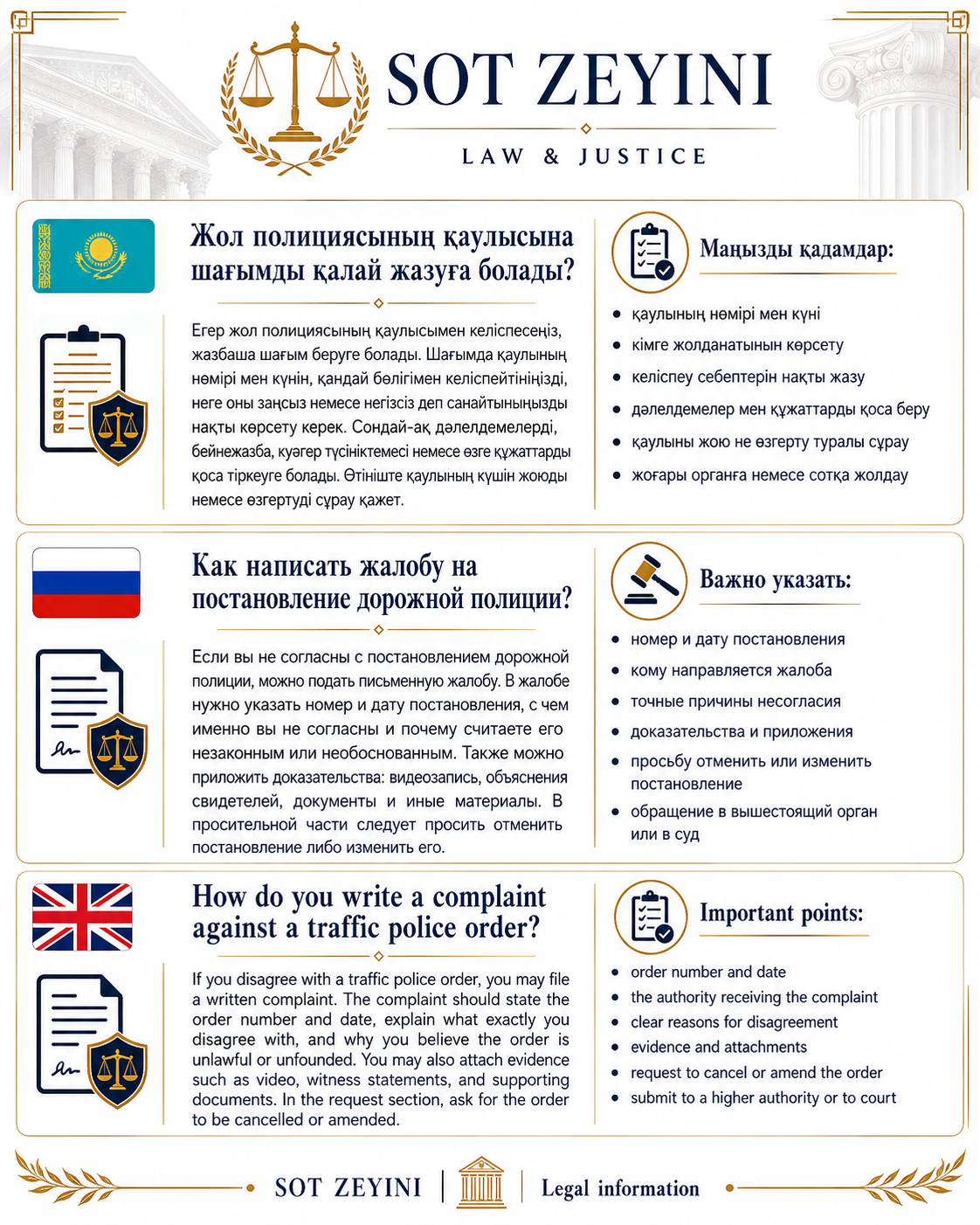
How to Write a Complaint Against a Traffic Police Ruling in Kazakhstan
How to Write a Complaint Against a Traffic Police Ruling
Learn how to write a complaint against a traffic police ruling in Kazakhstan: appeal deadline, where to file, what evidence is needed, how to challenge camera fines, and sample complaint.
complaint against traffic police ruling Kazakhstan, appeal traffic fine Kazakhstan, challenge traffic police fine, camera fine appeal Kazakhstan, Qamqor complaint, administrative fine Kazakhstan, traffic violation appeal
Short answer
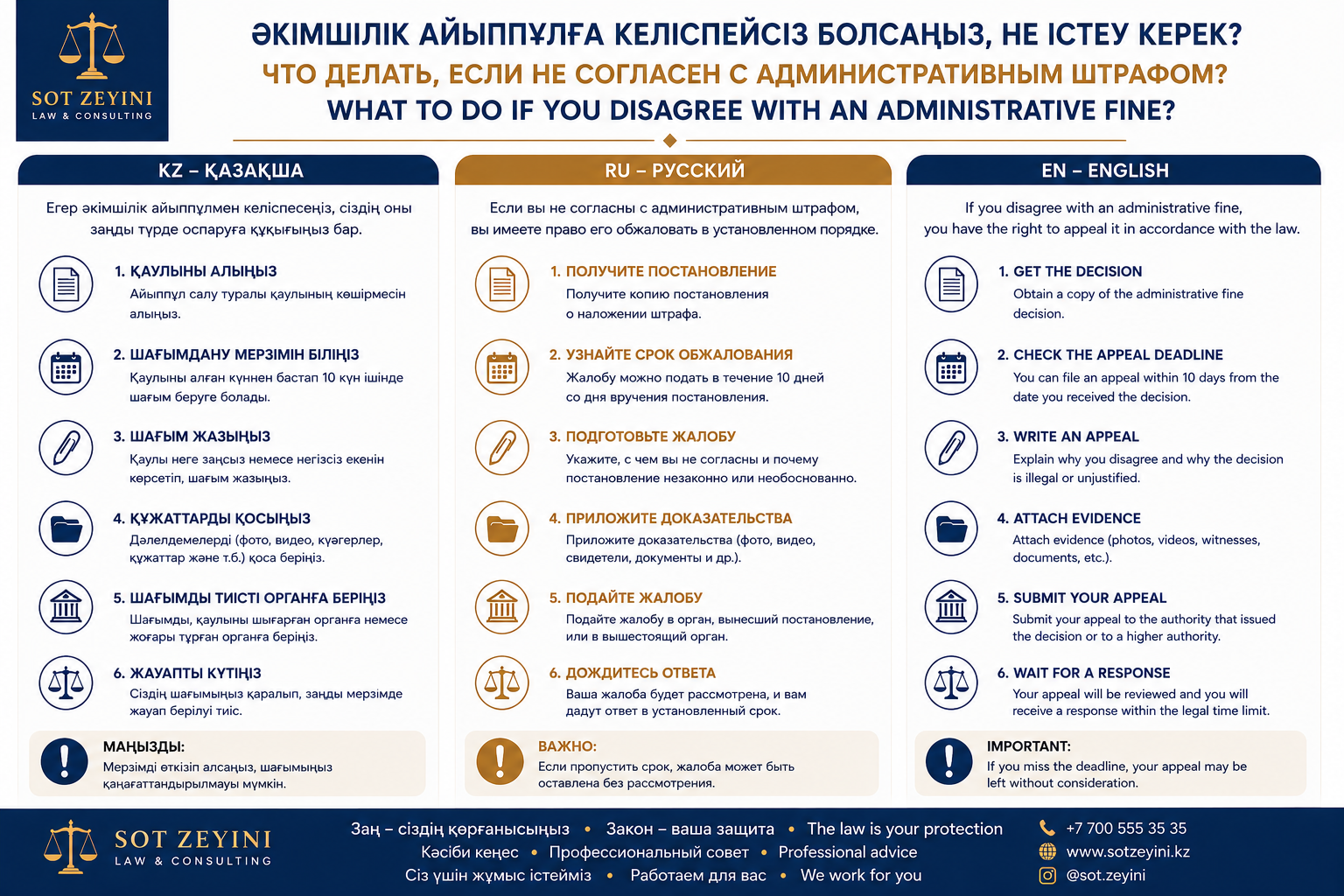
If you disagree with a traffic police ruling, you may appeal it within the legally established deadline. As a general rule, a complaint is filed within 10 days from the date the copy of the ruling is delivered. If the person did not participate in the case review, the period starts from the date they received the ruling.
The complaint should clearly explain why you disagree: no violation occurred, another person was driving, the camera made an error, the road sign was not visible, the protocol was prepared incorrectly, or the evidence does not prove guilt.
It is not enough to write “I disagree.” You need to identify a specific error, attach evidence, and clearly request cancellation of the ruling, termination of the case, or a new review.
What is a traffic police ruling?
A traffic police ruling is a decision in an administrative offense case related to a traffic violation. Based on such a ruling, a fine, warning, or other administrative penalty may be imposed.
The ruling usually states:
- date and place of the violation;
- driver or vehicle owner details;
- vehicle registration number;
- article of the Administrative Offenses Code;
- fine amount;
- circumstances of the violation;
- evidence;
- appeal procedure and deadline.
If the ruling is unlawful, unfounded, or issued with procedural violations, it can be challenged.
What rulings can be appealed?
You may appeal rulings related to:
- speeding;
- running a red light;
- driving into the oncoming lane;
- stopping or parking violations;
- violation of road signs;
- violation of road markings;
- creating an emergency situation;
- traffic accidents;
- camera-recorded fines;
- deprivation of driving rights;
- orders requiring payment of a fine.
If the ruling was issued by a court rather than police, the appeal procedure may differ. Always check the appeal section in the ruling.
When are there grounds for complaint?
Grounds may include:
- no offense actually occurred;
- there is no administrative offense;
- another person was driving;
- the camera recognized the license plate incorrectly;
- the place or time of violation is wrong;
- the road sign was hidden or not visible;
- road markings were unclear;
- photo or video does not prove the violation;
- the protocol contains errors;
- the driver’s rights were not explained;
- the driver was not allowed to give explanations;
- video or witnesses were not examined;
- the case was reviewed without proper notification;
- two fines were issued for the same violation;
- limitation periods were violated.
The key is to show the exact mistake and support it with evidence.
Appeal deadline
A complaint against an administrative offense ruling is usually filed within 10 days from the date the copy of the ruling is delivered.
If the person did not participate in the case review, the deadline starts from the date the ruling was received.
If the ruling was delivered electronically, check the date of delivery of the notice or order.
Do not miss the deadline. Administrative deadlines are short, and the law does not wait.
What if the deadline was missed?
If the deadline was missed, a motion to restore the deadline may be filed. A valid reason must be proven.
Valid reasons may include:
- late receipt of the ruling;
- no notice was delivered;
- illness;
- business trip;
- hospitalization;
- no access to the electronic cabinet;
- no notice of the case review.
Supporting evidence may include medical certificates, tickets, business trip documents, postal notices, portal screenshots, or other documents.
Where should the complaint be filed?
The complaint may be filed:
- with the authority that issued the ruling;
- with a higher police authority;
- with a court;
- through Qamqor.gov.kz;
- through eGov, if the service is available;
- through Judicial Cabinet if filing with a court;
- by registered mail;
- in person through the office.
If the ruling was issued by police, it may be appealed to a higher authority or court. If the ruling was issued by court, the complaint is usually filed with the higher court through the court that issued the ruling.
Can a complaint be filed through Qamqor?
Yes. In Kazakhstan, Qamqor.gov.kz may be used for administrative offense complaints.
The general steps are:
- Go to Qamqor.gov.kz;
- Log in with an electronic digital signature;
- Find the administrative case or fine;
- Review the materials;
- Check photos and videos;
- Write the complaint;
- Attach evidence;
- Sign and submit the complaint.
After submission, keep the registration number or filing confirmation.
What should be written in the complaint?
The complaint should include:
- name of the authority or court;
- applicant’s full name;
- individual identification number;
- address and phone number;
- ruling number;
- date of the ruling;
- authority that issued the ruling;
- article of the Administrative Offenses Code;
- fine amount;
- reasons for disagreement;
- evidence;
- specific requests;
- list of attachments;
- date and signature.
The text should be clear. Fewer emotions, more facts.
What can be requested?
The complaint may request:
- cancellation of the traffic police ruling;
- termination of the administrative case;
- cancellation of the order requiring payment of the fine;
- referral of the case for a new review;
- request for photo and video materials;
- request for technical device information;
- summoning witnesses;
- review of dashcam footage;
- restoration of the appeal deadline;
- review with the applicant’s participation.
If no violation occurred, request termination of the case. If procedural violations occurred, request cancellation and a new review.
What evidence is needed?
The complaint may include:
- copy of the ruling;
- copy of administrative protocol;
- photos and videos;
- dashcam recording;
- camera materials;
- witness explanations;
- photos of road signs;
- photos of road markings;
- documents proving another person was driving;
- vehicle sale agreement;
- power of attorney or lease agreement;
- data about the technical recording device;
- proof of improper notification;
- medical or business trip documents.
Evidence must relate directly to the disputed ruling.
How to challenge a camera fine
Camera fines may be challenged if:
- the license plate was recognized incorrectly;
- the wrong vehicle was recorded;
- another person was driving;
- the vehicle had been sold;
- the road sign was hidden;
- road markings were unclear;
- no violation actually occurred;
- the photo or video does not prove the violation;
- the same violation was fined twice.
In such cases, request photo and video materials and check the date, time, location, license plate, and technical data.
If another person was driving
If another person was driving at the time of the alleged violation, state this in the complaint.
You may attach:
- explanation from the actual driver;
- power of attorney;
- lease agreement;
- route sheet;
- work assignment;
- GPS data;
- correspondence;
- witness statements;
- other documents.
It is not enough to say “I was not driving.” You must show who was driving and how this is proven.
If the road sign was not visible
If the fine is related to a road sign or marking, check:
- whether the sign was installed correctly;
- whether it was visible to the driver;
- whether trees, advertising, or another vehicle blocked it;
- whether road markings were readable;
- whether the road situation matches the case materials;
- whether photos or videos exist.
If the sign was not visible or markings were missing, this may support cancellation of the ruling.
Sample complaint against a traffic police ruling
To: [name of authority or court]
From: [full name]
IIN: [IIN]
Address: [address]
Phone: [phone]
COMPLAINT
against a traffic police ruling
A ruling No. [number] dated [date] was issued against me in an administrative offense case. According to the ruling, I was fined [amount] tenge under Article [article] of the Code of Administrative Offenses of the Republic of Kazakhstan.
I disagree with this ruling and consider it unlawful and unfounded for the following reasons.
[State specific reasons: I did not commit the offense, another person was driving, the camera recorded the violation incorrectly, the road sign was not visible, the protocol contains violations, evidence was not examined, rights were not explained, etc.]
I believe that the circumstances of the case were not established fully, comprehensively, and objectively. The case materials do not contain sufficient evidence proving the elements of an administrative offense.
Based on the above,
I REQUEST:
- Cancel ruling No. [number] dated [date];
- Terminate the administrative offense case;
- If necessary, send the case for a new review;
- Request photo and video materials, technical device data, and other evidence;
- Review the complaint with my participation.
Attachments:
- Copy of ruling;
- Copy of administrative protocol;
- Photos and videos;
- Dashcam recording;
- Witness explanations;
- Motion to restore the deadline, if the deadline was missed;
- Other documents.
Date: ____________
Signature: ____________
How to file the complaint
The complaint may be filed:
- in person through the office;
- by registered mail;
- through Qamqor.gov.kz;
- through eGov;
- through Judicial Cabinet;
- by email if the authority accepts documents that way.
Keep proof of filing: incoming registration number, postal receipt, electronic notice, or portal registration number.
If the fine has already been paid
If the fine has already been paid, especially with a 50% discount, appeal becomes more difficult. Such payment may be treated as admission of the violation and agreement with payment.
If you disagree with the ruling, it is safer to file a complaint first and decide on payment later.
If the ruling is cancelled, refund of the paid amount may be requested separately.
What happens if the ruling is cancelled?
If the complaint is satisfied:
- the ruling is cancelled;
- the fine does not need to be paid;
- the case may be terminated;
- if paid, refund may be requested;
- if transferred to a private bailiff, enforcement proceedings and account freezes may need to be cancelled.
If the ruling is not cancelled, further appeal options should be assessed.
Common mistakes
Common mistakes include:
- missing the 10-day deadline;
- not stating specific reasons;
- not attaching evidence;
- not indicating the ruling number;
- filing with the wrong authority;
- not requesting camera materials;
- paying first and disputing later;
- not requesting deadline restoration;
- not participating in the review;
- writing emotionally.
A complaint should be a legal document, not an emotional message. Facts win.
Conclusion
A traffic police ruling can be challenged if it is unlawful, unfounded, or issued with violations. The complaint is usually filed within 10 days from receipt of the ruling.
The complaint should clearly state the reasons for disagreement, include evidence, and request cancellation of the ruling, termination of the case, or a new review.
FAQ
Can a traffic police ruling be appealed?
Yes, if you disagree with it, it may be appealed within the established deadline.
What is the deadline?
Usually 10 days from delivery of the ruling copy or from receipt if the person did not participate in the case review.
Where should the complaint be filed?
With the issuing authority, higher authority, court, or online through Qamqor.gov.kz.
Can a camera fine be appealed?
Yes, if the camera made an error, the license plate was recognized incorrectly, another person was driving, or no violation occurred.
What evidence is needed?
Ruling, protocol, photos, videos, dashcam recording, witness statements, vehicle documents, and other evidence.
Can the ruling be appealed after payment?
It is possible to try, but harder, especially if the fine was paid with a 50% discount.
What if the deadline was missed?
File a motion to restore the deadline and attach documents proving a valid reason.
If the ruling is cancelled, must the fine be paid?
No, if the ruling is cancelled and the case is terminated, the obligation to pay the fine ends.