 +7 775 858 9294
 WhatsApp
How to Recover Damages Caused by a Road Traffic Accident in Kazakhstan
How to Recover Damages After a Road Traffic Accident in KazakhstanLearn how to recover damages after a road traffic accident in Kazakhstan: insurance claim, independent assessment, pre-litigation demand, court claim, and recovery from the at-fault driver.recover damages after traffic accident Kazakhstan, car accident compensation Kazakhstan, road traffic accident claim, insurance payment accident Kazakhstan, at-fault driver compensation, independent vehicle assessment, court claim car accident Kazakhstan
Short answer
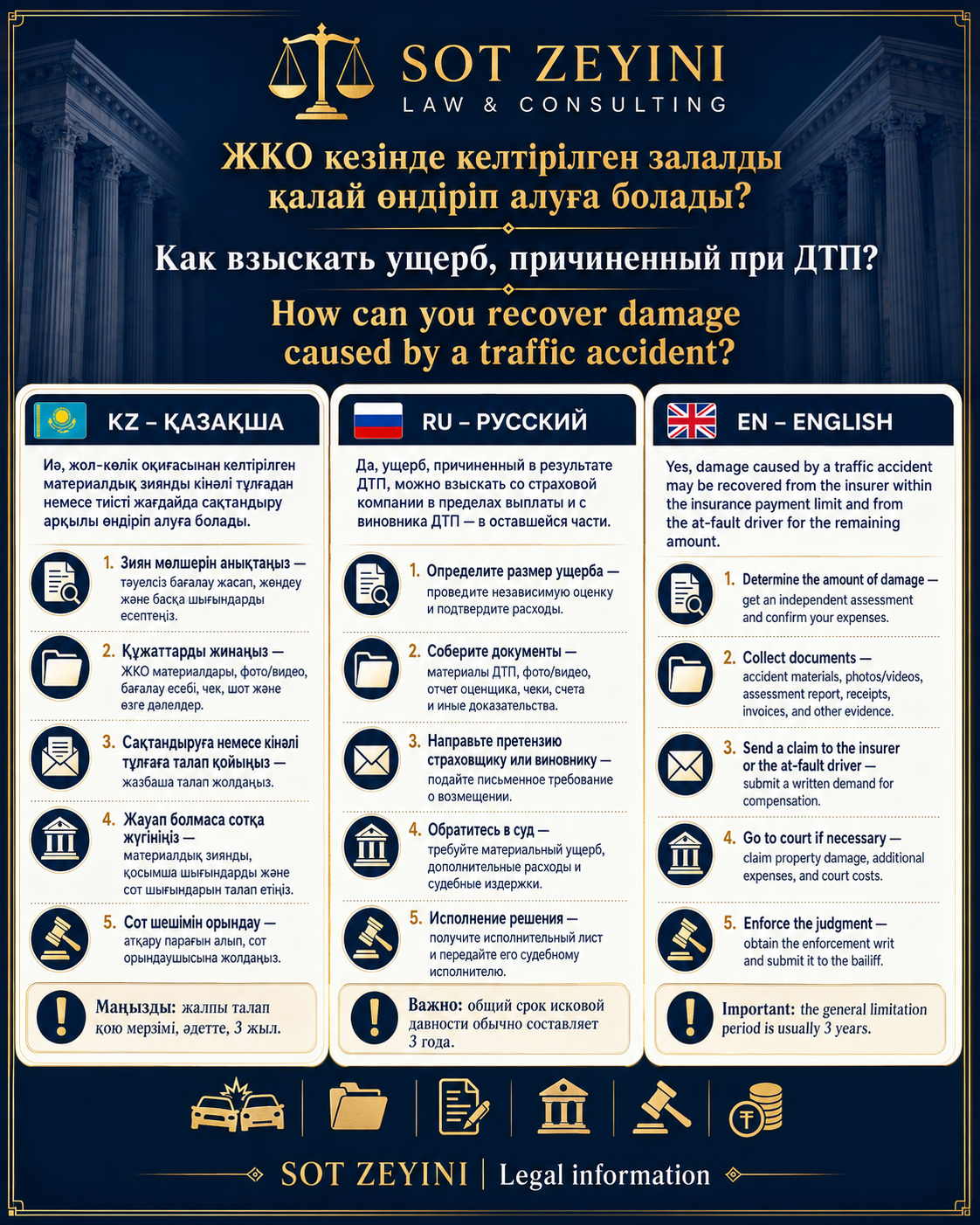
Damages caused by a road traffic accident can usually be recovered from the insurance company of the at-fault driver. If the insurance payment does not cover the full damage, the injured party may recover the difference directly from the at-fault driver through court.
The general process is:
Accident → official registration → determination of fault → damage assessment → insurance claim → insurance payment → court claim against the at-fault driver if the payment is insufficient.
The key point is proper documentation. In accident disputes, documents matter more than emotions.
What should you do immediately after an accident?
After a road traffic accident, you should:
- stop the vehicle;
- turn on hazard lights;
- place a warning triangle;
- avoid moving vehicles before the circumstances are recorded;
- call the police if the simplified procedure does not apply;
- call an ambulance if anyone is injured;
- take photos and videos of the accident scene, vehicle positions, damage, road signs, and braking marks;
- record the other driver’s details;
- get witness contact information;
- check whether the at-fault driver has valid insurance.
If the road must be cleared, it is advisable to first record the position of the vehicles and accident traces with photos and videos.
Can the accident be registered under the European protocol?
Yes, in certain cases a minor accident can be registered without calling the police under the simplified “European protocol” procedure.
It is usually suitable if:
- only two vehicles are involved;
- there are no injured persons;
- the damage does not exceed the established limit;
- both drivers have valid insurance;
- the parties agree on who is at fault;
- there is no dispute about the accident circumstances.
If there is a dispute, injury, serious damage, or the at-fault driver does not admit fault, it is safer to call the police.
What documents are prepared after an accident?
Depending on the case, the following documents may be needed:
- accident diagram;
- administrative offense protocol;
- explanations of the parties;
- witness statements;
- photos and videos from the accident scene;
- court ruling or other document confirming fault;
- insurance policy details;
- vehicle documents;
- medical documents, if there is injury.
These documents are needed for the insurance company and for court. If important details or damages are not recorded, proving the claim later may become difficult.
Who should compensate the damage?
There are several possible sources of compensation.
1. Insurance company of the at-fault driver
If the at-fault driver has compulsory motor insurance, the injured party applies to the insurance company. The insurer pays compensation within the statutory limit.
2. At-fault driver
If the insurance payment does not cover the full damage, the injured party may claim the difference from the at-fault driver.
For example, if an independent assessment shows damage of 2,500,000 tenge and the insurance company pays 1,800,000 tenge, the remaining 700,000 tenge may be claimed from the at-fault driver.
3. Vehicle owner or employer
If the driver was driving a company vehicle or performing job duties, liability may, in some cases, be imposed on the employer or vehicle owner. This depends on the facts of the case.
What damages can be recovered?
After an accident, the injured party may claim:
- vehicle repair costs;
- cost of spare parts;
- towing expenses;
- parking expenses;
- independent assessment costs;
- expert examination costs;
- medical treatment expenses;
- medication costs;
- lost income due to injury;
- legal assistance expenses;
- court expenses;
- moral damages, if there are grounds.
Every expense should be supported by documents: receipts, invoices, reports, contracts, medical records, or payment confirmations.
How do you receive an insurance payment?
After the at-fault person is identified, the injured party submits an insurance claim.
Usually, the following documents may be needed:
- application for insurance payment;
- identity document;
- vehicle documents;
- details of the at-fault driver’s insurance policy;
- accident documents;
- court ruling or other proof of fault;
- damage assessment documents;
- bank account details;
- documents confirming additional expenses.
The insurance company should accept the documents and provide confirmation of receipt. This is important because the date of submission may matter if a dispute later arises.
What if the insurance company undervalues the damage?
If the insurance company pays less than the actual damage, the injured party should obtain an independent assessment.
An independent assessment helps to:
- determine the real repair cost;
- prove that the insurance payment was understated;
- recover the difference;
- prepare a pre-litigation demand;
- support a court claim.
For example, if the insurance company assessed the damage at 900,000 tenge but an independent expert assessed it at 1,500,000 tenge, the injured party may claim the difference of 600,000 tenge.
What if the at-fault driver has no insurance?
If the at-fault driver does not have insurance, damages must be claimed directly from that person.
Recommended steps:
- Register the accident with the police.
- Obtain documents confirming fault.
- Arrange an independent damage assessment.
- Send a pre-litigation demand to the at-fault driver.
- If no payment is made, file a court claim.
- After the judgment, submit the writ of execution to a private bailiff.
The absence of insurance does not remove the injured party’s right to compensation. It simply makes the recovery process more difficult.
Should a pre-litigation demand be sent?
Yes, it is advisable to send a pre-litigation demand. It shows that the injured party attempted to resolve the matter peacefully.
The demand should include:
- date and place of the accident;
- details of the at-fault driver;
- circumstances of the accident;
- amount of damage;
- amount of insurance payment, if any;
- amount of the remaining difference;
- deadline for voluntary payment;
- warning about filing a court claim.
Sample wording:
“As a result of the accident, my vehicle was damaged. According to the independent assessment, the damage amounts to 1,800,000 tenge. The insurance company paid 1,100,000 tenge. I request voluntary payment of the difference in the amount of 700,000 tenge within 10 business days.”
It is best to send the demand by registered mail, courier, email, or deliver it against signature.
When should you go to court?
A court claim may be filed if:
- the insurance company refuses payment;
- the insurance company undervalues the damage;
- the at-fault driver refuses to pay the difference;
- the at-fault driver has no insurance;
- the damage exceeds the insurance limit;
- injury was caused;
- moral damages must be claimed;
- the at-fault person avoids payment.
The claim should clearly state the amount requested and include evidence supporting the damage.
What documents are needed for court?
The following documents are usually attached to the claim:
- statement of claim;
- identity document;
- vehicle documents;
- accident materials;
- court ruling or document confirming fault;
- insurance policy or policy details;
- response from the insurance company;
- document confirming insurance payment;
- independent assessment report;
- photos and videos of the damage;
- receipts for towing, parking, or repair;
- medical documents, if there was injury;
- pre-litigation demand;
- proof that the demand was sent;
- state duty payment receipt.
The main elements to prove are fault, amount of damage, and causal link between the accident and the damage.
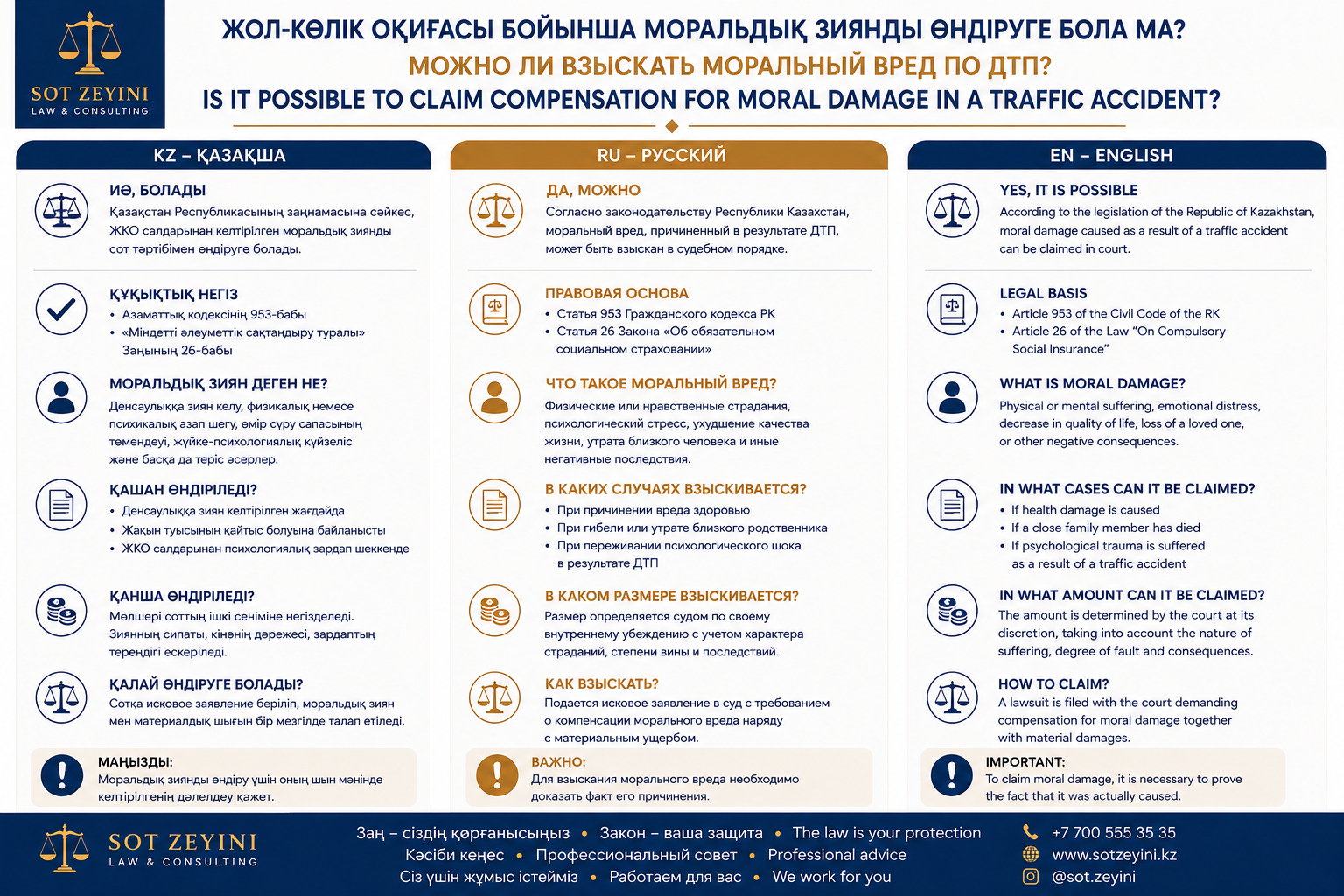
Can moral damages be recovered?
Yes, moral damages may be recovered if there are grounds. This is most common when the accident caused injury, physical suffering, emotional distress, long-term treatment, or other consequences.
The claimant states the amount of moral damages, but the final amount is determined by the court based on the circumstances.
Can damages be recovered if the car has already been repaired?
Yes, but it is better to take photos, videos, and obtain an independent assessment before repairs.
If the car was repaired without assessment, proving the amount of damage may be more difficult. The safer order is:
- Register the accident.
- Record the damage.
- Obtain an assessment.
- Keep receipts.
- Repair the vehicle.
How is money recovered after a court decision?
If the court satisfies the claim and the at-fault driver does not pay voluntarily, the claimant should obtain a writ of execution and submit it to a private bailiff.
The bailiff may:
- freeze bank accounts;
- withhold money from salary;
- impose restrictions on property;
- restrict vehicle registration actions;
- take other enforcement measures.
A court judgment is not always the final step. Often, enforcement proceedings become the next stage.
Common mistakes made by injured parties
Common mistakes include:
- not calling the police when the simplified procedure does not apply;
- failing to photograph the accident scene;
- signing documents without reading them;
- failing to record all damages;
- not obtaining an independent assessment;
- accepting an understated insurance payment;
- relying only on verbal agreements;
- not sending a pre-litigation demand;
- not keeping receipts;
- filing a court claim too late.
These mistakes may reduce the recoverable amount or complicate the court process.
Conclusion
Damages after a road traffic accident can be recovered through the insurance company, and if the payment is insufficient, from the at-fault driver through court. To do this, the accident must be properly documented, evidence must be collected, damage must be assessed, and a pre-litigation demand should be sent if necessary.
If the insurance company undervalues the payment or the at-fault driver refuses to pay, the injured party may file a court claim and recover repair costs, towing expenses, assessment costs, legal fees, court expenses, and moral damages where justified.
The most important rule is to preserve evidence and act through documents.
FAQ
Who compensates damages after a traffic accident?
Usually, the insurance company of the at-fault driver pays first. If the payment is insufficient, the difference may be recovered from the at-fault driver.
What if the insurance company paid too little?
An independent assessment should be obtained, and the injured party may demand additional payment or claim the difference in court.
Can damages be recovered directly from the at-fault driver?
Yes, if the driver has no insurance, the insurance payment is insufficient, or there are other legal grounds.
What documents are needed to recover damages?
Accident materials, proof of fault, damage assessment, vehicle documents, receipts, pre-litigation demand, and evidence of expenses.
Can towing expenses be recovered?
Yes, if they are related to the accident and confirmed by receipts or invoices.
Can moral damages be recovered?
Yes, if there are grounds, especially where injury or serious consequences occurred.
Is an independent assessment necessary?
It is highly advisable if the insurance payment is understated or there is a dispute about the amount of damage.
What if the at-fault driver does not pay after court?
The claimant should obtain a writ of execution and submit it to a private bailiff.