 +7 775 858 9294
 WhatsApp
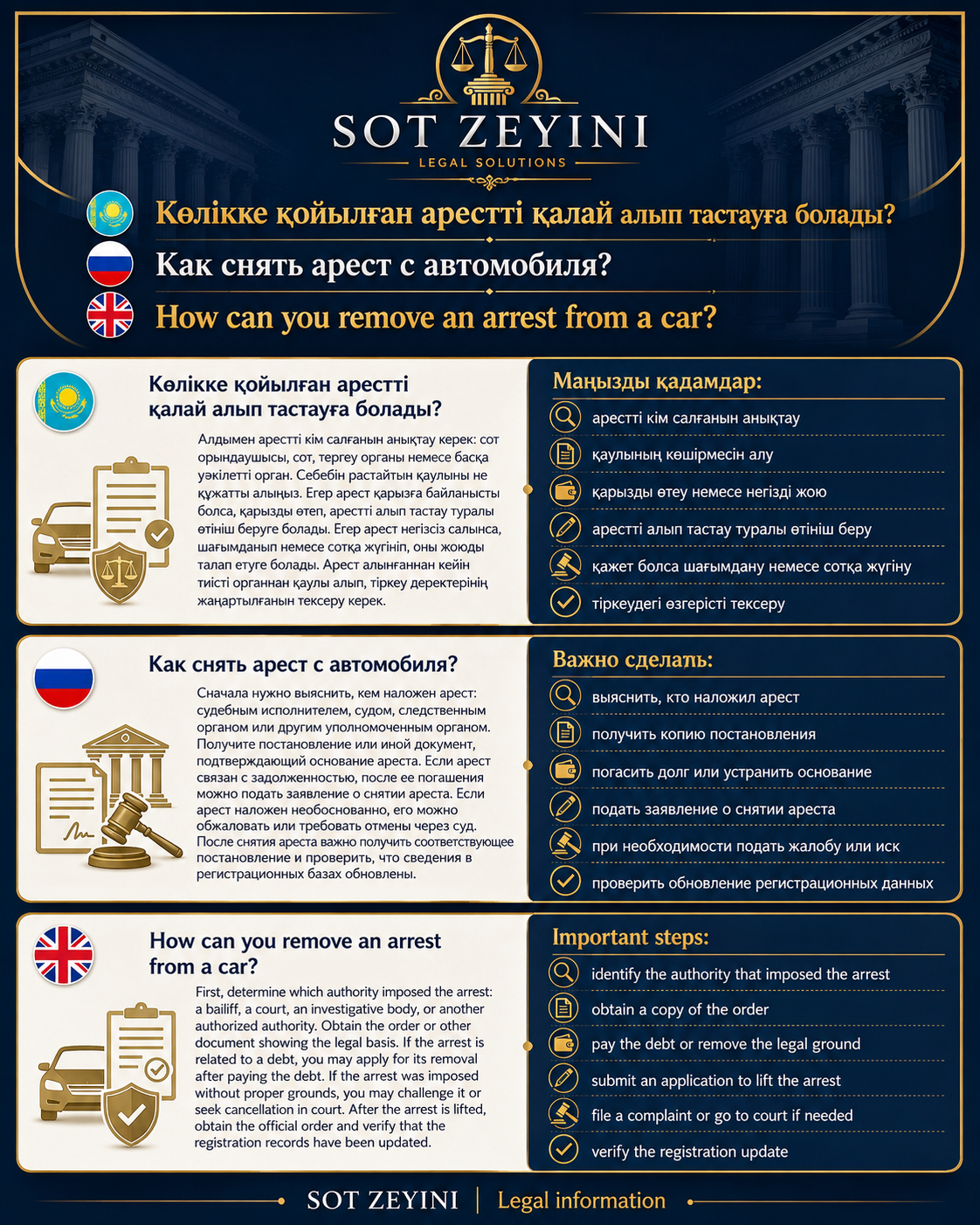
How to Remove an Arrest from a Vehicle in Kazakhstan
How to Remove an Arrest from a Vehicle in Kazakhstan
Learn how to remove an arrest or registration restriction from a vehicle in Kazakhstan: private bailiff arrest, court arrest, debt enforcement, required documents, applications, and procedure.
remove vehicle arrest Kazakhstan, car arrest Kazakhstan, private bailiff car arrest, vehicle registration restriction, remove car restriction, enforcement proceedings vehicle, vehicle seizure Kazakhstan, court arrest vehicle
Short answer
To remove an arrest from a vehicle, you first need to determine who imposed the restriction: a private bailiff, court, police, investigative authority, tax authority, bank, or another competent body.
The arrest is removed by the authority or official who imposed it, or by court decision. Therefore, simply visiting a specialized public service center and asking to remove the restriction is usually not enough. The center may see the restriction in the database, but it does not cancel the arrest.
If the vehicle was arrested by a private bailiff because of debt, the usual steps are to pay the debt, cover enforcement expenses, and submit a written application to the bailiff. If the arrest was imposed by a court as an interim measure, an application must be filed with the same court.
Why can a vehicle be arrested?
An arrest or restriction on vehicle registration actions may be imposed for different reasons:
- loan or microloan debt;
- unpaid administrative fines;
- alimony debt;
- tax debt;
- unfulfilled court decision;
- enforcement proceedings;
- interim measures in a civil case;
- ownership dispute over the vehicle;
- criminal case or investigation;
- vehicle pledge;
- vehicle search status;
- restrictions imposed by state authorities.
The first step is to identify the legal basis for the restriction.
How to find out who imposed the arrest
You need to identify:
- the authority that imposed the arrest;
- enforcement proceeding number;
- name and contacts of the private bailiff;
- debt amount;
- creditor or claimant;
- date of the arrest;
- legal basis for the restriction;
- type of restriction: property arrest, registration ban, search, or pledge.
Restrictions may be checked through eGov, a specialized public service center, the debtor database, Judicial Cabinet, the private bailiff, or the authority named in the restriction record.
How to remove an arrest imposed by a private bailiff
If the vehicle was arrested by a private bailiff, the usual procedure is as follows.
1. Find out the debt amount
Request from the bailiff a debt calculation, enforcement sanction, bailiff fee, and enforcement expenses.
2. Pay the debt
After payment, keep all receipts and payment confirmations.
3. Submit an application to the bailiff
Even after payment, the arrest is not always removed automatically. Submit a written application requesting removal of the arrest and registration restriction.
4. Obtain a decision
The bailiff should issue a decision removing the arrest or terminating the restriction and send it to the relevant state authority.
5. Check the database
After the decision is sent, check whether the registration restriction has actually been removed.
What if the debt is paid but the arrest remains?
This happens quite often. Possible reasons include:
- the bailiff did not issue the decision;
- the decision was not sent to the registration authority;
- the database has not been updated;
- enforcement expenses remain unpaid;
- another enforcement proceeding exists;
- the vehicle was arrested by several authorities.
In this case, submit a written request to the bailiff and demand removal of the arrest. If there is no response, a complaint may be filed with the Department of Justice or court.
Can the arrest be removed without full payment?
Sometimes yes, depending on the situation. For example:
- the creditor agrees to remove the arrest;
- a debt repayment agreement is signed;
- a payment schedule is approved;
- the arrest is disproportionate to the debt amount;
- the vehicle does not belong to the debtor;
- the arrest was imposed by mistake;
- the restriction violates the rights of a third party;
- enforcement proceedings should be terminated.
However, a payment schedule does not always automatically remove the arrest. The bailiff or creditor may keep the restriction as a measure securing debt recovery.
How to remove a court arrest from a vehicle
If the arrest was imposed by a court as an interim measure, the application should be filed with the same court that considered the case.
The application should state:
- case number;
- details of the parties;
- vehicle details;
- date and ruling by which the arrest was imposed;
- why the need for the arrest no longer exists;
- whether the court decision has been enforced;
- whether the case has been terminated;
- why the arrest violates the applicant’s rights.
If the court agrees, it issues a ruling cancelling the interim measures. After the ruling enters into force, it must be sent to the authority where the restriction is registered.
If the arrest relates to the previous owner
Sometimes a person buys a vehicle and later discovers an arrest connected to the previous owner’s debts.
In this situation, check:
- date of sale agreement;
- date of vehicle registration;
- date of arrest;
- who owned the vehicle at the time of arrest;
- who is the debtor;
- which authority imposed the restriction.
If the arrest was imposed after ownership transferred and the debt does not relate to the new owner, removal of the arrest may be requested from the bailiff or through court.
If the vehicle is pledged
A pledge and an arrest are different restrictions. If the vehicle is pledged to a bank or another organization, the restriction is usually removed after the obligation to the pledge holder is fulfilled or with the pledge holder’s consent.
If a bailiff arrest is additionally imposed on a pledged vehicle, the following must be reviewed separately:
- loan agreement;
- pledge agreement;
- debt to the bank;
- enforcement proceeding;
- pledge holder’s rights;
- market value of the vehicle.
A vehicle may have both a pledge and an arrest at the same time. They must be removed on different legal grounds.
What documents are needed?
The following documents may be needed:
- identity document;
- vehicle registration document;
- sale agreement;
- vehicle registration information;
- decision imposing the arrest;
- enforcement proceeding number;
- debt payment receipts;
- certificate of no debt;
- bailiff decision terminating enforcement proceedings;
- bailiff decision removing the arrest;
- court ruling cancelling interim measures;
- pledge termination documents;
- creditor’s statement;
- power of attorney if a representative acts.
The more accurate the documents, the faster the restriction can be removed.
Application to a bailiff for removal of vehicle arrest
To private bailiff: [full name]
Enforcement proceeding No.: [number]
From: [full name]
IIN: [IIN]
Address: [address]
Phone: [phone]
APPLICATION
for removal of arrest from a vehicle
Enforcement proceeding No. [number] is in your office. Within this proceeding, my vehicle [make, registration number, VIN] has been arrested / restricted from registration actions.
At present, the debt under the enforcement document has been fully paid / the need to maintain the arrest no longer exists / the vehicle does not belong to the debtor / the arrest was imposed by mistake / other ground: [state the ground].
Based on the above, I request that you:
- Remove the arrest and registration restriction from the vehicle [make, registration number, VIN];
- Issue a decision removing the arrest;
- Send the decision to the relevant registration authority;
- Provide me with a copy of the decision;
- Terminate the enforcement proceeding if there are grounds.
Attachments:
- Copy of identity document;
- Vehicle documents;
- Debt payment receipts;
- Documents confirming the ground for removal;
- Other documents.
Date: ____________
Signature: ____________
Application to court for removal of vehicle arrest
To: [name of court]
Case No.: [case number]
Applicant: [full name]
IIN: [IIN]
Address: [address]
Phone: [phone]
APPLICATION
for cancellation of vehicle arrest
Civil case No. [number] was considered by [name of court]. In this case, an arrest / restriction on registration actions was imposed as an interim measure on the vehicle [make, registration number, VIN].
At present, the need to maintain the arrest no longer exists because [the court decision has been enforced / the case has been terminated / the claim was left without consideration / the parties settled the dispute / other ground].
The continued arrest restricts my rights as the owner of the vehicle and prevents me from disposing of it.
Based on the above, I request the court to:
- Cancel the arrest / registration restriction on the vehicle [make, registration number, VIN];
- Send the ruling to the relevant registration authority;
- Provide me with a copy of the ruling.
Attachments:
- Copy of application;
- Vehicle documents;
- Court act in the case;
- Documents confirming enforcement of the decision or disappearance of grounds for arrest;
- Other documents.
Date: ____________
Signature: ____________
What if the bailiff does not remove the arrest?
If the bailiff does not remove the arrest despite grounds for removal, you may:
- submit a repeated written application;
- request access to enforcement case materials;
- demand a copy of the bailiff’s decision;
- contact the regional chamber of bailiffs;
- file a complaint with the Department of Justice;
- challenge the bailiff’s inaction in court.
Written requests are important. WhatsApp messages may be convenient, but formal complaints require proof of official submission.
How to check whether the arrest has been removed
After the bailiff’s decision or court ruling, check whether the database has been updated.
You can check through:
- eGov;
- specialized public service center;
- private bailiff;
- registration authority;
- debtor database;
- Judicial Cabinet if the arrest was court-imposed.
Sometimes the decision has already been issued, but the restriction still appears in the database. In that case, contact the bailiff or registration authority again.
Can a vehicle under arrest be sold?
In practice, this is difficult and risky. If the vehicle has an arrest or registration restriction, the buyer usually cannot re-register it.
Before selling, you should:
- check for restrictions;
- remove the arrest;
- check for pledge;
- close debts;
- obtain the decision removing the restriction;
- make sure the database has been updated.
Selling a vehicle under arrest may lead to a dispute with the buyer.
Common mistakes
Common mistakes include:
- not finding out who imposed the arrest;
- going only to the public service center;
- paying the debt but not applying to the bailiff;
- not obtaining the decision removing the arrest;
- not checking database updates;
- confusing pledge with arrest;
- not checking previous owner restrictions;
- not complaining about bailiff inaction;
- trying to sell the vehicle under arrest;
- relying only on verbal requests.
The main rule: the authority that imposed the arrest must remove it — or the court must do so.
Conclusion
To remove an arrest from a vehicle, first identify the legal basis and the authority that imposed it. If it was imposed by a private bailiff, the debt must be paid or the unlawfulness of the arrest must be proven, and then a written application should be submitted. If the arrest was imposed by a court, an application should be filed with that court to cancel interim measures.
After the decision or court ruling is issued, it is important to check whether the restriction has actually been removed from the database. Until it disappears, the vehicle may be impossible to sell, re-register, or deregister.
FAQ
How can I remove an arrest from a vehicle?
Find out who imposed the arrest and submit a written application with supporting documents to the bailiff, court, or relevant authority.
Is the arrest removed automatically after payment?
Not always. After payment, you should apply to the bailiff and obtain a decision removing the arrest.
What if the bailiff does not remove the arrest?
You can file a complaint with the Department of Justice or challenge the bailiff’s inaction in court.
Can a public service center remove the arrest?
No. It can see the restriction in the database but cannot cancel it. The arrest is removed by the authority that imposed it or by court.
How is a court-imposed vehicle arrest removed?
File an application with the court that imposed the arrest and explain why the need for the restriction no longer exists.
What if the arrest is related to the previous owner’s debts?
Check the sale date and arrest date, then apply to the bailiff or court with documents proving your ownership.
Can a vehicle under arrest be sold?
Usually re-registration is impossible or very risky. The arrest should be removed first.
How can I check whether the arrest has been removed?
Through eGov, a specialized public service center, the private bailiff, registration authority, debtor database, or Judicial Cabinet.