 +7 775 858 9294
 WhatsApp
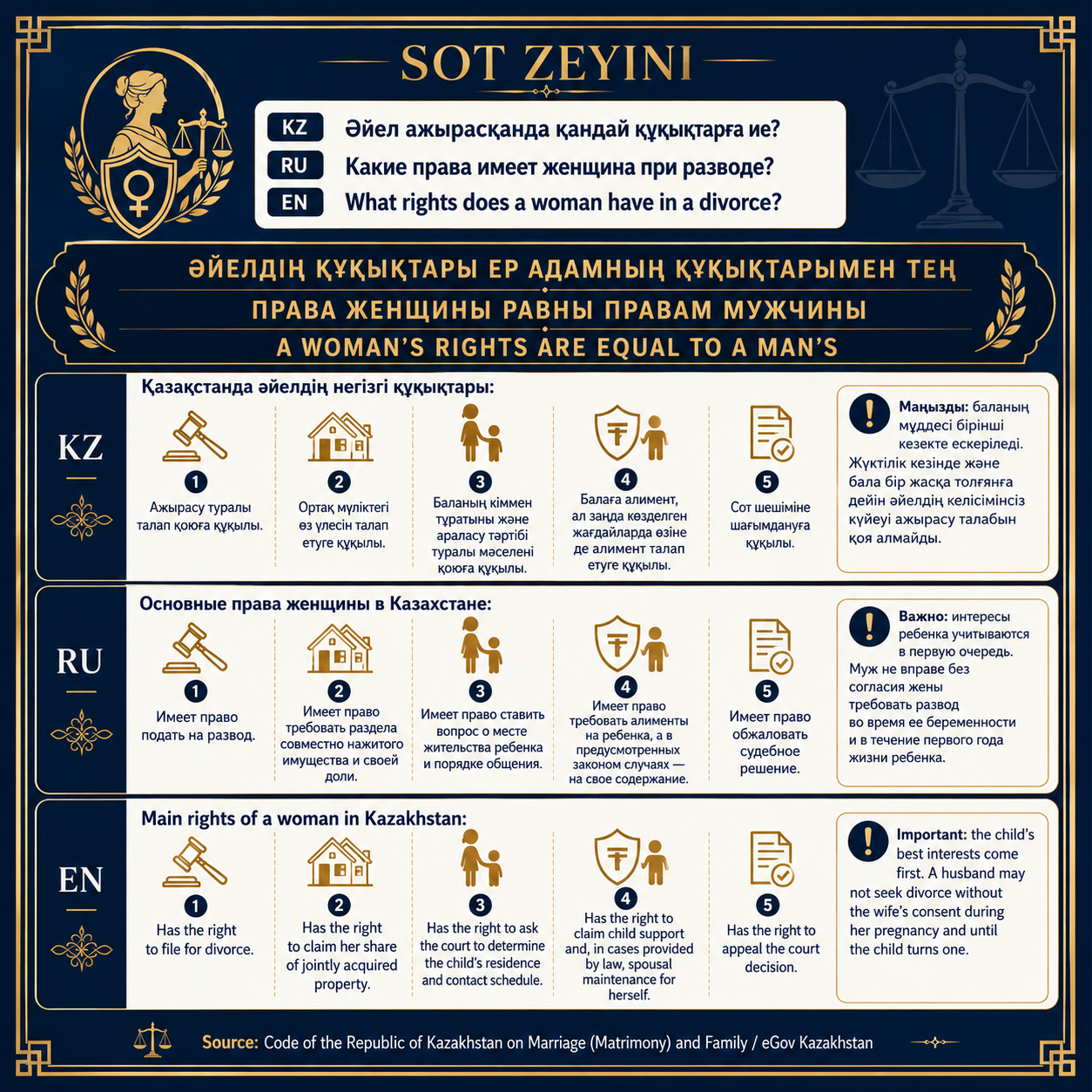
What rights does a woman have during divorce?
In Kazakhstan, a woman has equal rights with her spouse during divorce. She has the right to file for divorce, claim child support, determine the child’s place of residence, divide jointly acquired property, protect her housing rights, and recover expenses related to the maintenance of children.
Divorce is not only about ending a marriage. In many cases, divorce also involves children, child support, an apartment, a car, loans, and jointly acquired property. That is why it is important for a woman to know her rights in advance and prepare documents properly.
A woman’s right to file for divorce
A woman has the right to file for dissolution of marriage on her own. If the spouses do not have minor children, both agree to divorce, and there is no property dispute, the marriage may be dissolved through the civil registry office.
If there are minor children, a dispute, the husband does not agree to divorce, or he avoids the divorce procedure, the woman may apply to court.
A husband cannot “forbid” a woman from divorcing. If family relations have effectively ended and preserving the family is impossible, the woman has the right to demand dissolution of marriage through court.
Special protection during pregnancy and after childbirth
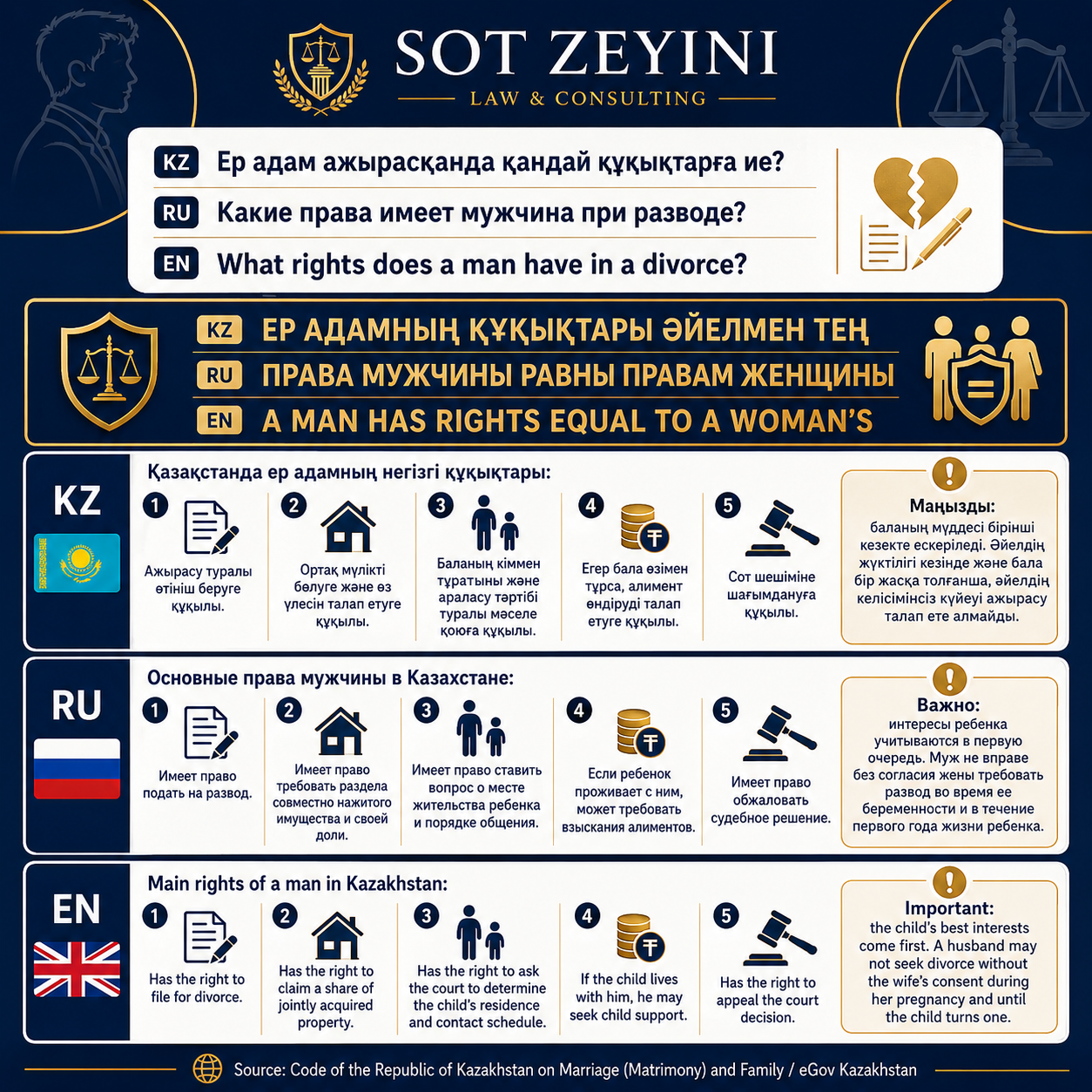
The law provides special protection for a woman during pregnancy and after the birth of a child. A husband may not demand divorce without his wife’s consent during her pregnancy and within the first year of the child’s life.
This means that if the woman is pregnant or the child is under one year old, the husband’s divorce claim should not be granted without the woman’s consent.
However, the woman herself may file for divorce in such a situation. The restriction applies specifically to the husband’s unilateral initiative.
Right to claim child support
If after divorce the children remain with the mother, she has the right to claim child support for their maintenance.
Child support may be established:
- by agreement between the parents;
- by court order;
- through a statement of claim in court;
- as a share of the parent’s income;
- as a fixed monetary amount if income is unstable or difficult to confirm.
Usually, child support for minor children is paid monthly. The amount depends on the number of children and the income of the parent obligated to pay support.
A woman’s right to maintenance from her former spouse
In some cases, a woman may claim support not only for the child, but also for herself.
Such a right may arise if the woman:
- is pregnant with a common child;
- cares for a common child until the child reaches the age of three;
- is disabled and in need of assistance;
- cares for a common disabled child;
- is in another situation provided by law.
This is an important point. Many people think that support payments are only for children. In fact, in certain cases, a woman may also claim maintenance for herself.
Right to determine the child’s place of residence
If a dispute arises during divorce about who the child will live with, the woman may apply to court to determine the child’s place of residence with the mother.
The court takes into account:
- the child’s age;
- the child’s attachment to each parent;
- living conditions;
- parents’ work schedules;
- each parent’s participation in upbringing;
- the opinion of the guardianship authority;
- the child’s interests;
- the parents’ behavior;
- the ability to provide a stable and safe environment for the child.
A child is not “property” to be divided between parents. The main criterion is the child’s interests and safety.
Right to establish the father’s visitation schedule
If the child lives with the mother, the father has the right to communicate with the child. However, if there is a conflict between the parents, the woman may ask the court to establish a clear visitation schedule.
For example:
- every Saturday from 10:00 a.m. to 6:00 p.m.;
- without overnight stays if the child is young;
- in the mother’s presence, if there are grounds;
- taking into account the child’s education, medical treatment, and daily routine;
- without taking the child to another city without the mother’s consent;
- with a prohibition on negative influence on the child.
The more specific the visitation schedule is, the fewer conflicts may arise in the future. The phrase “by mutual agreement of the parties” sounds nice, but in practice it can sometimes turn into complete chaos.
Right to divide jointly acquired property
A woman has the right to divide property acquired during the marriage. As a general rule, jointly acquired property is divided equally between spouses, unless otherwise provided by a marriage contract or agreement.
Jointly acquired property may include:
- an apartment;
- a house;
- a land plot;
- a car;
- money in bank accounts;
- furniture and household appliances;
- a business;
- shares in a company;
- securities;
- other property acquired with common income.
Important: property may be considered joint even if it is registered only in the husband’s name. If an apartment, car, or business was acquired during marriage using common funds, the woman may claim her rights.
If the woman did not work during marriage
If a woman took care of the home, children, and family and had no official income, this does not deprive her of the right to jointly acquired property.
Household work, raising children, and maintaining the family household are also taken into account. A woman should not be left without a share simply because the husband officially earned income while she cared for the home and children.
This is especially important when the husband says: “Everything was bought with my money.” If the property was acquired during marriage, the source of funds, the legal regime of the property, and the evidence must be analyzed.
Right to claim a larger share of property
In certain cases, the court may depart from the principle of equal shares of spouses. For example, if minor children remain with the woman or if the husband spent joint property against the interests of the family.
A woman may ask for an increased share if:
- the children remain with her;
- the husband did not participate in maintaining the family;
- the husband spent joint property to the detriment of the family;
- property was sold without consent;
- loans were not taken for family needs;
- the woman bore the main expenses for the children.
However, an increased share is not granted automatically. Evidence and a proper legal position are required.
Right to protection from the husband’s debts
Not every debt of the husband automatically becomes the wife’s debt. If a loan was taken for the husband’s personal purposes and was not used for family needs, the woman may object to the recognition of such debt as common.
It is important to establish:
- when the loan was taken;
- what the money was spent on;
- whether the woman knew about the loan;
- whether she gave consent;
- whether the loan was used for family needs;
- whether there is evidence that the debt was personal.
If the debt was taken for family needs, the situation may be assessed differently. Therefore, during divorce, each loan should be analyzed separately.
Housing rights after divorce
Housing issues depend on who owns the property and how it was acquired.
If an apartment was purchased during the marriage, the woman may claim a share or compensation.
If the apartment belonged to the husband before marriage, was gifted to him, or inherited by him, it may be considered his personal property. However, if common funds were invested in this housing, major repairs or reconstruction were carried out, the woman may raise claims related to the increase in the value of the property.
If children live in the apartment, this may also be relevant when determining the child’s place of residence and the procedure for using the housing.
Right to conclude a marriage contract or property division agreement
A woman may conclude the following documents with her spouse:
- marriage contract;
- property division agreement;
- mediation agreement;
- agreement on child support payment procedure;
- agreement regarding children.
Such documents can help avoid lengthy court disputes. However, they should be signed carefully. If the terms limit the rights of the woman or children, the document should not be signed without legal advice.
Agreements where a woman waives an apartment, child support, compensation, or a business share should be checked especially carefully.
Right to protection from pressure and threats
If the husband pressures the woman, threatens her, forces her to give up property, refuses to provide documents, takes the children away, or prevents her from going to court, the woman has the right to protect herself through legal means.
Depending on the situation, she may apply to:
- court;
- police;
- guardianship authority;
- private enforcement officer;
- advocate or lawyer;
- crisis center;
- prosecutor’s office, if there are grounds.
No documents should be signed under pressure. Any “agreement” signed out of fear may lead to serious legal consequences.
What documents does a woman need during divorce?
To divorce and protect her rights, a woman may need:
- identity document;
- marriage certificate;
- birth certificates of children;
- documents for an apartment, house, or land plot;
- vehicle registration documents;
- bank statements;
- loan agreements;
- receipts and payment confirmations;
- income certificates;
- documents confirming expenses for children;
- correspondence with the spouse;
- evidence that the child lives with the mother;
- medical documents, if necessary;
- opinion of the guardianship authority, if the dispute concerns children.
The better the documents are collected, the stronger the woman’s position in court will be.
What should a woman do before filing for divorce?
Before filing for divorce, it is advisable to:
- Collect documents related to marriage, children, and property.
- Check what property is registered in the husband’s name.
- Make copies of documents and preserve evidence.
- Decide whether child support is needed.
- Decide whether property should be divided immediately.
- Prepare a position regarding the children.
- Avoid signing agreements without legal review.
- Obtain legal consultation.
- If necessary, request measures to protect property.
- Prepare the statement of claim.
Proper preparation often decides half the case. In court, the winner is not the one who argues louder, but the one who has prepared better evidence.
Can divorce and child support be filed together?
Yes, a woman may file claims for divorce and child support together. However, in some cases, it may be more effective to claim child support separately in order to obtain a court act faster.
For example, if the husband does not support the children, child support may be claimed without waiting for the completion of a complicated divorce or property dispute.
The strategy depends on the specific situation: whether there is a dispute, how many children there are, whether the father is officially employed, whether there is property, and how the respondent behaves.
Can divorce and property division be filed together?
Yes, they can. But this is not always the best strategy.
If the goal is to dissolve the marriage quickly, it may be better to first file only for divorce and then file a separate property division claim.
However, if there is a risk that the husband may sell property, transfer a car to another person, withdraw money, or hide assets, the property issue should be addressed quickly, and the court may need to be asked to apply protective measures.
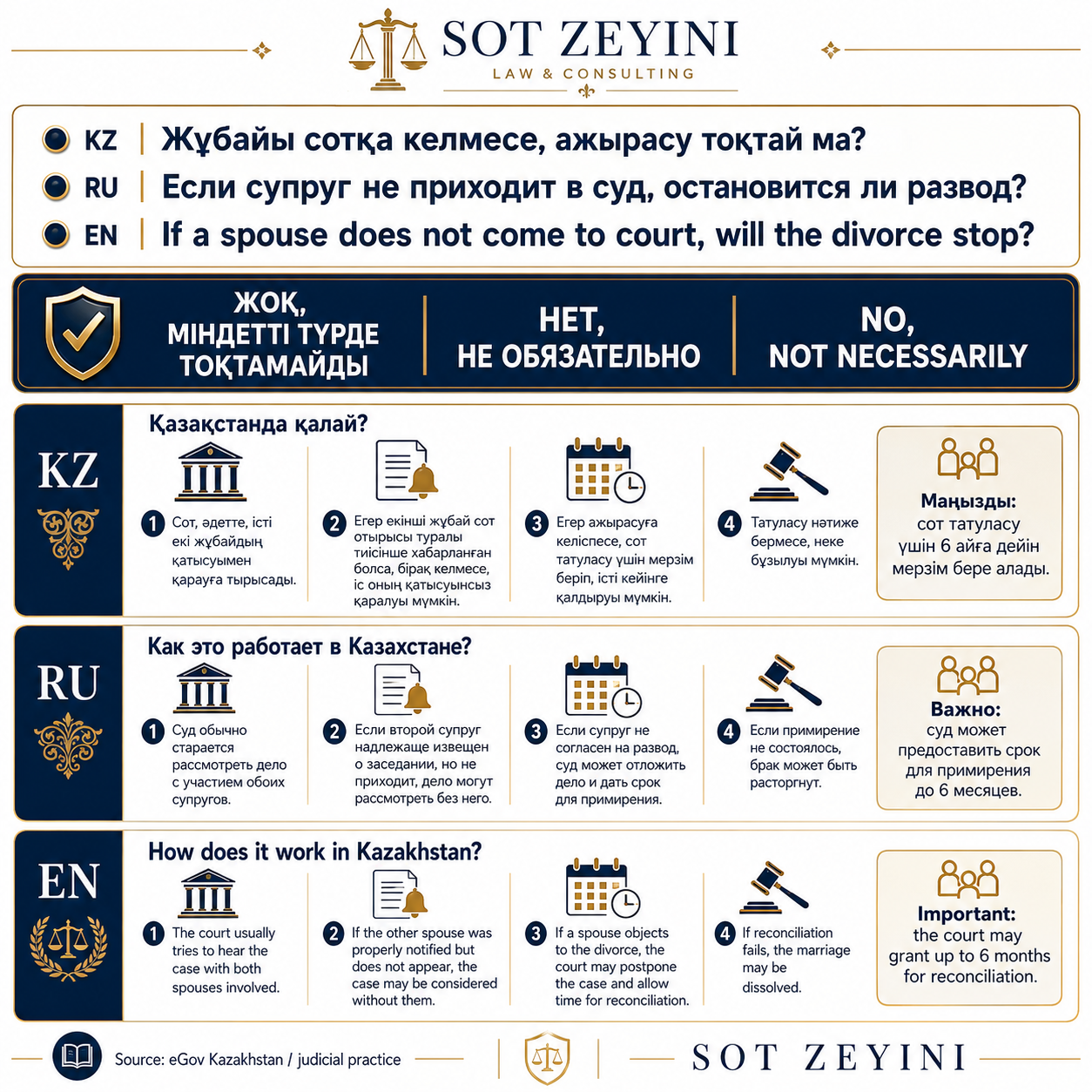
If the husband does not agree to divorce
The husband’s disagreement does not mean that the woman cannot divorce. The court may grant time for reconciliation, but if the woman continues to insist on divorce, the marriage may be dissolved.
A husband cannot block divorce indefinitely. However, he may delay the process, fail to attend court, or raise disputes about children or property. In such cases, it is important to handle the case properly and file the necessary motions on time.
If the husband refuses to provide documents
If the husband does not provide the marriage certificate, children’s documents, or property documents, the woman may restore these documents through the relevant authorities or request information in the legally established procedure.
The absence of original documents in the woman’s possession does not prevent her from applying to court. The main thing is to prepare evidence properly and attach the available documents.
If the husband threatens to take the children away
The father and mother have equal parental rights. However, if the husband threatens to take the children away, interferes with communication, or applies pressure, the woman should act quickly.
She may apply to:
- guardianship authority;
- court to determine the child’s place of residence;
- court to establish the visitation procedure;
- police, if there are threats or violence;
- a lawyer for urgent document preparation.
The main thing is not to leave such threats only in correspondence. Evidence should be recorded and legal steps should be taken.
Legal assistance for women during divorce
Divorce may affect not only family status, but also money, housing, children, loans, and safety. Therefore, it is important for a woman to understand her rights in advance and not agree to terms that worsen her position.
The lawyers of SOT ZEYINI can help with:
- preparing a divorce claim;
- claiming child support;
- determining the child’s place of residence;
- establishing a visitation schedule;
- dividing property;
- protecting a share in an apartment or car;
- objecting to unlawful debts;
- preparing a mediation agreement;
- representing interests in court.
Need a divorce consultation? Message us on WhatsApp — a lawyer will assess your situation, explain your rights, and help choose the right strategy.
FAQ: Frequently Asked Questions About Women’s Rights During Divorce
Can a woman file for divorce without her husband’s consent?
Yes. If the husband does not agree, the divorce is handled through court. His disagreement may delay the process, but it does not deprive the woman of the right to seek dissolution of marriage.
Can a husband divorce a pregnant wife?
Without the wife’s consent, the husband cannot dissolve the marriage during her pregnancy and within the first year of the child’s life. This is special protection for the woman and child.
Does a woman have the right to child support after divorce?
Yes. A woman may claim child support for children. In certain cases, she may also claim maintenance for herself, for example during pregnancy or while caring for a common child under the age of three.
If the child stays with the mother, can she claim child support?
Yes. The parent with whom the child lives has the right to claim child support from the other parent.
Can a woman receive half of the apartment?
If the apartment was purchased during marriage using common funds, the woman may claim a share, even if the apartment is registered in the husband’s name. As a rule, spouses’ shares are considered equal.
If the woman did not work, does she have rights to property?
Yes. If the woman took care of the home, children, and family, this does not deprive her of the right to jointly acquired property.
Are the husband’s loans divided during divorce?
Not all loans are divided automatically. If a loan was taken for family needs, it may be taken into account. If the money was spent only for the husband’s personal purposes, the woman may object to recognizing the debt as common.
Can a woman keep the child with her?
Yes. A woman may ask the court to determine the child’s place of residence with her. The court will consider the child’s interests, living conditions, each parent’s participation in upbringing, and other circumstances.
Can the father see the child after divorce?
Yes. The father has the right to communicate with the child. However, if there is a dispute, the mother may ask the court to establish a specific visitation schedule.
Can the father be prohibited from taking the child overnight?
The court may be asked to establish a visitation schedule without overnight stays if this corresponds to the child’s age, health, daily routine, or interests. The court evaluates the specific circumstances.
Can a woman claim a larger share of property?
Yes, in some cases she may ask the court to depart from equal shares. For example, if the children remain with her or if the husband spent joint property to the detriment of the family. Evidence is required.
What should be done if the husband hides property?
Evidence should be collected, information should be requested through the court, and, if necessary, protective measures should be requested to prevent the property from being sold or transferred to another person.
Can spouses conclude an agreement during divorce?
Yes. Spouses may conclude an agreement regarding children, child support, property, or a mediation agreement. However, before signing, it is better to have the document reviewed by a lawyer.
What should a woman do if the husband threatens or pressures her?
She should not sign documents under pressure, should record threats, and should seek legal assistance. If there is a threat to life, health, or children, she should contact the police and competent authorities.
Does a woman need a lawyer during divorce?
If there are children, property, loans, a mortgage, a dispute, or pressure from the husband, legal assistance is highly recommended. A lawyer can help protect rights and avoid losing important assets.