 +7 775 858 9294
 WhatsApp
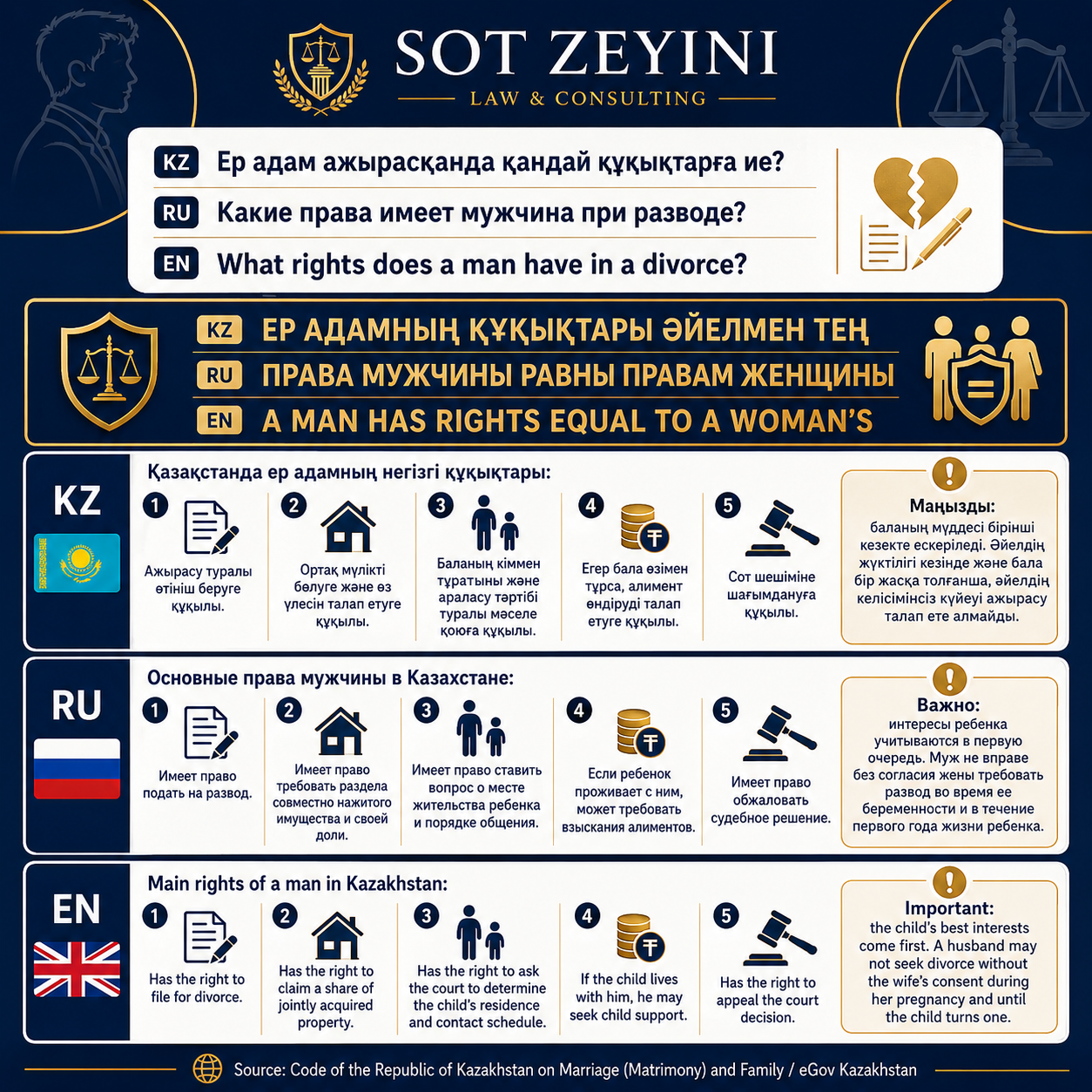
What rights does a man have during divorce?
In Kazakhstan, a man has equal rights with his spouse during divorce. He has the right to file for divorce, participate in the upbringing of children, request that the child’s place of residence be determined with him, establish a visitation schedule, divide jointly acquired property, protect his housing and business, and object to unfounded claims.
Divorce is not only about ending a marriage. In many cases, divorce also involves children, child support, an apartment, a car, loans, business, and jointly acquired property. Therefore, it is important for a man to know his rights in advance and prepare a proper legal position.
A man’s right to file for divorce
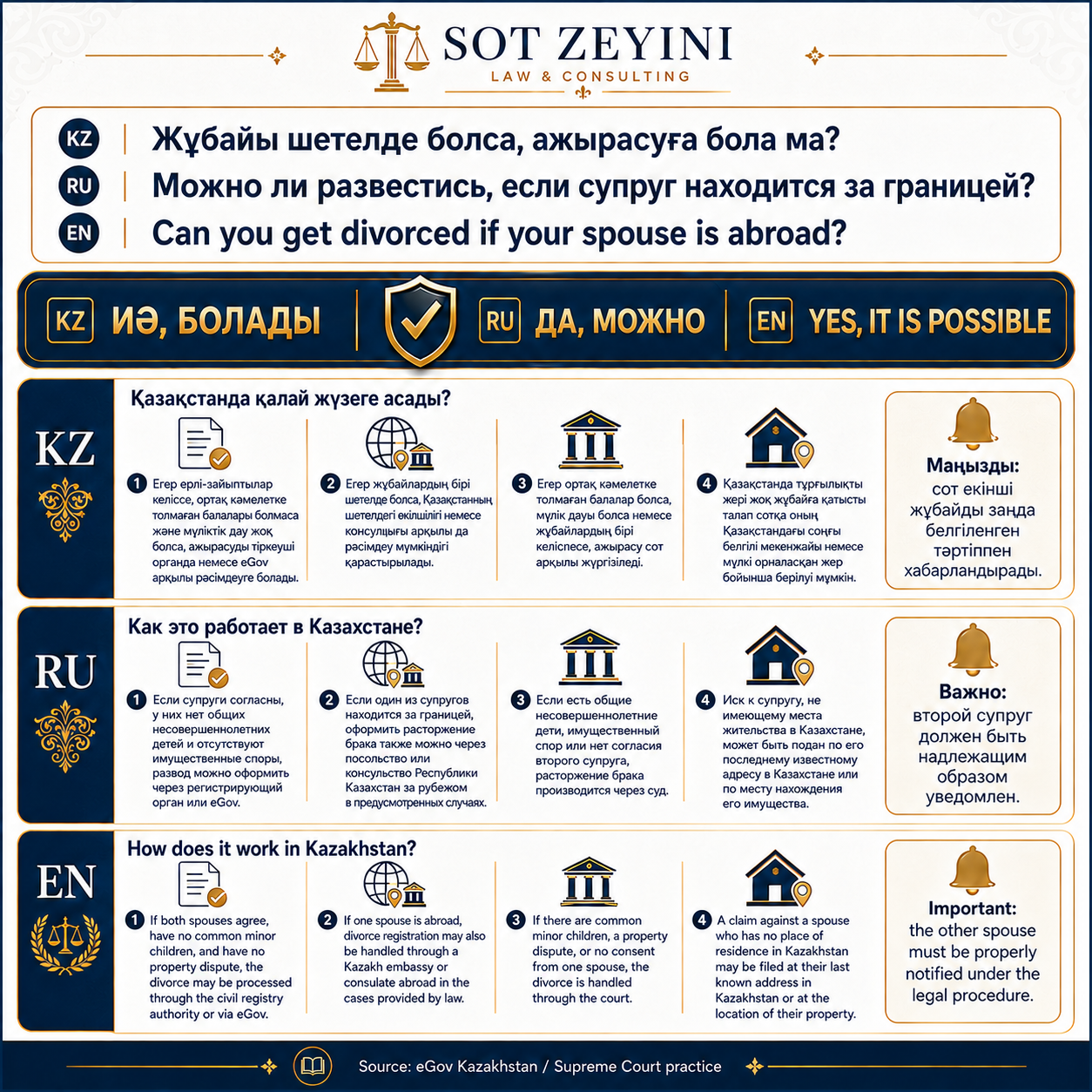
A man has the right to file for dissolution of marriage. If the spouses do not have minor children, both agree to divorce, and there is no property dispute, the marriage may be dissolved through the civil registry office.
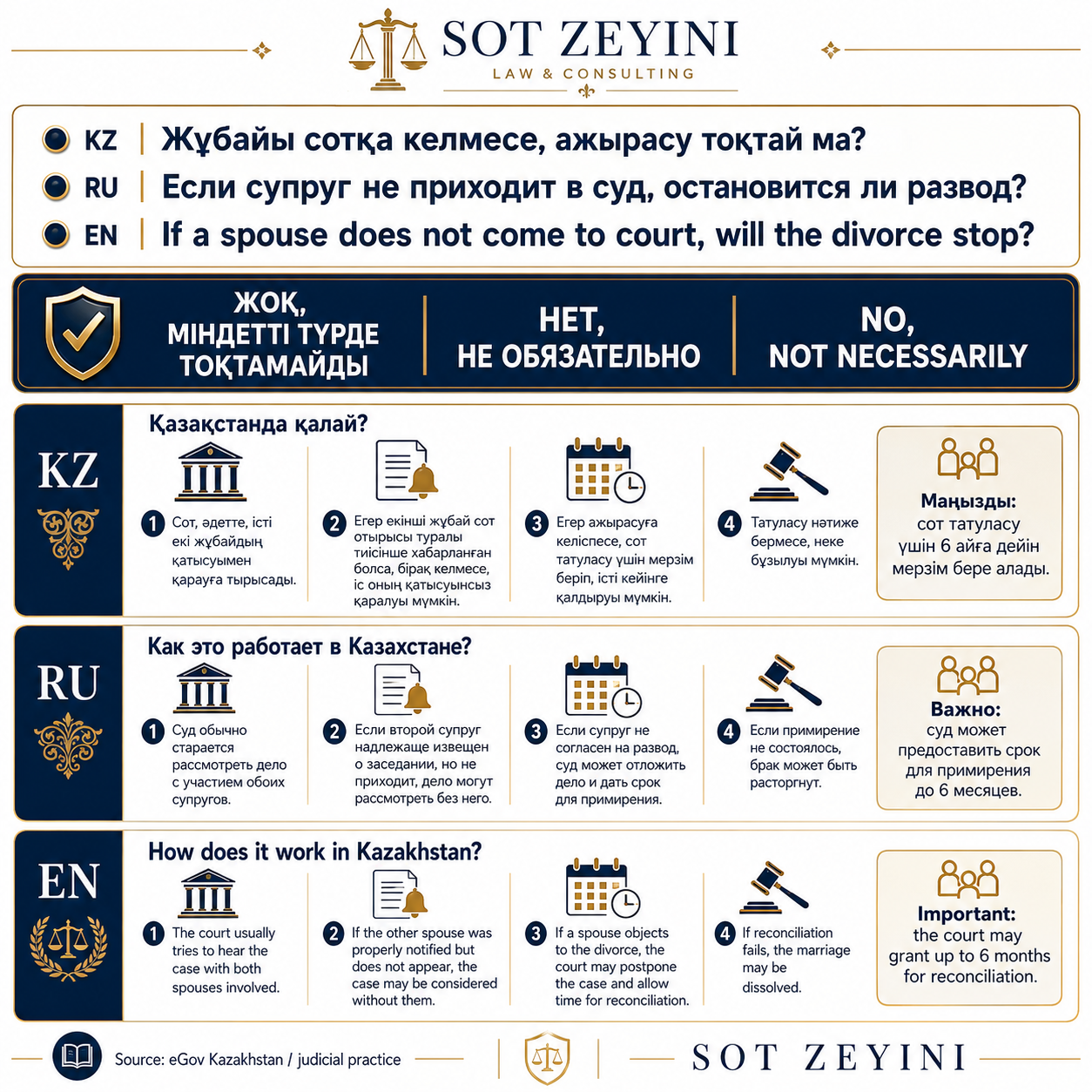
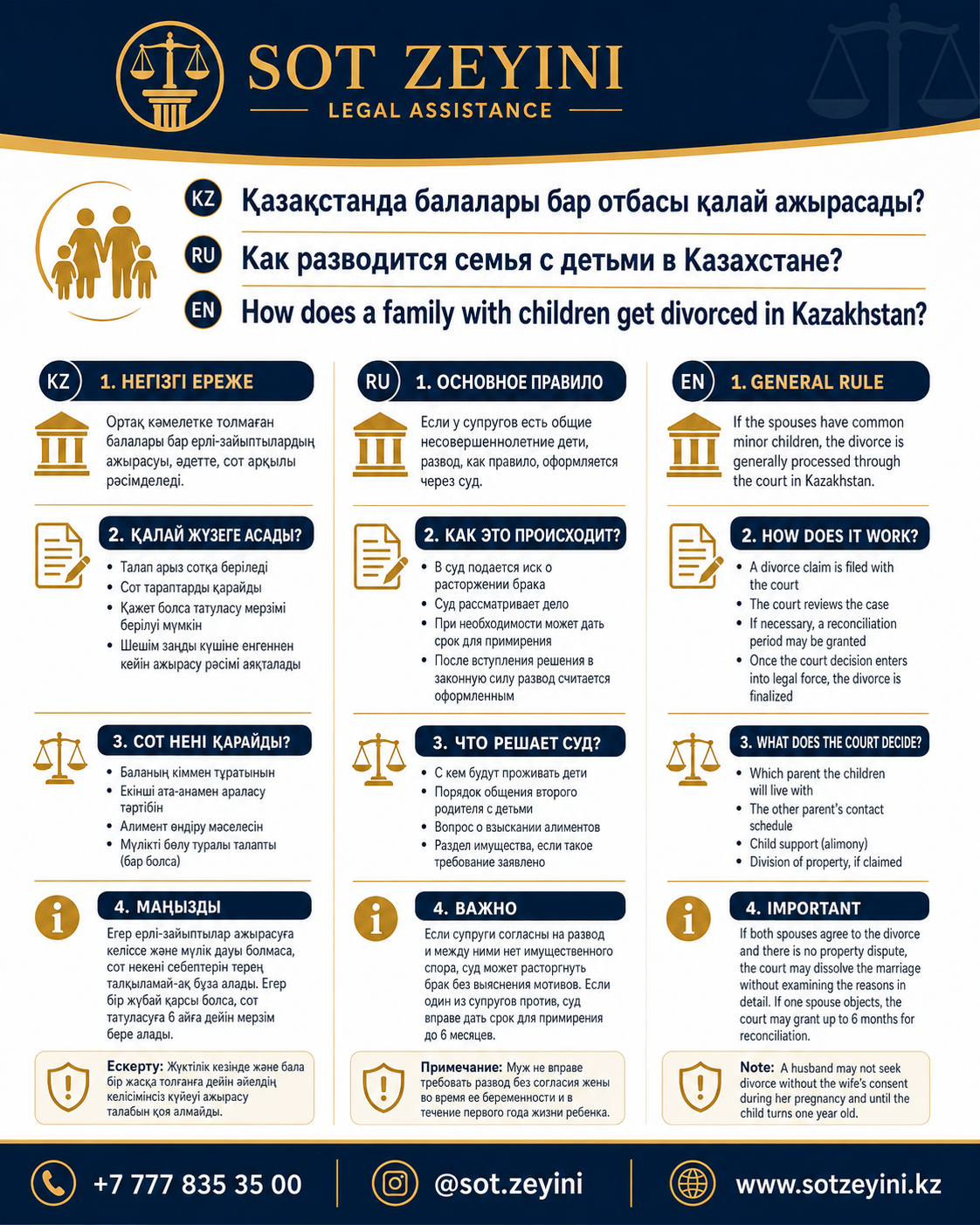
If there are minor children, a dispute, the wife does not agree to divorce, or she avoids the divorce procedure, the man may apply to court.
However, there is an important restriction: a husband may not demand divorce without his wife’s consent during her pregnancy and within the first year of the life of their common child. This is a special legal protection for the woman and child.
Can a man divorce if his wife is against it?
Yes, in most cases, a man can divorce through court even if his wife is against it. The court may grant time for reconciliation, but if preserving the family is impossible and the man continues to insist on divorce, the marriage may be dissolved.
The exception is when the wife is pregnant or the common child is under one year old. During this period, the husband cannot demand divorce without the wife’s consent.
A man’s right to participate in raising the child
The father and mother have equal parental rights. After divorce, a man does not lose the right to participate in the child’s life.
A father has the right to:
- communicate with the child;
- participate in upbringing;
- receive information about the child’s education and health;
- take part in choosing a school, medical treatment, and extracurricular activities;
- spend time with the child;
- participate in important decisions;
- protect the child’s interests in court and state authorities.
Divorce ends the marriage, but it does not end fatherhood. A former husband may stop being a spouse, but he does not stop being a father.
Right to establish a visitation schedule
If, after divorce, the child lives with the mother, the father has the right to see the child. If the mother prevents communication, the man may apply to court to establish a visitation schedule.
The court may be asked to establish a specific schedule, for example:
- every Saturday or Sunday;
- from 10:00 a.m. to 6:00 p.m.;
- with or without overnight stays;
- on public holidays;
- during school holidays;
- with phone and video calls;
- with the right to pick up the child from school or kindergarten;
- with a prohibition on preventing communication.
The more specific the schedule is, the fewer conflicts may arise later. The phrase “by agreement of the parents” sounds nice, but if there is no agreement, it can turn into an endless family quest.
A man’s right to request that the child live with him
A man has the right to ask the court to determine the child’s place of residence with the father. The law does not automatically state that the child must always remain with the mother.
The court takes into account:
- the child’s age;
- the child’s attachment to each parent;
- living conditions;
- each parent’s participation in upbringing;
- the work schedule of the father and mother;
- stability of income;
- moral qualities of the parents;
- the child’s opinion, if it can be taken into account;
- the opinion of the guardianship authority;
- the safety and interests of the child.
If the father is actively involved in the child’s life, provides stable conditions, participates in upbringing, and can prove that living with him is in the child’s best interests, he has the right to make such a claim.
What should a father do if the mother does not allow him to see the child?
If the mother prevents communication with the child, the man should not limit himself to sending WhatsApp messages asking to see the child. It is important to collect evidence.
Evidence may include:
- correspondence;
- audio and video materials, if obtained lawfully;
- applications to the guardianship authority;
- court applications;
- witness statements;
- evidence of attempts to see the child;
- documents confirming expenses for the child.
After that, the man may apply to court to establish a visitation schedule. If the schedule has already been established but the mother violates it, the issue of enforcement of the court act may be raised.
A man’s right to claim child support if the child lives with him
If the child lives with the father after divorce, the man has the right to claim child support from the mother.
Child support is not only the father’s obligation. It is the duty of both parents. The parent who lives separately from the child must participate in the child’s maintenance.
A father may claim child support:
- through a court order;
- through a statement of claim;
- as a share of the mother’s income;
- as a fixed monetary amount if income is unstable;
- by agreement between the parents.
If the child lives with the father, the father has the same right to claim child support as the mother would have in the same situation.
Right to object to an unreasonable amount of child support
If the claimed amount of child support is excessive or does not take into account the man’s actual financial situation, he has the right to present objections to the court.
The following circumstances may be considered:
- number of children;
- official income;
- presence of other children;
- health condition;
- loans and obligations;
- expenses for the child already paid by the father;
- actual participation in the child’s maintenance;
- lack of stable income;
- other circumstances deserving attention.
This does not mean that the father may avoid supporting the child. But he has the right to a fair and lawful amount of child support.
Right to reduce child support
In certain cases, a man may ask the court to reduce the amount of child support. For example, if his financial or family situation has changed.
Grounds may include:
- birth of other children;
- deterioration of health;
- loss of employment;
- decrease in income;
- presence of disabled dependents;
- excessive deductions from income;
- other circumstances affecting the ability to pay.
However, child support is not reduced automatically. It is necessary to apply to court and prove the relevant grounds.
Right to reasonably participate in additional child expenses
A father is obliged to participate in the maintenance of the child. But if additional expenses are demanded from him, he has the right to understand exactly what the money is needed for.
For example, supporting documents may be requested for expenses related to:
- medical treatment;
- education;
- extracurricular activities;
- sports clubs;
- clothing;
- medicines;
- rehabilitation;
- special needs of the child.
If the expenses are real and necessary, the father may participate in them. If the claims are unfounded, excessive, or not supported by documents, the man has the right to object.
Right to divide jointly acquired property
A man has the right to divide property acquired during marriage. As a general rule, jointly acquired property is divided equally between spouses, unless otherwise provided by a marriage contract or agreement.
Jointly acquired property may include:
- apartment;
- house;
- land plot;
- car;
- money in bank accounts;
- furniture and household appliances;
- business;
- share in a company;
- securities;
- income from entrepreneurship;
- other property acquired with common funds.
If the property is registered in the wife’s name but was acquired during marriage using common funds, the man may demand its division.
If the man was the only income earner in the family
Even if the man was the main or only source of income in the family, property acquired during marriage is usually considered joint property.
At the same time, the man may protect his position if:
- the property was purchased using personal money acquired before marriage;
- the property was received as a gift;
- the property was inherited;
- the purchase was made using proceeds from the sale of personal property;
- there is a marriage contract;
- there is evidence that the property is not joint.
The phrase “I earned it, so everything is mine” does not always work in court. But if the property is truly personal, this must be proven with documents.
A man’s right to personal property
Not all property is subject to division. A man’s personal property may include:
- property acquired before marriage;
- property received as a gift;
- inherited property;
- personal-use items;
- property acquired with personal funds;
- property excluded from the joint property regime by a marriage contract.
If the wife claims division of such property, the man has the right to object and provide evidence that the property is personal.
Right to protect business during divorce
If a man has a business, a share in a company, individual entrepreneurship, company assets, or income from business activities, it is important to correctly determine what exactly may be subject to division during divorce.
It is necessary to distinguish between:
- personal share in the company;
- property of the company itself;
- income received during marriage;
- investments in the business;
- business obligations;
- the spouse’s contribution to business development;
- marriage contract or agreements.
A wife cannot always simply “take half of the business.” However, if the business was created or developed during marriage using common funds, property claims may arise.
Right to protection from the wife’s debts
Not every debt of the wife automatically becomes a common family debt. If a loan was taken by the wife for personal purposes and was not used for family needs, the man may object to recognizing such debt as common.
It is important to establish:
- when the loan was received;
- whether the man gave consent;
- where the money was spent;
- whether the funds were used for family needs;
- whether there is evidence that the debt was personal;
- whether the man knew about the loan.
If the loan was used for family needs, the situation may be assessed differently. Therefore, each debt must be analyzed separately.
Right to protection from false or unfounded claims
Sometimes during divorce one party may make claims that do not reflect reality: overestimate the value of property, hide assets, present personal property as joint property, or demand unfounded expenses.
A man has the right to:
- submit objections;
- request evidence;
- file a motion for property valuation;
- ask the court to request bank documents;
- prove the personal nature of property;
- challenge unfounded claims;
- file a counterclaim.
Emotions may be loud during divorce, but the court looks at evidence. Documents speak louder than stories.
Right to conclude an agreement during divorce
A man may conclude the following agreements with his spouse:
- agreement regarding children;
- agreement on visitation schedule;
- child support agreement;
- property division agreement;
- mediation agreement;
- marriage contract;
- compensation agreement.
Such documents may save time, money, and nerves. But an agreement should be signed only after its terms have been checked.
Special attention should be paid to documents where the man:
- gives up his share in an apartment;
- assumes all loans;
- agrees to excessive child support;
- loses the right to communicate with the child;
- transfers property without compensation;
- signs terms without deadlines and liability.
Right to protection against false accusations
Sometimes, in a conflict divorce, accusations may arise regarding violence, threats, lack of participation in upbringing, addiction, or danger to the child.
If the accusations are false, the man should protect himself calmly and legally:
- collect evidence;
- preserve correspondence;
- involve witnesses;
- provide character references;
- confirm participation in the child’s life;
- provide documents confirming payment of expenses;
- avoid responding to aggression with aggression;
- act through court and official authorities.
The main thing is not to turn the conflict into an emotional war. Any harsh message may later become an “exhibit” in court.
What documents does a man need during divorce?
A man may need the following documents:
- identity document;
- marriage certificate;
- children’s birth certificates;
- property documents;
- vehicle documents;
- bank statements;
- loan agreements;
- business documents;
- receipts and payment confirmations;
- evidence of expenses for the child;
- correspondence with the spouse;
- photos and videos confirming participation in upbringing;
- character references;
- income certificates;
- medical documents, if necessary;
- documents confirming personal property.
The better the documents are prepared, the stronger the man’s position in court will be.
What should a man do before divorce?
Before divorce, it is advisable for a man to:
- Collect documents related to marriage, children, and property.
- Check what property is registered in the wife’s name.
- Make copies of documents.
- Record participation in the child’s upbringing.
- Keep proof of expenses for children.
- Check loans and obligations.
- Avoid signing agreements without analysis.
- Obtain legal advice.
- Determine a strategy regarding children.
- Prepare a legal position regarding property.
Proper preparation is not paranoia — it is legal hygiene.
Can divorce and visitation schedule be requested together?
Yes, a man may request establishment of a visitation schedule together with the divorce claim.
This is especially important if the mother already prevents meetings with the child. In such a case, it is better not to leave the issue “for later,” but to immediately ask the court to establish a specific schedule.
Can divorce and property division be filed together?
Yes, they can. But this is not always the best strategy.
If the goal is to dissolve the marriage quickly, it may be better to first file only for divorce and then file a separate property division claim.
However, if there is a risk that the spouse may sell property, withdraw money, transfer a car to another person, or hide assets, the property issue should be addressed urgently. In some cases, the court may be asked to apply protective measures.
If the wife refuses to provide documents
If the spouse does not provide the marriage certificate, children’s documents, car documents, apartment documents, or other property documents, the man may restore them through the relevant authorities or request information through the court.
The absence of original documents does not deprive the man of the right to apply to court. The main thing is to prepare the application and evidence correctly.
If the wife took the child away
If the mother took the child away and does not allow the father to communicate, it is necessary to act officially:
- preserve correspondence;
- apply to the guardianship authority;
- file a claim to determine the child’s place of residence;
- file a claim to establish a visitation schedule;
- contact the police if there are threats or unlawful actions;
- avoid self-help actions that may be used against the father.
Taking the child back on one’s own may worsen the father’s position in court. It is better to act through legal mechanisms.
Legal assistance for men during divorce
Divorce may affect children, property, child support, business, loans, and housing. A man should not take a passive position or assume that “the court will always side with the mother.”
The lawyers of SOT ZEYINI can help with:
- preparing a divorce claim;
- establishing a visitation schedule;
- determining the child’s place of residence with the father;
- defending against unfounded child support claims;
- reducing child support if there are legal grounds;
- dividing property;
- protecting business;
- objecting to the spouse’s personal debts;
- preparing a mediation agreement;
- representing interests in court.
Need a divorce consultation? Message us on WhatsApp — a lawyer will assess your situation, explain your rights, and help choose the right strategy.
FAQ: Frequently Asked Questions About Men’s Rights During Divorce
Can a man file for divorce without his wife’s consent?
Yes. However, if the wife is pregnant or the common child is under one year old, the husband cannot demand divorce without the wife’s consent.
If the wife is against divorce, will the court dissolve the marriage?
Yes, in most cases, the court may dissolve the marriage if reconciliation is impossible and the man insists on divorce. The court may grant time for reconciliation, but the wife’s disagreement does not block divorce forever.
Does the father have equal rights to the child?
Yes. The father and mother have equal parental rights and obligations. Divorce does not deprive the man of the right to participate in the child’s upbringing.
Can the father keep the child with him?
Yes. A man may ask the court to determine the child’s place of residence with the father. The court considers the child’s interests, living conditions, and each parent’s participation in upbringing.
What should be done if the mother does not allow the father to see the child?
The obstacles should be recorded as evidence, an application should be made to the guardianship authority, and a claim should be filed in court to establish a visitation schedule.
Can the father take the child overnight?
Yes, if this corresponds to the child’s age, routine, health, and interests. If there is a dispute, this issue may be resolved by the court.
Can the father claim child support from the mother?
Yes. If the child lives with the father, he has the right to claim child support from the mother.
Can child support be reduced?
Yes, if there are grounds, the man may apply to court to reduce child support. For example, if his financial or family situation has changed.
Can a man control how child support is spent?
Child support must be spent on the child’s maintenance, education, and upbringing. If there are serious doubts about how the money is being used, evidence should be collected and a lawyer should be consulted.
Does a man have the right to half of the property?
Yes, if the property was acquired during marriage and is considered joint property, the man may claim his share even if the property is registered in the wife’s name.
Is property acquired by the man before marriage divided?
Usually, property acquired before marriage is considered personal property and is not divided. However, documents confirming the date and source of acquisition should be available.
Is a man’s business divided during divorce?
This depends on when and with what funds the business was created or developed. If the business was created during marriage using common funds, claims for division or compensation may arise.
Is a man obliged to pay his wife’s debts?
Not always. If the debt was taken for personal purposes and was not used for family needs, the man may object to recognizing it as a common debt.
What should be done if the wife hides property?
Evidence should be collected, information should be requested through the court, and, if necessary, protective measures should be requested to prevent the property from being sold or transferred.
Can spouses conclude an agreement during divorce?
Yes. Spouses may conclude an agreement regarding children, child support, property division, or mediation. However, before signing, the document should be checked by a lawyer.
What should a man do if the wife makes false accusations?
He should remain calm, record evidence, avoid responding aggressively, and defend himself officially through the court, guardianship authority, police, and a lawyer.
Does a man need a lawyer during divorce?
If there are children, property, child support, business, loans, or conflict, legal assistance is highly recommended. A lawyer can help protect the man’s rights and avoid losing important property or contact with the child.