 +7 775 858 9294
 WhatsApp
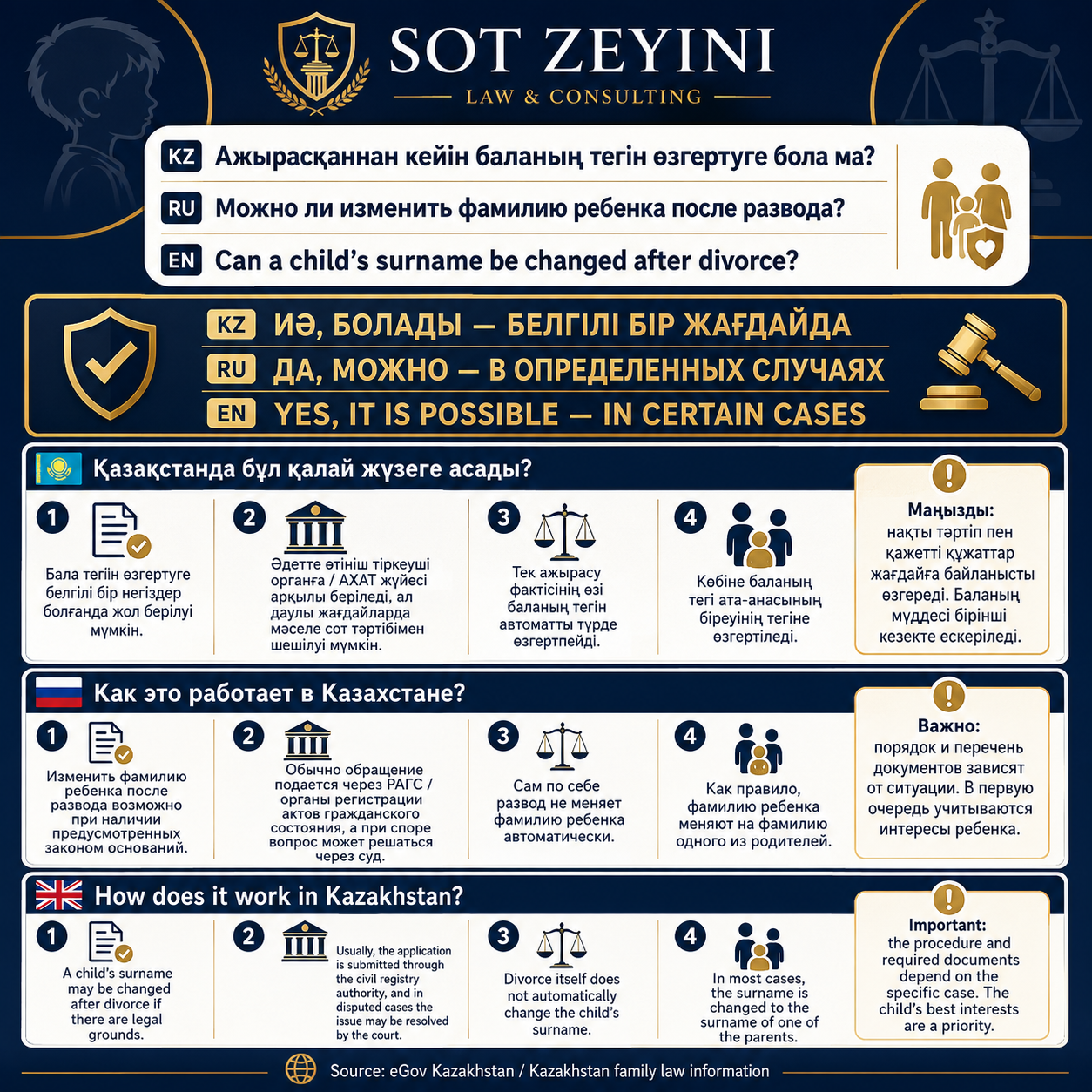
Can a child’s surname be changed after divorce?
Yes, in Kazakhstan, a child’s surname can be changed after the parents’ divorce. However, it is important to understand that divorce itself does not automatically change the child’s surname. After the marriage is dissolved, the child usually keeps the surname given at birth.
To change a child’s surname, the legal procedure must be followed. In most cases, the consent of the parents, the interests of the child, and the child’s own opinion are taken into account if the child has reached the required age.
In other words, after divorce, one parent cannot simply decide: “Now the child will have my surname” and immediately change the documents. The issue is resolved through the competent authorities, and if there is a dispute between the parents, it may need to be resolved in court.
What surname does the child keep after divorce?
After the parents’ divorce, the child keeps the surname received at birth. For example, if the child was registered under the father’s surname, the divorce of the parents does not automatically change the surname to the mother’s surname.
This rule protects the stability of the child’s legal status. A surname is an important part of a child’s personal data, so changing it requires lawful grounds and proper formalization.
Who can apply to change the child’s surname?
The issue of changing a child’s surname may be raised by the parents or legal representatives of the child.
A minor child’s surname may be changed:
- upon a joint application of the parents;
- through the registering authority;
- taking into account the child’s interests;
- with the child’s consent if the child has reached the age of 10;
- through court if there is a dispute between the parents.
If both parents agree, the procedure is usually easier. If one parent objects, the situation becomes more complicated.
Is the consent of both parents required?
In most cases, the consent of both parents is required to change a child’s surname. If the parents reach a common decision, they may file a joint application with the competent authority.
For example, if the child has the father’s surname and after divorce the mother wants to change the child’s surname to her own, the father’s opinion is usually taken into account. Such consent or opinion is often formalized notarized.
However, if one parent objects, the issue is resolved based on the child’s interests. The simple wish of one parent may not be enough.
Can a child’s surname be changed without the father’s consent?
Yes, in some cases, a child’s surname may be changed without the mandatory consideration of the father’s opinion.
This may be possible if:
- the father’s whereabouts cannot be established;
- the father has been deprived of parental rights;
- the father’s parental rights have been restricted;
- the father has been declared legally incapable;
- the father avoids supporting and raising the child without valid reasons;
- paternity has not been legally established.
For example, if the father does not participate in the child’s life, does not pay child support, is not interested in the child’s upbringing, and his actual whereabouts are unknown, the mother may raise the issue of changing the child’s surname.
However, simply saying “the father does not help” is not enough. Evidence is required.
Can a child’s surname be changed without the mother’s consent?
Yes, theoretically, the father may also raise the issue of changing the child’s surname. However, the mother’s opinion is also taken into account.
If the child lives with the mother, the mother participates in upbringing, cares for the child, and objects to changing the surname, it may be difficult to achieve such a change.
The father must prove that changing the surname is in the child’s interests. For example, the child actually lives with the father, the mother does not participate in upbringing, or there are other serious circumstances.
Is the child’s consent required?
Yes. If the child has reached the age of 10, changing the child’s surname is allowed only with the child’s consent.
This is an important rule. Even if both parents agree, but a child aged 10 or older objects to the surname change, the child’s opinion must be taken into account.
The surname is carried not by the parent, but by the child. Therefore, the child’s position matters, especially if the child already attends school, communicates socially, and is used to the current surname.
Until what age can parents change a child’s surname?
Until the child reaches the age of 16, parents may apply to change the child’s name or surname. The competent authority must consider the child’s interests.
Grounds for changing a surname may include:
- the child lives with the mother and wants to have her surname;
- one of the parents changed their surname;
- the parents agreed to change the child’s surname;
- the surname needs to be brought into line with national traditions;
- one parent does not participate in raising the child;
- changing the surname meets the psychological or social interests of the child.
Each situation is considered individually. There is no automatic rule that “the parents divorced, so the surname can immediately be changed.”
If the child lives with the mother, can the child receive the mother’s surname?
Yes, it is possible. If after divorce the child lives with the mother, she may apply to change the child’s surname to her own.
The following circumstances are usually considered:
- who the child actually lives with;
- whether the surname change is in the child’s interests;
- the opinion of the other parent;
- the child’s consent if the child has reached the age of 10;
- the other parent’s participation in the child’s upbringing and maintenance;
- whether there is a dispute between the parents.
If the father agrees, the procedure may be easier. If the father objects, court proceedings or an application to the competent authorities may be required.
What should be done if the father objects to the surname change?
If the father objects to changing the child’s surname, it is necessary to understand how justified his position is. If the father participates in the child’s life, pays child support, communicates with the child, and takes part in upbringing, his opinion will matter.
However, if the father formally objects but does not participate in the child’s life, does not pay child support, and does not maintain contact, the mother may prove her position.
In such a situation, the following may be needed:
- certificate of child support arrears;
- documents from the enforcement officer;
- evidence of lack of communication with the child;
- certificates from school or kindergarten;
- applications to the guardianship authority;
- correspondence;
- witness statements;
- the child’s opinion if the child has reached the age of 10.
In court, evidence works better than emotions. The phrase “the father is bad” is weaker than a document showing that the father does not pay child support and does not participate in the child’s upbringing.
What documents are needed to change a child’s surname?
The list of documents depends on the specific situation. Usually, the following may be required:
- application from one or both parents;
- identity documents of the parents;
- child’s birth certificate;
- document confirming divorce;
- documents confirming the child’s place of residence;
- notarized consent or opinion of the other parent;
- child’s consent if the child has reached the age of 10;
- documents confirming child support arrears, if any;
- court decision on deprivation or restriction of parental rights, if any;
- documents confirming that a parent has been declared legally incapable, if any;
- evidence that the whereabouts of the other parent cannot be established;
- guardianship authority documents, if required;
- court decision, if the issue was resolved through court.
Before applying, it is better to check the required document list in advance, because requirements may differ depending on the grounds.
Where should you apply to change a child’s surname?
The issue of changing a child’s surname is usually considered by the registering authority. In some cases, an application may be submitted through a Public Service Center or electronic government services.
If there is no dispute between the parents, the procedure may be completed administratively.
If there is a dispute, the other parent objects, or it is necessary to prove grounds for changing the surname without the other parent’s consent, the issue may be resolved through court.
Before submitting documents, it is important to determine:
- whether the other parent agrees;
- how old the child is;
- who the child lives with;
- whether the other parent participates in upbringing;
- whether child support is paid;
- whether there is evidence of avoidance of parental duties;
- whether court action is necessary.
Submitting documents without analyzing the situation is like going to court without evidence: technically possible, but stressful and inefficient.
Can a child’s surname be changed through court?
Yes. If there is a dispute between the parents, the issue may go to court. The court will assess not only the parents’ positions but also the child’s interests.
The court may consider:
- who the child lives with;
- whether the other parent participates in the child’s life;
- whether child support is paid;
- how the surname change may affect the child;
- the child’s opinion if the child has reached the age of 10;
- the position of the guardianship authority;
- evidence submitted by the parties;
- reasons why one parent requests the surname change;
- reasons why the other parent objects.
The main question for the court is whether the surname change serves the child’s interests or is only a result of conflict between the parents.
Does changing a child’s surname affect child support?
No. Changing a child’s surname does not terminate the parent’s obligation to pay child support.
For example, if the child had the father’s surname and later receives the mother’s surname, the father is still required to pay child support if such obligation exists under the law, an agreement, or a court act.
The child’s surname and the obligation to support the child are separate issues. A surname change does not cancel parental duties.
Are the father’s parental rights terminated after the child’s surname is changed?
No. Changing a child’s surname does not automatically terminate the father’s parental rights.
If the father has not been deprived of parental rights, he keeps the right to:
- communicate with the child;
- participate in upbringing;
- receive information about the child’s education and health;
- apply to court to establish a visitation schedule;
- protect the child’s interests;
- participate in important decisions.
A surname change is a change in the child’s personal data, not a termination of family relationship.
Is it necessary to deprive the father of parental rights to change the child’s surname?
No, this is not always necessary. The law does not require the father to be deprived of parental rights in every case only to change the child’s surname.
However, if the father has already been deprived of parental rights, his opinion may not be taken into account when changing the child’s surname.
At the same time, deprivation of parental rights is a serious legal measure. Using it only to change the child’s surname is not always the right strategy. There must be independent legal grounds for deprivation of parental rights.
If the father does not pay child support, can the child’s surname be changed?
Non-payment of child support may be one of the arguments for changing the child’s surname. However, this does not mean that the surname will be changed automatically.
It is necessary to prove:
- existence of child support arrears;
- avoidance of child maintenance;
- lack of participation in upbringing;
- lack of contact with the child;
- that the surname change is in the child’s interests;
- the child’s consent if the child has reached the age of 10.
Non-payment of child support is a strong argument, but it is better to support it with additional evidence.
If the father does not communicate with the child, can the surname be changed?
Yes, this issue may be raised. If the father does not actually participate in upbringing, does not maintain a relationship with the child, and does not fulfill parental duties, this may be taken into account.
However, evidence must be collected. For example:
- correspondence;
- certificates;
- enforcement officer documents;
- witness statements;
- applications to authorities;
- information on child support arrears.
The more evidence there is, the stronger the position of the parent requesting the surname change.
If the father’s whereabouts are unknown
If it is impossible to establish the whereabouts of the other parent, that parent’s opinion may not be taken into account.
However, this fact must be confirmed by documents. The following may be needed:
- information about the last known address;
- documents confirming impossibility of delivering notice;
- responses from state authorities;
- evidence of lack of contact;
- other materials confirming that the whereabouts are unknown.
Simply saying “I do not know where he is” is usually not enough. Evidence is needed.
How long does it take to change a child’s surname?
The timeframe depends on the specific situation.
If both parents agree, the documents are complete, and there is no dispute, the procedure may be completed faster.
If the other parent objects, their whereabouts are unknown, court proceedings are required, or evidence must be collected, the process may take longer.
Therefore, before starting the procedure, it is better to consult a lawyer and choose the correct legal route.
What documents need to be updated after changing the child’s surname?
After the child’s surname is changed, changes are made to the birth record, and a new birth certificate may be issued.
It may also be necessary to update:
- the child’s identity card or passport, if any;
- school documents;
- kindergarten documents;
- medical documents;
- bank documents, if any;
- visa or migration documents;
- data in child support or court documents.
If documents are not updated on time, difficulties may arise later at school, in a clinic, when traveling abroad, or when receiving public services.
Common mistakes when changing a child’s surname
In practice, the following mistakes are common:
- the parent does not take into account that the other parent’s opinion may be required;
- the consent of a child aged 10 or older is not obtained;
- the application is submitted without evidence;
- the child’s interests are not properly justified;
- child support arrears are not confirmed;
- avoidance of upbringing by the other parent is not proven;
- the application is submitted to the wrong authority;
- the application is too emotional;
- necessary documents are not attached.
Changing a child’s surname is not just “changing letters in documents.” It is a legally significant procedure where accuracy matters.
Is a lawyer needed to change a child’s surname?
If both parents agree, the situation may be relatively simple. However, if the other parent objects, does not pay child support, does not participate in upbringing, their whereabouts are unknown, or the child has already reached the age of 10, legal assistance may be very useful.
A lawyer can help:
- assess the situation;
- determine where to apply;
- collect documents;
- prepare evidence;
- draft an application or claim;
- respond to the objections of the other parent;
- prove the child’s interests;
- represent interests in court.
The main goal is not to prove which parent is “more right,” but to protect the child’s interests legally and properly.
Legal assistance from SOT ZEYINI
The lawyers of SOT ZEYINI can assist with issues related to changing a child’s surname after divorce.
We can help if:
- the child’s surname needs to be changed to the mother’s surname;
- the father does not give consent;
- the mother does not give consent;
- the whereabouts of the other parent are unknown;
- the other parent does not pay child support;
- the other parent does not participate in upbringing;
- the child has already reached the age of 10;
- an application needs to be prepared;
- it is necessary to apply to court;
- the child’s interests must be proven.
Need advice on changing a child’s surname? Message us on WhatsApp — a lawyer will assess your situation, explain what documents are needed, and tell you where to apply.
FAQ: Frequently Asked Questions About Changing a Child’s Surname After Divorce
Does a child’s surname change automatically after the parents’ divorce?
No. After the parents’ divorce, the child keeps the surname received at birth. A separate procedure is required to change the surname.
Can a child’s surname be changed to the mother’s surname?
Yes, it can. However, the legal procedure must be followed. Usually, the child’s interests, the opinion of the other parent, and the child’s consent if the child has reached the age of 10 are taken into account.
Can a child’s surname be changed without the father’s consent?
In some cases, yes. For example, if the father has been deprived of parental rights, has been declared legally incapable, his whereabouts are unknown, or he avoids supporting and raising the child.
Can a child’s surname be changed without the mother’s consent?
In certain cases, the issue may be considered, but the mother’s opinion is also taken into account. If there is a dispute between the parents, it may be resolved through court.
Is the child’s consent required?
Yes. If the child has reached the age of 10, the child’s consent is mandatory.
Can the surname be changed if the child objects?
If the child has reached the age of 10 and objects, changing the surname may be difficult because the child’s opinion must be taken into account.
If the father does not pay child support, can the child’s surname be changed?
Yes, non-payment of child support may be one of the grounds. However, arrears and avoidance of child maintenance must be confirmed by documents.
If the father does not communicate with the child, can the surname be changed?
Yes, this issue may be raised. But it must be proven that the father does not actually participate in upbringing and that changing the surname is in the child’s interests.
Does changing the surname release the father from child support?
No. Changing the child’s surname does not release the father from the obligation to pay child support.
Does changing the surname terminate the father’s parental rights?
No. Changing the surname does not terminate parental rights. A separate legal procedure is required for that.
Is it necessary to deprive the father of parental rights to change the child’s surname?
No, not always. Deprivation of parental rights is not a mandatory condition for changing a child’s surname.
Where should one apply to change a child’s surname?
Depending on the situation, it may be necessary to apply to the registering authority, through a Public Service Center, electronic government services, or to court if there is a dispute.
What documents are required?
Usually, the child’s birth certificate, parents’ documents, divorce document, consent or opinion of the other parent, consent of a child over 10 years old, and additional evidence depending on the situation are required.
How long does the procedure take?
If the parents agree and the documents are ready, the procedure may be completed faster. If there is a dispute or court proceedings are required, the timeframe may increase.
Is it mandatory to go to court?
Not always. If the parents agree and there is no dispute, the issue may be resolved through the registering authority. If there is a dispute or no consent from the other parent, court proceedings may be required.