 +7 775 858 9294
 WhatsApp
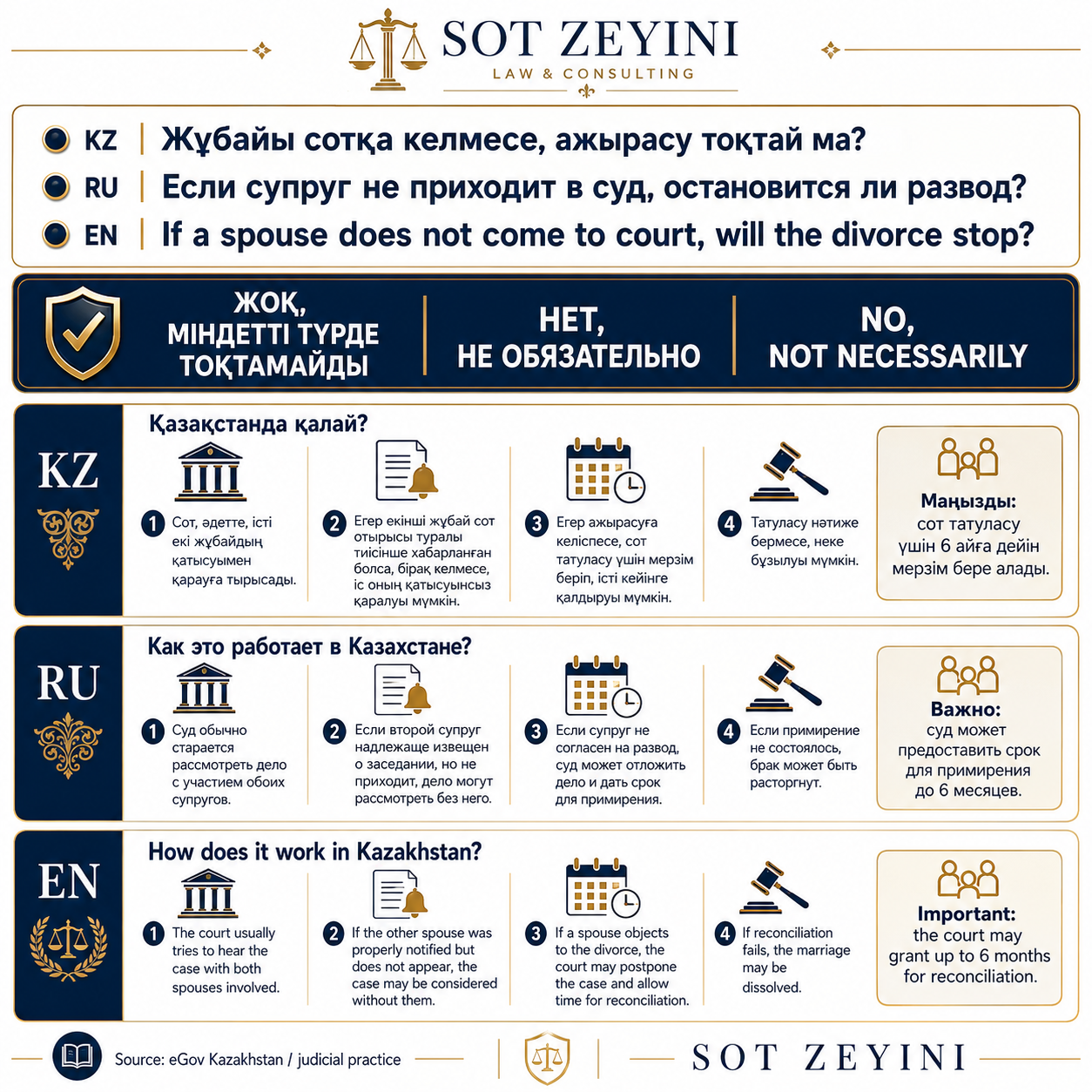
If a spouse does not attend court, will the divorce stop?
No. A spouse’s failure to attend court does not automatically stop the divorce. If the respondent, meaning the other spouse, was properly notified of the date, time, and place of the court hearing but did not appear without a valid reason, the court may consider the case in their absence.
The key condition is proper notification. The court must be satisfied that the respondent was informed about the hearing. If there is no confirmation that the respondent was notified, the hearing may be postponed.
So, if your spouse does not attend court, the divorce may be delayed, but it does not become impossible.
What does the court do if the spouse does not appear?
If the spouse does not attend the hearing, the court checks:
- whether the respondent was notified;
- whether the address was indicated correctly;
- whether the court notice was sent;
- whether the notice was delivered;
- whether the respondent gave a reason for absence;
- whether there are documents proving a valid reason;
- whether the respondent asked for the case to be considered without them;
- whether the claimant insists on continuing the case.
If the respondent was notified and failed to appear without a valid reason, the court may continue the proceedings.
When can the court postpone the hearing?
The court may postpone the hearing if:
- there is no confirmation that the respondent was notified;
- the notice was sent to the wrong address;
- the respondent provided a valid reason for absence;
- the respondent is ill, on a business trip, or unable to attend for objective reasons;
- the court needs additional documents;
- there is a dispute about children, child support, or property;
- additional circumstances must be clarified.
If the spouse fails to attend the first hearing, the court may postpone it. However, repeated absence without a valid reason should not block the divorce indefinitely.
Can a spouse’s absence delay the divorce?
Yes, it can. This is especially true if the court cannot confirm that the respondent was properly notified.
The process may be delayed if:
- the respondent’s address is incorrect;
- the respondent lives in another city;
- the spouse is abroad;
- court letters are returned;
- the respondent deliberately refuses to receive mail;
- the respondent files motions to postpone the hearing;
- there is a dispute about children or property.
However, absence from court does not allow a spouse to block divorce forever. If family relations have ended and the claimant continues to insist on divorce, the court may dissolve the marriage.
What should be done if the spouse deliberately avoids court?
If your spouse intentionally does not attend court and tries to delay the divorce, it is advisable to:
- provide the court with the spouse’s exact address;
- provide phone number, email, WhatsApp, or other contact details;
- indicate the last known address;
- file a motion to consider the case without the respondent;
- explain that the respondent is delaying the process;
- provide proof of notification;
- file additional motions if necessary.
It is important not only to say, “They do not come to court,” but to properly ask the court to proceed.
If the spouse refuses to receive court notices
Sometimes the respondent deliberately refuses to receive court mail or does not live at the registered address. This does not always prevent divorce.
The court may be provided with:
- the respondent’s registered address;
- last known place of residence;
- phone number;
- email;
- messenger contacts;
- workplace information;
- information about property in Kazakhstan;
- screenshots of correspondence showing that the respondent knows about the process.
If the court sees that reasonable steps were taken to notify the respondent, the case may continue.
Can the court issue a divorce decision without the spouse?
Yes. If the spouse was properly notified but did not appear, the court may issue a divorce decision without their participation.
This is possible if:
- the spouses no longer live together;
- they do not maintain a joint household;
- reconciliation is impossible;
- the claimant insists on divorce;
- the respondent does not attend court;
- the notification procedure was followed.
The court’s main question is whether the family can be preserved. If the marriage has effectively broken down, the respondent’s absence should not stop the divorce.
If the spouse objects to divorce but does not attend court
If the spouse says they object to divorce but does not attend court, the court may still consider the case. In some situations, the court may grant time for reconciliation.
If, after the reconciliation period, the claimant still insists on divorce, the court may dissolve the marriage.
A spouse’s objection does not mean that divorce is blocked forever. The law does not work in “no-show means eternal marriage” mode.
What happens if the claimant does not attend court?
If the claimant, meaning the person who filed the divorce claim, does not attend court, the situation may be different.
If the claimant fails to appear and did not request that the case be considered in their absence, the court may postpone the hearing. If the claimant repeatedly fails to appear and does not file such a request, the claim may be left without consideration.
Therefore, if the claimant cannot attend court, it is better to:
- file a request for the case to be considered in their absence;
- send a representative;
- explain the reason for absence;
- attach supporting documents.
Can a request be filed to consider the case without participation?
Yes. If a party cannot attend court, they may file a request for the case to be considered without their participation.
This is useful when a person:
- is in another city;
- is abroad;
- cannot attend due to health reasons;
- is working on the hearing date;
- participates through a representative;
- has already submitted their position in writing.
Such a request helps avoid delays.
Does a spouse’s absence affect child-related issues?
If the spouses have common minor children, the court may consider issues related to the children.
The court may determine:
- who the child will live with;
- child support;
- visitation schedule;
- the child’s interests;
- opinion of the guardianship authority;
- living conditions of the parents.
If the respondent does not appear, the court still must take the child’s interests into account. Child-related issues are not decided automatically just because one parent is absent.
Can child support be awarded if the respondent does not attend?
Yes. If the respondent was notified but did not attend, the court may consider the child support claim.
The claimant should prepare:
- children’s birth certificates;
- information about who the children live with;
- known information about the respondent’s income;
- child support claim amount;
- documents confirming expenses for children;
- justification for a fixed monetary amount, if requested.
The respondent’s absence does not cancel their obligation to support the child.
Can property be divided if the spouse does not attend?
Yes, but property division is more complicated than a simple divorce. The court must examine evidence even if the respondent does not appear.
For property division, the following may be required:
- documents for apartment, house, land, or car;
- sale and purchase agreements;
- bank statements;
- property valuation report;
- loan agreements;
- evidence that property was acquired during marriage;
- registration information.
If the main goal is to divorce quickly, it may be better to file for divorce first and file a separate property division claim later.
If the spouse is abroad and does not attend
If the spouse is abroad and does not attend court, divorce is still possible. However, notifying such a respondent may take more time.
It is useful to provide the court with:
- foreign address;
- last known address;
- email;
- phone number;
- WhatsApp or other messengers;
- information confirming that the spouse is abroad;
- registered address in Kazakhstan.
When there is an international element, the process is a bit “hard mode,” but it does not stop divorce.
If the spouse is missing and their whereabouts are unknown
If the spouse’s whereabouts are completely unknown, the last known address should be indicated, and lack of contact should be explained.
In some cases, it may be necessary to consider recognizing the person as missing. This is a separate court procedure.
If the spouse is recognized as missing, the divorce procedure may become simpler.
How to speed up divorce if the spouse does not attend?
To avoid unnecessary delays, it is advisable to:
- prepare the claim correctly;
- indicate the respondent’s exact address;
- attach all documents immediately;
- provide information about children;
- pay the state fee correctly;
- attend court hearings;
- if unable to attend, file a request for consideration without participation;
- ask the court to consider the case without the respondent if they were notified;
- participate through a representative if necessary;
- avoid combining a simple divorce with complicated property division if it delays the process.
Sometimes the right strategy is to dissolve the marriage first and resolve property, child support, or other complex issues separately.
What documents are needed?
Usually, the following documents are needed for divorce:
- statement of claim for divorce;
- copy of identity document;
- marriage certificate;
- children’s birth certificates, if there are children;
- receipt confirming payment of the state fee;
- respondent’s address information;
- respondent’s contact details for notification;
- evidence related to child support, if claimed;
- property documents, if property division is claimed;
- power of attorney or advocate’s warrant, if a representative participates.
If the respondent does not attend, it is also useful to provide information confirming the possibility of notifying them.
What should be written in the claim?
The claim should include:
- name of the court;
- claimant’s details;
- respondent’s details;
- when and where the marriage was registered;
- information about children;
- that the spouses no longer live together;
- that family relations have ended;
- that reconciliation is impossible;
- that the respondent avoids participation or does not attend court;
- what exactly the claimant asks the court to do.
The claimant may ask the court to:
- dissolve the marriage;
- consider the case without the respondent;
- award child support;
- determine the child’s place of residence;
- divide property.
Common mistakes
Common mistakes in divorce cases where the spouse does not attend court include:
- incorrect respondent address;
- failure to provide notification details;
- no request for consideration without participation;
- the claimant also fails to attend court;
- child-related information is missing;
- child support is claimed incorrectly;
- property division is added without evidence;
- the claim is written emotionally;
- the request to the court is unclear.
The court looks at documents, not emotions. The claim should be a clear legal position, not a complaint saying, “They did not show up again.”
Is a lawyer needed?
If the spouse does not attend court, delays the process, their address is unknown, or there are children, child support, or property issues, legal assistance can be very useful.
A lawyer can help:
- prepare the claim correctly;
- determine jurisdiction;
- resolve the notification issue;
- prepare a motion to consider the case without the respondent;
- claim child support;
- determine the child’s place of residence;
- divide property;
- represent interests in court;
- prevent unnecessary delays.
Legal assistance from SOT ZEYINI
The lawyers of SOT ZEYINI can help properly handle divorce if a spouse does not attend court.
We can help if:
- your spouse does not appear in court;
- the respondent avoids divorce;
- the respondent’s address is unknown;
- the spouse is abroad;
- there are common children;
- child support must be claimed;
- property must be divided;
- a divorce claim must be prepared;
- the case must be considered without the respondent.
Need a divorce consultation? Message us on WhatsApp — a lawyer will assess your situation and explain what to do if your spouse does not attend court.
FAQ: Frequently Asked Questions
If a spouse does not attend court, will the divorce stop?
No. If the spouse was notified but failed to attend without a valid reason, the court may consider the case without them.
If the spouse misses the first hearing, will the court grant divorce immediately?
Not always. The court may postpone the hearing, especially if notification of the respondent is not confirmed.
What happens if the spouse fails to attend several times?
If the respondent repeatedly fails to appear without a valid reason and was notified, the court may consider the case without their participation.
What if the spouse deliberately refuses to receive the court notice?
The court should be provided with the spouse’s address, phone number, email, messenger contacts, and other notification details. A motion to consider the case without the respondent may also be filed.
If the respondent was not notified, will the court grant divorce?
Usually, the court checks notification. If the respondent was not notified, the hearing may be postponed.
What if the spouse objects to divorce but does not attend?
The court may grant time for reconciliation. However, if the claimant continues to insist on divorce, the marriage may be dissolved.
What happens if the claimant does not attend court?
If the claimant does not attend and does not request consideration without participation, the court may postpone the case or leave the claim without consideration.
Can I ask the court to consider the case without me?
Yes. You may file a request for the case to be considered without your participation.
Can child support be awarded if the respondent does not attend?
Yes. If the respondent was notified, the court may consider the child support claim.
Can property be divided without the respondent?
Yes, but evidence must be provided. Property division requires more serious preparation.
If the spouse is abroad and does not attend, can divorce still happen?
Yes. However, notifying a respondent abroad may take more time.
What if the spouse’s address is unknown?
The last known address, registered address, workplace, property location, or other information should be provided to help notify the respondent.
Can the respondent appeal the decision later?
Yes. The respondent may appeal the court act in the procedure established by law. That is why proper notification is important.
How can divorce be accelerated?
Prepare the claim correctly, provide the respondent’s address, attach documents, attend hearings, or file a request for consideration without participation.
Is a lawyer needed?
If the spouse does not attend, the address is unknown, or there are children, child support, or property issues, a lawyer can help prevent delays and protect your rights.