 +7 775 858 9294
 WhatsApp
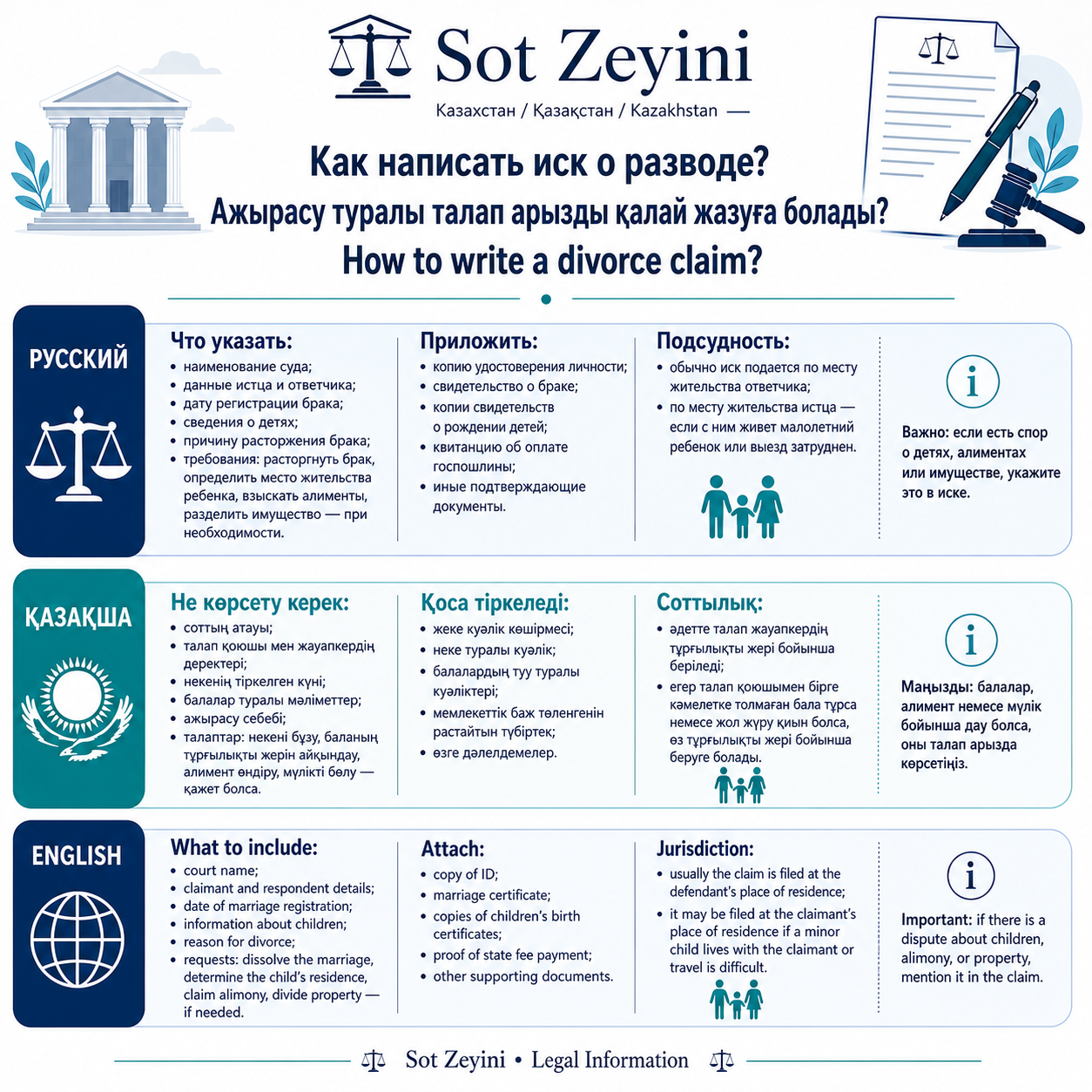

How to write a divorce claim?
A divorce claim is an official court document in which one spouse asks the court to dissolve the marriage. Such a claim is filed when divorce through the civil registry office is not possible. For example, this may apply if the spouses have minor children, one spouse does not agree to divorce, avoids going to the civil registry office, or there is a dispute between the parties.
For the court to accept the claim, the document must be prepared correctly. It should clearly state the name of the court, the details of the parties, information about the marriage, information about children, and the exact request to the court.
When should a divorce claim be filed in court?
A divorce claim is usually filed in court if:
- the spouses have common minor children;
- one spouse objects to the divorce;
- one spouse avoids divorce through the civil registry office;
- there is a dispute about children, child support, or property;
- an official court decision on divorce is required.
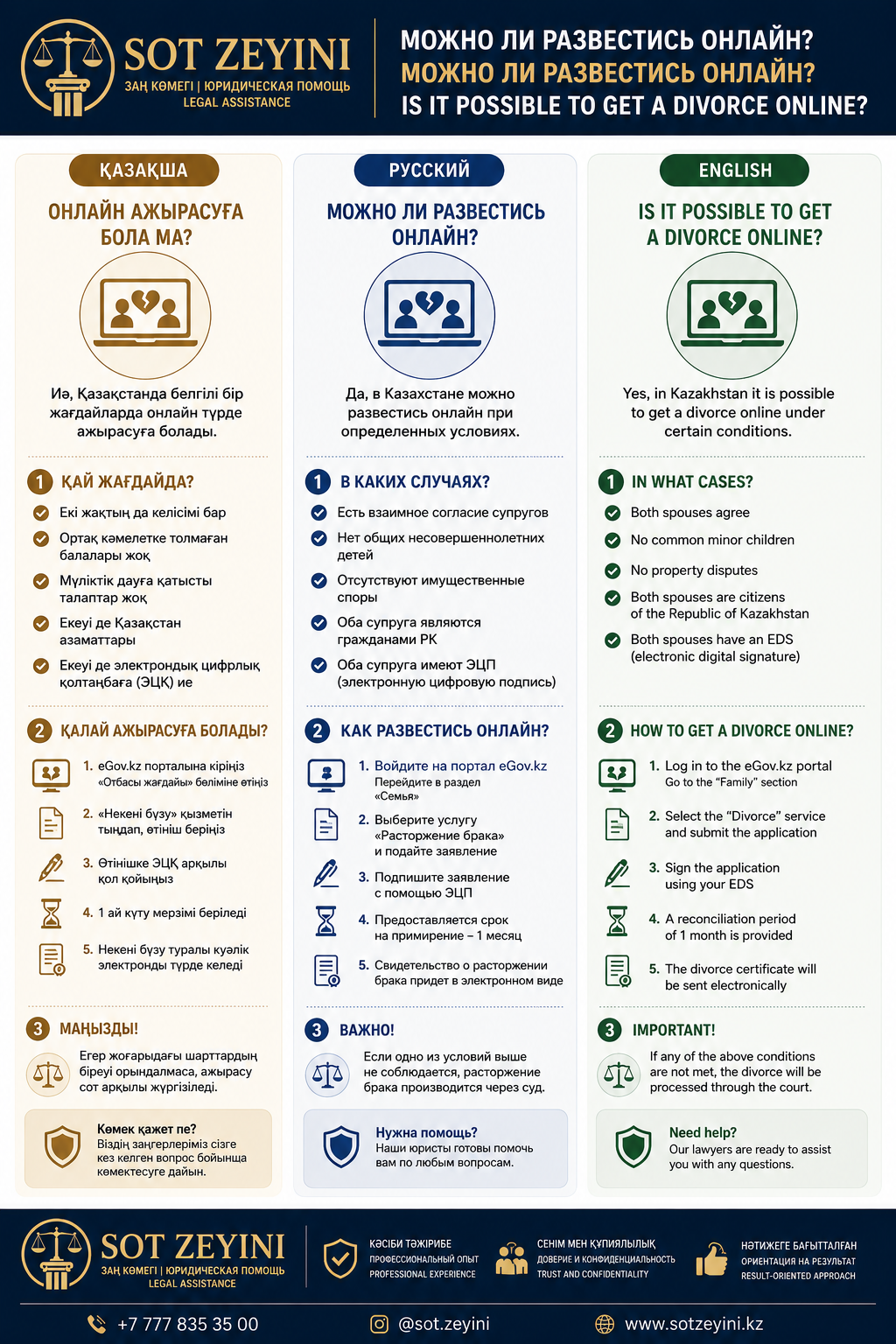
If there are no children, both spouses agree to divorce, and there is no property dispute, the marriage can be dissolved through the civil registry office. However, if there are children or a dispute, it is usually necessary to apply to court.
Which court should the divorce claim be filed with?
As a general rule, a divorce claim is filed with the court at the respondent’s place of residence. The respondent is the second spouse against whom the divorce claim is filed.
However, in some cases, the claimant may file the claim at their own place of residence. For example, this may apply if a minor child lives with the claimant or if the claimant cannot travel to the respondent’s court due to health reasons.
Choosing the correct court is very important. If the claim is filed with the wrong court, it may be returned.
What should be included in a divorce claim?
A divorce claim should be clear, structured, and legally accurate. Usually, it consists of several parts.
1. Header of the claim
The upper part of the claim should include:
- name of the court;
- claimant’s full name, personal identification number, address, and phone number;
- respondent’s full name, personal identification number if available, address, and phone number;
- title of the document: “Statement of Claim for Divorce”.
2. Information about the marriage
The claim should state:
- when the marriage was registered;
- where the marriage was registered;
- whether there is a marriage certificate;
- whether the spouses have common children;
- since when the spouses have not lived together, if applicable.
For example:
“The marriage between the claimant and the respondent was registered on May 15, 2018. The parties have minor children from the marriage. Family relations have effectively ended, and the parties no longer maintain a joint household.”
3. Reason for divorce
There is no need to write emotional details or describe personal conflicts in depth. It is usually enough to state that family relations have ended, further cohabitation is impossible, and reconciliation has not been reached.
A proper formal wording may be:
“Family relations between the parties have effectively ended. Joint living and preservation of the family are impossible. Reconciliation between the parties has not been achieved.”
4. Information about children
If the spouses have children, the claim should include:
- children’s full names;
- dates of birth;
- who the children live with;
- whether there is a dispute about the children’s place of residence;
- whether there is a dispute regarding child support.
If there is no dispute, you may write:
“There is no dispute between the parties regarding the children’s place of residence. The children live with the claimant.”
If child support needs to be claimed, this requirement may be included in the divorce claim or filed separately.
5. Property issues
If division of property is not requested, it is better to state this clearly:
“No claim for division of jointly acquired property is made within this statement of claim.”
This helps the court understand that the claim concerns only the dissolution of marriage and is not connected with a complicated property dispute.
If it is necessary to divide an apartment, car, loan, business, or other property, a property division claim may also be included. However, in that case, the case may become more complicated and take longer.
6. Request to the court
At the end of the claim, it is necessary to clearly state what exactly the claimant asks the court to do.
For example:
“Based on the above, I ask the court to:
- Dissolve the marriage registered between the claimant and the respondent;
- Resolve court expenses in accordance with the law.”
If there are additional claims, the claimant may also ask the court to:
- recover child support;
- determine the child’s place of residence;
- determine the visitation schedule with the child;
- divide jointly acquired property.
What documents should be attached to a divorce claim?
Usually, the following documents are attached to the divorce claim:
- copy of the claimant’s identity document;
- marriage certificate;
- birth certificates of children, if there are children;
- receipt confirming payment of the state duty;
- information confirming the respondent’s address;
- copy of the claim for the respondent;
- power of attorney or advocate’s warrant, if the claim is filed by a representative.
If child support, child-related disputes, or property division are also claimed, additional documents may be required. These may include certificates, receipts, contracts, property documents, income information, and other evidence.
How to properly state the reason for divorce?
Many people think they must describe all family problems in detail. In reality, in most cases, it is enough to state that the family has broken down and further life together is impossible.
The claim should not contain insults, accusations, or excessive emotions. A court document must be formal, clear, and specific.
A good example:
“Family life between the parties has not worked out, marital relations have effectively ended, and the parties no longer maintain a joint household. Preservation of the family is impossible.”
This wording looks professional and does not turn the claim into an emotional letter.
Can a divorce claim be filed online?
Yes, a divorce claim can be filed through electronic court services, including the Judicial Cabinet, if the claimant has an electronic digital signature. Scanned documents, proof of payment of the state duty, and other required materials must be attached to the claim.
The documents must be readable, properly signed, and uploaded to the correct section. Incorrect uploading or missing documents may lead to the claim being left without movement or returned.
Common mistakes when writing a divorce claim
A divorce claim may be returned or left without movement if:
- the wrong court is indicated;
- the marriage certificate is not attached;
- the state duty is not paid;
- the respondent’s details are missing;
- information about children is not included;
- the claims are unclear;
- copies of documents are not attached;
- the claim is too emotional and lacks legal structure.
To avoid mistakes, it is better to have the claim checked by a lawyer in advance.
Structure of a divorce claim
A divorce claim may be prepared using the following structure:
- Name of the court.
- Claimant’s details.
- Respondent’s details.
- Title of the document.
- Date and place of marriage registration.
- Information about children.
- Circumstances showing that family relations have ended.
- Information about disputes regarding children, child support, and property.
- References to legal provisions.
- Request to the court.
- List of attachments.
- Date and signature.
Should child support be included in a divorce claim?
A claim for child support may be included together with the divorce claim. However, in some cases, it may be more practical to claim child support separately, especially if a court act needs to be obtained faster.
For example, if the divorce case may take a long time, a separate child support claim may be more convenient. This depends on the specific situation: the number of children, the income of the other parent, whether there is a dispute, and other circumstances.
Should property division be included in a divorce claim?
It is not mandatory. Divorce and division of property are two separate claims. They can be filed together in one statement of claim or separately.
If the main goal is to dissolve the marriage quickly, it may be better not to combine the divorce with a complicated property dispute. Otherwise, the case may take longer due to property valuation, evidence, bank documents, and objections from the respondent.
How much does it cost to file a divorce claim?
When filing a divorce claim, a state duty must be paid. If property division is also claimed together with the divorce, the amount of the state duty may depend on the value of the claim.
There may also be expenses for legal services, document preparation, court representation, and obtaining additional certificates.
Legal assistance in preparing a divorce claim
A properly prepared divorce claim helps avoid the return of documents, speeds up the process, and protects your rights. Legal assistance is especially important if there are children, child support issues, a mortgage, loans, joint property, or if the other spouse does not agree to divorce.
The lawyers of SOT ZEYINI can help you with:
- preparing a divorce claim;
- filing documents with the court;
- claiming child support;
- determining the child’s place of residence;
- preparing an agreement between spouses;
- protecting your interests during property division.
Need help preparing a divorce claim? Message us on WhatsApp — a lawyer will review your situation and explain how to properly file your claim with the court.
Frequently Asked Questions
Can I write a divorce claim myself?
Yes, you can. However, if there are children, property, child support issues, or a dispute between the spouses, it is better to seek legal assistance to avoid mistakes.
What should I write as the reason for divorce?
It is enough to state that family relations have ended, living together is impossible, the parties no longer maintain a joint household, and reconciliation has not been achieved.
Can I file for divorce without the respondent?
Yes. If the respondent does not want to go to court or avoids divorce, this does not limit the claimant’s right to apply to court.
What should I do if the respondent’s address is unknown?
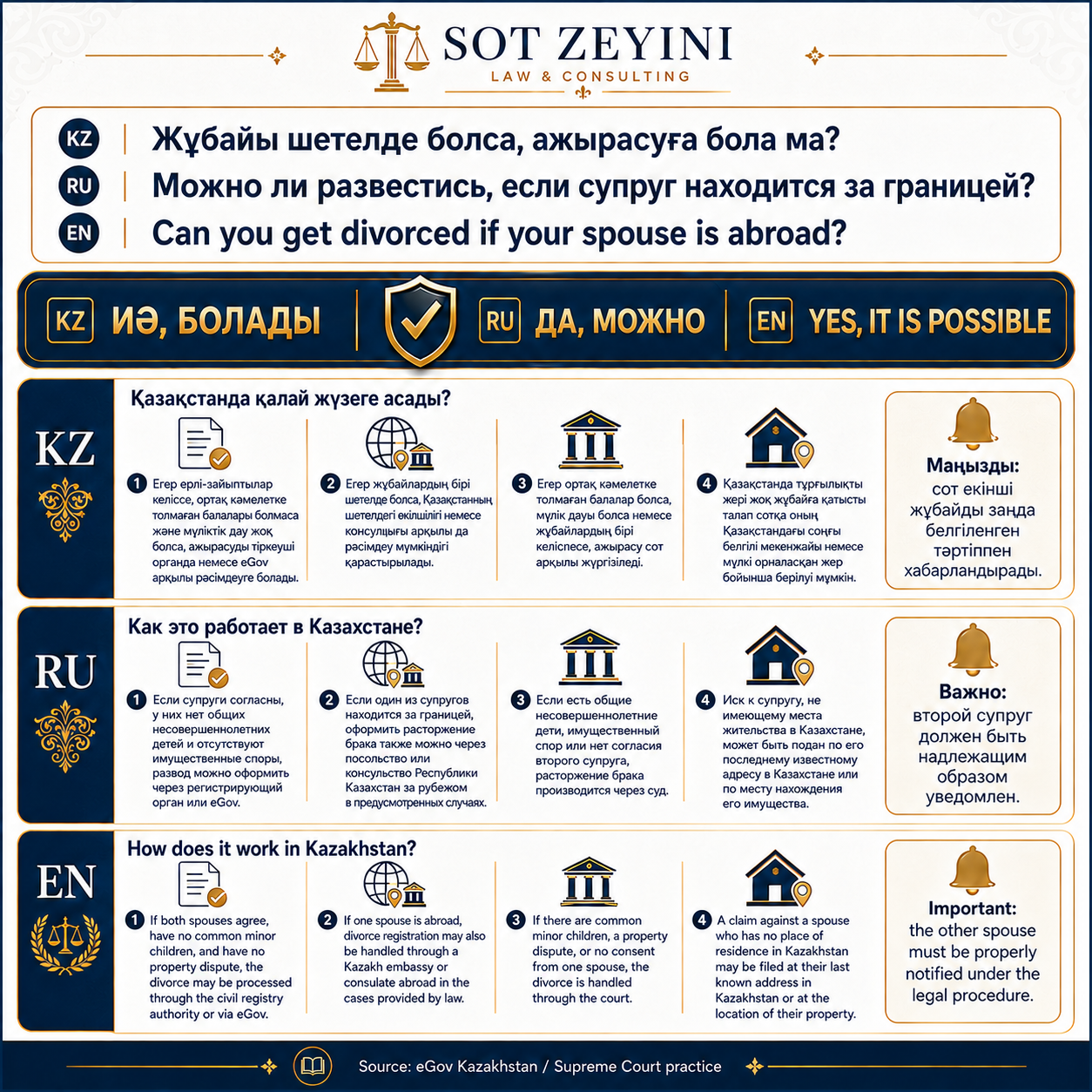
In this case, it is necessary to correctly determine jurisdiction and prepare information confirming that the respondent’s address is unknown. In some situations, the claim may be filed at the location of the respondent’s property or on other grounds provided by law.
Can I divorce if we have a small child?
Yes. However, if the spouses have minor children, divorce is usually handled through court. The court may also consider the child’s interests, child support, place of residence, and visitation issues.