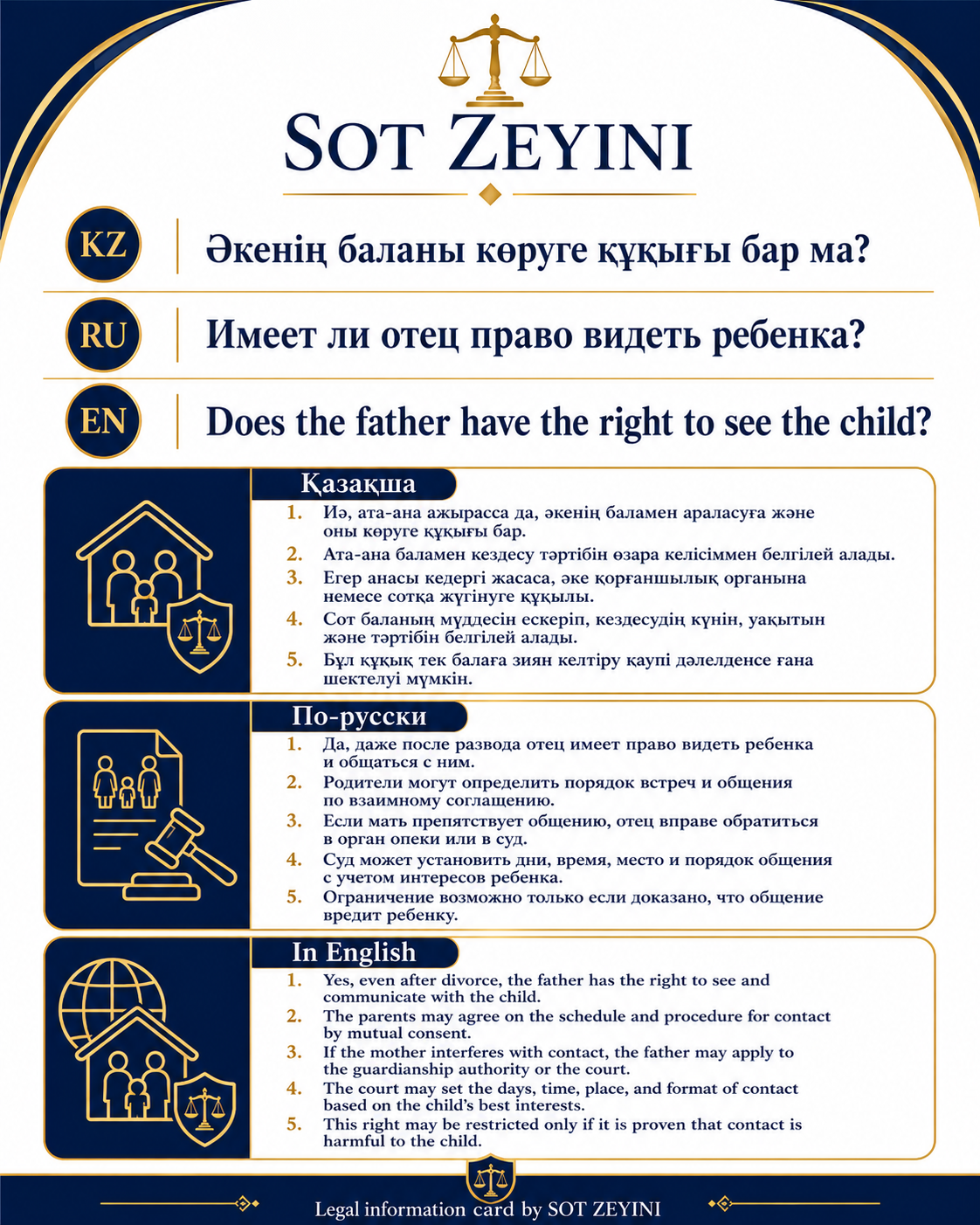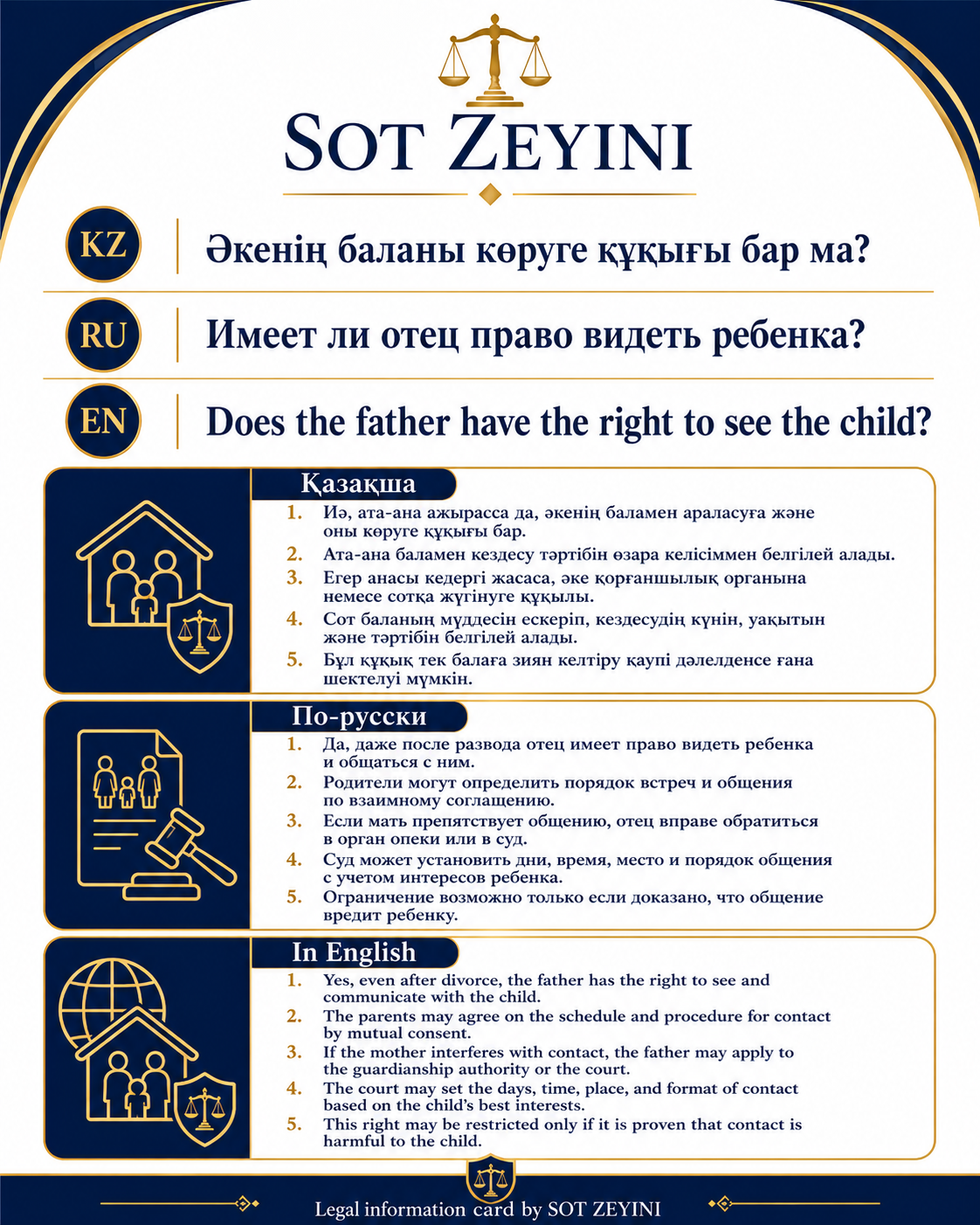
 +7 775 858 9294
 WhatsApp
What is a child visitation schedule?
A child visitation schedule is a clear arrangement that defines when, where, and how the parent living separately communicates with the child.
It may be established:
- by agreement between the parents;
- through mediation;
- through the guardianship authority;
- by court decision.
A vague phrase such as “the father may see the child” is usually not enough. A proper schedule should specify the exact days, time, location, handover procedure, phone calls, video calls, holidays, school vacations, and special conditions.
Why should the schedule be specific?
The more specific the schedule, the fewer conflicts arise later.
A clear schedule helps to:
- protect the child’s right to communicate with both parents;
- maintain the child’s daily routine;
- prevent disputes between parents;
- make court enforcement easier;
- avoid arguments about time and place;
- regulate video calls and phone calls;
- plan holidays and school vacations;
- provide emotional stability for the child.
If the parents are already in conflict, “by mutual agreement” often does not work. In that case, the schedule must be written like a GPS route, not like a wish list.
What should be included in the schedule?
A good visitation schedule should include:
- name of the parent who will communicate with the child;
- child’s name and age;
- exact days of visitation;
- start and end time;
- location of handover;
- who picks up the child;
- who returns the child;
- return address;
- phone call schedule;
- video call schedule;
- holidays;
- birthdays;
- school vacations;
- whether overnight stays are allowed;
- whether travel to another city is allowed;
- whether travel abroad is allowed;
- what happens if the child is sick;
- what happens if a parent is late;
- travel costs if parents live in different cities;
- obligation not to interfere with communication.
The schedule should be easy to understand and possible to enforce.
Basic example of a proper schedule
A clear court-ready wording may look like this:
“To establish the following visitation schedule: the father shall communicate with the minor child every Saturday from 10:00 a.m. to 6:00 p.m. The father shall pick up the child from the mother’s residence at 10:00 a.m. and return the child to the same address no later than 6:00 p.m. on the same day.”
This wording clearly states:
- who communicates with the child;
- which day;
- start time;
- end time;
- pick-up location;
- return location;
- return time.
A weak wording would be:
“The father may see the child in his free time.”
This is too vague. “Free time” means different things to different people and often leads to new disputes.
Common types of visitation schedules
The schedule depends on the child’s age, health, school routine, relationship with the parent, and distance between the parents.
1. Weekend visitation
A common option:
“The father shall communicate with the child every Saturday from 10:00 a.m. to 6:00 p.m.”
Or:
“The father shall communicate with the child on the first and third Sunday of each month from 11:00 a.m. to 5:00 p.m.”
2. Weekday visitation
Suitable if the parents live close to each other:
“The father shall meet with the child every Wednesday from 6:00 p.m. to 8:00 p.m. in a public place or playground.”
3. Video calls
Video calls should be stated separately:
“The father has the right to communicate with the child by WhatsApp video call every Tuesday and Thursday from 7:00 p.m. to 8:00 p.m. The mother shall not interfere with the child’s communication during this time.”
4. School vacations
For school-age children, vacations should be included:
“During spring and autumn school vacations, the father has the right to spend the first two days of the vacation with the child from 10:00 a.m. to 6:00 p.m.”
For summer:
“During summer school vacation, the father has the right to spend 10 consecutive calendar days with the child, provided that he notifies the mother in writing at least 15 calendar days in advance.”
5. Holidays and birthdays
For example:
“On the child’s birthday, the father has the right to meet with the child for at least 2 hours. If the birthday falls on a school day, the meeting shall take place from 6:00 p.m. to 8:00 p.m.”
6. Overnight stays
If the child is old enough and used to the parent:
“The father shall pick up the child on the first and third Saturday of each month at 10:00 a.m. and return the child on Sunday no later than 6:00 p.m.”
For young children, overnight stays may be introduced gradually.
How to draft a schedule based on the child’s age
The child’s age is one of the most important factors.
Child under 3 years old
Short visits may be better:
“The father shall meet with the child every Saturday from 11:00 a.m. to 1:00 p.m. in the presence of the mother or another agreed person.”
Child from 3 to 7 years old
Longer visits may be possible:
“The father shall meet with the child every Saturday from 10:00 a.m. to 4:00 p.m., picking up the child from the mother’s residence and returning the child to the same address.”
Child from 7 to 12 years old
School, homework, and extracurricular activities should be considered:
“The father shall meet with the child every Saturday from 10:00 a.m. to 6:00 p.m. and shall also communicate with the child by video call twice a week.”
Child over 12 years old
The child’s opinion may be considered more actively, but the schedule should still be clear:
“The father shall meet with the child on the second and fourth Sunday of each month, taking into account the child’s school schedule, from 11:00 a.m. to 6:00 p.m.”
How to define the handover procedure
The handover procedure should be very clear.
The schedule should answer:
- where the child is handed over;
- who hands over the child;
- who picks up the child;
- whether the child may be picked up from school or kindergarten;
- where the child is returned;
- what happens if a parent is late;
- whether grandparents or other persons may pick up the child.
Example:
“The father shall pick up the child from the mother’s residence every Saturday at 10:00 a.m. and return the child to the same address no later than 6:00 p.m. If the father is late, he must notify the mother at least 30 minutes in advance.”
If handover occurs at school:
“The father may pick up the child from school after classes on Friday, provided that he notifies the mother at least 24 hours in advance.”
Should the meeting location be specified?
Yes. It is better to specify the meeting location.
Possible locations include:
- mother’s residence;
- father’s residence;
- school;
- kindergarten;
- playground;
- park;
- shopping mall;
- children’s center;
- neutral public place;
- premises suggested by the guardianship authority.
If the parents are in serious conflict, a neutral location is often safer.
Example:
“The child shall be handed over at the entrance to the school or another public place agreed by the parents in writing.”
How to write phone and video call rules
Video calls should be included separately to prevent blocking of communication.
Example:
“The father has the right to communicate with the child by phone or video call every Tuesday and Thursday from 7:00 p.m. to 8:00 p.m. The mother shall ensure the child’s ability to communicate during this time, unless this contradicts the child’s health or daily routine.”
Avoid wording such as “call at any time,” because it may interfere with sleep, school, and rest.
How to write school vacation rules
For school vacations, specify:
- which vacation;
- how many days;
- who picks up the child;
- who returns the child;
- how many days in advance notice must be given;
- whether travel to another city is allowed;
- how communication with the other parent is maintained.
Example:
“During summer school vacation, the father has the right to spend 10 consecutive calendar days with the child. Specific dates shall be determined by written notice to the mother at least 15 calendar days before the start of the visitation period.”
If there is conflict, it is better to state that travel to another city requires written consent.
How to write holiday rules
Holidays should not be left vague if the parents are in conflict.
Example:
“On the child’s birthday, the father has the right to meet with the child from 6:00 p.m. to 8:00 p.m. if the birthday falls on a school day, or from 12:00 p.m. to 3:00 p.m. if it falls on a weekend.”
Another option:
“The child shall spend New Year holidays with the father in even-numbered years and with the mother in odd-numbered years, provided that this does not interfere with the child’s health and routine.”
Can travel restrictions be included?
Yes, if there is a risk.
For example:
“The father may not take the child outside the city of Almaty without the mother’s written consent.”
Or:
“The father may not take the child outside the Republic of Kazakhstan without the mother’s notarized consent.”
Such clauses are important if there were previous conflicts, threats of relocation, refusal to return the child, or violations of the schedule.
How to draft a schedule if parents live in different cities
If parents live in different cities, weekly visitation may be unrealistic. The schedule should include video calls and longer meetings during vacations.
Example:
“Since the father resides in another city, he has the right to communicate with the child by video call every Wednesday and Sunday from 7:00 p.m. to 8:00 p.m. During summer vacation, the father has the right to spend 10 consecutive calendar days with the child, provided that he notifies the mother in writing at least 20 calendar days in advance.”
Travel expenses can also be addressed:
“The father shall bear the child’s travel expenses to and from the place of visitation.”
What if the child is young or has not seen the parent for a long time?
In that case, gradual restoration of contact may be better.
Example:
“During the first three months, the father shall meet with the child every Saturday from 11:00 a.m. to 1:00 p.m. in the presence of the mother. After three months, if there is no negative impact on the child, the visitation time may be increased to 10:00 a.m.–4:00 p.m.”
A gradual schedule often looks more reasonable than demanding full weekends immediately.
What schedule may the court reject?
The court may question a schedule if it:
- is too vague;
- disrupts the child’s routine;
- ignores the child’s age;
- interferes with school;
- ignores health issues;
- creates conflict risk;
- deprives the other parent of contact;
- has no exact time or place;
- allows travel without consent;
- does not serve the child’s interests.
Poor wording examples:
“The father may see the child whenever he wants.”
“The mother must give the child upon first request.”
“The father may take the child for an indefinite period.”
“The parents will agree additionally.”
These phrases are difficult to enforce.
Court-ready sample schedule
The following wording may be used:
“I ask the court to establish the following visitation schedule between the father and the minor child:
- The father shall meet with the child every Saturday from 10:00 a.m. to 6:00 p.m.
- The father shall pick up the child from the mother’s residence at 10:00 a.m. and return the child to the same address no later than 6:00 p.m. on the same day.
- The father has the right to communicate with the child by WhatsApp video call every Tuesday and Thursday from 7:00 p.m. to 8:00 p.m.
- On the child’s birthday, the father has the right to meet with the child for at least 2 hours, with the exact time agreed in advance with the mother.
- During school vacations, the father has the right to spend the first 2 days of the vacation with the child from 10:00 a.m. to 6:00 p.m.
- The father may not take the child to another city or outside the Republic of Kazakhstan without the mother’s written consent.
- The mother shall not interfere with the father’s visitation and video communication with the child at the established time.
- Communication with the child shall not interfere with the child’s school, sleep, medical treatment, or rest.”**
This sample should be adjusted to the child’s age, health, location, and family circumstances.
What to add if the mother does not allow visitation
If one parent obstructs visitation, add clear obligations:
“If visitation cannot take place for a valid reason, the parent with whom the child lives must notify the other parent no later than 3 hours before the start of visitation. The missed visit shall be rescheduled to the nearest available day by agreement of the parents.”
If the child is sick:
“If the child is ill, the parent with whom the child lives shall provide confirmation and propose an alternative time for communication.”
What to add if the father returns the child late
You may include:
“The father must return the child strictly at the established time. Systematic violation of the return time may be grounds for changing the visitation schedule.”
If there is a risk:
“Until stable communication is restored, visits shall take place without overnight stays and without taking the child outside the city.”
Can the schedule be changed later?
Yes. The schedule can be changed if circumstances change.
For example:
- the child grows older;
- school routine changes;
- a parent moves;
- the child’s health changes;
- the schedule is not followed;
- the child adapts better;
- conflicts arise;
- the parent returns the child late;
- one parent obstructs communication.
In such cases, a claim to modify the visitation schedule may be filed.
Can parents make a schedule by agreement?
Yes. Parents may make a written agreement on child visitation.
The agreement should include:
- days and time;
- handover procedure;
- addresses;
- video calls;
- vacations;
- holidays;
- travel rules;
- child illness procedure;
- consequences of violations;
- procedure for changing the schedule.
If the agreement is not followed, a parent may apply to the guardianship authority or court.
Conclusion
A child visitation schedule should be clear, specific, and enforceable. It should include days, time, location, handover and return procedure, video calls, holidays, school vacations, and special conditions.
The best schedule protects the child’s stability and interests, not the ambitions of either parent.
Avoid vague wording where the parents cannot cooperate. Write clearly: Saturday, 10:00 a.m.–6:00 p.m., pick-up address, return address, video calls, vacations, and travel restrictions if needed.
FAQ: Frequently Asked Questions
1. What should be included in a child visitation schedule?
Days, time, location, handover and return procedure, video calls, holidays, school vacations, and special conditions.
2. Can the schedule say “by agreement of the parents”?
It can, but if the parents are in conflict, this wording often does not work. Specific days and time are better.
3. What is a common visitation schedule?
For example, every Saturday from 10:00 a.m. to 6:00 p.m., with pick-up and return at the mother’s residence.
4. Should video calls be included?
Yes. For example, every Tuesday and Thursday from 7:00 p.m. to 8:00 p.m. by WhatsApp.
5. Can school vacations be included?
Yes. The schedule may specify a number of days during summer or other school vacations.
6. Can travel to another city be restricted?
Yes, if there is a risk or dispute. The schedule may require written consent from the other parent.
7. Can overnight stays be requested immediately?
Yes, if they are in the child’s interests. But for young children or children who have not seen the parent for a long time, gradual contact may be better.
8. How should visitation be drafted for a young child?
Short visits, for example 1–2 hours in the presence of the mother or another trusted person.
9. What if the mother does not allow visitation?
Violations should be documented. The parent may apply to the guardianship authority, enforcement officer if there is a court decision, or court.
10. What if the father returns the child late?
The violations should be documented. The court may be asked to modify or restrict the schedule.
11. Can the schedule be changed later?
Yes. It may be changed if circumstances change or the existing schedule no longer serves the child’s interests.
12. Who participates in court?
Usually the parents and the guardianship authority participate. Psychologists, witnesses, or other specialists may be involved if necessary.