 +7 775 858 9294
 WhatsApp
What does it mean if the father does not return the child?
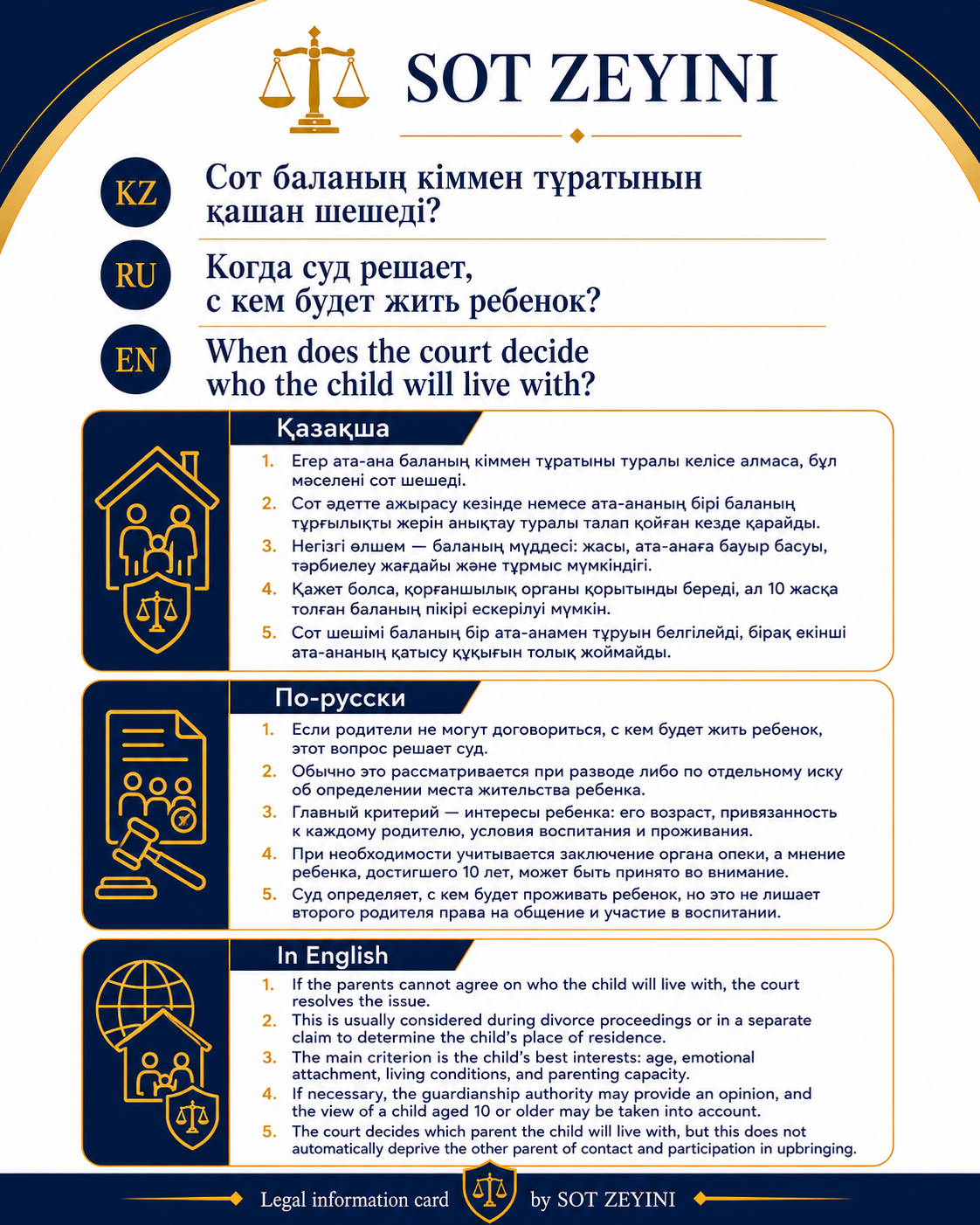
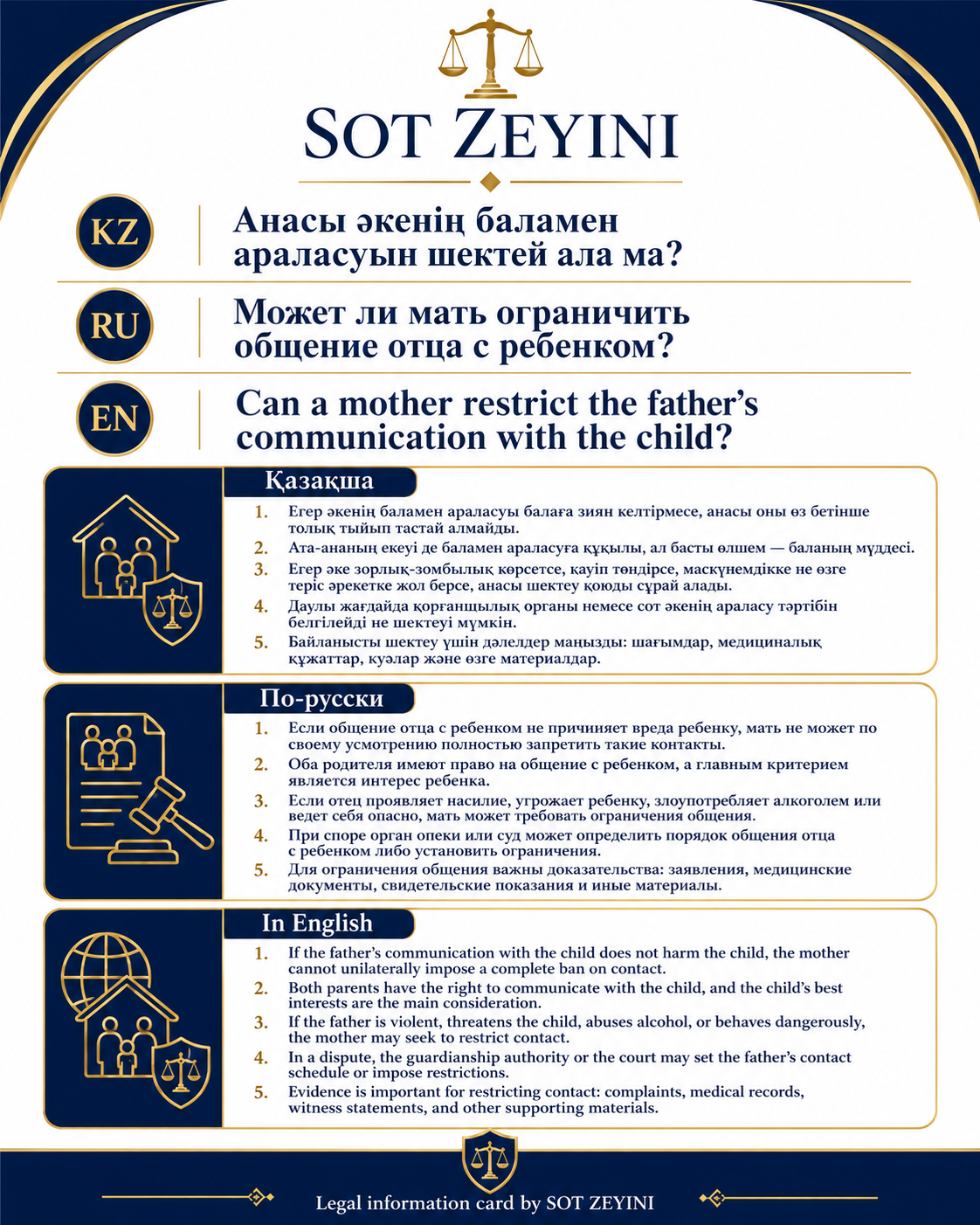
If the father takes the child and refuses to return them to the mother, the first step is to understand whether there is a court decision on the child’s place of residence and under what conditions the father took the child.
Different situations may arise:
- the father took the child for visitation and did not return them on time;
- the father took the child to another city;
- the father refuses to say where the child is;
- the father prevents the mother from speaking with the child;
- the father keeps the child even though the child previously lived with the mother;
- the father does not comply with a court decision;
- the father threatens to take the child abroad.
In such cases, the mother should act quickly, calmly, and legally. Emotions are understandable, but courts and authorities rely on evidence.
What should be done first?
If the father does not return the child, the mother should:
- Send the father a written demand to return the child.
- Save messages, calls, audio, video, and screenshots.
- Record the date, time, and circumstances in which the father took the child.
- Try to determine where the child is.
- Contact the police if there is a risk to the child.
- File an application with the guardianship and custody authority.
- Contact an enforcement officer if there is a court decision.
- File a court claim if there is no court decision.
The key point is to avoid relying only on verbal conversations. Written evidence is much stronger.
If there is already a court decision
If the court has already determined that the child’s place of residence is with the mother, and the father refuses to return the child, this may be treated as failure to comply with a court decision.
The mother should:
- obtain a copy of the court decision;
- obtain an enforcement writ;
- contact a private enforcement officer;
- file an application to initiate enforcement proceedings;
- attach evidence that the father is keeping the child;
- request enforcement of the court decision;
- ask for the involvement of the guardianship authority and police if necessary.
If the child’s residence has already been determined with the mother, the main issue is enforcement.
If there is no court decision
If there is no court decision on the child’s place of residence, but the child actually lived with the mother and the father took the child and refuses to return them, the mother should file a court claim.
The mother may ask the court to:
- determine the child’s place of residence with the mother;
- order the father to return the child to the mother;
- involve the guardianship and custody authority;
- request an opinion from the guardianship authority;
- establish the father’s visitation schedule if necessary;
- apply interim measures if there is a risk of relocation or travel abroad.
If the child attended school or kindergarten near the mother’s home, received medical care there, and had a stable routine, the mother should prove this with documents.
Can the mother contact the police?
Yes. In some cases, contacting the police is necessary.
The police should be contacted especially if:
- the child’s location is unknown;
- the father does not respond;
- the child cannot contact the mother;
- there is a threat to the child’s life or health;
- the father threatens the mother;
- the father took the child to another city;
- the father may take the child abroad;
- the child needs medical care;
- the situation resembles a missing child case.
The police report should include:
- the child’s full name and date of birth;
- the father’s details;
- when and where the father took the child;
- why the mother believes the child is being unlawfully kept;
- whether there is a court decision;
- whether there is any risk to the child;
- where the child may be;
- a request to take measures and establish the child’s location.
If the father is a legal parent and there is no court decision yet, the police may treat the matter as a family-law dispute. Therefore, it is important to contact the guardianship authority and court at the same time.
How to apply to the guardianship authority
The application may be filed with the guardianship and custody authority at the child’s place of residence or where the child is actually located.
The application should state:
- the mother’s details;
- the father’s details;
- the child’s details;
- with whom the child lived before;
- when the father took the child;
- why the child is not being returned;
- whether there is contact with the child;
- whether there is any risk to the child;
- a request to inspect the situation and protect the child’s interests.
The guardianship authority may review the situation, speak with the parents, assess the child’s living conditions, provide an opinion, and participate in court proceedings.
What claim should be filed in court?
Depending on the situation, the mother may file:
1. A claim to determine the child’s place of residence with the mother
This is used when the child’s residence has not been officially determined.
2. A claim to return the child to the mother
If the father keeps the child without proper legal grounds, the mother may ask the court to order the father to return the child.
3. A claim to establish the father’s visitation schedule
If the father wants communication with the child but tries to solve the issue by keeping the child, the court may determine residence with the mother and establish a lawful visitation schedule for the father.
4. A request for interim measures
If there is a risk that the father will move the child to another city or abroad, the mother may ask the court to take urgent measures.
Which court should hear the case?
Such cases are usually heard by the specialized interdistrict court for minors.
As a general rule, the claim is filed at the defendant’s place of residence, meaning the father’s place of residence. However, depending on the circumstances, the child’s actual location, safety, and urgency may also matter.
The claim may be filed electronically through the “Court Cabinet” system.
What evidence is needed?
The mother should collect:
- the child’s birth certificate;
- the mother’s ID;
- marriage or divorce certificate;
- documents proving that the child lived with the mother;
- school or kindergarten certificate;
- the child’s medical documents;
- correspondence with the father;
- messages in which the father refuses to return the child;
- audio, video, screenshots;
- witness statements;
- police report;
- application to the guardianship authority;
- court decision, if any;
- enforcement writ, if any;
- documents proving risk of relocation or travel abroad.
The more specific the evidence, the stronger the mother’s legal position.
Can the father say, “I am also a parent, so I will not return the child”?
The father is indeed a legal parent and has parental rights. However, this does not mean he can take the child and refuse to return them.
If the father believes the child should live with him, he should apply to court and legally determine the child’s place of residence. Taking the child and creating a “fact of residence” may be negatively assessed by the court.
Parental rights do not allow a parent to disrupt the child’s stability, hide the child’s location, or deprive the other parent of communication.
If the father took the child to another city
If the father took the child to another city, the mother should:
- contact the police;
- contact the guardianship authority;
- file a court claim;
- request that the child’s location be established;
- prove that the child previously lived with the mother;
- request the return of the child;
- ask for interim measures if necessary.
If the child stopped attending school, kindergarten, or medical appointments, or if contact with the child has been cut off, this should be presented as an urgent circumstance.
If the father may take the child abroad
If there is a risk that the father may take the child abroad, the mother should act urgently:
- Contact the police.
- Apply to the guardianship authority.
- File a court claim.
- Request interim measures.
- Explain why there is a risk of international travel.
- Attach messages, tickets, threats, or other evidence.
Time matters in such situations. If the child is taken abroad, the return process may become much more complicated.
Common mistakes the mother should avoid
The mother should avoid:
- relying only on verbal demands;
- failing to save messages;
- delaying court action;
- failing to contact the guardianship authority;
- writing a vague police report;
- threatening the father;
- insulting the father in messages;
- turning the child against the father;
- trying to take the child by force without authorities;
- waiting for the situation to resolve itself.
It is better to act calmly, quickly, and in writing.
Common mistakes the father should avoid
The father should avoid:
- failing to return the child on time;
- hiding the child’s location;
- cutting off communication with the mother;
- taking the child without consent;
- disrupting school or medical routines;
- turning the child against the mother;
- ignoring a court decision;
- using the child as leverage.
If the father believes the child should live with him, the proper way is to apply to court.
Sample court requests
In the statement of claim, the mother may ask the court to:
- Determine the minor child’s place of residence with the mother.
- Order the father to return the child to the mother.
- Involve the guardianship and custody authority in the case.
- Request an opinion from the guardianship authority regarding the child’s situation.
- Establish the father’s visitation schedule if necessary.
- Apply interim measures if there is a risk of relocation or travel abroad.
These are sample requests and should be adjusted to the facts of the case.
Conclusion
If the father does not return the child to the mother, the mother should act quickly and legally. She should document the situation, send a written demand, contact the guardianship authority, and contact the police if there is a risk.
If there is a court decision, it should be enforced through an enforcement officer. If there is no decision, the mother should file a claim to determine the child’s place of residence and return the child.
The key criterion for the court is the child’s safety, stability, and best interests.
FAQ: Frequently Asked Questions
1. What should a mother do if the father took the child and refuses to return them?
She should send a written demand, save evidence, contact the guardianship authority, contact the police if there is a risk, and file a court claim.
2. Can the mother contact the police?
Yes, especially if the child’s location is unknown, the father does not respond, there is a safety risk, or there is a risk of taking the child abroad.
3. What if there is already a court decision?
The mother should obtain an enforcement writ and contact an enforcement officer.
4. What if there is no court decision?
The mother should file a claim to determine the child’s place of residence with her and request the return of the child.
5. Can the father keep the child because he is also a parent?
No. Parental rights do not allow a parent to unlawfully keep the child and hide them from the other parent.
6. What does the guardianship authority do?
It checks the situation, evaluates the child’s interests, may provide an opinion, and may participate in court proceedings.
7. What if the father took the child to another city?
The mother should contact the police, guardianship authority, and court, and request that the child’s location be established.
8. What if the father may take the child abroad?
The mother should urgently contact the police, guardianship authority, and court, and request interim measures.
9. Can the mother take the child back by herself?
If there is a risk of conflict, it is safer to act through the police, guardianship authority, court, or enforcement officer.
10. What evidence is needed?
Messages, audio, video, witness statements, school or kindergarten documents, medical documents, police reports, and applications to the guardianship authority.
11. Will the court immediately return the child to the mother?
It depends on the circumstances. If the court finds that living with the mother is in the child’s best interests, it may order the father to return the child.
12. Can the claim be filed online?
Yes. In Kazakhstan, the claim may be filed electronically through the “Court Cabinet” system.