
Articles

Whose permission is needed to sell a child’s property?

Whose permission is needed to sell a child’s property?

If property is registered in the name of a minor child, or the child is a co-owner, the parents cannot simply sell it at their own discretion. In most cases, the consent of the parents or legal representatives and permission from the guardianship and custody authority are required. The purpose of this rule is to protect the child’s property rights. Until the child reaches adulthood, they cannot fully dispose of their property independently, so the state supervises transactions to make sure the child’s interests are not harmed. In simple terms: if the child owns the property, “we are the parents, so we decide” is not enough. The child’s interests come first.

Read article →

What is a child visitation schedule?

What is a child visitation schedule?

A child visitation schedule is a clear arrangement that defines when, where, and how the parent living separately communicates with the child. It may be established: by agreement between the parents; through mediation; through the guardianship authority; by court decision. A vague phrase such as “the father may see the child” is usually not enough. A proper schedule should specify the exact days, time, location, handover procedure, phone calls, video calls, holidays, school vacations, and special conditions.

Read article →
Can insults against the other parent be used as evidence?

Can insults against the other parent be used as evidence?

Yes. If a mother or father insults the other parent in front of the child, this may be used as evidence in court. However, a general statement such as “he insults me in front of the child” or “she speaks badly about me” is usually not enough. The court will look at specific facts: what exactly was said; how often it happened; whether the child heard it; how it affected the child; whether there are audio, video, messages, or witnesses; whether there is a psychologist’s opinion; what the guardianship authority says. If a parent regularly says things like “your father abandoned you,” “your mother does not love you,” “do not go to him,” or “tell the court you do not want to see her,” this may be considered psychological pressure and an attempt to turn the child against the other parent.

Read article →
Балаға психологиялық қысым деген не?

Балаға психологиялық қысым деген не?

Балаға психологиялық қысым — баланың ішкі күйіне, қауіпсіздік сезіміне, өзін-өзі бағалауына және қалыпты дамуына зиян келтіретін сөздер, әрекеттер немесе тұрақты мінез-құлық. Бұл тек ұрып-соғу емес. Кейде балаға физикалық күш қолданылмаса да, оның психикасына ауыр зиян келуі мүмкін. Мысалы, баланы қорқыту, кемсіту, кінәлау, “сен ешкімге керек емессің” деп айту, бір ата-анасына қарсы қою, баланы сот немесе алимент дауына құрал ету — мұның бәрі психологиялық қысым белгілері болуы мүмкін. Психологиялық қысым сырт көзге бірден байқалмауы мүмкін. Бірақ балада қорқыныш, тұйықталу, жылауықтық, ұйқының бұзылуы, сабақ үлгерімінің төмендеуі, ата-ананың бірінен қорқу немесе өзін кінәлі сезіну сияқты белгілер пайда болуы мүмкін. “Қол тигізген жоқ қой” деген сөз психологиялық зиян жоқ дегенді білдірмейді. Кейде сөз де соққыдан кем ауыр болмайды.

Read article →
What is termination of parental rights?

What is termination of parental rights?

Termination, or deprivation, of parental rights is a court measure under which a mother or father loses legal rights in relation to the child. The parent can no longer raise the child, represent the child’s interests, make important decisions on behalf of the child, or act as the child’s legal representative. However, termination of parental rights does not release the parent from the duty to support the child. The parent may lose rights, but the obligation to pay child support remains. This is one of the most serious legal measures in family law. It is not used because of ordinary conflict between parents. It is applied when the parent’s conduct seriously violates the child’s rights and interests.

Read article →
Is the other parent’s consent required?

Is the other parent’s consent required?

The answer depends on the purpose of the trip. There are two different situations: 1. Temporary travel abroad — vacation, medical treatment, sports competition, study trip, visiting relatives, or tourism. 2. Permanent relocation abroad — when the child changes their country of residence. For temporary travel abroad with one parent, Kazakhstan law does not require the other parent’s notarized consent in every case. However, consent may be required by the consulate, visa center, airline, or the destination country. For permanent relocation abroad with one parent, notarized consent of the other parent living in Kazakhstan may be required. If the other parent does not consent, the matter may be resolved by court. In simple terms, a 7-day vacation and moving a child to another country permanently are not the same thing. What is temporary travel abroad?

Read article →
Is the other parent’s permission required?

Is the other parent’s permission required?

When a child is taken to another city within Kazakhstan, it is important to distinguish between two situations: 1. A short-term trip — vacation, visiting relatives, medical treatment, sports competition, school event, or a trip for several days. 2. Permanent relocation — changing the child’s place of residence, school, kindergarten, daily routine, and access to the other parent. For a short-term trip within Kazakhstan, notarized consent from the other parent is generally not required. However, it is advisable to notify the other parent in advance: where the child is going, for how long, where the child will stay,and how contact will be maintained. If the child is being moved to another city permanently, the issue becomes more serious. Such relocation may affect the child’s place of residence and the other parent’s right to communicate with the child. In that case, written consent or a court decision may be necessary if there is a dispute.

Read article →
What does it mean if the father does not return the child?

What does it mean if the father does not return the child?

If the father takes the child and refuses to return them to the mother, the first step is to understand whether there is a court decision on the child’s place of residence and under what conditions the father took the child. Different situations may arise: the father took the child for visitation and did not return them on time; the father took the child to another city; the father refuses to say where the child is; the father prevents the mother from speaking with the child; the father keeps the child even though the child previously lived with the mother; the father does not comply with a court decision; the father threatens to take the child abroad. In such cases, the mother should act quickly, calmly, and legally. Emotions are understandable, but courts and authorities rely on evidence.

Read article →
What is the opinion of the guardianship authority?

What is the opinion of the guardianship authority?

The opinion of the guardianship and custody authority is a written document in which the state authority evaluates the child’s situation and provides its view on what decision would best protect the child’s interests. This opinion is often required in court cases involving children: determining the child’s place of residence, establishing a visitation schedule with a parent, restricting contact, returning a child, or limiting or terminating parental rights. In simple terms, the guardianship authority helps the court understand where the child will be safer, more stable, and better cared for.

Read article →
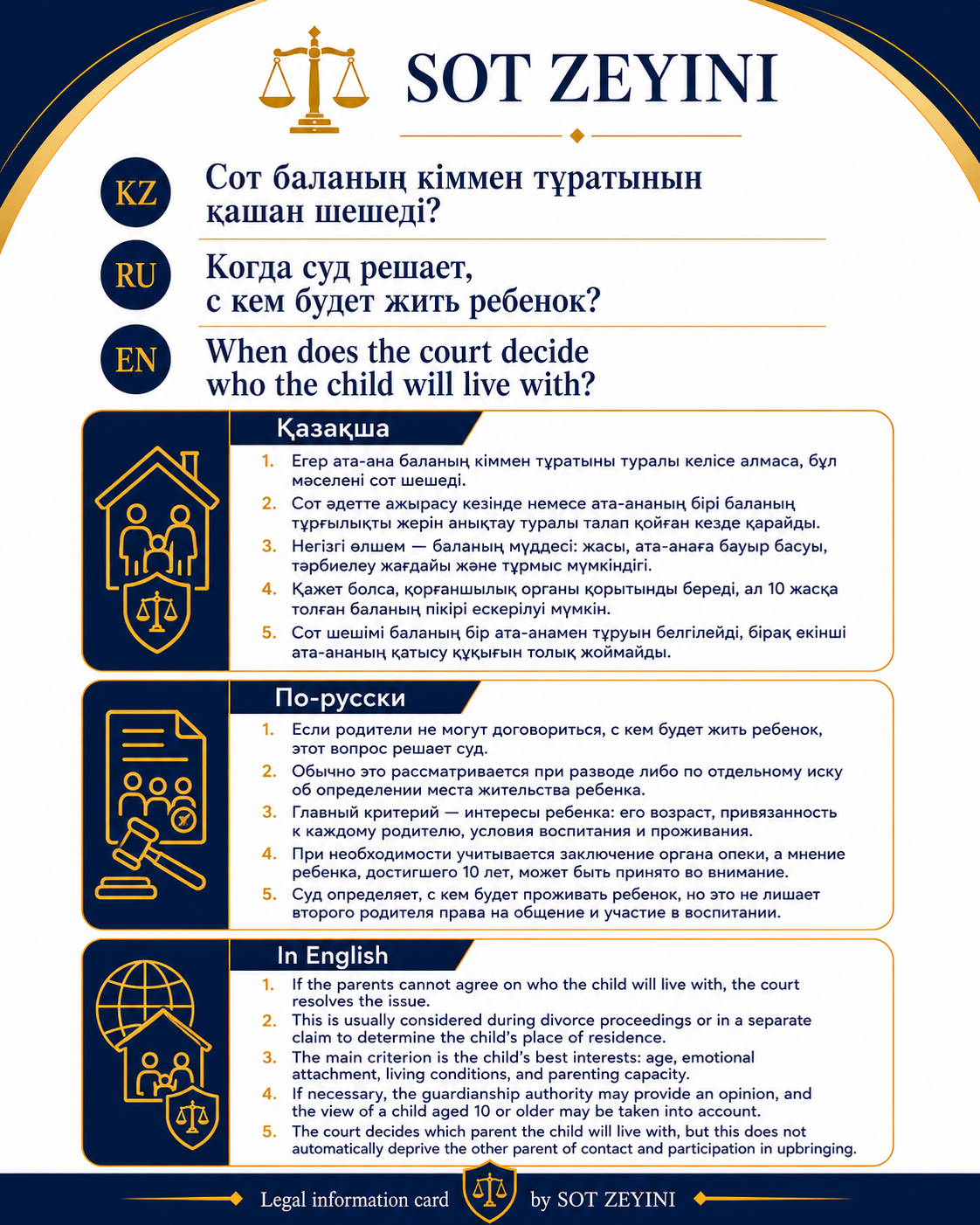
When does the court decide which parent the child will live with?

When does the court decide which parent the child will live with?

The court decides which parent the child will live with when the parents cannot reach an agreement themselves. This usually happens after divorce, separation, or a conflict between the parents about the child’s upbringing and residence. Legally, this is called determining the child’s place of residence. The court decides whether the child will permanently live with the mother or with the father. It is important to understand that if the court determines the child’s residence with one parent, the other parent does not lose the right to communicate with the child, participate in upbringing, call, meet, and receive information about the child’s health and education.

Read article →
ИИ Бот