 +7 775 858 9294
 WhatsApp
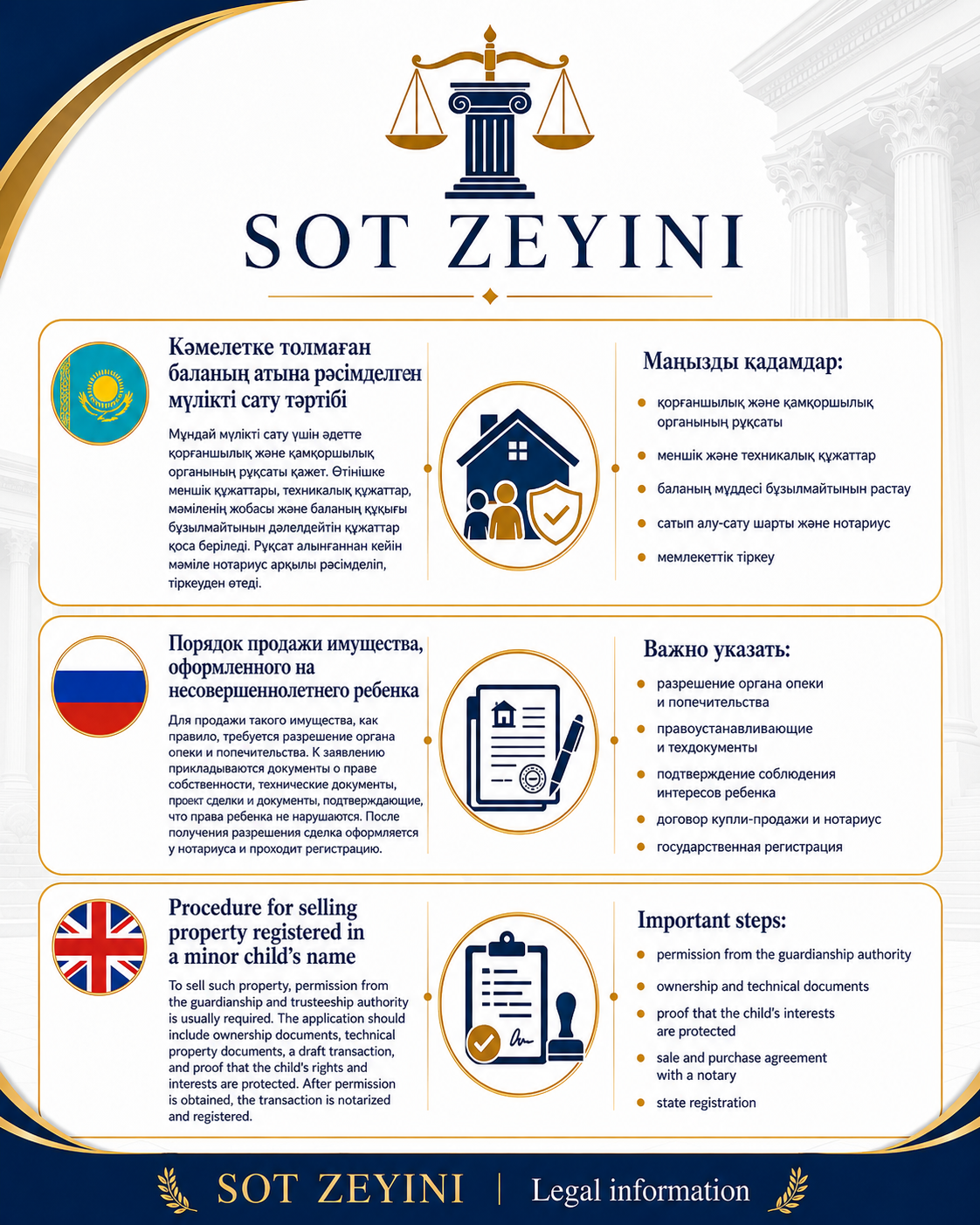
Procedure for Selling Property Registered in the Name of a Minor Child
Can property registered in a minor child’s name be sold?
In Kazakhstan, property registered in the name of a minor child can be sold, but the transaction must follow a special legal procedure. If the child owns an apartment, house, land plot, or a share in real estate, parents cannot dispose of that property on their own without permission from the guardianship and custody authority.
The purpose of this requirement is to protect the child’s property rights. The law is designed to prevent situations where a child’s property is sold against the child’s interests.
In simple terms: if a child owns a share in the apartment, the sale is not just a regular family decision. It requires official approval.
When is permission from the guardianship authority required?
Permission from the guardianship and custody authority is required if:
- the child is the sole owner of an apartment or house;
- the child owns a share in real estate;
- the property was inherited by the child;
- the property was gifted to the child;
- a land plot is registered in the child’s name;
- the child’s property is being sold, exchanged, pledged, or rented out;
- the transaction may affect the child’s housing or property rights.
If the child is only registered or lives in the apartment but is not an owner and has no share, guardianship permission is usually not required. However, depending on the situation, a notary, bank, or buyer may ask for additional documents.
What is the difference between children under 14 and children aged 14 to 18?
The procedure depends on the child’s age.
Child under 14
If the child is under 14, the transaction is carried out on behalf of the child by the parents or legal representatives. The child does not sign the contract. However, permission from the guardianship and custody authority is still required.
Child aged 14 to 18
If the child is between 14 and 18, the child may participate in the transaction personally, but only with the consent of the parents or legal representatives. In this case, the minor participates in the transaction, while the parents confirm their consent.
Where should parents apply for permission?
Parents or legal representatives should apply to the guardianship and custody authority at the child’s place of residence. In practice, these functions are often carried out by local executive bodies, education departments, or other authorized divisions under the akimat.
The application may be submitted through eGov or directly to the competent local authority. The application should explain why the child’s property is being sold and why the transaction does not violate the child’s interests.
What does the guardianship authority check?
The guardianship authority checks whether the child’s situation will worsen after the sale. The main question is whether the child will retain housing, a share in another property, or another form of equivalent property protection.
The authority usually reviews:
- whether the property is the child’s only home;
- what share belongs to the child;
- whether the child will receive another property or share;
- whether the child’s housing conditions will become worse;
- how the money from the sale will be used;
- whether the transaction is in the child’s interests;
- whether both parents consent;
- whether there is a risk that the child will be left without property.
If the child may lose housing or the transaction worsens the child’s position, permission may be refused.
What documents are required?
The following documents may be required:
- application from parents or legal representatives;
- identity documents of the parents;
- child’s birth certificate;
- child’s identity document, if available;
- documents confirming ownership of the property;
- certificate of registered rights to real estate;
- technical passport;
- draft sale and purchase agreement;
- documents for the new property, if another property is being purchased;
- consent of the second parent;
- marriage or divorce certificate;
- documents confirming the need for the transaction;
- the child’s opinion, if the child is old enough for it to be considered;
- other documents requested by the guardianship authority.
The exact list may vary depending on the circumstances. For example, if one parent has died, was deprived of parental rights, was declared missing, or was declared legally incapable, this must be confirmed by official documents.
Is the second parent’s consent required?
In most cases, the second parent’s consent is required. Even if the parents are divorced, the sale of a child’s property affects the child’s rights, so the second parent’s position may be relevant.
If consent cannot be obtained, the applicant should provide documents explaining why, such as:
- death certificate;
- court decision on deprivation of parental rights;
- court decision declaring the parent missing;
- court decision declaring the parent legally incapable;
- other documents confirming that consent cannot be obtained.
If there is a dispute between the parents, the issue may need to be resolved through the guardianship authority or court.
Can a child’s share be sold without buying another apartment?
It depends on the circumstances. The guardianship authority will assess whether the child’s rights are protected. If the child receives an equivalent share in another property or the money is placed in the child’s account and preserved for the child’s benefit, permission may be possible.
However, if the sale leaves the child without property or worsens the child’s situation, permission may be refused.
What happens after permission is obtained?
After permission is obtained, the transaction is completed through a notary. The notary checks:
- real estate documents;
- guardianship authority permission;
- identities of the parties;
- authority of the parents;
- consent of the second parent;
- age of the child;
- terms of the contract.
After the contract is signed, the transfer of ownership is registered according to the required procedure.
What if the child’s property is sold without permission?
If a minor child’s property is sold without the required permission, the transaction may later be challenged. If it is established that the transaction violated the child’s rights, it may be declared invalid.
This creates risk not only for the seller, but also for the buyer. Therefore, before buying an apartment or house, it is important to check whether any minor children are among the owners.
Conclusion
Property registered in the name of a minor child can be sold only under a special procedure. If the child is an owner or has a share, permission from the guardianship and custody authority is required.
The key criterion is the child’s best interests. If the child does not lose housing, receives an equivalent share, or receives another form of property protection, permission may be granted. If the transaction worsens the child’s position, permission may be refused.
FAQ
Can an apartment registered in a minor child’s name be sold?
Yes, but only with permission from the guardianship and custody authority.
Is guardianship permission needed if the child is only registered in the apartment?
If the child is not an owner and has no share, permission is usually not required.
Who signs the contract for a child under 14?
A parent or legal representative signs the contract on behalf of a child under 14.
Can a child aged 14 to 18 sign the contract?
Yes, but only with the consent of the parents or legal representatives.
Can a child’s share be sold without buying another apartment?
In some cases, yes, but the guardianship authority must be satisfied that the child’s rights are not violated.
What should be done if the guardianship authority refuses permission?
The reasons for refusal may be corrected, additional documents may be submitted, or the refusal may be appealed to a higher authority or court.
What is the risk of buying an apartment with a child’s share?
If the transaction was completed without guardianship authority permission, it may be challenged and declared invalid.