 +7 775 858 9294
 WhatsApp
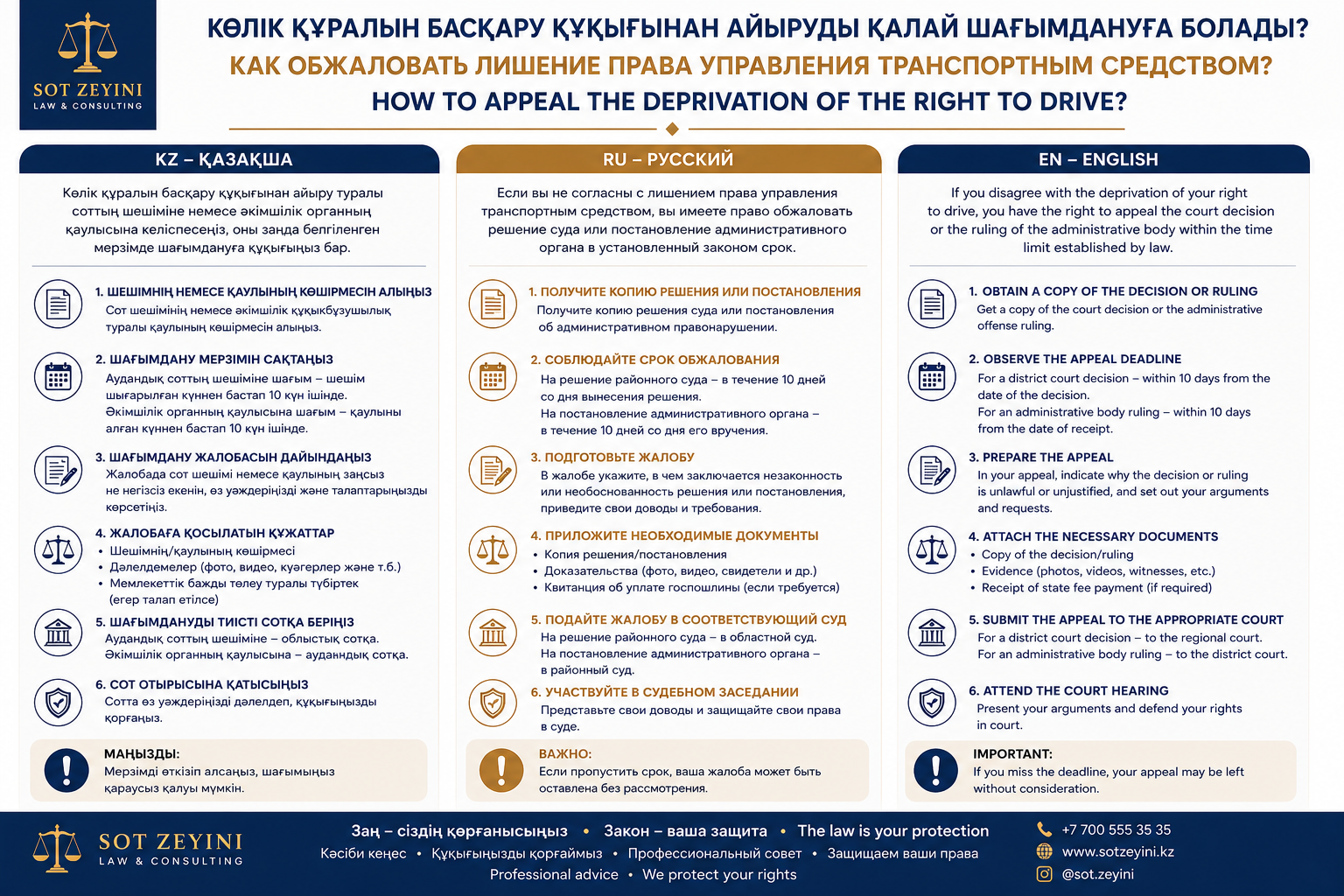
How to Appeal the Deprivation of Driving Rights in Kazakhstan
Short answer
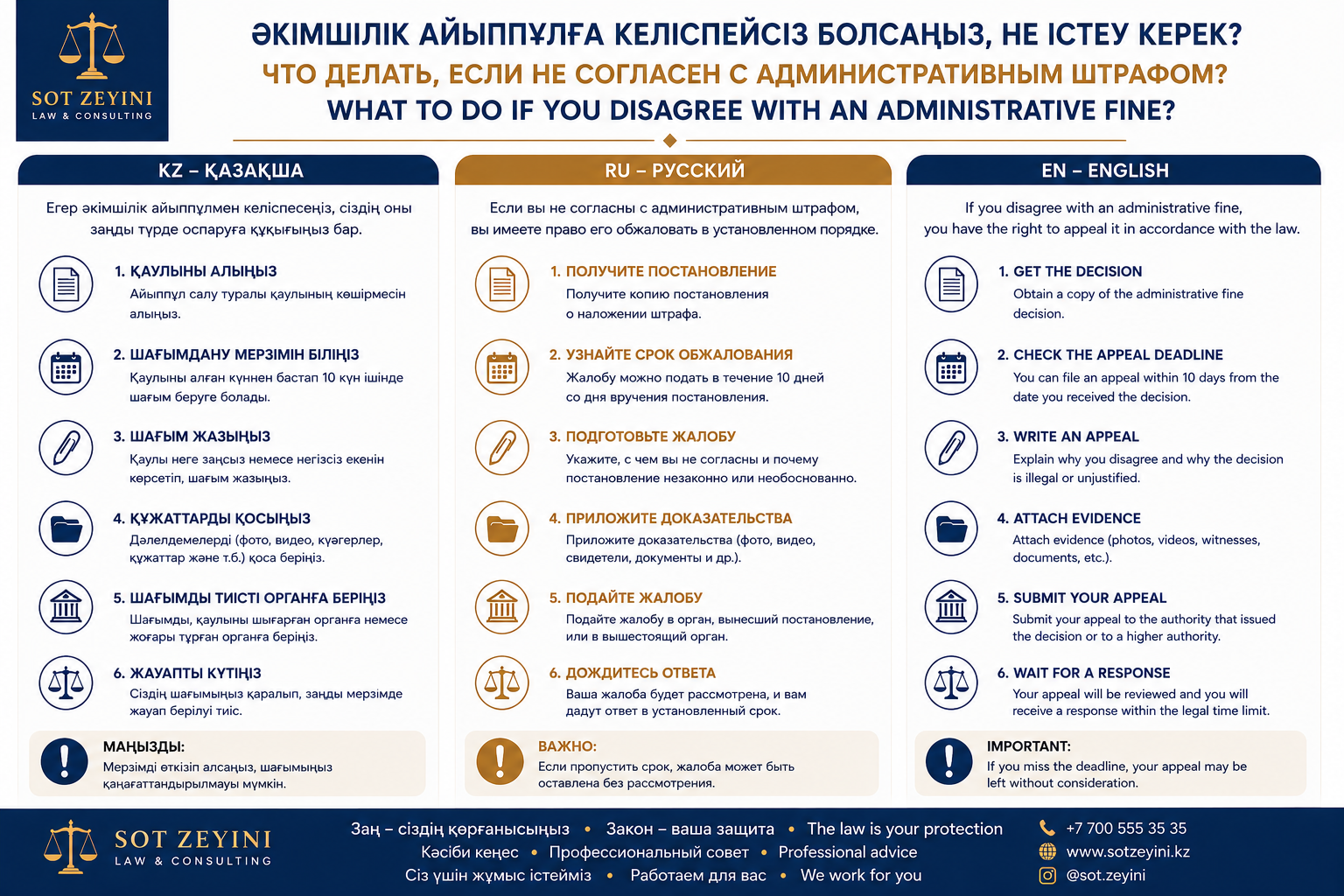
If you disagree with a ruling depriving you of the right to drive, you may appeal it within the legally established period. In most cases, the complaint must be filed within 10 days from the date the copy of the ruling is delivered. If the driver did not participate in the hearing, the period starts from the date they received the ruling.
The most important rule is to act quickly. Once the ruling enters into legal force, restoring or changing the situation becomes much more difficult.
When can a driver be deprived of driving rights?
Deprivation of the right to drive may be imposed for various administrative offenses, such as:
- driving under the influence;
- refusal to undergo medical examination;
- leaving the scene of a traffic accident;
- driving into the oncoming lane;
- creating an emergency situation;
- driving while already deprived of the right to drive;
- repeated serious traffic violations;
- an accident causing harm to health;
- other serious violations provided by law.
Before filing a complaint, it is necessary to check which article was applied and what sanction was imposed.
What document is appealed?
Deprivation of driving rights is usually imposed by a court ruling in an administrative offense case.
A complaint may be filed against:
- a court ruling;
- a ruling of an administrative authority;
- a decision imposing an additional penalty;
- a ruling depriving the person of the right to drive.
The ruling should state the case number, legal article, circumstances of the violation, deprivation period, and appeal procedure.
Appeal deadline
As a general rule, the complaint must be filed within 10 days:
- from the date the copy of the ruling is delivered;
- if the driver did not participate in the hearing — from the date the ruling was received;
- if the document was delivered electronically — from the date of proper electronic receipt.
If the deadline is missed, a motion to restore the deadline may be filed, but a valid reason must be proven.
What if the deadline was missed?
If the 10-day period has passed, a motion to restore the deadline should be filed together with the complaint.
Valid reasons may include:
- late receipt of the ruling;
- no notice of the hearing;
- illness;
- business trip;
- hospitalization;
- serious family circumstances;
- objective inability to access electronic notification;
- other documented circumstances.
Supporting documents may include medical certificates, tickets, business trip documents, postal notices, portal screenshots, or other evidence.
Where should the complaint be filed?
Usually, the complaint is filed with the higher court through the court that issued the ruling.
Depending on the case, it may also be filed:
- through the court that issued the ruling;
- through Qamqor.gov.kz;
- through the Judicial Cabinet;
- with the authority that issued the ruling;
- with a higher administrative authority, if the case was not decided by a court.
The appeal procedure written in the ruling should be checked before filing.
Can the complaint be filed online?
Yes, in some cases the complaint may be filed online through Qamqor.gov.kz or the Judicial Cabinet.
The general process is:
- Log in using an electronic digital signature;
- Find the administrative case;
- Review the case materials;
- Write the complaint text;
- Attach evidence;
- Sign with electronic digital signature;
- Submit the complaint.
After submission, keep the registration number or filing confirmation.
Grounds for appealing deprivation of driving rights
A ruling may be appealed if:
- there is no administrative offense;
- the driver’s guilt is not proven;
- the protocol was drawn up with violations;
- the driver’s rights were not explained;
- the driver was not allowed to give explanations;
- the right to legal defense was violated;
- video evidence was not examined;
- medical examination was conducted improperly;
- there are doubts about the breathalyzer or technical device;
- there is no information about device verification;
- the driver was not properly notified of the hearing;
- mitigating circumstances were not considered;
- the punishment was imposed without full examination of the case.
The specific grounds depend on the type of offense. For example, drunk driving cases require checking the medical examination procedure, while oncoming lane cases require reviewing signs, road markings, diagrams, and video.
What evidence is needed?
The complaint may include:
- copy of the court ruling;
- administrative protocol;
- accident diagram, if any;
- video recording;
- dashcam footage;
- photos of road signs and markings;
- witness statements;
- medical examination report;
- breathalyzer result;
- information about device verification;
- documents proving improper notification;
- employment certificate;
- documents showing that driving is necessary for work;
- family or medical documents;
- other evidence.
The evidence should show why the ruling is unlawful or unfounded.
If driving rights were revoked for alcohol
In drunk driving cases, it is important to check:
- whether the medical examination was lawful;
- whether the driver’s rights were explained;
- whether the examination report was filled out correctly;
- whether the device number was indicated;
- whether device verification information exists;
- whether the time and result were recorded;
- whether video recording exists;
- whether witnesses were involved where required;
- whether referral to medical examination was lawful.
A simple statement “I did not drink” is not enough. Specific procedural violations or evidence are needed.
If rights were revoked for driving into the oncoming lane
In such cases, check:
- whether the vehicle actually entered the oncoming lane;
- whether road markings were visible;
- whether the road sign was installed correctly;
- whether video evidence exists;
- whether the maneuver was forced;
- whether there was an obstacle on the road;
- whether the diagram was correct;
- whether the location was accurately stated.
If markings were erased, the sign was hidden, or the video does not clearly prove the violation, this may support the complaint.
If the driver did not attend the hearing
If the ruling was issued without the driver’s participation, proper notification must be checked.
The complaint may state:
- no notice of the hearing was received;
- the driver did not know the date and time of the hearing;
- the driver could not provide explanations;
- the driver could not file motions;
- the driver could not use legal assistance;
- the case was reviewed without full examination of circumstances.
Violation of the right to participate in the case may be a serious ground for cancellation or new review.
What should be written in the complaint?
The complaint should include:
- name of the higher court or authority;
- applicant’s full name;
- individual identification number;
- address;
- phone number;
- case number;
- date of the ruling;
- court or authority that issued the ruling;
- article applied;
- penalty imposed;
- reasons for disagreement;
- evidence supporting the position;
- specific requests;
- list of attachments;
- date and signature.
The complaint should be precise. “I need my license” is a weak argument. “The ruling is unlawful because the procedure was violated, evidence was not examined, and guilt was not proven” is a legal position.
Sample complaint
To [name of higher court]
Through [name of court that issued the ruling]
Applicant: [full name]
IIN: [IIN]
Address: [address]
Phone: [phone]
Case No.: [case number]
COMPLAINT
against the ruling depriving the applicant of the right to drive
By ruling of [name of court] dated [date], I was held administratively liable under Article [article] of the Code of Administrative Offenses of the Republic of Kazakhstan. The ruling imposed an administrative penalty in the form of deprivation of the right to drive vehicles for [period].
I disagree with this ruling and consider it unlawful and unfounded for the following reasons.
[State specific arguments: no administrative offense, guilt was not proven, protocol was drawn up with violations, rights were not explained, medical examination was conducted improperly, video evidence was not examined, notification of the hearing was not received, mitigating circumstances were not considered, etc.]
I believe that the circumstances of the case were not established fully, comprehensively, and objectively. The case materials do not contain sufficient grounds for imposing deprivation of the right to drive.
Based on the above,
I REQUEST:
- Cancel the ruling of [name of court] dated [date];
- Terminate the administrative offense case;
- Alternatively, send the case for a new review;
- If necessary, request video recording, medical examination materials, technical device verification data, and other evidence;
- Review the complaint with my participation and/or with the participation of my defense counsel.
Attachments:
- Copy of the ruling;
- Copy of the administrative protocol;
- Photos and videos;
- Medical documents, if any;
- Employment certificate;
- Other evidence.
Date: ____________
Signature: ____________
Can you drive before the ruling enters into force?
This depends on the specific situation. If the ruling has not yet entered into legal force and the driver’s license has not been seized, the status must be checked based on the case materials.
However, if the ruling has already entered into legal force, driving may result in new administrative liability. Before driving, the status of the ruling and license should be verified.
Does filing a complaint stop the deprivation period?
Filing a complaint may affect when the ruling enters into legal force, but the exact procedural situation must be checked: ruling date, receipt date, complaint filing date, and license status.
If the ruling has entered into force and the person continues to drive, this may create new legal problems.
If the license is needed for work
If the driver’s license is necessary for work, this can be stated in the complaint. For example:
- the person works as a driver;
- the person is the only provider for the family;
- the person lives in an area without public transport;
- the person transports a sick relative or child;
- without a vehicle, the person cannot earn income.
However, this is not an automatic ground for cancellation. It may be considered as a mitigating circumstance or part of the overall fairness assessment.
Common mistakes
Common mistakes include:
- missing the 10-day deadline;
- failing to request restoration of the deadline;
- filing a complaint without specific legal grounds;
- not attaching evidence;
- not checking medical examination documents;
- not requesting video evidence;
- not attending court;
- continuing to drive after the ruling enters into force;
- relying only on the phrase “I need my license for work.”
A strong complaint is built on three elements: error, evidence, and a clear request.
Conclusion
Deprivation of driving rights can be appealed, but quick action is essential. In most cases, the complaint must be filed within 10 days from receipt of the ruling. The complaint should explain why the ruling is unlawful or unfounded and include supporting evidence.
If the deadline is missed, restoration should be requested. If the ruling has entered into legal force, driving is prohibited and may lead to new liability.
FAQ
Can deprivation of driving rights be appealed?
Yes, if you disagree with the ruling, it may be appealed within the established deadline.
What is the appeal deadline?
Usually 10 days from delivery of the ruling copy or from receipt if the driver did not participate in the case review.
Where should the complaint be filed?
Usually with the higher court through the court that issued the ruling. Online filing through Qamqor.gov.kz or Judicial Cabinet may also be possible.
What if the deadline was missed?
File a motion to restore the deadline and attach documents proving a valid reason.
Can deprivation for alcohol be appealed?
Yes, but the medical examination procedure, documents, breathalyzer, video, and driver’s rights must be carefully checked.
Can I drive while the complaint is pending?
You need to verify whether the ruling has entered into legal force. If it has, driving may lead to new liability.
Does an employment certificate help?
It may help as a mitigating circumstance, but it does not guarantee cancellation of the deprivation.
What documents should be attached?
Ruling, protocol, video, medical examination documents, technical device data, employment certificate, and other evidence.