 +7 775 858 9294
 WhatsApp
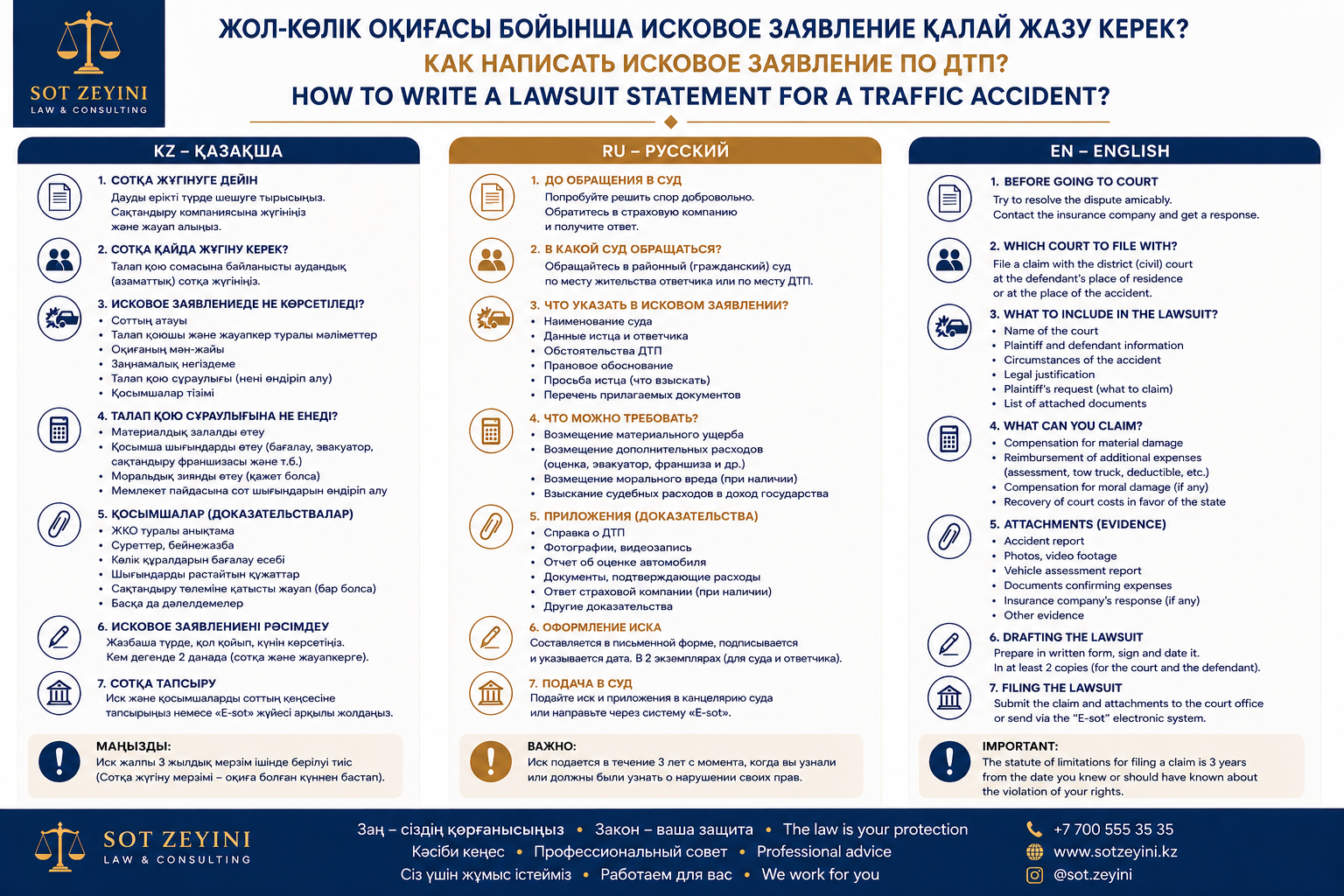
How to Write a Court Claim After a Traffic Accident in Kazakhstan
How to Write a Court Claim After a Traffic Accident in Kazakhstan
Learn how to write a court claim after a traffic accident in Kazakhstan: damage recovery, insurance shortfall, independent assessment, towing expenses, legal fees, and moral damages.
traffic accident court claim Kazakhstan, accident damage claim, sue at-fault driver Kazakhstan, insurance payment not enough, recover accident damages, independent assessment accident, moral damages accident Kazakhstan, car accident lawsuit Kazakhstan
Short answer
A court claim after a traffic accident should state when and where the accident happened, who was at fault, what damage was caused, how much the insurance company paid, and what amount the injured party seeks to recover from the at-fault person.
In such cases, three key elements must be proven:
- the defendant’s fault;
- the amount of damage;
- the causal link between the accident and the damage.
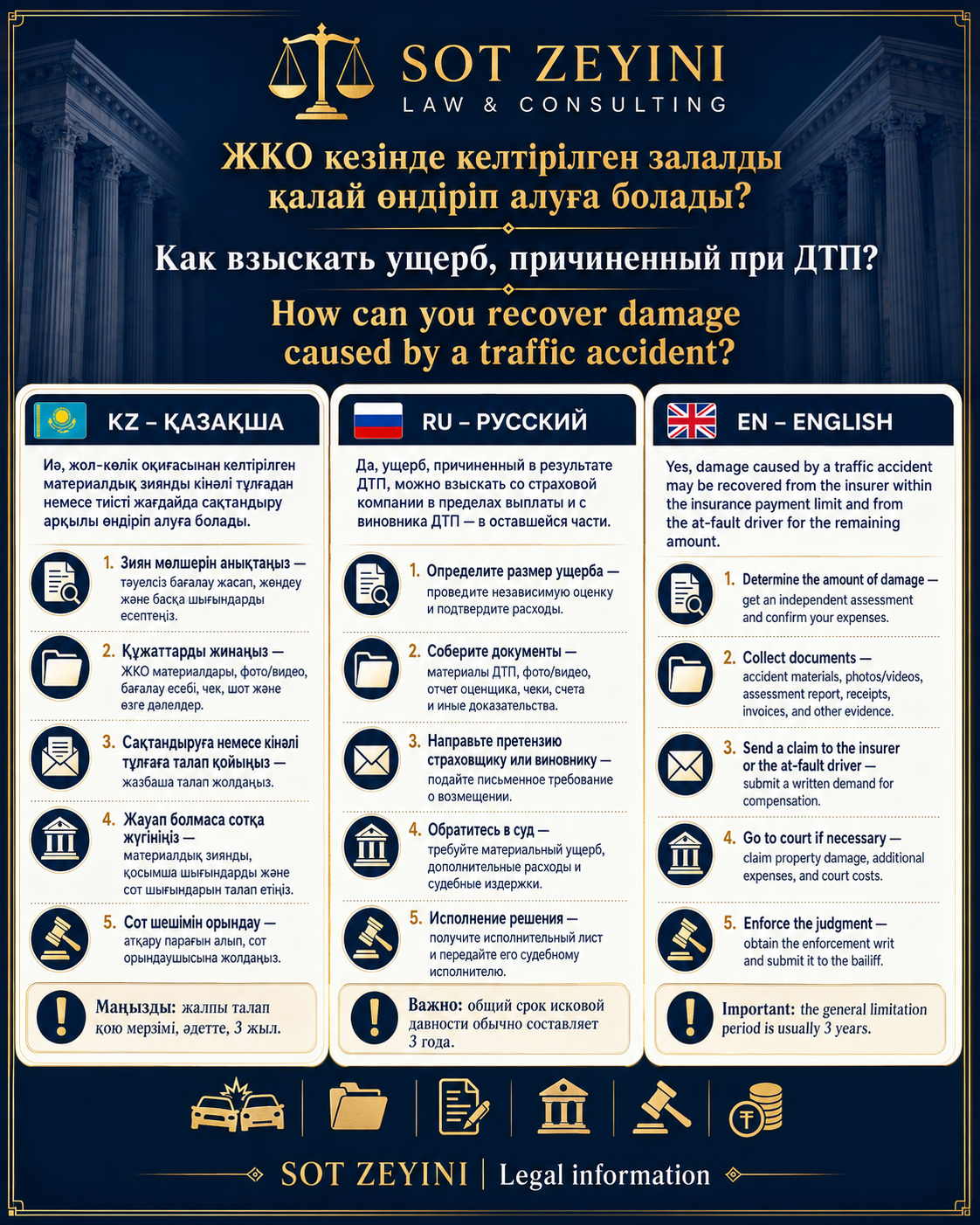
If these elements are supported by documents, the injured party may recover material damage, the difference between insurance payment and actual damage, independent assessment costs, towing expenses, legal fees, state duty, court expenses, and, where justified, moral damages.
When is a traffic accident claim filed?
A traffic accident claim may be filed if:
- the at-fault driver refuses to compensate damages voluntarily;
- the insurance payment does not cover the full damage;
- the insurance company refuses payment;
- the at-fault driver had no insurance;
- an independent assessment shows a higher amount of damage;
- towing, parking, assessment, or legal expenses were not compensated;
- injury was caused;
- moral damages must be recovered;
- the at-fault person does not respond to a pre-litigation demand.
For example, if the insurance company paid 1,200,000 tenge, but the independent assessment showed damage of 1,900,000 tenge, the difference of 700,000 tenge may be recovered from the at-fault driver through court.
Which court should the claim be filed with?
As a general rule, the claim is filed with the district or city court at the defendant’s place of residence.
If the defendant is an individual, the claim is usually filed at their registered address. If the defendant is a legal entity, the claim is filed at its registered location.
In some cases, alternative jurisdiction may apply. For example, if the accident caused harm to health, the injured party may consider filing at their own place of residence.
Before filing, it is important to correctly identify the defendant: full name, individual identification number, address, and contact details if known.
Structure of a traffic accident claim
The claim usually includes:
- name of the court;
- claimant’s details;
- defendant’s details;
- third parties, if any;
- claim amount;
- title of the document;
- circumstances of the accident;
- evidence of the defendant’s fault;
- damage calculation;
- information about insurance payment;
- calculation of the difference;
- legal grounds;
- requests to the court;
- list of attachments;
- date and signature.
The claim should be clear and evidence-based. The court needs documents, calculations, and legal reasoning — not emotions.
How to write the heading of the claim
At the beginning, state the court, parties, and claim amount.
Example:
To [name of court] District Court
Claimant: [full name, IIN, address, phone]
Defendant: [full name, IIN, address, phone]
Third party: [insurance company, if necessary]
Claim amount: [amount] tenge
Statement of Claim
for recovery of damages caused by a traffic accident
If the insurance company has already paid part of the amount or is related to the dispute, it may be included as a third party.
How to describe the accident circumstances
The claim should state:
- date of the accident;
- time of the accident;
- place of the accident;
- vehicles involved;
- which vehicle was damaged;
- who was found at fault;
- which document confirms fault;
- what damage was caused.
Example:
“On [date], at approximately [time], at [place], a road traffic accident occurred involving my vehicle [make, registration number] and the vehicle [make, registration number] driven by the defendant [full name]. As a result of the accident, my vehicle sustained mechanical damage.”
After that, specify which document confirms the defendant’s fault.
How to prove the defendant’s fault
The defendant’s fault may be confirmed by:
- administrative offense protocol;
- accident diagram;
- police materials;
- court ruling;
- explanations of the parties;
- witness statements;
- photos and videos;
- expert opinion.
If the court ruling on the defendant’s fault has entered into legal force, it is an important piece of evidence.
Example:
“The defendant’s fault in the accident is confirmed by the ruling of [name of court] dated [date], which has entered into legal force.”
How to state the amount of damage
The amount of damage must be supported by calculation and documents.
Example:
- damage according to independent assessment — 1,900,000 tenge;
- insurance payment — 1,200,000 tenge;
- difference — 700,000 tenge;
- assessment costs — 30,000 tenge;
- towing expenses — 25,000 tenge;
- legal fees — 150,000 tenge.
The claim should explain how the final amount was calculated. Approximate statements are weak in court. Reports, receipts, invoices, and contracts are needed.
If the insurance payment did not cover the damage
If the insurance company paid part of the amount, but the actual damage is higher, the claim should show the difference.
Example:
“The insurance company paid compensation in the amount of 1,200,000 tenge. However, according to the independent assessment report, the actual material damage amounts to 1,900,000 tenge. Therefore, the difference between the actual damage and the insurance payment is 700,000 tenge and should be recovered from the defendant.”
Attach proof of insurance payment and the independent assessment report.
If the at-fault driver had no insurance
If the at-fault driver had no compulsory insurance policy, the entire damage may be claimed directly from that person.
Example:
“At the time of the accident, the defendant did not have a valid compulsory motor third-party liability insurance policy. Therefore, the damage caused to me was not compensated by an insurance company and must be recovered directly from the defendant.”
If the at-fault driver is not the vehicle owner
Sometimes the person who caused the accident is not the owner of the vehicle. In such cases, it is important to identify the proper defendant.
The responsible person may be:
- the driver;
- the vehicle owner;
- the lawful possessor of the vehicle;
- the employer, if the driver was performing work duties;
- carrier or another responsible person.
If the driver was driving a company vehicle during work, the employer’s liability may also be considered.
What can be claimed?
The claim may request recovery of:
- material damage;
- difference between insurance payment and actual damage;
- independent assessment costs;
- towing expenses;
- parking expenses;
- medical expenses;
- lost income;
- legal fees;
- state duty;
- court expenses;
- moral damages, if there are grounds.
Every amount must be supported by documents.
How to write the request section
The request section should be clear.
Example:
I request the court to:
- Recover from the defendant [full name] material damage caused by the traffic accident in the amount of [amount] tenge;
- Recover independent assessment costs in the amount of [amount] tenge;
- Recover towing expenses in the amount of [amount] tenge;
- Recover legal fees in the amount of [amount] tenge;
- Recover state duty and court expenses;
- If there are grounds, recover moral damages in the amount of [amount] tenge.
The court should not have to guess what the claimant wants. The requests must be clear.
What documents should be attached?
It is advisable to attach:
- copy of the claim;
- copy of claimant’s identity document;
- vehicle documents;
- accident diagram;
- administrative offense protocol;
- court ruling;
- police materials;
- photos and videos;
- independent assessment report;
- insurance company response;
- proof of insurance payment;
- pre-litigation demand;
- proof that the demand was sent;
- receipts for towing, parking, and repair;
- medical documents, if there was injury;
- legal services agreement;
- proof of payment for legal services;
- state duty payment receipt.
Documents should be arranged in order. The judge should not have to solve a document puzzle.
How is state duty paid?
A claim for material damage is a property claim. State duty is calculated based on the claim amount.
The claim amount usually includes the amount the claimant seeks to recover: damage difference, assessment expenses, towing expenses, repair costs, and other material expenses.
The receipt for state duty payment should be attached to the claim.
Is a pre-litigation demand required?
In many traffic accident cases, a pre-litigation demand may not be mandatory, but it is advisable.
It helps to:
- give the defendant a chance to pay voluntarily;
- show the claimant’s good faith;
- prove that the defendant refused to pay;
- sometimes resolve the dispute without court.
The demand should be sent by registered mail, courier, email, or delivered against signature.
Sample traffic accident court claim
To [name of court] District Court
Claimant: [full name, IIN, address, phone]
Defendant: [full name, IIN, address, phone]
Third party: [insurance company, if necessary]
Claim amount: [amount] tenge
STATEMENT OF CLAIM
for recovery of damages caused by a traffic accident
On [date], at approximately [time], at [place], a road traffic accident occurred involving my vehicle [make, registration number] and the vehicle [make, registration number] driven by the defendant [full name].
As a result of the accident, my vehicle sustained mechanical damage.
The defendant’s fault is confirmed by [court ruling / administrative case materials / police documents]. According to the indicated document, the accident occurred due to the defendant’s violation of traffic rules.
According to the independent assessment report, the amount of material damage is [amount] tenge.
The insurance company paid compensation in the amount of [amount] tenge. However, this amount does not cover the actual damage. The difference between the insurance payment and the actual damage is [amount] tenge.
In addition, as a result of the accident, I incurred expenses for [assessment, towing, legal assistance, and other expenses], which are confirmed by the attached documents.
Based on the above, the damage caused to me should be recovered from the defendant.
I request the court to:
- Recover from the defendant [full name] material damage caused by the traffic accident in the amount of [amount] tenge;
- Recover independent assessment costs in the amount of [amount] tenge;
- Recover towing expenses in the amount of [amount] tenge;
- Recover legal fees in the amount of [amount] tenge;
- Recover state duty and other court expenses;
- If there are grounds, recover moral damages in the amount of [amount] tenge.
Attachments:
- Copy of the statement of claim;
- Copy of identity document;
- Vehicle documents;
- Accident materials;
- Court ruling;
- Independent assessment report;
- Proof of insurance payment;
- Pre-litigation demand;
- Proof of sending the demand;
- Documents confirming expenses;
- State duty payment receipt;
- Other documents.
Date: ____________
Signature: ____________
Common mistakes
Common mistakes include:
- incorrect defendant;
- no document confirming fault;
- no precise calculation of damage;
- no assessment report;
- insurance payment not taken into account;
- no receipts;
- no pre-litigation demand attached;
- incorrect state duty calculation;
- unclear request section;
- too many emotions and too little evidence.
A court claim should say: here is the fault, here is the damage, here is the calculation, and here are the documents.
Conclusion
A traffic accident court claim should clearly state the accident circumstances, defendant’s fault, amount of damage, insurance payment, difference to be recovered, and specific requests. Accident materials, court ruling, independent assessment report, proof of insurance payment, receipts, and other evidence should be attached.
If the insurance payment does not cover the full damage, the difference may be recovered from the at-fault driver. If injury or moral suffering occurred, moral damages may also be claimed.
The key is to write the claim with evidence, not emotions. In accident disputes, documents win.
FAQ
Which court should hear a traffic accident claim?
Usually, the claim is filed at the defendant’s place of residence in a district or city court.
Can the difference between actual damage and insurance payment be recovered?
Yes, if the actual damage is confirmed by assessment and the insurance payment did not cover it.
Is an independent assessment required?
It is not always mandatory, but it is very important for proving the amount of damage.
What if the at-fault driver had no insurance?
In that case, the entire damage may be claimed directly from the at-fault driver.
Can moral damages be claimed?
Yes, if there are grounds, such as harm to health or proven physical or emotional suffering.
Is a pre-litigation demand required?
Not always, but it is advisable. It shows an attempt to resolve the dispute peacefully.
Is state duty required?
Yes, for property claims, state duty is calculated based on the claim amount.
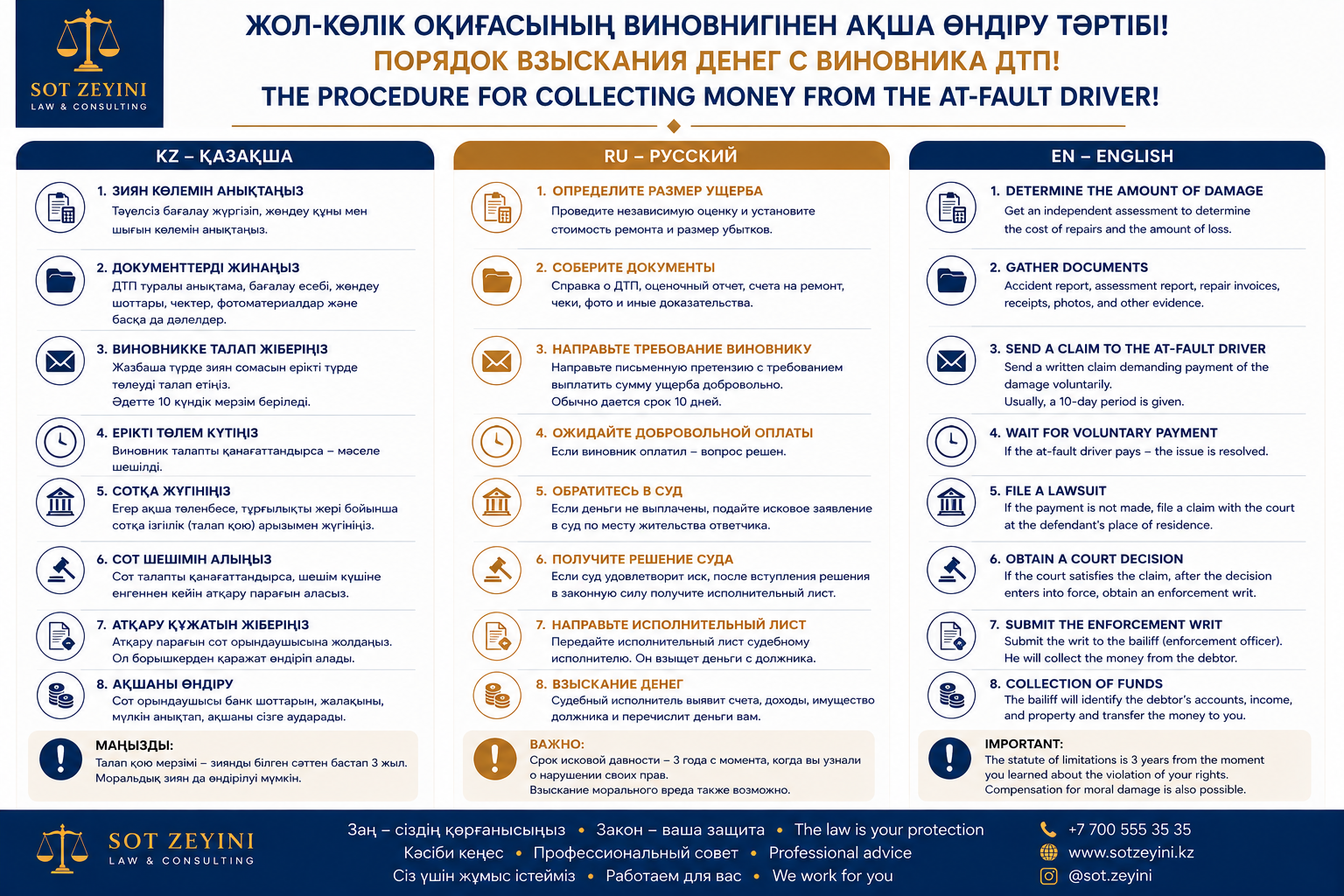
How do you recover money after a court decision?
After the decision enters into force, a writ of execution should be obtained and submitted to a private bailiff.