 +7 775 858 9294
 WhatsApp
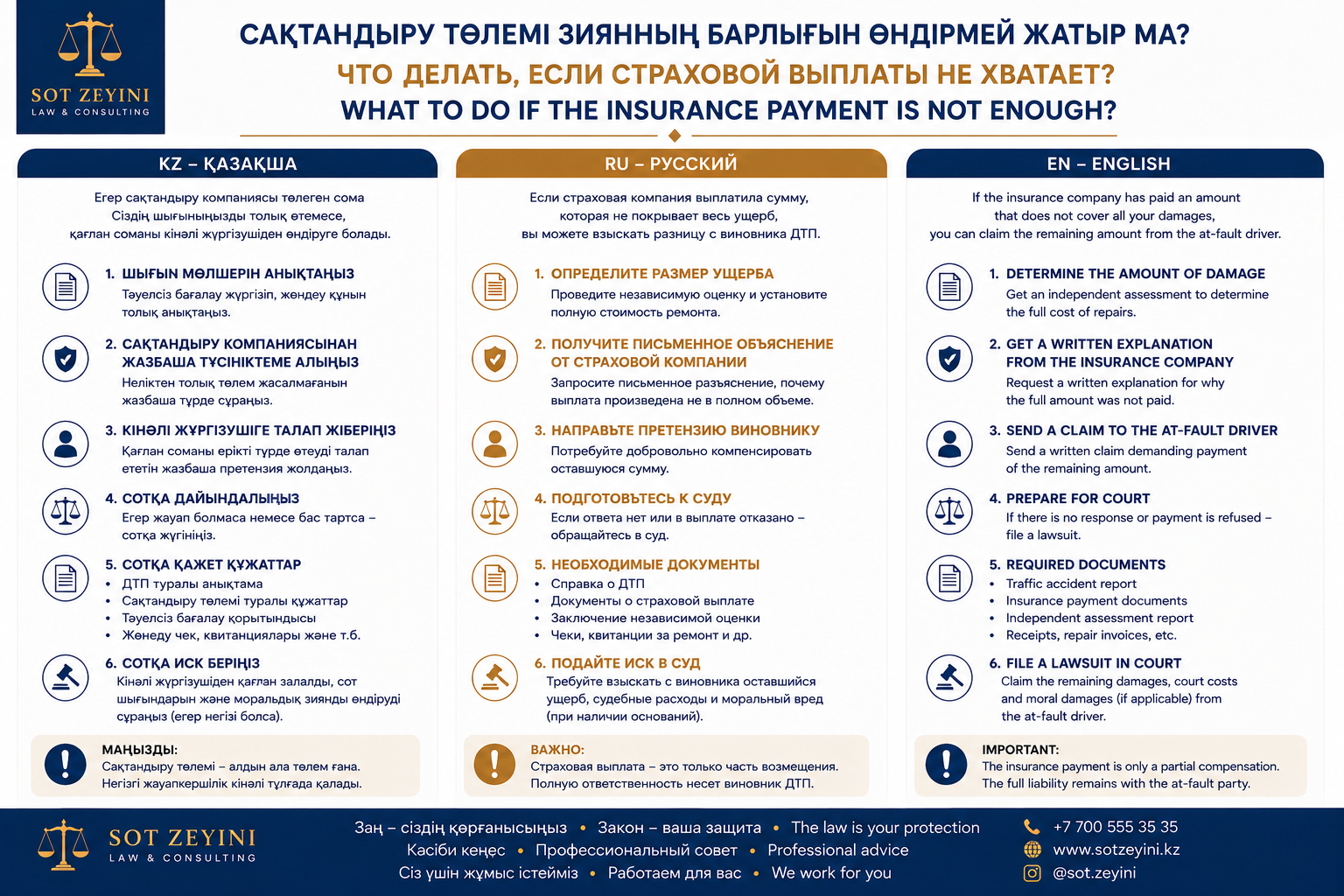
What to Do If the Insurance Payment Is Not Enough After a Traffic Accident in Kazakhstan
What to Do If Insurance Payment Is Not Enough After an AccidentLearn what to do if the insurance company pays too little after a traffic accident in Kazakhstan: independent assessment, recalculation request, claim against the at-fault driver, court claim, and enforcement.insurance payment not enough Kazakhstan, accident insurance underpaid, recover difference from at-fault driver, independent vehicle assessment Kazakhstan, traffic accident compensation, insurance dispute accident, car accident damage claim Kazakhstan
Short answer
If the insurance payment after a traffic accident is not enough to cover the repair costs, the injured party may obtain an independent assessment and claim the difference between the actual damage and the insurance payment from the at-fault driver.
For example, if vehicle repair costs 2,000,000 tenge and the insurance company pays 1,300,000 tenge, the remaining 700,000 tenge may be claimed from the at-fault driver.
The key is not to accept the amount automatically. If the payment seems understated, the injured party should request the calculation, obtain an independent assessment, send a demand, and, if necessary, file a court claim.
Why may the insurance payment be insufficient?
The insurance payment may be insufficient for several reasons:
- the insurance company underestimated the repair cost;
- not all damage was included;
- spare parts were calculated below market price;
- depreciation of parts was applied;
- some damage was considered unrelated to the accident;
- the actual damage exceeded the insurer’s liability limit;
- several injured parties were involved;
- towing, parking, assessment, or other expenses were not included;
- actual repair costs were higher than the insurer’s calculation.
An insurance payment does not always mean that the issue is fully resolved. If the real damage is higher, the injured party may challenge the calculation or claim the difference from the at-fault driver.
Step one: request the insurance company’s calculation
If the amount paid seems too low, the injured party should request a detailed calculation from the insurance company.
The request may ask for:
- assessment report;
- list of included damage;
- list of excluded damage;
- cost of spare parts;
- cost of repair works;
- information on depreciation;
- formula used to calculate the payment;
- reasons for reducing the amount.
The insurance company should explain how the payment was calculated. A simple statement that “the system calculated it” is not enough.
Step two: obtain an independent assessment
If the injured party disagrees with the insurance company’s calculation, an independent assessment should be obtained.
An independent assessment helps to:
- determine the real repair cost;
- record all damage;
- compare the insurer’s calculation with market repair prices;
- prove that the insurance payment was understated;
- prepare a pre-litigation demand;
- support a court claim.
For example:
- independent assessment: 1,800,000 tenge;
- insurance payment: 1,100,000 tenge;
- difference: 700,000 tenge.
This difference may be claimed from the at-fault driver.
Step three: do not repair the vehicle before damage is recorded
It is not advisable to repair the vehicle immediately if the damage has not yet been properly recorded. After repairs, it may be harder to prove the original damage.
Before repair, it is better to:
- take photos of all damage;
- record video;
- wait for the insurance company’s inspection;
- obtain an independent assessment;
- keep all receipts;
- obtain a repair cost estimate.
If the vehicle has already been repaired, recovery is still possible, but documents will be needed: repair orders, receipts, completion acts, photos of damage, and an assessment report.
Step four: submit a recalculation request to the insurance company
After receiving an independent assessment, the injured party may submit a request to the insurance company asking to review the payment amount.
The request should state:
- disagreement with the amount paid;
- amount of damage according to the independent assessment;
- amount already paid by the insurance company;
- difference requested as additional payment;
- request for recalculation;
- request for a written response.
If the insurance company refuses, the written refusal may be used as evidence in a complaint or in court.
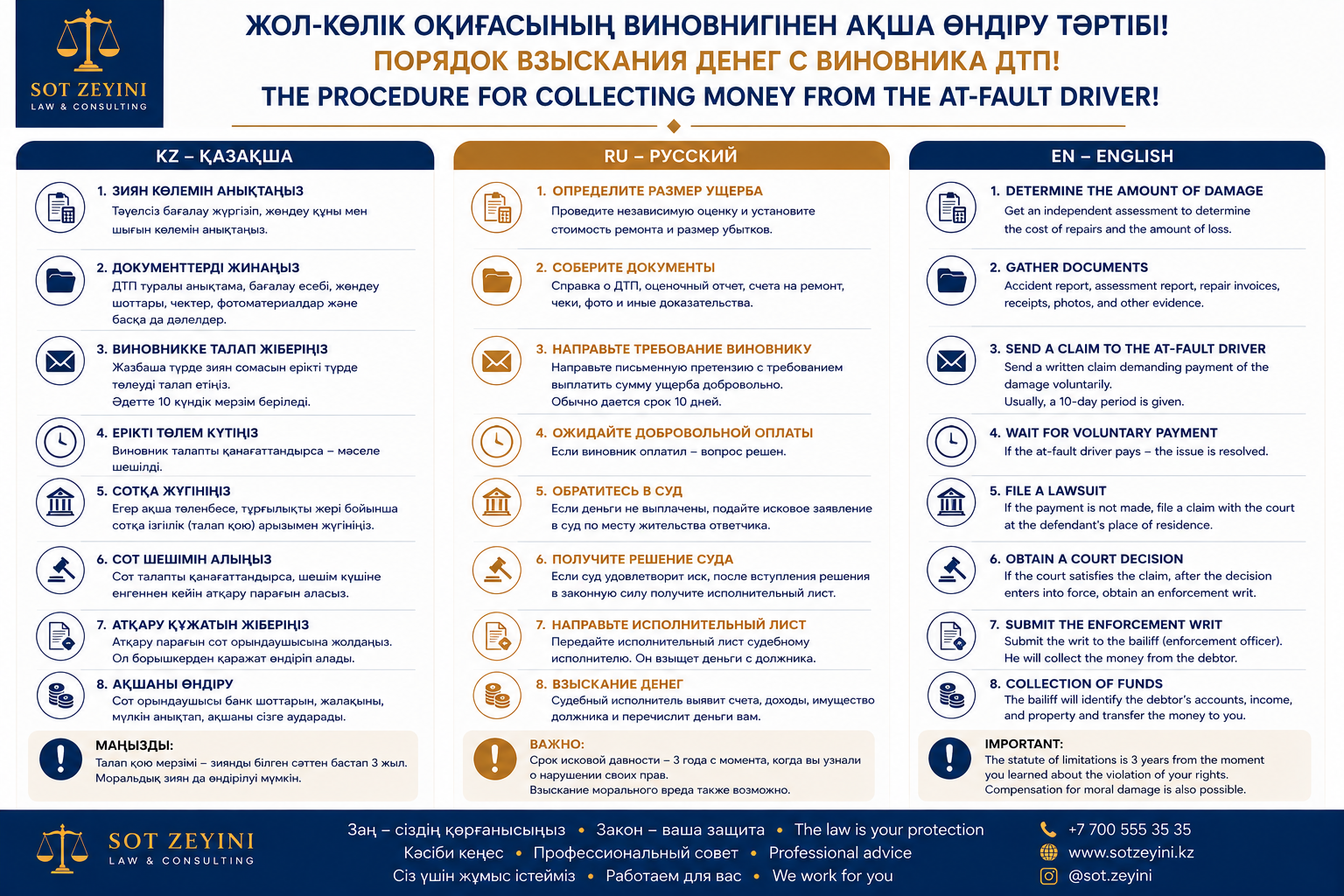
Step five: claim the difference from the at-fault driver
If the insurance payment does not cover the full damage, the remaining amount may be claimed from the at-fault driver.
A pre-litigation demand should be sent to the at-fault driver. It should include:
- date and place of the accident;
- details of the at-fault driver;
- document confirming fault;
- amount of insurance payment;
- amount of actual damage according to independent assessment;
- amount of the difference;
- deadline for voluntary payment;
- warning about filing a court claim.
Sample wording:
“According to the independent assessment, the amount of damage is 1,800,000 tenge. The insurance company paid 1,100,000 tenge. Therefore, I request voluntary payment of the difference in the amount of 700,000 tenge within 10 business days.”
Step six: file a court claim
If the at-fault driver does not pay voluntarily, the injured party may file a court claim.
In court, the injured party may claim:
- difference between actual damage and insurance payment;
- independent assessment costs;
- towing expenses;
- parking expenses;
- legal fees;
- state duty;
- court expenses;
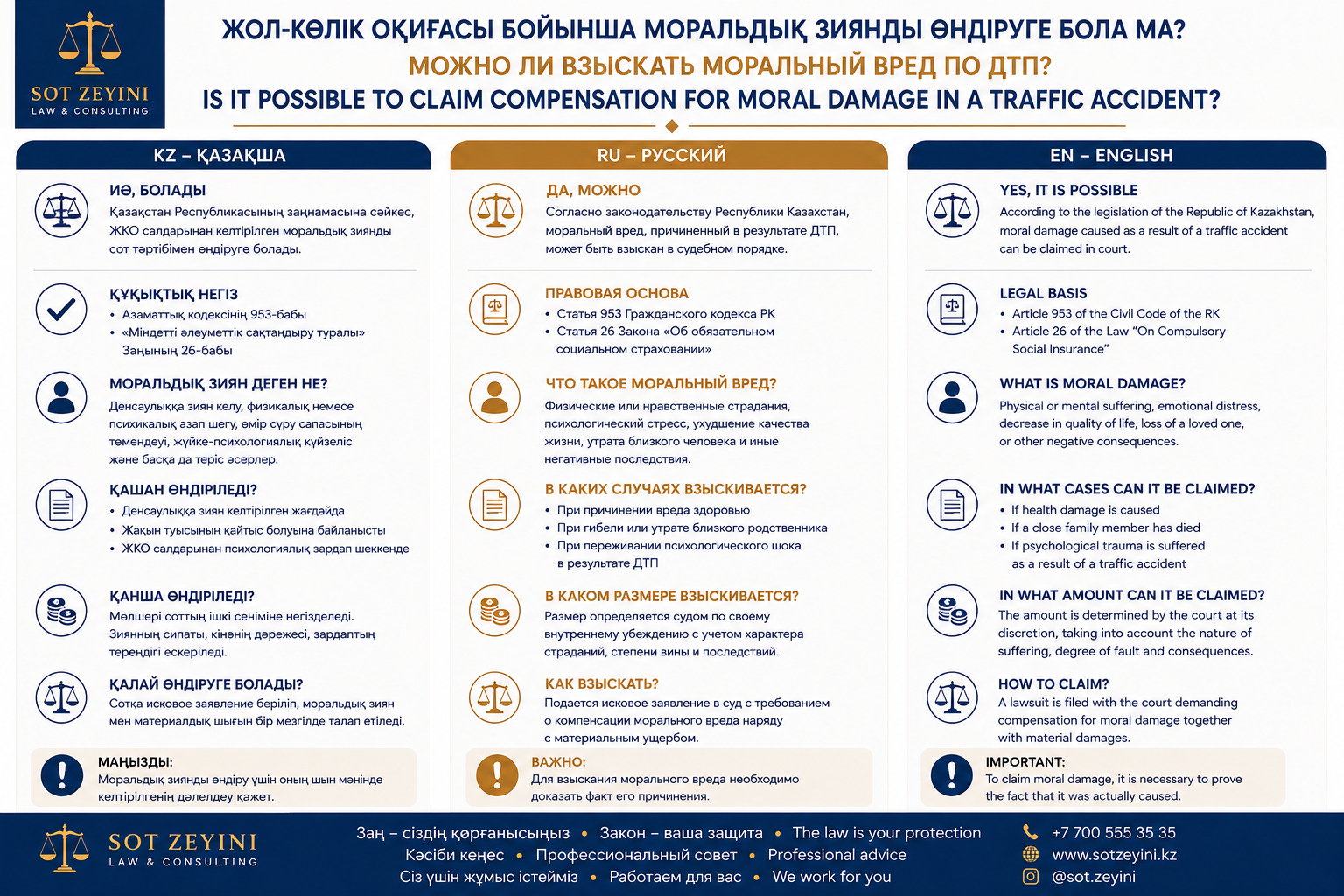
- moral damages, if there are grounds;
- medical expenses, if there was injury.
Every amount should be supported by documents.
What documents are needed for court?
It is advisable to attach:
- identity document;
- vehicle documents;
- accident materials;
- ruling confirming fault;
- insurance policy or policy details;
- insurance company’s response;
- document confirming insurance payment;
- insurance company’s calculation;
- independent assessment report;
- photos and videos of damage;
- receipts for towing, parking, and repair;
- pre-litigation demand;
- proof that the demand was sent;
- state duty payment receipt.
In these cases, documents matter more than emotions. The stronger the evidence, the stronger the claim.
If the damage exceeds the insurance limit
The insurance company pays only within the statutory liability limit. If the actual damage exceeds that limit, the remaining amount may be recovered from the at-fault driver.
For example, if the insurance limit is lower than the actual damage, the injured party may claim the difference directly from the at-fault person.
If the insurance company refuses payment
If the insurance company refuses payment fully or partially, the injured party should obtain a written refusal.
After that, the injured party may:
- submit a repeated request;
- apply to the insurance ombudsman;
- file a complaint with the competent authority;
- file a court claim;
- claim damages from the at-fault driver if there are grounds.
A verbal refusal is difficult to prove. A written document is important because it can later be used as evidence.
If the at-fault driver does not pay after court
If the court grants the claim but the at-fault driver does not pay voluntarily, the injured party should obtain a writ of execution and submit it to a private bailiff.
The bailiff may:
- freeze bank accounts;
- withhold money from salary;
- restrict vehicle registration actions;
- impose restrictions on property;
- take enforcement measures.
A court decision is not always the final step. Often, enforcement proceedings become the next stage.
Common mistakes made by injured parties
Common mistakes include:
- accepting the insurance payment immediately;
- not requesting the insurance calculation;
- not obtaining an independent assessment;
- repairing the vehicle before damage is recorded;
- not photographing all damage;
- not sending a demand to the at-fault driver;
- not keeping receipts;
- not checking the insurance limit;
- filing a court claim without a complete set of documents;
- not monitoring enforcement after judgment.
To recover money, the injured party should act through documents, not emotions.
Conclusion
If the insurance payment after a traffic accident is not enough, the injured party does not have to simply accept it. The first step is to request the insurance calculation, obtain an independent assessment, and determine the real amount of damage.
If the difference between the insurance payment and actual damage is supported by documents, it may be recovered from the at-fault driver. First, a pre-litigation demand is sent. If there is no payment, a court claim may be filed.
FAQ
What should I do if the insurance company paid too little?
Request the insurance company’s calculation and obtain an independent assessment. If the actual damage is higher, you may claim additional payment or recover the difference from the at-fault driver.
Can the difference be recovered from the at-fault driver?
Yes. If the insurance payment does not cover all damage, the remaining amount may be recovered from the at-fault driver.
Is an independent assessment necessary?
It is highly advisable if there is a dispute about the amount of damage. It helps prove the real repair cost.
Can I repair the car before assessment?
It is better not to repair the vehicle before inspection and assessment. If it has already been repaired, keep all receipts, repair acts, and photos.
What if the insurance company refuses payment?
Obtain a written refusal and then consider filing a complaint, applying to the ombudsman, or going to court.
What expenses can be recovered?
The difference in damage, assessment costs, towing, parking, legal fees, state duty, and other documented expenses may be recovered.
Where should the court claim be filed?
Usually, the claim is filed at the defendant’s place of residence, unless the law provides another option.
What should be done after the court decision?
Obtain a writ of execution and submit it to a private bailiff for enforcement.