 +7 775 858 9294
 WhatsApp
Can an Employer Recover Training Costs from an Employee?
Can an employer recover training costs from an employee?
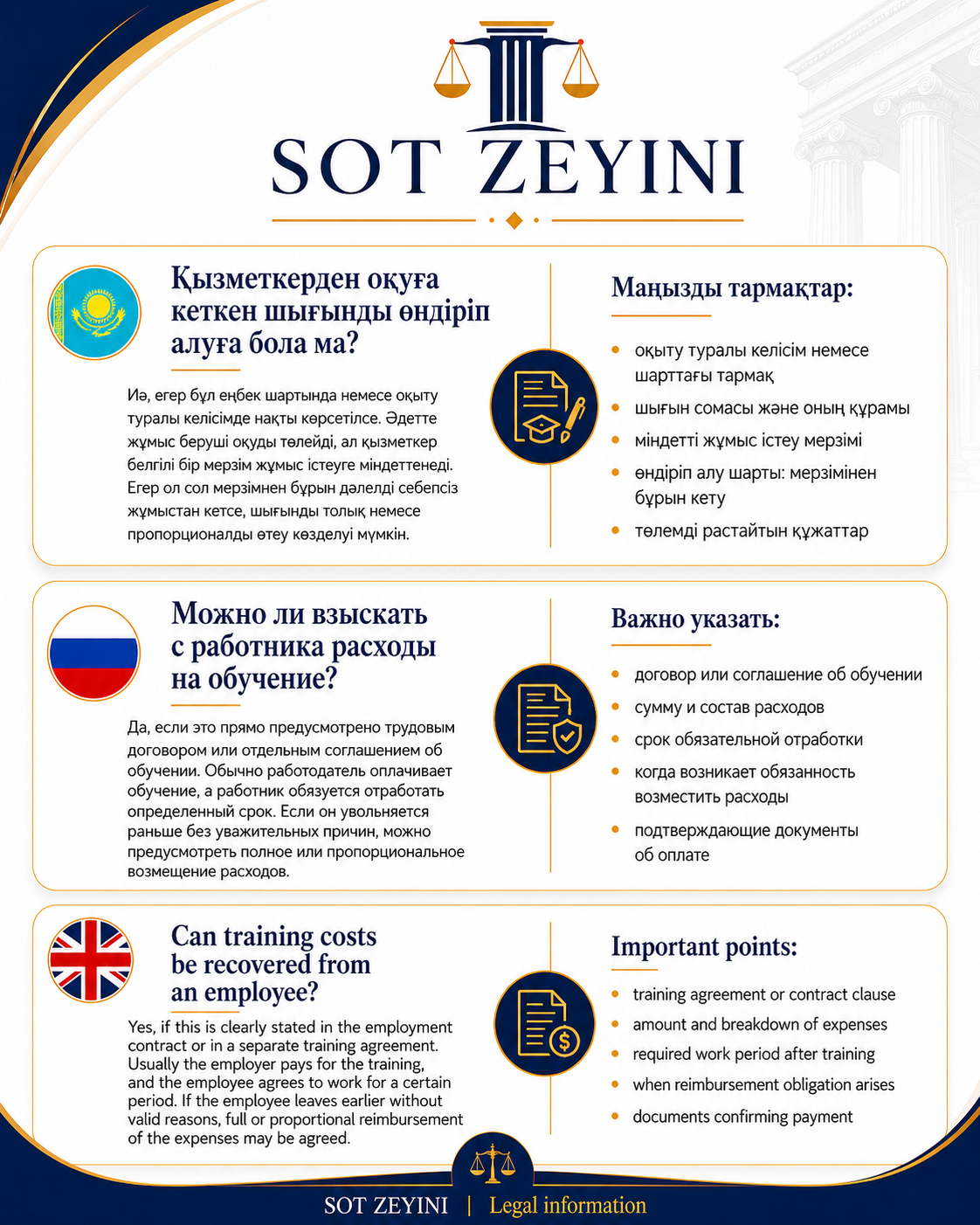
Yes, in Kazakhstan an employer may recover training costs from an employee if the training was paid for by the employer and the parties signed a written training agreement or a relevant additional agreement.
However, the recovery is not automatic. The employer must prove that the employee agreed to work for a certain period after completing the training or to reimburse the employer if they leave before that period ends.
In practice, the employer needs documents: a training agreement, proof of payment, a work-off period, and a clear calculation of the amount to be reimbursed.
When can the employer claim reimbursement?
The employer may claim reimbursement if:
- the employee was sent to training by the employer;
- the training was paid by the employer;
- a written training agreement was signed;
- the agreement contains a work-off period after training;
- the agreement describes the reimbursement procedure;
- the employee did not complete the required work-off period;
- the expenses are supported by documents.
If these conditions are met, the employer may request voluntary reimbursement or file a court claim.
What is a training agreement?
A training agreement is a written agreement between the employer and the employee or trainee regarding professional training, retraining, or qualification improvement.
The agreement should specify:
- name of the course or program;
- profession, qualification, or specialty;
- duration of training;
- training cost;
- rights and obligations of the parties;
- work-off period after training;
- reimbursement procedure;
- calculation formula;
- guarantees and compensation;
- liability of the parties.
Without a training agreement, it may be difficult for the employer to prove that the employee had an obligation to reimburse the costs.
Is a clause in the employment contract enough?
Sometimes employers include a general clause in the employment contract stating that the employee must work for a certain period after training. This is better than having no clause at all, but it may not always be sufficient.
A safer option is to sign a separate training agreement or a detailed additional agreement to the employment contract. It should identify the specific training, cost, duration, work-off obligation, and reimbursement formula.
The more specific the agreement, the lower the risk of a dispute.
What expenses can be recovered?
Usually, recoverable expenses are real and documented costs directly related to the training.
For example:
- course fee;
- certification cost;
- examination fee;
- study materials;
- training or seminar fee;
- qualification improvement program cost;
- other expenses expressly stated in the agreement.
Travel, accommodation, and per diem expenses should be assessed separately. If they are not clearly included in the agreement as reimbursable training-related expenses, it may be harder to recover them from the employee.
Does the employee have to return the full amount?
Usually, the employee reimburses only the part proportional to the unworked period. For example, if the employee was required to work for 12 months after training but worked only 6 months, the employer may claim reimbursement for the remaining 6 months.
Example:
- training cost — 600,000 tenge;
- required work-off period — 12 months;
- actually worked — 6 months;
- unworked period — 6 months;
- reimbursable amount — 300,000 tenge.
This proportional approach is usually clearer and more reasonable in court.
When is recovery difficult?
Recovery may be difficult if:
- no training agreement was signed;
- no work-off period was specified;
- no reimbursement procedure was agreed;
- the training cost is not proven by documents;
- the employee completed the full work-off period;
- the employee resigned due to the employer’s violations;
- the training was a mandatory safety briefing or the employer’s legal obligation;
- the employee was not officially sent to training by the employer.
In such cases, the dispute may not be resolved in the employer’s favor.
Can the employer deduct training costs from salary?
The employer should not unilaterally deduct training costs from the employee’s salary unless there is a legal basis, a court decision, or the employee’s written consent.
A safer approach is to:
- sign an agreement on voluntary reimbursement;
- obtain written consent for salary deductions;
- define the amount and schedule of deductions;
- go to court if there is a dispute.
Unlawful salary deductions may create a separate labor dispute against the employer.
Should the employer send a demand letter?
Yes. It is advisable to send a written demand letter before going to court. The letter should state:
- details of the training agreement;
- name of the training;
- training cost;
- required work-off period;
- actual period worked;
- amount to be reimbursed;
- deadline for payment;
- warning about court action.
A demand letter shows that the employer tried to resolve the dispute before filing a claim.
What documents are needed for court?
The following documents may be needed:
- employment contract;
- training agreement or additional agreement;
- order sending the employee to training;
- contract with the training provider;
- payment documents;
- invoices, acts, receipts;
- certificate or proof of training completion;
- employee resignation letter;
- termination order;
- reimbursement calculation;
- demand letter and proof of delivery.
The stronger the documents, the stronger the employer’s position.
What if the employee refuses to pay?
If the employee refuses to reimburse the costs voluntarily, the employer may file a court claim. The claim may include training costs and court expenses. If the agreement includes a penalty, the employer may also consider claiming it.
The court will check:
- whether there was a training agreement;
- whether the employee was sent to training;
- how much the training cost;
- what work-off period was agreed;
- how long the employee actually worked;
- whether the reimbursement amount was calculated correctly.
What arguments can the employee raise?
The employee may argue that:
- no training agreement was signed;
- the work-off period was not agreed;
- the reimbursement procedure was not specified;
- the amount of expenses was not proven;
- the training was mandatory for the employer;
- resignation was caused by the employer’s violations;
- salary deductions were unlawful;
- the calculation was incorrect.
That is why employers should prepare documents carefully in advance.
How can an employer protect itself in advance?
The employer should:
- sign a separate training agreement;
- identify the specific program and cost;
- set a work-off period after training;
- include a reimbursement formula;
- obtain the employee’s signature;
- keep payment documents;
- issue an order sending the employee to training;
- obtain proof of training completion;
- legally formalize salary deductions if they are planned.
If everything is documented in advance, recovering training costs becomes much easier.
Conclusion
An employer can recover training costs from an employee, but only if the arrangement is properly documented. A written training agreement, proven expenses, a work-off period, and a reimbursement procedure are essential.
If the employee leaves before completing the agreed work-off period, the employer may usually claim reimbursement proportional to the unworked period.
The main rule is simple: training costs are protected by documents, not by verbal promises.
FAQ
Can an employer recover training costs from an employee?
Yes, if the employer paid for the training and there is a written training agreement with a work-off period and reimbursement terms.
What if there is no training agreement?
Recovery becomes more difficult because the employer must prove that the employee had an obligation to reimburse the costs.
Must the employee repay the full training cost?
Usually, the employee reimburses the part proportional to the unworked period, unless another lawful procedure is agreed.
Can the employer deduct the amount from salary?
Only if there is a legal basis, a court decision, or the employee’s written consent. Unilateral deductions are risky.
What expenses can be recovered?
Documented training-related expenses, such as course fees, certification, exams, study materials, and other costs specified in the agreement.
How long should the employee work after training?
The period is agreed by the parties and should be stated in the training agreement.
What documents are needed for court?
Employment contract, training agreement, training order, payment documents, certificate, termination documents, reimbursement calculation, and demand letter.