Articles

How to Sign an NDA with an Employee
Labor, employee, contract Jun 2, 2026 364 views

How to Sign an NDA with an Employee

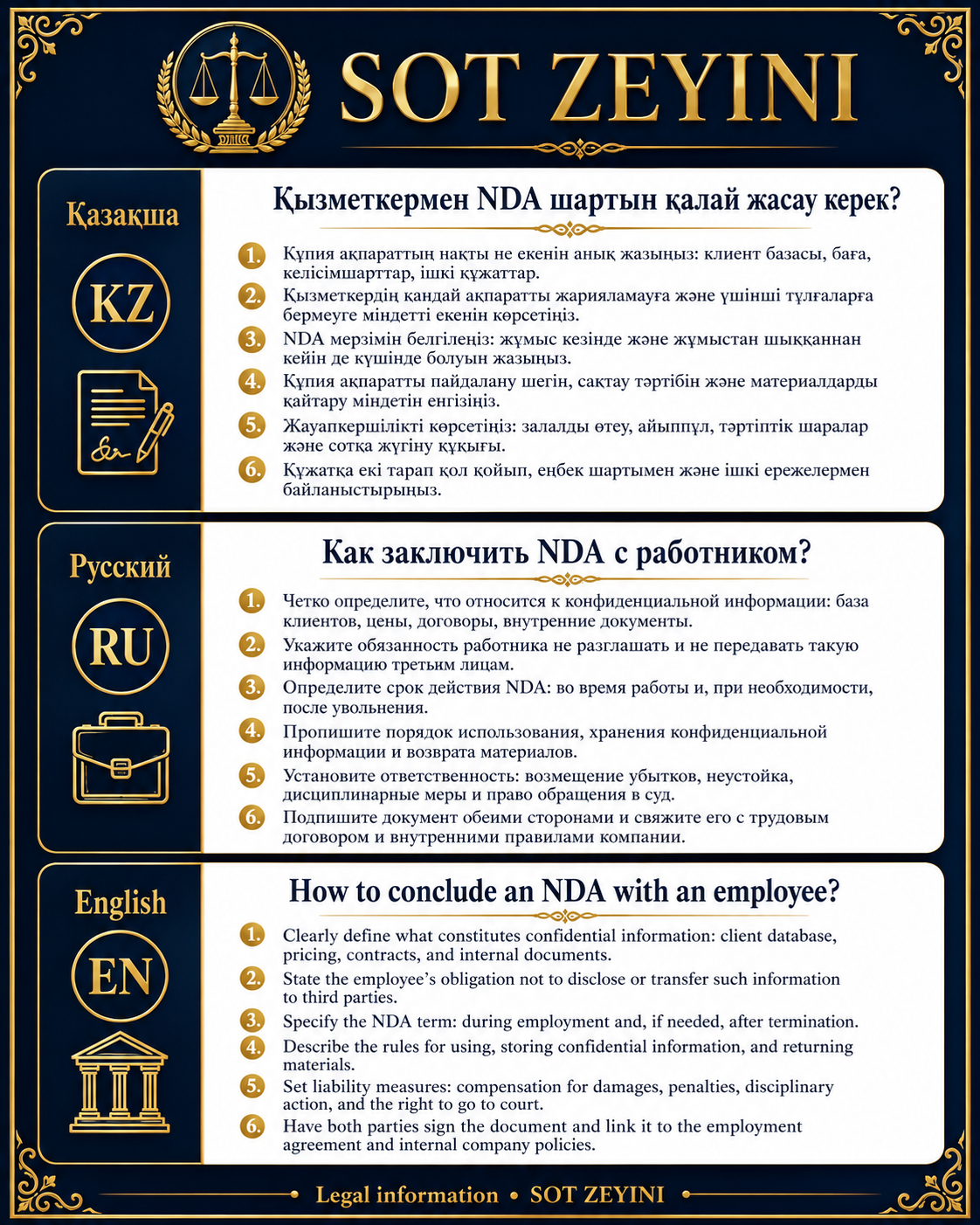
What is an employee NDA? An NDA is a non-disclosure agreement. An employer signs it with an employee to protect the company’s client database, commercial offers, prices, CRM data, internal documents, business model, logins, passwords, and other important information. In simple terms, an NDA means that the employee may receive access to company information, but may not disclose it, copy it, transfer it to third parties, or use it for personal purposes. An NDA is especially important for sales managers, administrators, accountants, lawyers, marketers, SMM specialists, IT specialists, HR employees, department heads, and anyone who works with clients or internal company data.

Read article →
Can You Sue a Manager Who Takes a Client for Themselves?
Labor, employee, contract Jun 2, 2026 142 views

Can You Sue a Manager Who Takes a Client for Themselves?

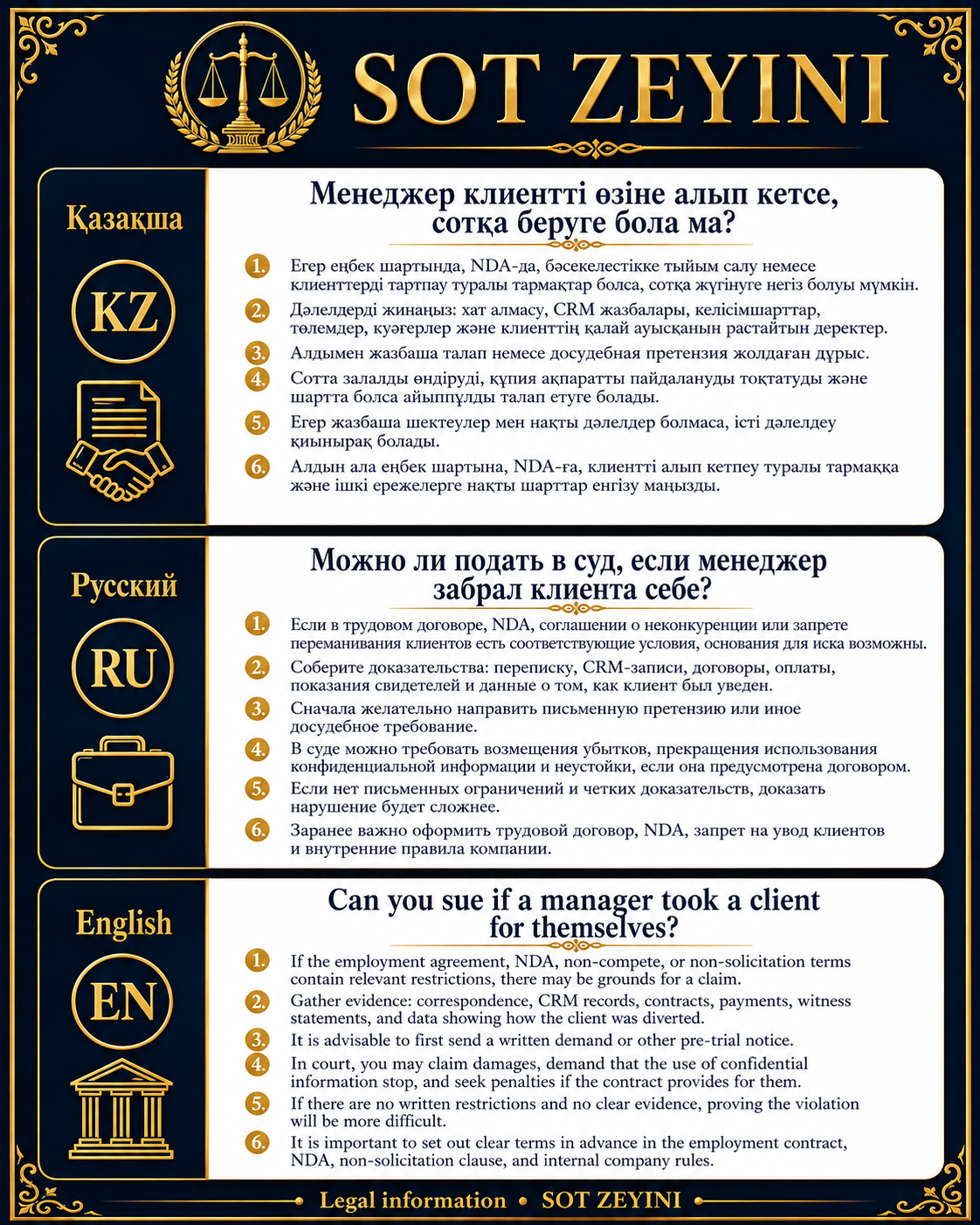
Can an employer sue a manager who takes a client? Yes, an employer may sue a manager if the manager used a company client for personal benefit, made a deal behind the employer’s back, transferred the client to a competitor, or unlawfully used the company’s client database. However, a successful claim requires evidence. The mere fact that a manager spoke with a client is not always enough. The employer must show that the client came to the company, the manager received access to the client through work, and then used that access against the company’s interests. In simple terms, the legal chain is: the client came to the company, the manager received access, the manager bypassed the company, and the company lost money. If this chain is proven, the employer has a stronger legal position.

Read article →
What Contract Should Be Signed with a Measurement Specialist?
Labor, employee, contract Jun 2, 2026 135 views

What Contract Should Be Signed with a Measurement Specialist?

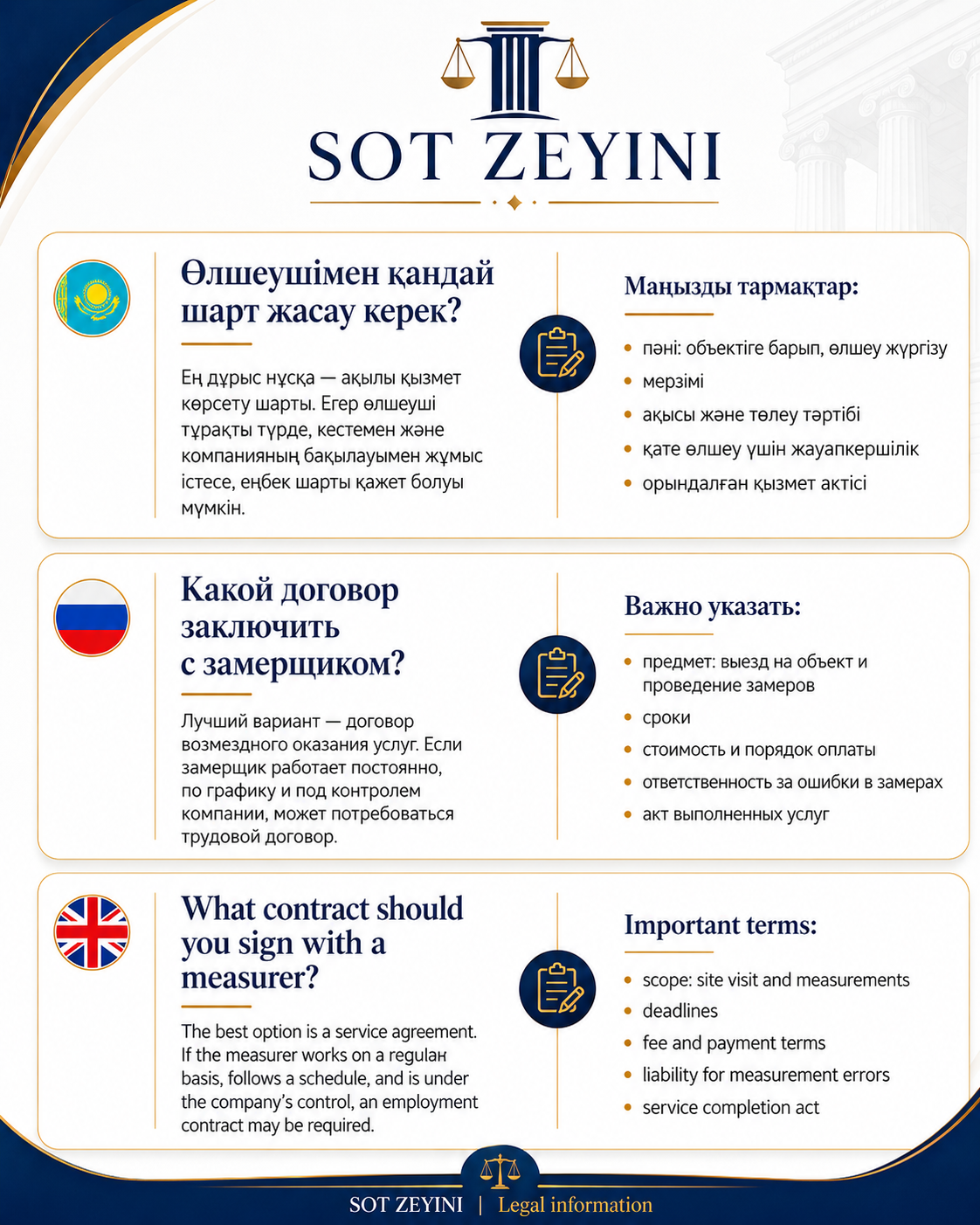
Who is a measurement specialist? A measurement specialist is a person who visits a client’s site, takes measurements, records technical details, and provides data for calculation, production, installation, or a commercial offer. Such specialists are often used in the fields of windows, doors, furniture, kitchens, wardrobes, stretch ceilings, repairs, construction, and interior design. Although the work may seem simple, one measurement error can cause serious losses: the product may not fit, installation may fail, the client may complain, and the company may have to redo the order. That is why the contract with a measurement specialist should be drafted carefully.

Read article →
How to Properly Draft a Penalty Clause in a Contract
Labor, employee, contract Jun 2, 2026 144 views

How to Properly Draft a Penalty Clause in a Contract

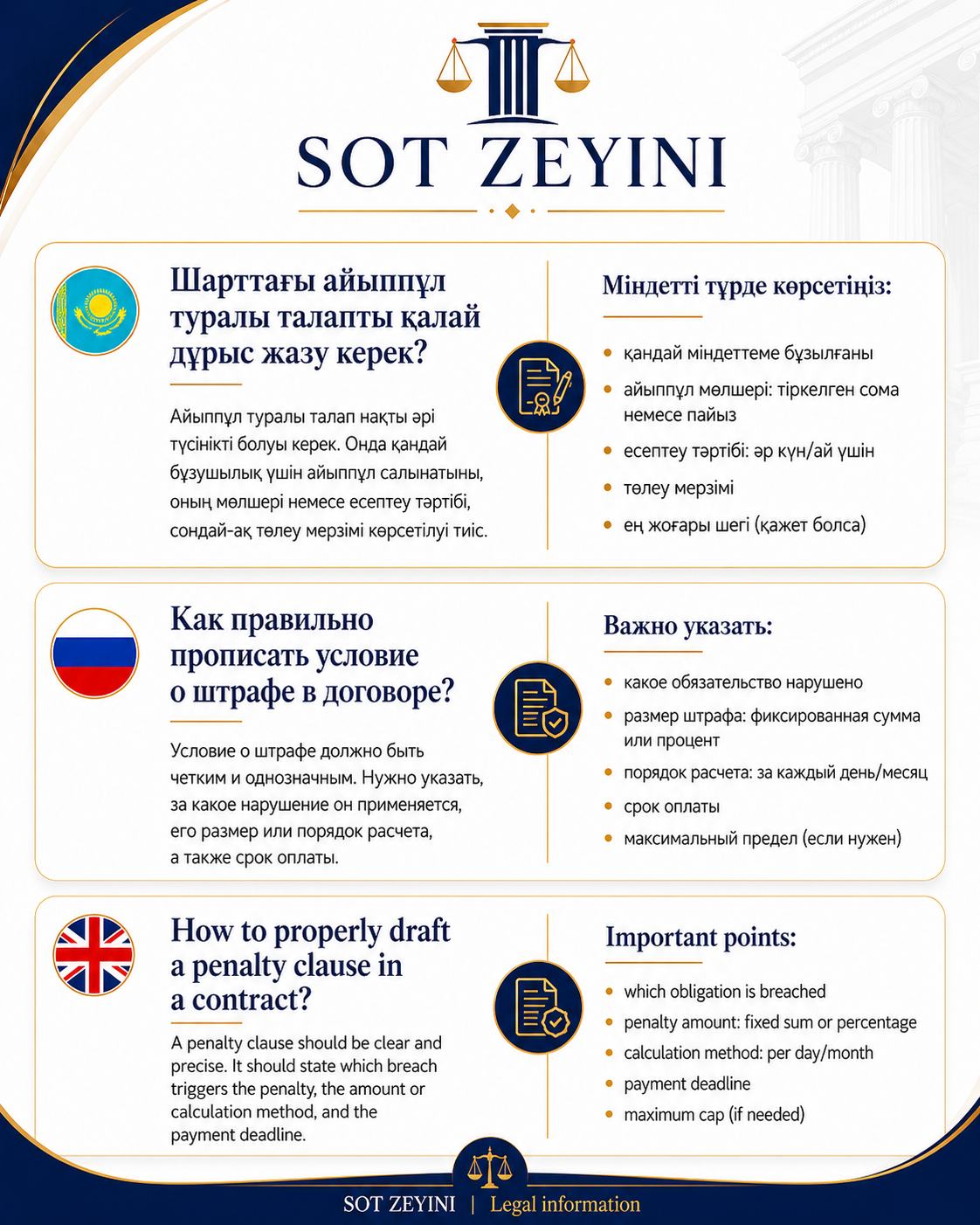
Why is a penalty clause needed? In any contract, the parties are expected to perform their obligations properly and on time. However, in practice, one party may delay payment, fail to perform work, miss a delivery deadline, disclose confidential information, or refuse to perform the contract. A penalty clause is included for such situations. It creates a pre-agreed monetary liability for breach of contract. A well-drafted penalty clause disciplines the parties and makes enforcement easier. It is not just a scary sentence in the contract. It is a practical protection tool.

Read article →
Can an Employer Recover Training Costs from an Employee?
Labor, employee, contract Jun 2, 2026 243 views

Can an Employer Recover Training Costs from an Employee?

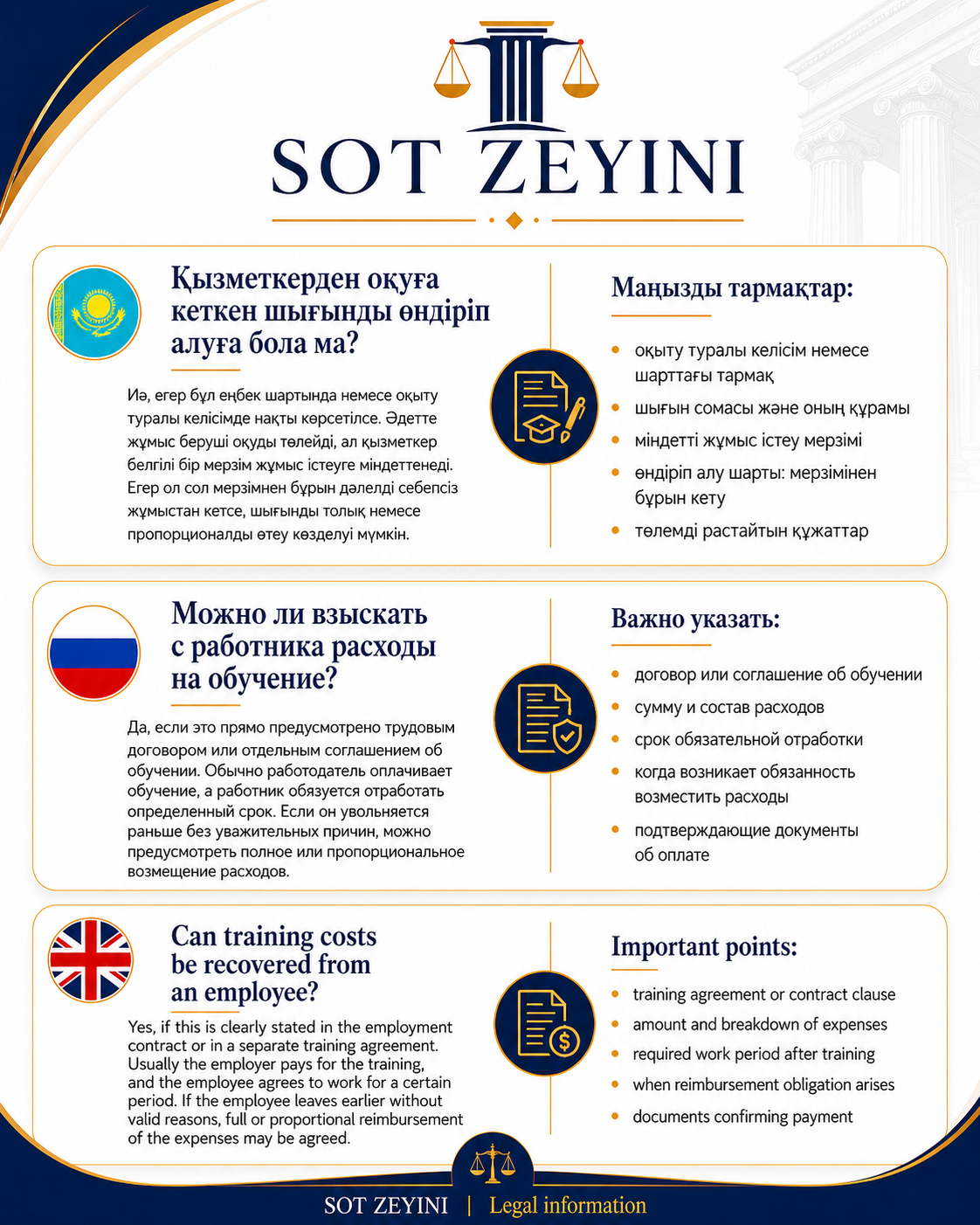
Can an employer recover training costs from an employee? Yes, in Kazakhstan an employer may recover training costs from an employee if the training was paid for by the employer and the parties signed a written training agreement or a relevant additional agreement. However, the recovery is not automatic. The employer must prove that the employee agreed to work for a certain period after completing the training or to reimburse the employer if they leave before that period ends. In practice, the employer needs documents: a training agreement, proof of payment, a work-off period, and a clear calculation of the amount to be reimbursed. When can the employer claim reimbursement? The employer may claim reimbursement if: the employee was sent to training by the employer; the training was paid by the employer; a written training agreement was signed; the agreement contains a work-off period after training; the agreement describes the reimbursement procedure; the employee did not complete the required work-off period; the expenses are supported by documents. If these conditions are met, the employer may request voluntary reimbursement or file a court claim.

Read article →
What Can a Company Do If an Employee Joins a Competitor?
Labor, employee, contract Jun 2, 2026 158 views

What Can a Company Do If an Employee Joins a Competitor?

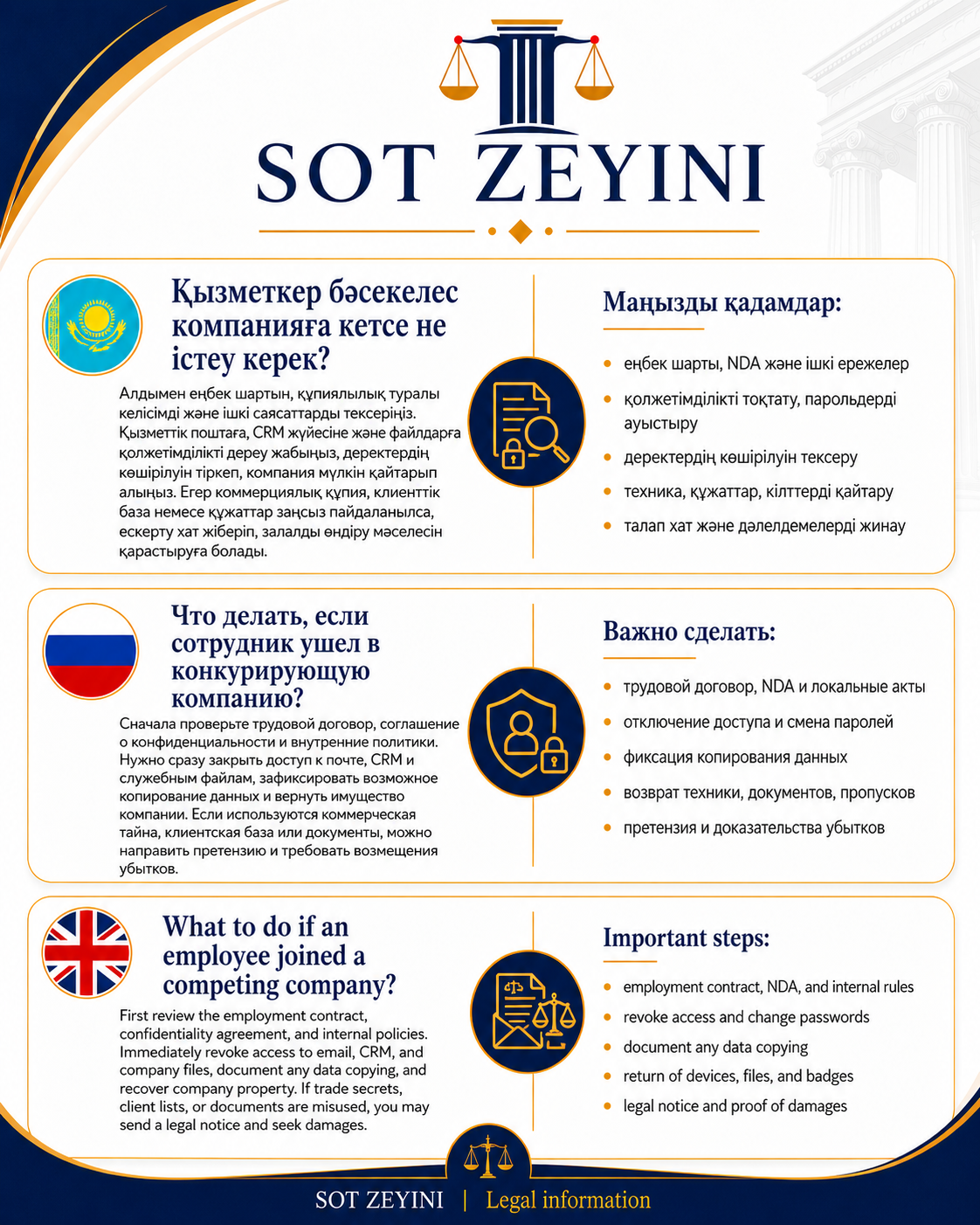
Is it illegal for an employee to join a competitor? An employee’s decision to join a competing company is not automatically illegal. A person generally has the right to choose their place of work, profession, and field of activity. Therefore, an employer cannot simply prohibit a former employee from working for a competitor without proper legal grounds. The real issue is not where the employee goes, but what they take with them. If the employee takes the client database, trade secrets, internal documents, pricing information, CRM data, logins, passwords, or business processes, the employer may have legal grounds to act. In simple terms, joining a competitor may be lawful. Joining a competitor with the former employer’s client database is a very different situation. When can the employer take action? The employer may take action if the employee: copied the client database; exported data from the CRM; sent company documents to a personal email; transferred commercial offers to a competitor; used internal sales scripts; disclosed prices, discounts, or contract terms; took logins and passwords; failed to return corporate documents; started poaching clients; encouraged other employees to leave; breached an NDA or confidentiality agreement; caused losses to the company. If there are no such facts, the mere fact that the employee joined a competitor may not be enough for a legal claim.

Read article →
How to Protect a Company’s Trade Secrets
Labor, employee, contract Jun 2, 2026 179 views

How to Protect a Company’s Trade Secrets

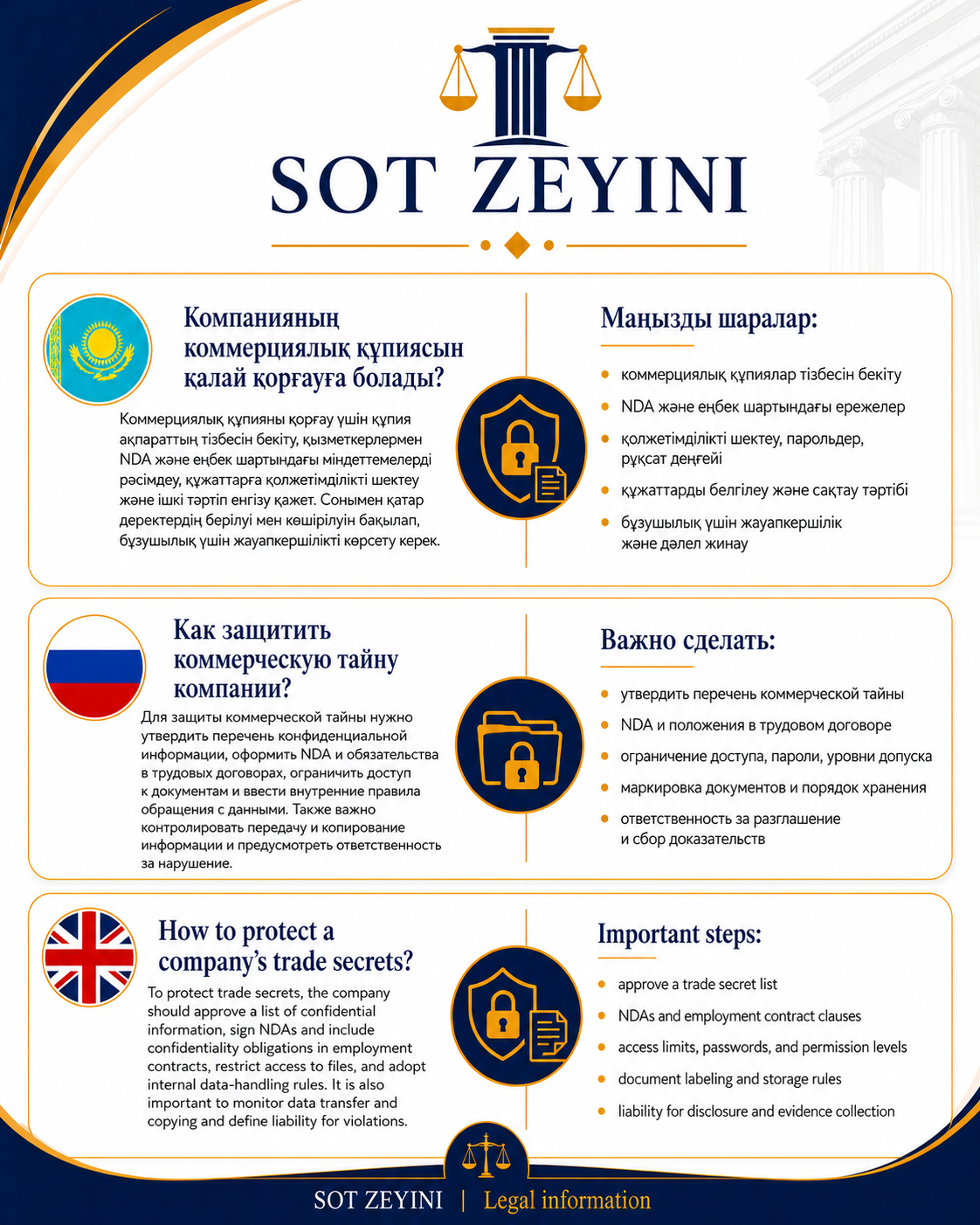
What is a trade secret? A trade secret is information that has commercial value for a company, is not publicly available, and is protected by the company. This may include a client database, pricing policy, contracts, marketing strategy, sales scripts, business model, financial data, suppliers, internal regulations, technologies, and other valuable information. However, not every piece of information automatically becomes a trade secret. The company must take steps to protect it: define what is confidential, restrict access, inform employees and contractors, and establish liability for disclosure. In simple terms, a trade secret is protected not only by saying “this is confidential,” but by creating a real protection system. What can be considered a trade secret? A company’s trade secrets may include: client database; client contact details; negotiation history; contract terms; price offers; discount system; sales scripts; marketing strategy; advertising account data; CRM information; list of suppliers and partners; financial reports; business plans; internal instructions; access to IT systems; logins and passwords; training materials; know-how; plans for new products or services. Each company should define which information is confidential based on its business model. How can trade secrets be protected? Trade secret protection should be systematic. One clause in a contract is usually not enough. The company should combine legal documents, technical restrictions, and internal control.

Read article →
Is taking a client database a legal violation?
Labor, employee, contract Jun 2, 2026 163 views

Is taking a client database a legal violation?

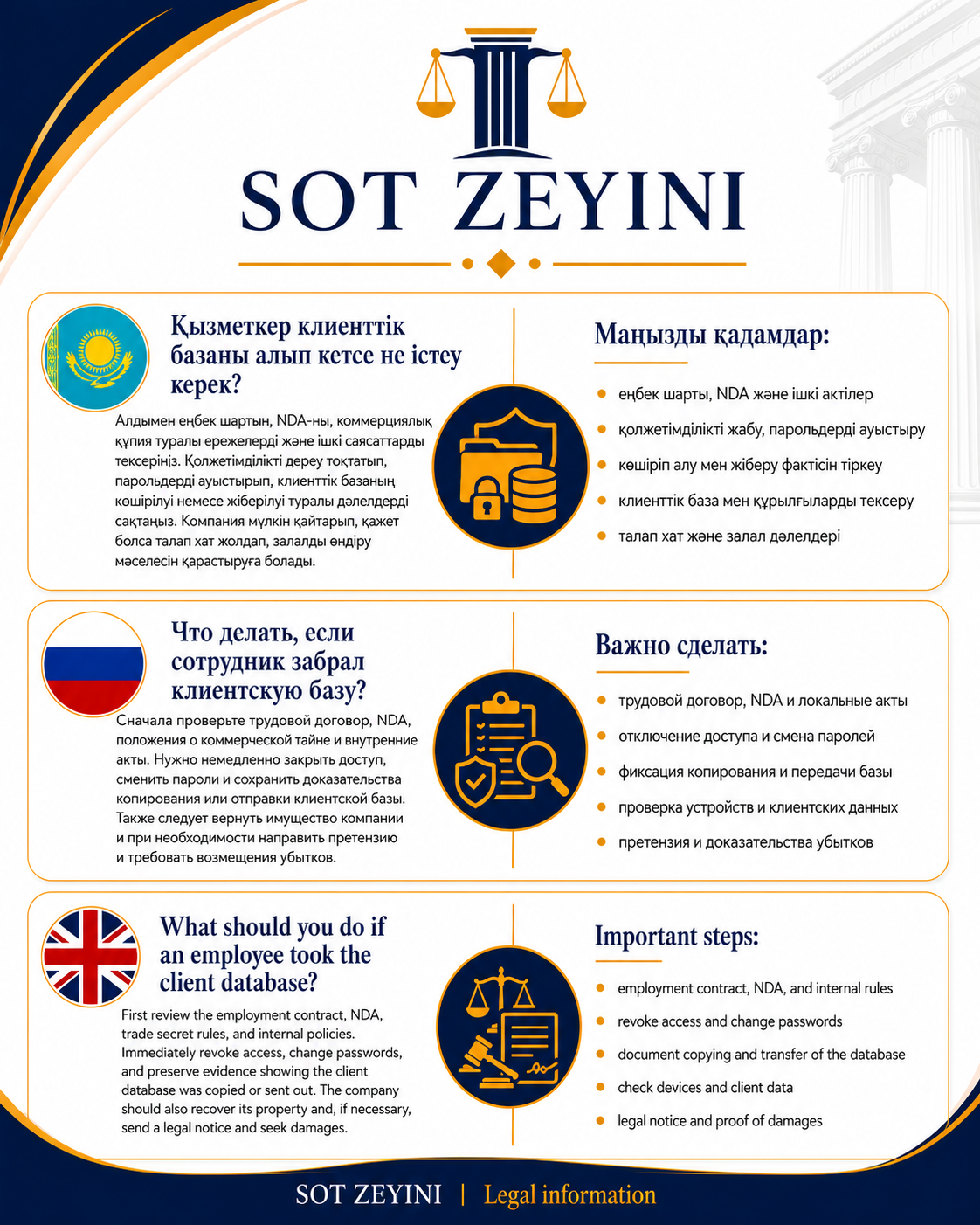
If an employee copies the company’s client database, sends it to a personal email, transfers it to a competitor, or starts using it for personal business, this may be a serious violation of the employer’s rights. A client database may include names, phone numbers, application history, contracts, payment data, correspondence, personal data, and commercial information. Therefore, unauthorized use of such information may lead to labor, civil, administrative, or even criminal consequences. A client database is not just an Excel spreadsheet. For many businesses, it is one of the most valuable assets. What should the employer do first? The employer should act quickly, but carefully. It is not advisable to threaten the employee, take their personal phone, or create a conflict. The first step is to preserve evidence. Immediate actions may include: Block the employee’s access to CRM, email, WhatsApp Business, website, Google Drive, Telegram, Instagram, and other systems. Change passwords. Save CRM and email logs. Check file download and export history. Take screenshots of correspondence and suspicious activity. Prepare an internal incident report. Request a written explanation from the employee. Record client complaints if the employee started contacting them. Consider notarizing online evidence or correspondence. Prepare a written claim or court action.The key point is evidence. It is not enough to say “the employee took the database.” The employer must show what was copied, when, how, and what damage was caused. Can a client database be a trade secret? Yes, a client database may be treated as a trade secret if the company has taken measures to protect it. It is advisable for the company to have: internal trade secret rules; a confidentiality agreement; confidentiality clauses in the employment contract; restricted access to the database; individual logins and passwords; a ban on copying or transferring the database; proof that the employee was informed about confidentiality obligations. If these documents exist, the employer’s position is much stronger. If they do not exist, the case is more difficult, but protection may still be possible.

Read article →

What Claims Can Be Made Against a Person Working Under a Civil Law Contract?
Labor, employee, contract Jun 2, 2026 129 views

What Claims Can Be Made Against a Person Working Under a Civil Law Contract?

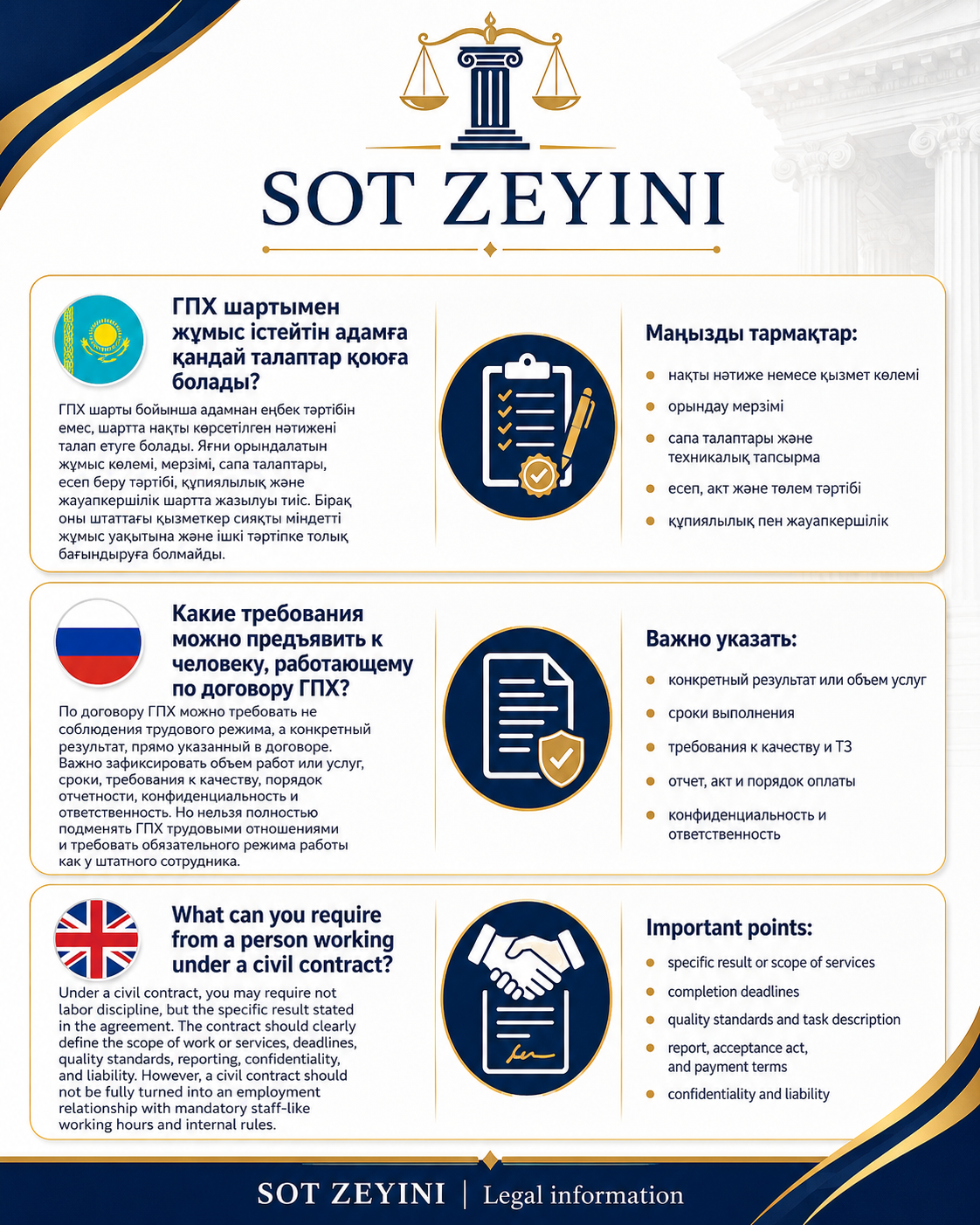
What is a civil law contract? A civil law contract is an agreement under which a contractor performs specific work or provides a service, while the customer accepts the result and pays for it. Unlike an employment contract, a person working under a civil law contract is usually not a staff employee. The contractor does not hold a company position, does not follow internal labor rules, and does not receive a salary as an employee. The key element of a civil law contract is a specific result. In simple terms, the issue is not whether the person “came to work every day,” but whether they delivered the agreed result: a document, website, design, consultation, repair work, report, or another service.

Read article →
What Is the Difference Between an Employment Contract and a Civil Law Contract?
Labor, employee, contract Jun 2, 2026 161 views

What Is the Difference Between an Employment Contract and a Civil Law Contract?

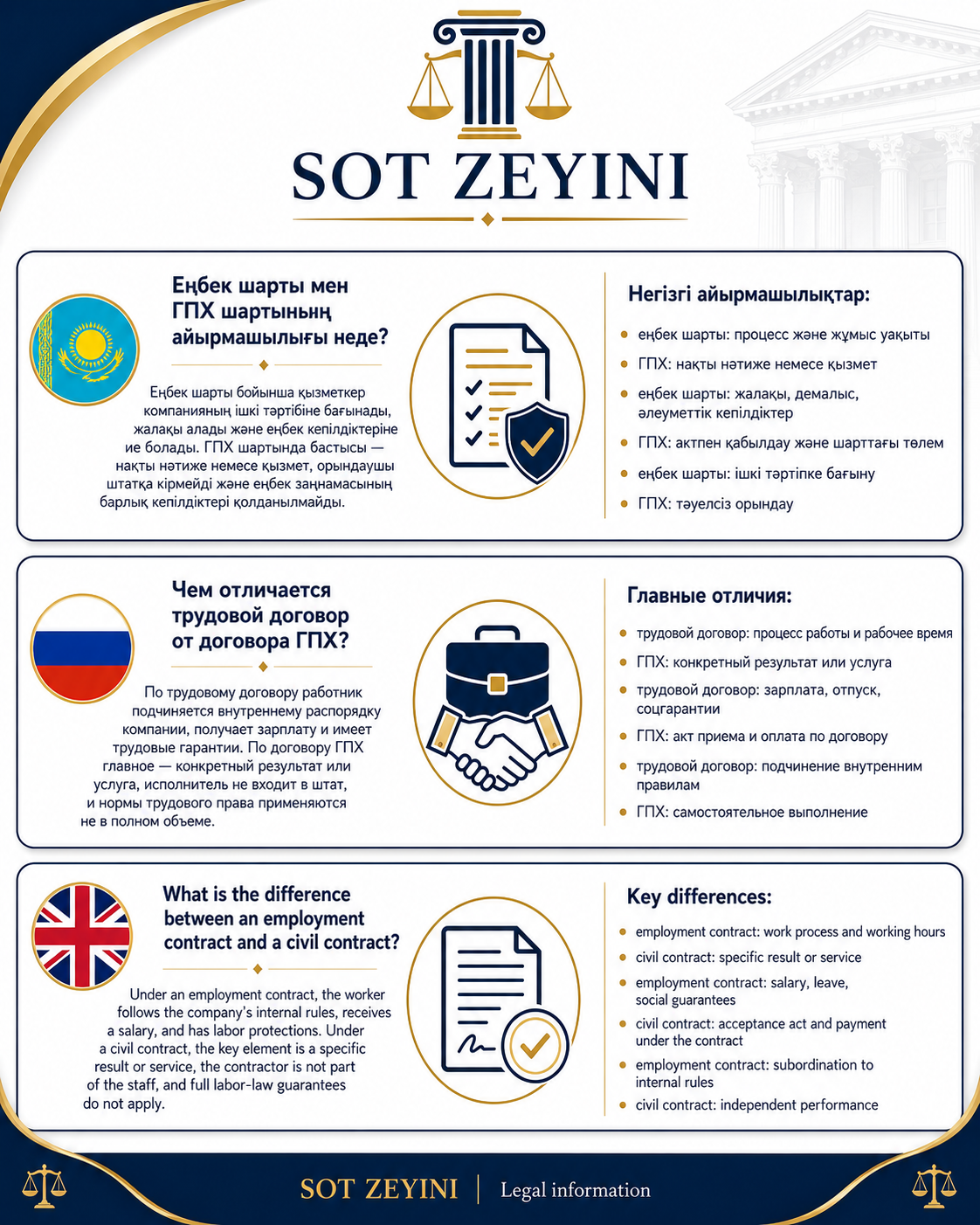
What are an employment contract and a civil law contract? In Kazakhstan, a company may work with an individual under an employment contract or under a civil law contract. A civil law contract is often referred to as a GPH contract in practice. An employment contract is an agreement between an employer and an employee. Under this contract, the person holds a specific position, performs a labor function, follows internal workplace rules, and receives a salary. A civil law contract is an agreement under which a contractor performs a specific task or provides a specific service. The parties are not called “employer” and “employee,” but “customer” and “contractor” or “client” and “service provider.” In simple terms, an employment contract means the person becomes part of the company’s team. A civil law contract means the person performs a specific task and delivers a result.

Read article →
ИИ Бот