 +7 775 858 9294
 WhatsApp
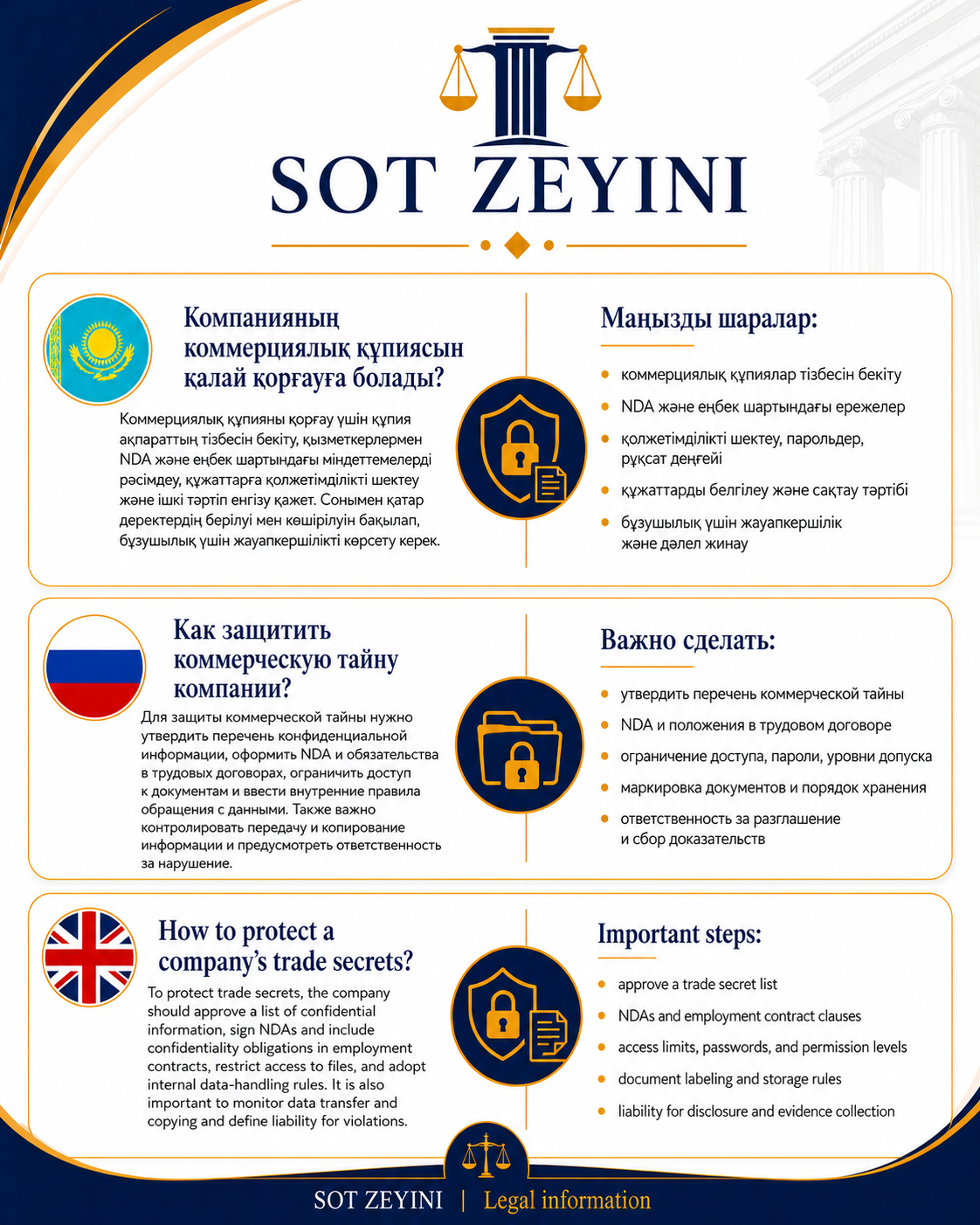
How to Protect a Company’s Trade Secrets
What is a trade secret?
A trade secret is information that has commercial value for a company, is not publicly available, and is protected by the company. This may include a client database, pricing policy, contracts, marketing strategy, sales scripts, business model, financial data, suppliers, internal regulations, technologies, and other valuable information.
However, not every piece of information automatically becomes a trade secret. The company must take steps to protect it: define what is confidential, restrict access, inform employees and contractors, and establish liability for disclosure.
In simple terms, a trade secret is protected not only by saying “this is confidential,” but by creating a real protection system.
What can be considered a trade secret?
A company’s trade secrets may include:
- client database;
- client contact details;
- negotiation history;
- contract terms;
- price offers;
- discount system;
- sales scripts;
- marketing strategy;
- advertising account data;
- CRM information;
- list of suppliers and partners;
- financial reports;
- business plans;
- internal instructions;
- access to IT systems;
- logins and passwords;
- training materials;
- know-how;
- plans for new products or services.
Each company should define which information is confidential based on its business model.
How can trade secrets be protected?
Trade secret protection should be systematic. One clause in a contract is usually not enough. The company should combine legal documents, technical restrictions, and internal control.
1. Adopt an internal trade secret policy
The first step is to approve an internal trade secret policy. This document should specify:
- what information is treated as a trade secret;
- who has access to it;
- how it must be stored;
- who may or may not receive it;
- whether copies may be made;
- how documents and access must be returned after termination;
- what liability applies in case of violation.
This policy becomes the main internal document for protecting the company’s confidential information.
2. Include confidentiality clauses in employment contracts
Employment contracts should contain a separate section on trade secrets and confidential information.
The contract may state that the employee must:
- not copy the client database;
- not transfer information to third parties;
- not disclose logins and passwords;
- not use company materials for personal purposes;
- maintain confidentiality after termination;
- return documents and access credentials.
Without such clauses, it may be harder to hold the employee liable.
3. Sign NDAs
An NDA is a non-disclosure agreement. It should be signed not only with employees, but also with contractors, freelancers, partners, investors, accountants, marketers, IT specialists, and consultants.
An NDA should include:
- definition of confidential information;
- list of protected data;
- purpose of using the information;
- ban on disclosure to third parties;
- confidentiality period;
- penalty or damages procedure;
- procedure for returning or deleting information.
An NDA does not solve every problem, but it significantly strengthens the company’s legal position.
4. Properly inform employees
It is not enough to approve a policy and keep it in a folder. The company must be able to prove that employees were informed about confidentiality rules.
Employees should:
- sign the employment contract;
- confirm that they reviewed the trade secret policy;
- sign an NDA;
- confirm receipt of access rights;
- sign a return act when leaving the company.
The company should keep signed acknowledgment forms or electronic confirmations.
5. Restrict access to the client database
Not every employee needs full access to the entire client database. Access should be granted on a need-to-know basis.
For example:
- a sales manager sees only their own clients;
- an accountant sees payment data;
- a marketer sees statistics without unnecessary personal data;
- a manager has broader access;
- export rights are limited to authorized persons.
If every employee can download the full database, the risk of leakage increases significantly.
6. Use CRM and IT protection
Technical protection is essential.
The company should:
- use individual logins;
- enable two-factor authentication;
- restrict data export;
- keep user action logs;
- record file downloads;
- immediately block access after termination;
- regularly change passwords;
- control Google Drive, WhatsApp Business, corporate email, websites, and social media accounts.
If the client database is stored only on managers’ personal phones, protecting it becomes much harder.
7. Mark confidential documents
Important documents should be marked with labels such as:
- “Trade Secret”;
- “Confidential”;
- “For Internal Use Only”.
Such marking shows that the company treated the information as protected. This may help in a dispute.
It is especially useful for client lists, business plans, financial reports, commercial offers, training materials, and internal regulations.
8. Block access after termination
When an employee leaves or a contractor agreement ends, the company should immediately:
- block CRM access;
- disable corporate email;
- remove access to WhatsApp Business and social media accounts;
- change passwords;
- return documents;
- return equipment;
- sign a return act for materials and access rights.
Many leaks happen during termination. That is why the offboarding procedure should be prepared in advance.
9. Define penalties and liability
Contracts and internal documents should define liability for breach of confidentiality.
For example:
- penalty for disclosure of confidential information;
- penalty for copying the client database;
- liability for failure to return documents;
- obligation to compensate damages;
- reimbursement of court expenses;
- prohibition on using confidential information.
A court may reduce an excessive penalty, but having no liability clause weakens the company’s position.
10. What should be done if a trade secret is leaked?
If confidential information is leaked or stolen, the company should act quickly:
- Block access.
- Preserve evidence.
- Prepare an internal incident report.
- Request an explanation from the employee or contractor.
- Demand deletion of the information and stop its use.
- Send a written claim.
- Calculate damages.
- File a court claim if necessary.
- Contact the police if there are signs of a criminal offense.
- If personal data was leaked, assess personal data protection risks separately.
Logs, correspondence, screenshots, file history, and client statements may become key evidence.
What can be claimed in court?
Through court, the company may request:
- prohibition on using confidential information;
- return of the client database and documents;
- deletion of unlawfully copied data;
- compensation for damages;
- contractual penalty, if provided;
- an obligation not to disclose trade secrets;
- reimbursement of court expenses.
Before going to court, it is advisable to send a written demand with specific claims.
Conclusion
To protect a company’s trade secrets, the business should create a clear system: internal trade secret policy, NDA, confidentiality clauses in employment contracts, access restrictions, CRM control, IT security, and a proper offboarding procedure.
Trade secrets are protected not by words, but by documents and actions. If the company builds the right system in advance, it becomes much easier to protect its client database, business model, and internal materials.
FAQ
What is a company trade secret?
It is valuable company information that is not publicly available and is protected by the company.
Can a client database be a trade secret?
Yes, if the company restricts access, establishes confidentiality rules, and informs employees that the database is protected information.
Is an NDA required?
It may not always be mandatory, but it is highly recommended. An NDA helps prove confidentiality obligations.
What should a company do if an employee discloses trade secrets?
The company should block access, preserve evidence, prepare an internal report, request an explanation, send a written claim, and consider court or police action.
What documents are needed to protect trade secrets?
An internal trade secret policy, employment contract confidentiality clause, NDA, access transfer act, document return act, and internal regulations.
Can damages be recovered for disclosure?
Yes, if the company proves the amount of damage and the connection between the disclosure and the loss.
How can a client database be protected in advance?
Use CRM access controls, restrict exports, sign NDAs, mark documents, use individual logins, and block access immediately after termination.