 +7 775 858 9294
 WhatsApp
Can You Sue a Manager Who Takes a Client for Themselves?
Can an employer sue a manager who takes a client?
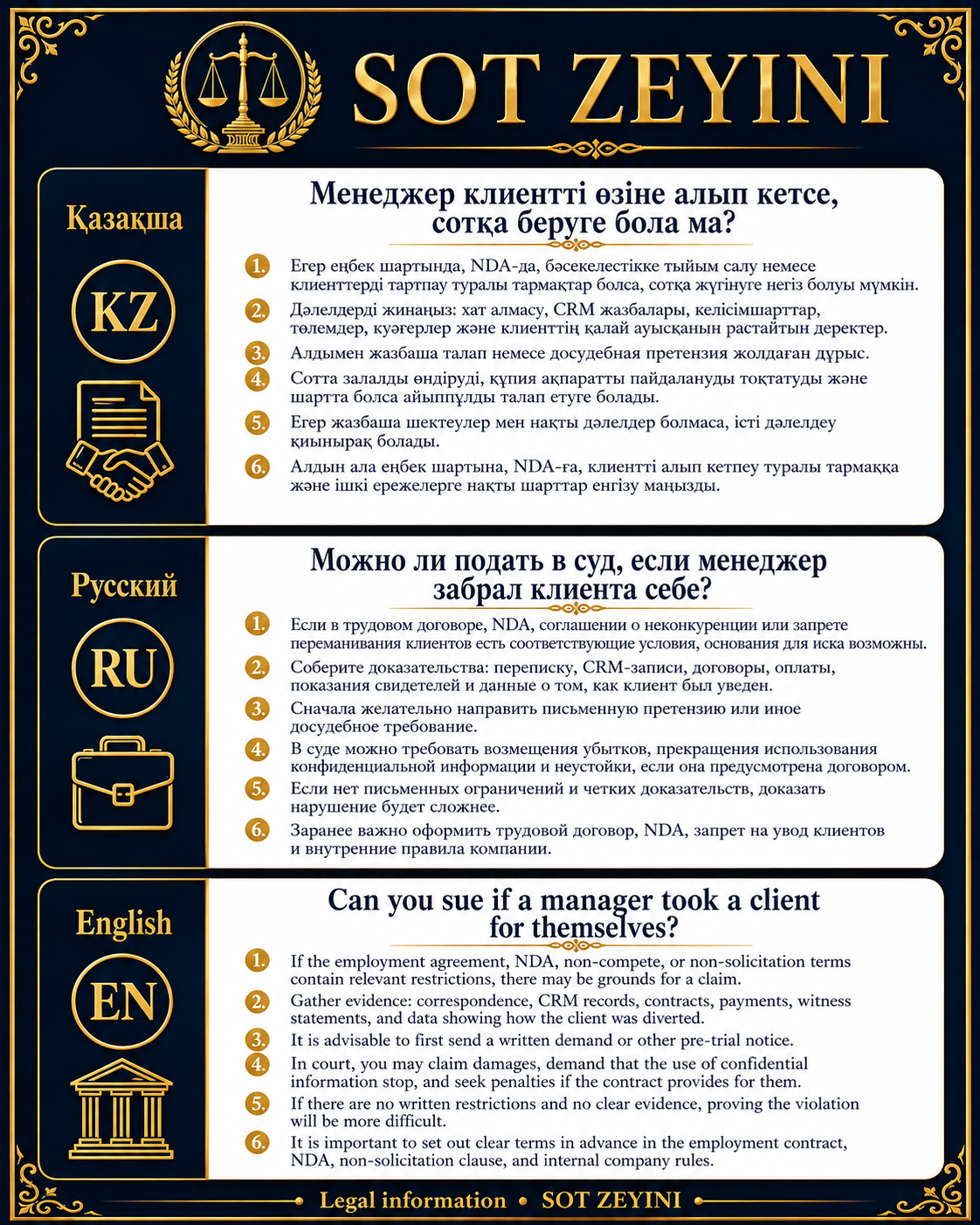
Yes, an employer may sue a manager if the manager used a company client for personal benefit, made a deal behind the employer’s back, transferred the client to a competitor, or unlawfully used the company’s client database. However, a successful claim requires evidence.
The mere fact that a manager spoke with a client is not always enough. The employer must show that the client came to the company, the manager received access to the client through work, and then used that access against the company’s interests.
In simple terms, the legal chain is: the client came to the company, the manager received access, the manager bypassed the company, and the company lost money. If this chain is proven, the employer has a stronger legal position.
When are there grounds for a claim?
There may be grounds for a court claim if the manager:
- made a direct deal with the client;
- asked the client to pay them personally;
- referred the client to another company;
- used the client database after leaving the company;
- copied client contacts;
- sent personal payment details to the client;
- hid the client’s request from the company;
- deleted messages or CRM records;
- transferred the client to a competitor;
- used the company’s commercial offer for personal benefit;
- breached an NDA or confidentiality agreement;
- caused losses to the employer.
If these facts are not proven, the claim may be difficult.
Is the client the company’s client or the manager’s client?
If the client came through the company’s website, advertising, Instagram, WhatsApp Business, office, CRM, corporate phone number, or a recommendation to the company, the client is usually treated as the company’s client.
The manager does not become the owner of the client simply because they communicated with that client. The manager negotiates on behalf of the company, uses company resources, and receives access to the lead because of their position.
Therefore, taking such a client personally may violate the employer’s rights.
What should the employer do first?
The employer should act quickly and carefully:
- Restrict the manager’s access to CRM, WhatsApp Business, Instagram, email, and other systems.
- Save correspondence with the client.
- Check CRM logs.
- Identify where the client came from.
- Check whether the manager sent personal payment details.
- Obtain a written explanation from the client, if possible.
- Prepare an internal incident report.
- Request a written explanation from the manager.
- Calculate possible losses.
- Prepare a written demand letter.
It is important not to delete correspondence or lose technical logs. In such cases, screenshots and CRM records can be crucial evidence.
What evidence is needed?
The following evidence may be useful:
- employment contract;
- job description;
- NDA;
- confidentiality agreement;
- internal trade secret policy;
- proof that the manager had access to the client database;
- CRM logs;
- WhatsApp, Telegram, Instagram, and email correspondence;
- personal payment details sent to the client;
- written statement from the client;
- proof that the client submitted a request to the company;
- evidence of a personal deal between the manager and the client;
- payment documents;
- calculation of losses;
- internal investigation report;
- demand letter and response.
The strongest evidence usually shows that the manager contacted the client outside the company, sent personal payment details, or redirected the client elsewhere.
What claims can be made against the manager?
Depending on the facts, the employer may bring several claims.
1. Stop using the client database
The employer may demand that the manager stop contacting company clients for personal purposes.
2. Delete unlawfully copied data
If the client database is stored on the manager’s personal phone, email, flash drive, or cloud storage, the employer may demand deletion.
3. Return documents and access credentials
The manager should return logins, passwords, documents, commercial offers, CRM access, WhatsApp Business access, Instagram access, and other company resources.
4. Contractual penalty
If a penalty is provided in an NDA, confidentiality agreement, or other contract, the employer may claim it.
5. Damages
If the company lost a client, contract, or revenue, the employer may claim damages if they are proven.
6. Prohibit use of confidential information
Through court, the employer may request a prohibition on the use of the client database, prices, contract terms, and other internal information.
7. Police report
If the client database was unlawfully copied, sold, transferred to a competitor, or there was unauthorized system access, the employer may consider filing a police report.
How are damages calculated?
Damages must be real and supported by documents. The calculation may include:
- the amount of the transaction the company expected to receive;
- expected profit;
- cost of acquiring the client;
- advertising costs;
- additional costs to restore the client relationship;
- lost contract;
- other proven losses.
A court will not compensate abstract frustration. The employer needs numbers, documents, and a connection between the manager’s actions and the lost client.
Can a claim be filed without an NDA?
Yes, but it will be more difficult. Without an NDA, the employer may rely on:
- employment contract;
- job duties;
- CRM logs;
- proof that the client came to the company;
- correspondence;
- personal data issues;
- use of corporate resources;
- proven damage.
For future protection, it is strongly advisable to sign NDAs and introduce a trade secret policy.
Should a demand letter be sent?
Yes. It is advisable to send a written demand letter before going to court. It should state:
- the manager’s former or current position;
- what clients and data the manager had access to;
- what actions were taken;
- why the company considers them unlawful;
- what evidence exists;
- what the company demands;
- deadline for voluntary compliance;
- warning about court or authorities.
The letter should be calm, professional, and fact-based.
What claims can be filed in court?
The employer may file claims to:
- prohibit use of the client database;
- stop use of confidential information;
- delete unlawfully obtained data;
- recover damages;
- recover contractual penalty;
- return documents and access credentials;
- recover court expenses.
If the manager was an employee, liability should be assessed under employment law rules. If the manager signed a separate NDA or civil law agreement, civil law claims may also apply.
How can a business protect itself in advance?
To prevent such situations, the company should:
- sign NDAs with managers;
- include confidentiality clauses in employment contracts;
- adopt an internal trade secret policy;
- store clients in CRM;
- use individual logins;
- prohibit export of the client database;
- communicate with clients through corporate channels;
- record all leads in CRM;
- block access immediately after termination;
- sign a return act for access credentials;
- include a non-solicitation clause where appropriate.
This system makes the company’s legal position much stronger.
Conclusion
If a manager takes a client for themselves, the employer may sue. However, the employer must prove that the client belonged to the company, the manager accessed the client through work, used that access for personal benefit, and caused losses.
The best approach is to block access, preserve evidence, prepare an internal report, request an explanation, send a demand letter, and, if necessary, file a court claim.
A client database is a company asset. Without documents and CRM control, proving client poaching can be much harder.
FAQ
Can an employer sue a manager who takes a client?
Yes, if there is evidence that the manager used a company client for personal benefit and caused damage.
What evidence is needed?
CRM logs, correspondence, client statement, employment contract, NDA, personal payment details, payment documents, and damage calculation.
Can damages be recovered?
Yes, if the employer proves the violation, the amount of damage, and the link between the manager’s actions and the loss.
What if there is no NDA?
A claim may still be possible, but it will be harder. CRM logs, correspondence, employment documents, and proof of loss become very important.
Can the employer contact the police?
Yes, if there are signs of unlawful copying of the database, transfer to a competitor, sale of information, or unauthorized system access.
Can a manager be prohibited from working with company clients?
Restrictions on using the client database and poaching clients may be included in an NDA or separate agreement.
How can the company prevent this?
Use CRM, NDAs, trade secret policies, individual logins, export restrictions, and immediate access blocking after termination.