 +7 775 858 9294
 WhatsApp
Does a receipt have legal force?
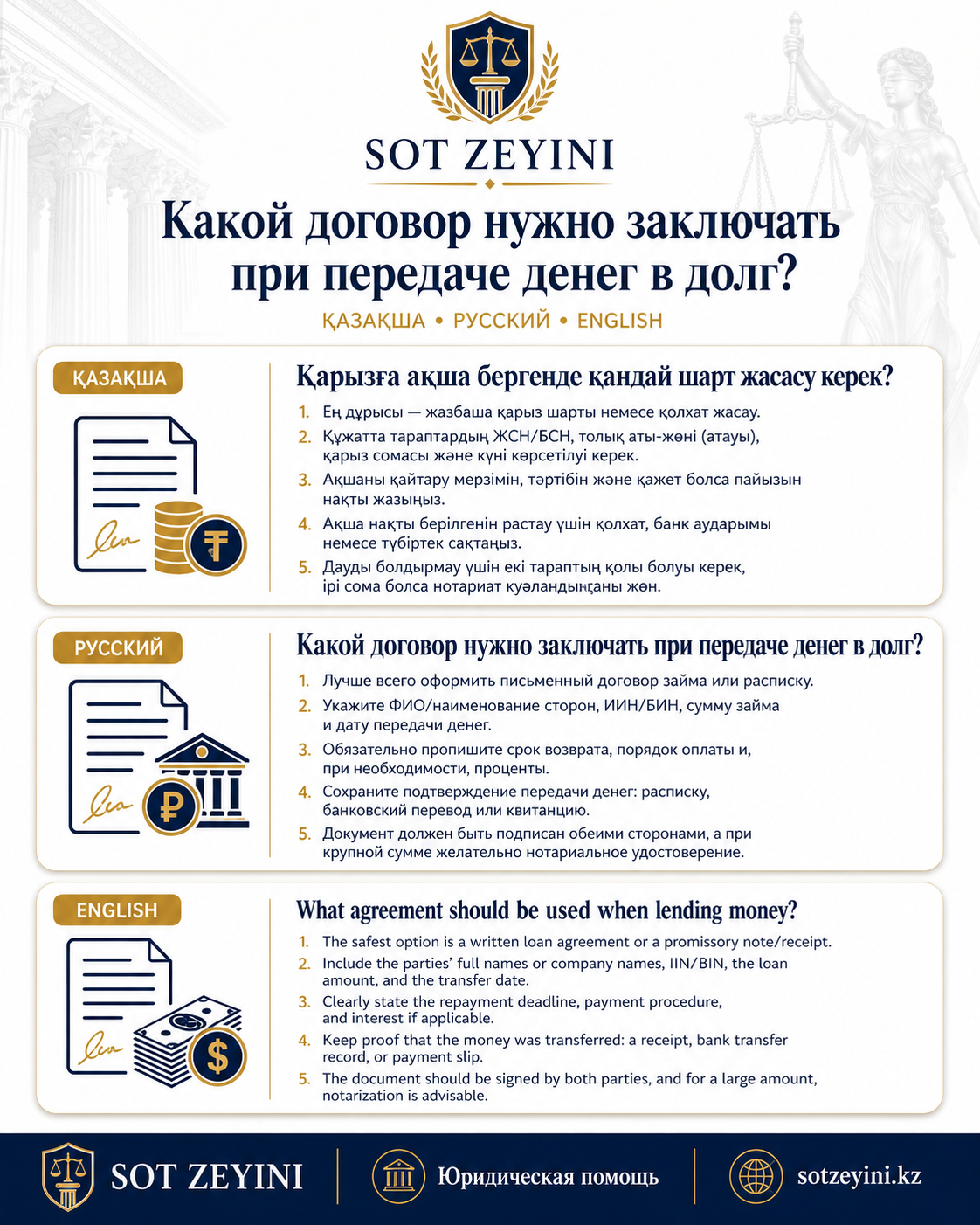
A receipt is a written document confirming that one person received a certain amount of money from another person and undertook to repay it. In Kazakhstan, a receipt may serve as evidence of a loan agreement if it clearly shows who received the money, from whom, in what amount, and under what repayment terms.
Many people believe that a receipt must be notarized to be valid. This is not always the case. A simple written receipt may have legal force if it contains the essential information and the borrower’s signature.
What should be included in a debt receipt?
To make the receipt strong evidence in court, it should ideally include:
- full name of the borrower;
- borrower’s individual identification number, if available;
- full name of the lender;
- amount of debt in numbers and words;
- date of money transfer;
- repayment deadline;
- interest or penalty terms, if any;
- borrower’s signature;
- date of signing.
The more detailed the receipt is, the easier it is to prove the debt in court.
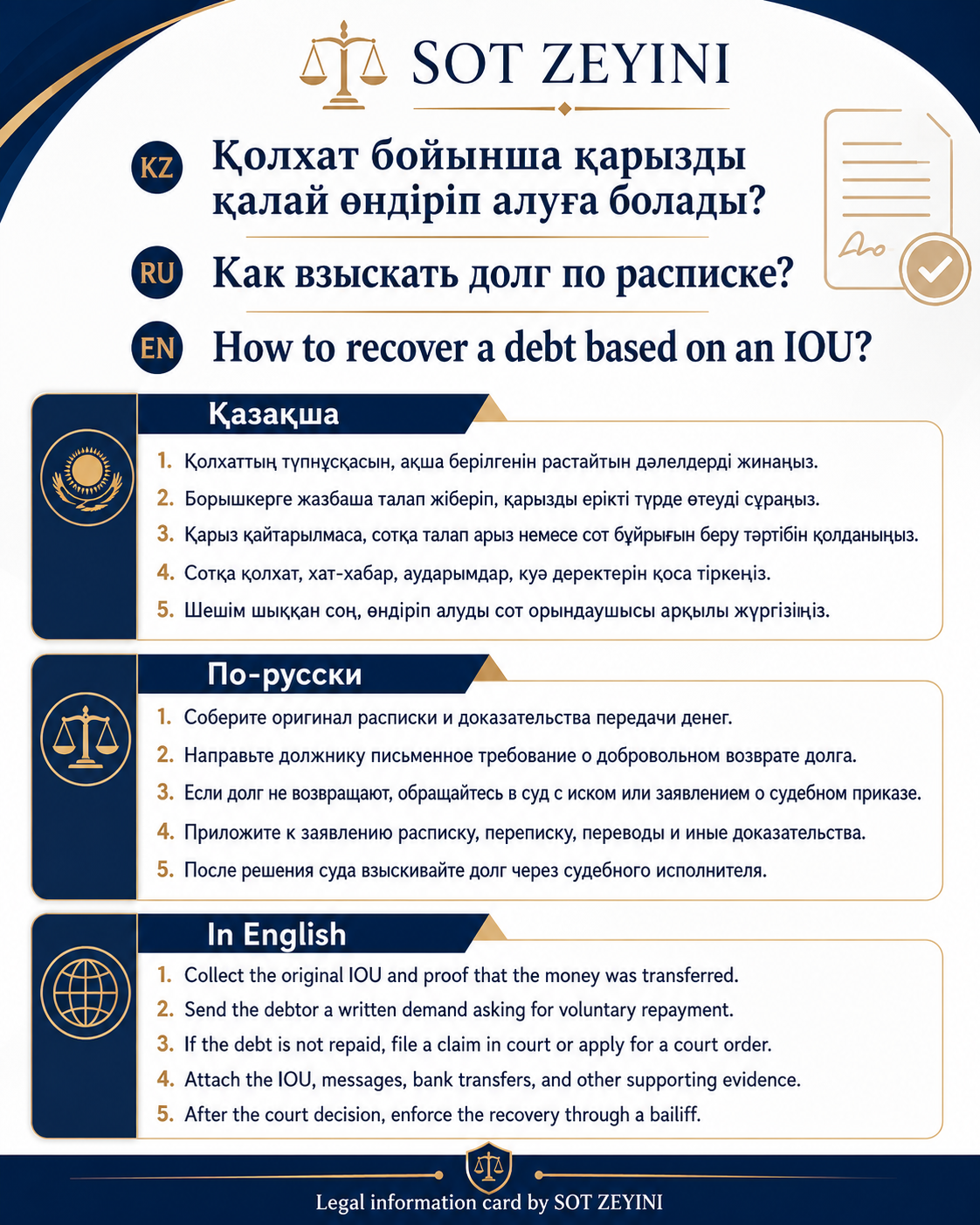
What documents are needed to recover a debt?
To file a court claim, it is advisable to prepare:
- Original or copy of the receipt;
- Bank transfer confirmation, Kaspi receipt, or other proof of payment;
- WhatsApp, Telegram, SMS, or email correspondence;
- Written demand for repayment, if it was sent;
- Claimant’s identity document;
- Debtor’s details: full name, identification number, address, phone number;
- State duty payment receipt;
- Documents confirming legal expenses, if such expenses are claimed.
If the debtor admitted the debt in messages, such correspondence should also be attached to the claim.
Is a pre-trial demand required?
A pre-trial demand is not always mandatory in debt recovery cases based on a receipt, but it is recommended. The demand should include:
- amount of debt;
- date of the receipt;
- repayment deadline;
- requirement to repay the money;
- deadline for voluntary payment;
- warning that a court claim will be filed if the debt is not paid.
A written demand shows the court that the creditor tried to resolve the dispute peacefully.
How to file a claim for debt recovery?
If the debtor refuses to repay the money voluntarily, the creditor may file a claim with the court. As a general rule, the claim is filed at the debtor’s place of residence.
The claim should include:
- details of the claimant and defendant;
- when and how much money was transferred;
- reference to the receipt;
- repayment deadline;
- explanation that the debt has not been repaid;
- amount to be recovered;
- court expenses;
- request to the court to recover the debt.
The receipt, proof of money transfer, correspondence, state duty receipt, and other evidence should be attached to the claim.
How much is the state duty?
A debt recovery claim is usually a property claim. In Kazakhstan, the state duty is generally calculated based on the amount of the claim: 1% for individuals and 3% for legal entities.
For example, if the debt amount is KZT 1,000,000, the state duty for an individual would usually be KZT 10,000.
Can interest and penalties be recovered?
Yes, if the interest or penalty was clearly stated in the receipt or loan agreement. If the receipt only states the principal amount without interest or penalties, the court may recover the principal debt and court expenses.
That is why repayment terms, interest, penalties, and deadlines should be written clearly when lending money.
What if the debtor denies the receipt?
The debtor may argue that:
- they did not receive the money;
- they did not write the receipt;
- the signature is not theirs;
- the debt has already been repaid;
- the receipt was signed under pressure.
In such cases, additional evidence is important: bank transfers, correspondence, witnesses, audio or video materials. If the debtor disputes the signature, the claimant may request a handwriting expert examination.
Can the debtor’s property be frozen?
Yes. Together with the claim, the claimant may request interim measures. For example, the court may be asked to freeze bank accounts, vehicles, real estate, or other property within the amount of the claim.
This is important if there is a risk that the debtor may sell property or withdraw funds before the court case is completed.
What happens after the court decision?
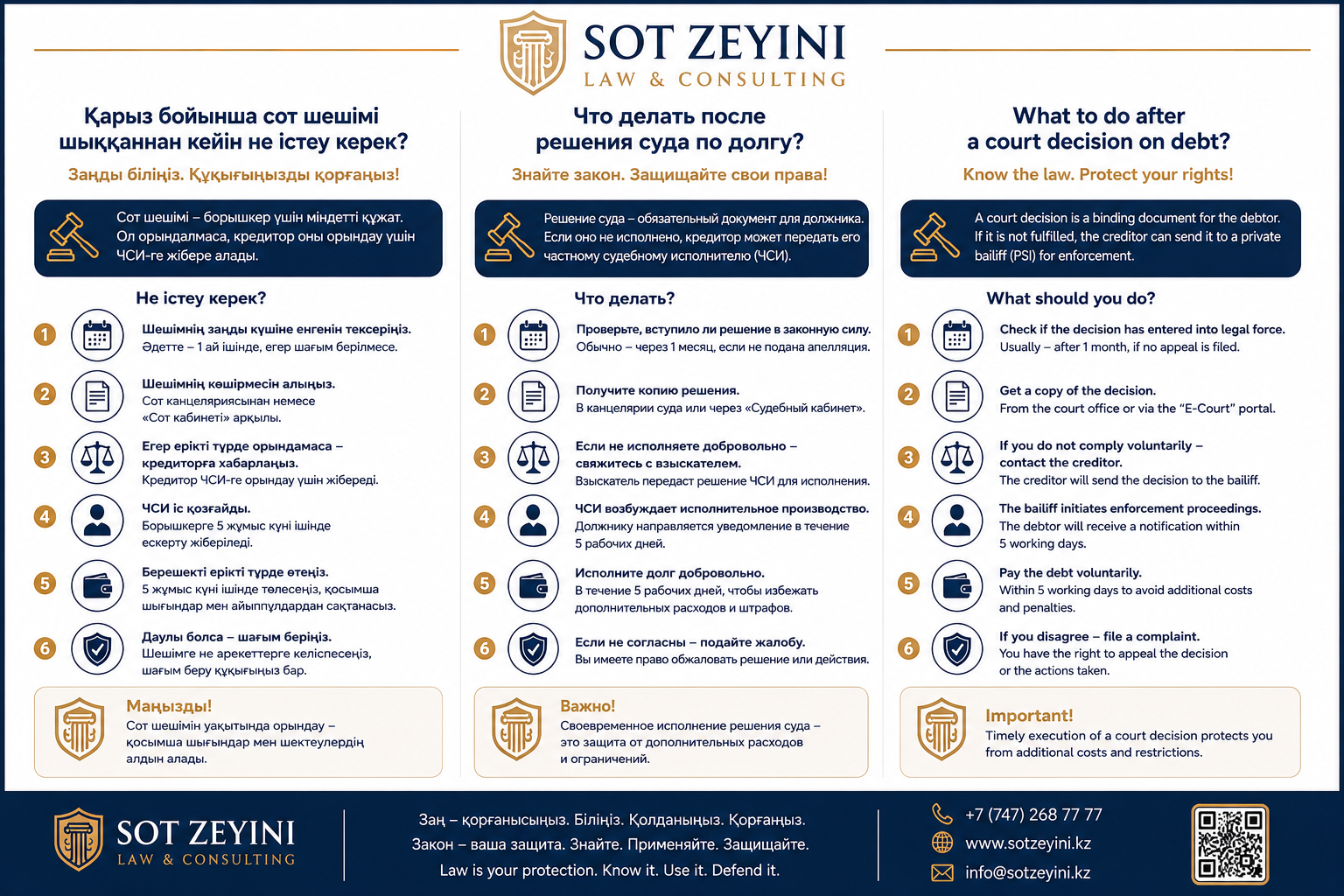
If the court satisfies the claim, it issues a decision on debt recovery. After the decision enters into legal force, the claimant may obtain a writ of execution and submit it to a bailiff.
A bailiff may:
- freeze bank accounts;
- deduct money from the debtor’s salary;
- seize a vehicle;
- seize real estate;
- restrict travel outside Kazakhstan;
- include the debtor in the debtor register.
Winning the court case is only the first stage. The second stage is proper enforcement of the court decision.
Can the debt be recovered without court?
Yes, if the debtor is ready to repay voluntarily. The parties may sign a payment schedule, mediation agreement, or notarized document. However, if the debtor keeps promising but does not pay, it is better not to delay court action, as the limitation period may expire.
Conclusion
Recovering a debt based on a receipt in Kazakhstan is possible if the evidence is properly collected and the claim is correctly filed. A receipt, bank transfers, correspondence, and written demand can help prove the loan and the debtor’s obligation to repay it.
SOT ZEYINI lawyers assist with preparing debt recovery claims, filing documents with the court, requesting interim measures, and supporting enforcement proceedings. Contact us via WhatsApp for legal consultation.
FAQ: debt recovery based on a receipt
1. Can I recover a debt if the receipt was not notarized?
Yes. Notarization is not always required. The key point is that the receipt must confirm that the borrower received money and undertook to repay it.
2. What if the receipt does not contain the debtor’s identification number?
The absence of an identification number does not automatically make the receipt invalid. However, it is better to identify the debtor’s address, phone number, and other personal details for court proceedings.
3. Can I recover a debt if the money was given in cash?
Yes. In this case, the receipt becomes the main evidence of the money transfer. Correspondence, witnesses, and other evidence may also be used.
4. What if the debtor claims that the debt was already repaid?
If the debtor claims repayment, they must prove it by providing a payment receipt, bank transfer, written confirmation, or other evidence.
5. Can WhatsApp messages be used as evidence?
Yes. WhatsApp messages may be used as additional evidence, especially if the debtor admits the debt, the amount, or the repayment deadline.
6. What is the limitation period for a debt receipt?
The general limitation period is 3 years. It is usually calculated from the date when the debt should have been repaid.
7. Can legal fees be recovered?
Yes. Legal expenses may be claimed in court if they are supported by a contract, payment receipt, or other proof of payment.
8. What if the debtor lives in another city?
As a general rule, the claim is filed at the debtor’s place of residence. If the address is unknown, the issue of jurisdiction and registration address should be checked separately.
9. Can the debtor’s car be seized?
Yes, if there is a risk that the debtor may hide, sell, or transfer the property. A separate application for interim measures should be filed.
10. What should I do after receiving the court decision?
After the decision enters into legal force, you should obtain a writ of execution and submit it to a bailiff for compulsory enforcement.