 +7 775 858 9294
 WhatsApp
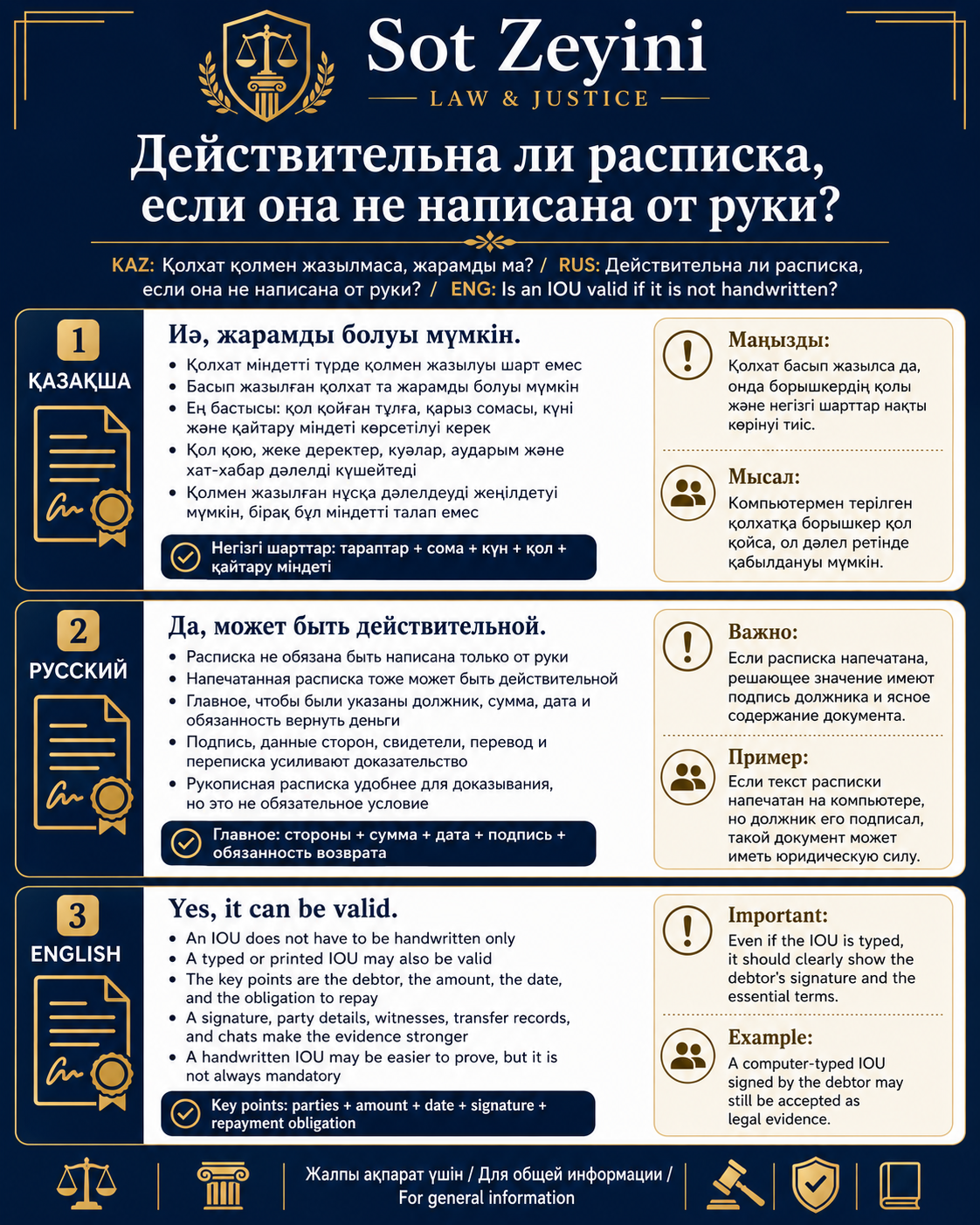
Must a debt receipt be handwritten?
Many people believe that a debt receipt must be fully handwritten to be legally valid. In practice, this is not necessarily true. The law does not always require the entire text of a receipt to be written by hand.
A receipt may be typed on a computer, printed on paper, and signed by the borrower. The key point is that the document must clearly show who received the money, from whom, in what amount, and when the money must be repaid.
In other words, a typed receipt does not become invalid only because it was not handwritten.
Is a typed receipt legally valid?
Yes, a typed receipt may be legally valid. If the borrower signs the document, the signature may confirm that the borrower read the document and agreed with its contents.
A proper receipt should preferably include:
- full name of the borrower;
- borrower’s identification number, if available;
- full name of the lender;
- debt amount in numbers and words;
- date of money transfer;
- repayment deadline;
- interest or penalty terms, if any;
- borrower’s signature;
- date of signing.
If these details are included and the borrower signs the receipt, it may be used in court as written evidence.
What is more important: handwritten text or signature?
The most important element of a receipt is the borrower’s signature. By signing the document, the borrower confirms agreement with the contents of the receipt.
If the text is typed but the borrower signed it, the document may still confirm the existence of the debt. However, if the debtor later denies the signature, a handwriting examination may be required.
For stronger protection, it is advisable to ask the borrower to write at least a short handwritten phrase, such as:
“I received the money and agree with the terms of this receipt.”
Or:
“I received KZT 1,000,000 as a loan and undertake to repay it by December 1, 2026.”
Such a handwritten phrase may strengthen the creditor’s position in court.
Why is a handwritten receipt often stronger evidence?
A handwritten receipt may be easier to prove in court. If the debtor claims that they did not write or sign the receipt, an expert can examine not only the signature but also the handwritten text.
If the receipt is typed, the expert usually examines only the signature. This is still possible, but handwritten text provides more material for expert analysis.
Therefore, a handwritten receipt is not always mandatory, but it may be stronger as evidence.
Can a debt be recovered based on a typed receipt?
Yes. If the receipt is typed but signed by the borrower, the creditor may file a court claim for debt recovery.
To strengthen the case, it is advisable to attach additional evidence:
- bank transfer confirmation;
- Kaspi receipt;
- original receipt;
- WhatsApp or Telegram correspondence;
- SMS messages;
- audio or video recordings, if legally obtained;
- written demand for repayment.
The court evaluates all evidence together. Therefore, the more supporting documents the creditor has, the higher the chances of successful debt recovery.
What if the debtor denies the signature?
If the debtor claims that the signature is not theirs, the claimant may request a handwriting examination.
For such an examination, it is preferable to provide the original receipt. A copy, photo, or scan may be accepted by the court, but the original document is usually much better for expert analysis.
Other evidence may also be used:
- correspondence where the debtor admits the debt;
- bank transfers;
- partial repayments;
- messages promising repayment;
- witness statements.
Is a receipt valid without notarization?
Yes. A receipt may be valid even if it was not notarized. Notarization is not always required for a loan between individuals.
However, notarization reduces the risk of disputes. If the amount is significant, it is better to execute a notarized loan agreement or at least prepare a detailed receipt signed by the borrower and supported by proof of money transfer.
Can a photo or scan of a receipt be used?
A photo or scan of a receipt may be submitted to court, but it is always better to have the original. If the debtor disputes the signature or authenticity of the document, the court may request the original receipt.
If the original is lost, the debt may need to be proven through other evidence:
- bank transfers;
- correspondence;
- debtor’s admission of debt;
- partial repayments;
- witness statements.
Ideally, the original receipt should be kept by the creditor until the debt is fully repaid.
What should a proper receipt include?
A proper debt receipt should clearly confirm the loan relationship. It should state:
- who received the money;
- from whom the money was received;
- the exact amount;
- that the money was received as a loan;
- repayment deadline;
- whether interest applies;
- whether penalties apply in case of delay;
- date of signing;
- borrower’s signature.
Example wording:
“I, Ivan Ivanov, ID No. 000000000000, received from Petr Petrov the amount of KZT 1,000,000 as a loan. I undertake to repay this amount by December 1, 2026. I received the money in full and agree with the terms.”
The date, city, full name, and borrower’s signature should be added below.
What mistakes weaken a receipt?
A receipt may become weak evidence if:
- there is no borrower’s signature;
- the debt amount is not stated;
- it does not say that the money was given as a loan;
- there is no date;
- there is no repayment deadline;
- it is unclear who gave money to whom;
- the amount is written only in numbers;
- there is no proof of actual money transfer;
- only a poor-quality photo of the receipt exists.
These mistakes do not always make the receipt invalid, but they may complicate debt recovery in court.
What should be done if the debtor does not repay the debt?
If the debtor refuses to repay the money, the creditor should:
- Review the receipt and available evidence;
- Send a written demand for repayment;
- Calculate the debt amount;
- Pay the state duty;
- Prepare a statement of claim;
- File the claim with the court;
- Obtain a writ of execution after the court decision;
- Submit the writ of execution to a bailiff.
If there is a risk that the debtor may sell property or withdraw funds, the claimant may request interim measures.
Conclusion
A receipt does not necessarily have to be fully handwritten. If it is typed, printed, and signed by the borrower, and if it contains the essential loan terms, it may be used in court as evidence.
However, for stronger protection, it is better to ask the borrower to write at least a key phrase by hand confirming receipt of the money and agreement with the terms. It is also important to keep the original receipt, payment confirmations, bank transfers, and correspondence.
SOT ZEYINI lawyers assist with debt recovery based on receipts, preparation of court claims, collection of evidence, and legal support in court. Contact us via WhatsApp for legal consultation.
FAQ: is a receipt valid if it is not handwritten?
1. Must a receipt be handwritten?
No. A receipt may be typed on a computer. The main requirement is that the borrower signs it and the document clearly confirms the loan obligation.
2. Is a typed receipt legally valid?
Yes, if it is signed by the borrower and contains the key loan terms: amount, date, parties, and repayment deadline.
3. What matters more: handwritten text or signature?
The borrower’s signature is the most important element. However, handwritten text may strengthen the evidentiary value of the receipt.
4. Can a debt be recovered based on a receipt typed in Word?
Yes. If the receipt was printed and signed by the borrower, it may be used in court.
5. What if the debtor says the signature is not theirs?
The claimant may request a handwriting examination. The original receipt is preferable for this purpose.
6. Does a receipt need to be notarized?
Not always. A simple written receipt may also serve as evidence. However, notarization reduces the risk of disputes.
7. Can I file a claim with only a photo of the receipt?
A photo may be submitted, but the original is much stronger. If the debtor disputes the document, the court may request the original.
8. What if the receipt is typed but signed by the debtor?
Such a receipt may be used as evidence. It is better to also attach bank transfer confirmations, receipts, or correspondence.
9. Is it necessary to state the repayment deadline?
It is highly recommended. If no deadline is stated, it is better to first send a written demand for repayment.
10. How can a receipt be made stronger?
Include full details of the parties, amount in numbers and words, repayment deadline, borrower’s signature, and a handwritten phrase confirming receipt of the money.