 +7 775 858 9294
 WhatsApp
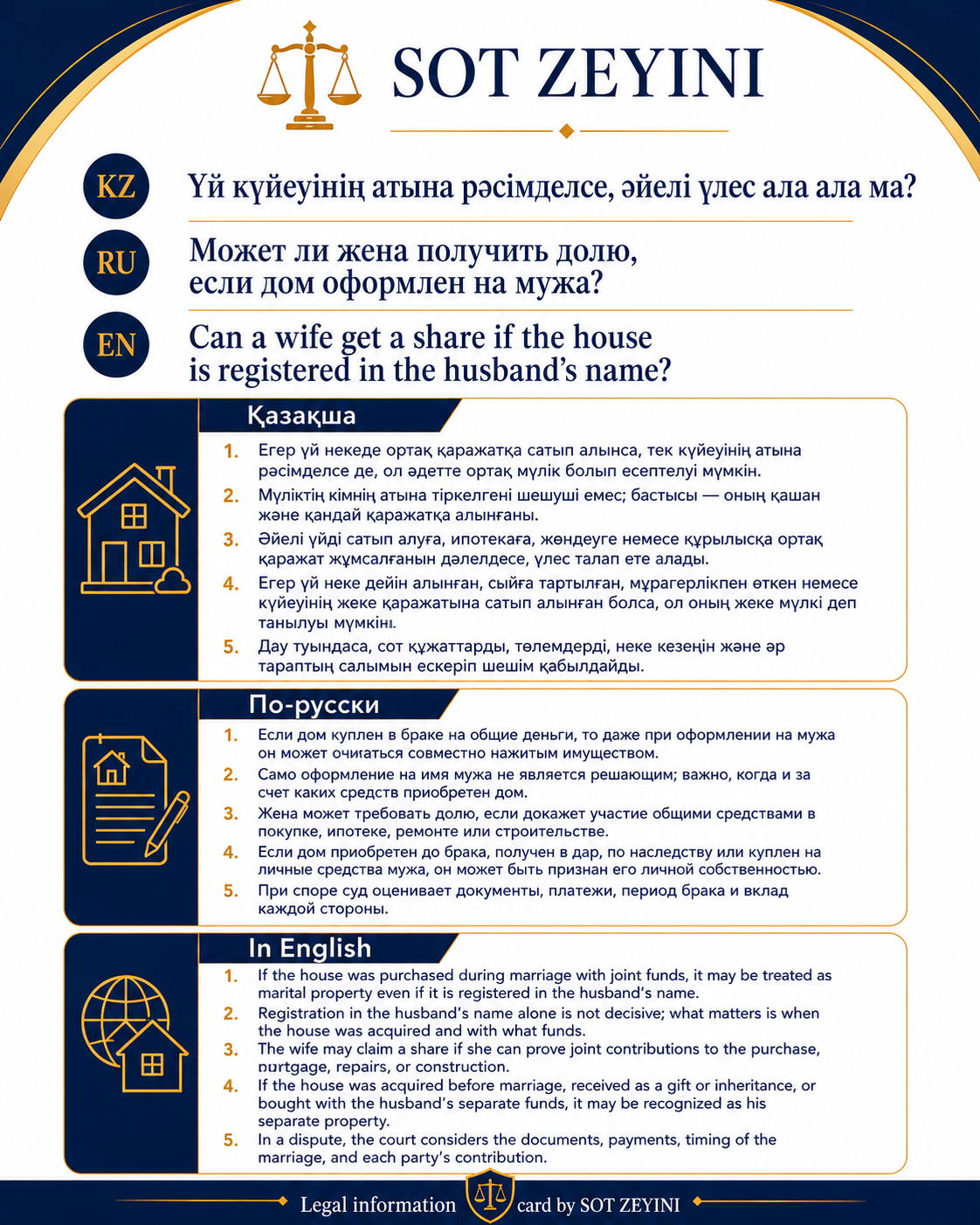
Can a wife get a share if the house is registered to the husband?
Yes. A wife may claim a share if the house or apartment was acquired during the marriage. Even if the property is registered only in the husband’s name, it may still be considered joint marital property.
In Kazakhstan, the key issue is not only whose name appears in the ownership documents. The court will look at when the property was acquired and what funds were used.
If the house was purchased during the marriage and it is not proven to be the husband’s personal property, the wife may ask the court to recognize it as joint property and determine her share.
If the house was bought during marriage
If the house was acquired during the official marriage, it is usually treated as joint marital property.
This may apply even if:
- the house is registered only to the husband;
- only the husband signed the purchase agreement;
- the mortgage is in the husband’s name;
- the wife is not mentioned in the documents;
- payments were made from the husband’s bank card;
- the wife did not work and cared for the home or children.
If the property was acquired during marriage, the wife may apply to court and claim her share. As a general rule, spouses’ shares are presumed equal unless there is a prenuptial agreement or other legally relevant circumstances.
If the wife is not registered at the address
The wife may still claim a share even if she is not registered at the property address. Residence registration is not the same as ownership.
For example, the spouses bought an apartment during marriage, registered it in the husband’s name, and the wife remained registered at her parents’ address. This does not automatically deprive her of property rights if the apartment was acquired during marriage.
If the wife did not work
If the wife did not work, this does not mean she loses the right to marital property. Household work, childcare, family support, and other family duties may be considered.
For example, the husband worked and paid the mortgage, while the wife cared for the children and managed the household. This does not automatically make the house the husband’s personal property.
The court does not look only at who earned the money. Family contribution may be financial or non-financial.
If the husband bought the house before marriage
If the husband acquired the house before marriage, it is usually considered his personal property and is not divided in divorce.
For example:
- the husband bought the house before marriage registration;
- ownership was registered before marriage;
- the house was fully paid for before marriage.
In such a case, the wife cannot automatically claim a 1/2 share. However, there is an important exception: if during the marriage joint funds or labor were invested in the house and its value significantly increased, the wife may claim compensation or recognition of a share.
If the house was renovated during marriage
If the house was the husband’s personal property, but significant investments were made during marriage, the wife may have a claim.
Examples include:
- major renovation;
- construction of a second floor;
- building additional rooms;
- installation of utilities;
- expansion of the house;
- significant increase in market value;
- renovation paid from joint family funds;
- money invested by the wife or her relatives.
The wife must prove not only that renovation occurred, but also that the investments significantly increased the value of the house.
If the husband inherited the house
If the husband inherited the house, it is generally considered his personal property and is not divided in divorce.
Even if the inheritance was registered during marriage, inherited property usually belongs personally to the spouse who received it.
However, if significant investments were made into the inherited house during marriage, the wife may claim compensation or a share if she can prove an increase in the property’s value.
If the house was gifted to the husband
If the house was personally gifted to the husband, it usually is not divided in divorce.
For example:
- the husband’s parents gifted him the house;
- the gift agreement names only the husband;
- the documents show that the property was transferred personally to him.
However, if the gift agreement was only formal and the property was actually purchased with joint funds, the wife may try to prove that the property is marital.
If the mortgage is in the husband’s name
If the mortgage is in the husband’s name, but the house was bought during marriage, the wife may still have a share.
The court may consider:
- when the mortgage was taken;
- who paid the initial payment;
- who made monthly payments;
- whether the house was used by the family;
- whether payments came from the family budget;
- whether there are children;
- remaining debt to the bank.
In mortgage cases, both the property and the loan obligation must be considered. Sometimes the property remains with one spouse and the other receives compensation.
If the husband’s parents paid the initial payment
If the husband’s parents paid the initial payment, this may affect the case, but it does not always mean the house fully belongs to the husband.
The court may examine:
- to whom the parents gave the money;
- whether it was family assistance or a personal gift to the husband;
- whether there is a gift agreement, receipt, or bank transfer;
- who paid the mortgage afterward;
- whether the house was used as family housing;
- whether the wife contributed to the family.
If the initial payment was the husband’s personal gift, the court may consider this when determining shares. But payments made during marriage may still support the wife’s claim.
What can the wife request in court?
The wife may file a property division claim.
Depending on the facts, she may ask the court to:
- Recognize the house as joint marital property.
- Determine the spouses’ shares in the house.
- Recognize her 1/2 share.
- Leave the house to the husband and award monetary compensation to the wife.
- Freeze the house or prohibit registration actions.
- If the house has been sold, recover half of its market value.
The exact claims depend on the documents, property value, mortgage, children, and other circumstances.
What evidence does the wife need?
The wife should prepare:
- marriage certificate;
- divorce certificate, if the marriage has ended;
- house or apartment documents;
- purchase agreement;
- mortgage agreement;
- bank statements;
- payment documents;
- documents on the initial payment;
- renovation receipts;
- contractor agreements;
- before-and-after photos;
- correspondence with the husband;
- witness statements;
- documents showing family residence in the house;
- children’s birth certificates;
- property valuation report.
The main task is to prove that the house was acquired during marriage or that joint funds significantly increased its value.
If the husband sold the house
If the husband sold the house without the wife’s consent, the wife may go to court.
Possible claims include:
- invalidation of the transaction;
- recovery of 1/2 of the market value;
- recognition of the house as marital property;
- review of the buyer’s good faith;
- freezing other property of the husband;
- interim measures.
If the house has not yet been sold, the wife should urgently request interim measures to prevent sale or transfer.
Can sale of the house be prohibited?
Yes. If there is a risk that the husband may sell, gift, pledge, or transfer the house, the wife may ask the court for interim measures.
She may request:
- freezing the house;
- prohibiting sale;
- prohibiting gift transfer;
- prohibiting registration actions;
- prohibiting pledge of the property.
This helps preserve the property until the court case is resolved.
If the children remain with the wife
If children remain with the wife after divorce, the court may consider this, but it does not automatically mean the entire house will be transferred to her.
The court may consider:
- children’s housing conditions;
- availability of other housing;
- interests of minor children;
- income of both parties;
- child support obligations;
- possibility of paying compensation;
- other marital property.
In some cases, the court may depart from equal shares if the children’s interests require it, but strong evidence is needed.
If the house is registered to the husband’s parents
If the house is registered to the husband’s parents, the wife does not automatically receive a share. Formally, the parents are the owners.
However, if the wife proves that the house was actually purchased with the spouses’ joint funds and registered to the parents only formally, she may raise the issue in court.
Evidence may include:
- bank transfers;
- receipts;
- correspondence;
- payment documents;
- agreements;
- actual residence;
- renovation paid by spouses;
- witness statements.
These cases are complex because the wife must prove the real source of funds and the true nature of the property arrangement.
If the couple lived together without official marriage
If there was no official marriage, the rules on joint marital property do not apply automatically.
This means that if a couple lived together but did not register the marriage, and the house is registered to the man, the woman does not automatically receive a 1/2 share.
However, she may bring other claims if she proves:
- she invested her own money;
- she participated in the purchase;
- she paid for renovation or construction;
- there was an agreement on joint ownership;
- the man was unjustly enriched at her expense.
In such cases, evidence is especially important.
What is the time limit for filing a claim?
A three-year limitation period may apply to property division claims after divorce.
However, this period is often counted not simply from the date of divorce, but from the moment when the wife learned or should have learned that her right was violated.
Examples include:
- the husband says the wife has no share;
- the husband attempts to sell the house;
- the husband tries to evict the wife;
- the house is transferred to another person;
- the husband refuses to divide the property.
Such events may indicate the beginning of a rights violation.
Sample wording for a court claim
The claim may include:
“The disputed residential house was acquired by the parties during the marriage, used for family needs, and constitutes joint marital property. The fact that the house is registered in the defendant’s name does not exclude the claimant’s right to a share in this property.”
Another possible wording:
“During the marriage, the claimant managed the household, raised the children, and contributed to family life, which does not deprive her of rights to joint marital property.”
If compensation is requested:
“I ask the court to leave the residential house in the defendant’s ownership and recover monetary compensation in favor of the claimant in the amount of 1/2 of the house’s market value.”
Conclusion
A wife may receive a share in a house even if the house is registered only to the husband, provided that the property was acquired during the marriage. Registration in the husband’s name does not automatically exclude the wife’s rights.
However, if the house was bought before marriage, inherited by the husband, or gifted personally to him, it is usually considered his personal property. In that case, the wife may claim a share or compensation only if special grounds exist, such as significant investments during marriage.
The key evidence concerns when the house was acquired, what funds were used, how it was used, and whether family funds or efforts increased its value.
FAQ: Frequently Asked Questions
1. Can a wife get a share if the house is registered to the husband?
Yes, if the house was acquired during marriage, the wife may claim a share even if it is registered only to the husband.
2. Does the wife have rights if she is not listed in the documents?
Yes, if the house is joint marital property.
3. Is a house bought before marriage divided?
Usually no. But if significant investments were made during marriage, the wife may claim compensation or a share.
4. Does the wife have a share in inherited property?
Usually no. Inherited property is generally personal property.
5. Does the wife have a share in a gifted house?
Usually no, if the gift was personal and properly documented.
6. Can a non-working wife claim a share?
Yes. Household work and childcare do not deprive her of rights to marital property.
7. Does the wife have a share if the mortgage is in the husband’s name?
Yes, if the mortgage was taken during marriage and the property was acquired for the family.
8. If the husband’s parents paid the initial payment, is the house only his?
Not always. The court will consider who received the money and how the mortgage was paid afterward.
9. What if the husband is selling the house?
The wife should file a claim and request interim measures to prohibit sale or registration actions.
10. Can the wife receive compensation instead of a share?
Yes. The court may leave the house to the husband and award monetary compensation to the wife.
11. If children stay with the wife, will she get more?
Possibly, but not automatically. The court needs evidence that this is required by the children’s interests.
12. If the house is registered to the husband’s parents, does the wife have a share?
Not automatically. She must prove that the house was actually purchased with joint marital funds.
13. If there was no official marriage, does the woman get 1/2?
No, marital property rules do not apply automatically. She must prove specific financial contributions or another legal basis.
14. What evidence is needed?
Marriage documents, purchase agreement, mortgage agreement, bank payments, renovation receipts, correspondence, witnesses, and property valuation.
15. What is the limitation period?
A three-year period may apply, often starting from the moment when the right was violated, not simply from the divorce date.