 +7 775 858 9294
 WhatsApp
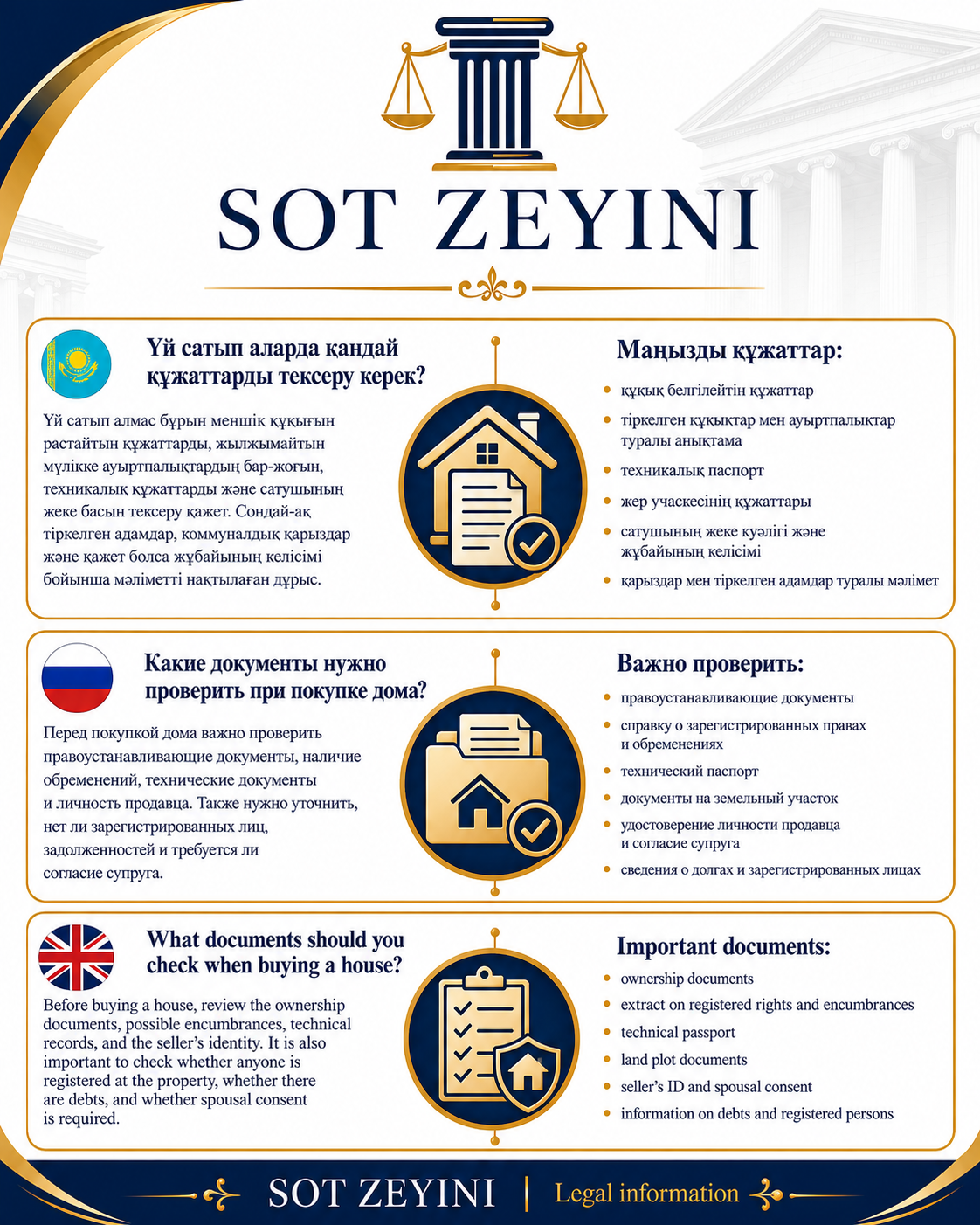
What Documents Should You Check Before Buying a House in Kazakhstan?
What Documents Should You Check Before Buying a House in Kazakhstan?
Learn what documents to check before buying a house or apartment in Kazakhstan: ownership documents, encumbrance certificate, arrest, mortgage, spouse consent, technical passport, registered residents, debts, and sale agreement.
documents to check before buying a house in Kazakhstan, buying property Kazakhstan, real estate documents Kazakhstan, encumbrance certificate Kazakhstan, apartment purchase documents, house purchase legal check, mortgage property Kazakhstan, real estate lawyer Kazakhstan
Short answer
Before buying a house or apartment in Kazakhstan, you should check not only the price and condition of the property, but also its legal status. The most important documents include the seller’s identity document, title document, certificate of registered rights and encumbrances, technical passport, spouse consent if required, power of attorney if the seller acts through a representative, utility debt information, and the draft sale and purchase agreement.
The main purpose of the check is to confirm that the seller has the legal right to sell the property and that the property is not under arrest, pledge, mortgage, registration ban, court dispute, or other hidden restriction.
The safest formula is simple: documents first, agreement second, money third. Not the other way around.
Why should documents be checked before buying property?
Buying a house or apartment is one of the largest transactions for most people. A mistake in documents can lead to serious legal and financial consequences.
If the documents are not checked properly, the buyer may face problems such as:
- the property is under arrest;
- the property is pledged to a bank;
- the seller is not the real owner;
- spouse consent is missing;
- there is an inheritance dispute;
- the property is involved in court proceedings;
- registration actions are restricted;
- unauthorized redevelopment exists;
- other people are registered in the property;
- there are unpaid utility debts;
- the sale agreement may later be challenged.
Document review is not just a formality. It is the buyer’s legal safety belt.
1. Seller’s identity document
The first step is to check the seller’s identity.
You should verify:
- full name of the seller;
- individual identification number;
- validity of the identity document;
- whether the identity document matches the title documents;
- whether the seller personally participates in the transaction;
- whether the seller acts through a representative.
If someone says, “The house is mine, but it is registered under my relative’s name,” this is a red flag. Only the owner or a properly authorized representative can sell real estate.
2. Title document
A title document shows how the seller acquired the house or apartment.
It may be:
- sale and purchase agreement;
- gift agreement;
- exchange agreement;
- inheritance certificate;
- privatization agreement;
- court decision;
- commissioning act;
- equity participation agreement;
- akimat decision;
- another document confirming ownership.
The buyer should check whether the seller’s details, property address, area, and object description match all other documents.
3. Certificate of registered rights and encumbrances
This is one of the most important documents before buying real estate. In practice, it is often referred to as an encumbrance certificate or F-2 certificate.
It helps verify:
- who the registered owner is;
- whether there is an arrest;
- whether there is a mortgage or pledge;
- whether there is a registration ban;
- whether third-party rights are registered;
- whether there are other restrictions;
- whether ownership is properly registered.
This certificate should be fresh. Do not rely on a document issued a month ago. A property may be clean today and under arrest tomorrow.
4. Arrest or registration ban
If a house or apartment is under arrest, the transaction may not be registered.
An arrest may be imposed by:
- court;
- private bailiff;
- tax authority;
- investigative authority;
- enforcement proceedings;
- credit debts;
- alimony debts;
- court dispute.
If the certificate shows any arrest, ban, or restriction, the reason must be clarified and the restriction must be removed before payment. Paying for property under arrest is one of the riskiest moves.
5. Mortgage or pledge
A house or apartment may be pledged to a bank. In this case, the seller may not be able to sell it without the bank’s consent.
You should check:
- whether the property is pledged;
- which bank is the pledge holder;
- remaining debt amount;
- whether the bank agrees to the sale;
- when the pledge will be removed;
- how payment will be made;
- how mortgage repayment and ownership registration will be connected.
Buying mortgaged property is possible, but the payment and registration process must be carefully structured.
6. Technical passport
The technical passport or technical characteristics describe the actual physical parameters of the property.
It may contain:
- property address;
- total area;
- living area;
- number of rooms;
- floor;
- year of construction;
- layout;
- additional structures;
- technical specifications.
The actual property condition should match the technical documents. If there is unauthorized construction, redevelopment, wall removal, balcony expansion, or room extension, this may create problems with registration, mortgage approval, valuation, or future sale.
7. Address and area
The address in the sale agreement, technical passport, and encumbrance certificate must match.
Check:
- street name;
- building number;
- apartment number;
- total area;
- floor;
- property type;
- cadastral or registration number;
- land plot cadastral number if it is a private house.
If one document shows 45.6 square meters and another shows 48 square meters, the reason must be clarified. Small differences can become big legal issues.
8. Land documents for private houses
If you are buying a private house, you must check not only the building but also the land plot.
You should review:
- land act;
- cadastral number of the land plot;
- land area;
- designated purpose;
- ownership or lease right;
- encumbrances on the land;
- servitudes;
- boundaries;
- disputes with neighbors;
- whether the land is transferred together with the house.
Sometimes the house is being sold, but the land documents are incomplete. This can create serious problems after purchase. When buying a private house, remember: the house and the land are legally connected, but they must both be properly documented.
9. Spouse consent
If the property was acquired during marriage, it may be marital property. In that case, notarized consent of the seller’s spouse may be required.
Check:
- whether the seller is married;
- when the property was acquired;
- whether the property was acquired before or during marriage;
- whether there is a marriage contract;
- whether spouse consent is required;
- whether the consent refers specifically to this property.
If spouse consent is required but not obtained, the transaction may later be challenged.
10. Inherited property
If the seller acquired the property through inheritance, documents should be checked especially carefully.
Review:
- inheritance certificate;
- whether inheritance rights were registered;
- whether there are other heirs;
- whether there is an inheritance dispute;
- whether any court case is pending;
- whether the seller’s ownership is fully formalized.
Inherited property may carry hidden risks if another heir later appears and claims a share.
11. Sale through power of attorney
If the seller does not appear personally and the property is sold by a representative, the power of attorney must be checked very carefully.
The power of attorney should authorize the representative to:
- sell the specific property;
- sign the sale and purchase agreement;
- receive money;
- act before a notary;
- submit documents for registration;
- sign applications.
You should also check whether the power of attorney is still valid and has not been revoked. Transactions through representatives require extra caution.
12. Registered residents
Before buying a house or apartment, it is also advisable to check who is registered at the property.
There may be:
- the seller;
- family members;
- minor children;
- former owners;
- tenants;
- other residents.
The agreement should state that all registered persons must be deregistered within a specific period. Otherwise, the buyer may receive ownership but still have people registered at the address.
13. Utility debts
Before purchase, check utility debts.
This may include:
- electricity;
- water;
- heating;
- gas;
- waste collection;
- condominium or owners’ association payments;
- intercom;
- internet;
- repair fund payments;
- property tax.
The agreement should clearly state that all debts arising before the transaction must be paid by the seller.
14. Unauthorized redevelopment
If you are buying an apartment, redevelopment must be checked.
Check whether:
- walls were removed;
- kitchen was moved;
- balcony was expanded;
- rooms were combined;
- bathroom area was expanded;
- changes were reflected in the technical passport.
If redevelopment is illegal, the buyer may later have to legalize it or restore the original layout.
15. Court disputes
If the property is involved in a court dispute, the buyer enters a high-risk transaction.
Disputes may concern:
- ownership;
- inheritance;
- division of marital property;
- previous sale agreement;
- debt or pledge;
- eviction;
- invalidation of transaction.
The seller should provide a contractual guarantee that there are no court disputes regarding the property. If necessary, court databases and public records should be checked.
16. Sale and purchase agreement
The sale and purchase agreement should include:
- full details of the parties;
- exact description of the property;
- title documents;
- price;
- payment procedure;
- property transfer procedure;
- seller’s guarantee on absence of encumbrances;
- deregistration of registered persons;
- responsibility for utility debts;
- spouse consent;
- state registration procedure;
- liability of the parties;
- dispute resolution procedure.
Do not sign an agreement without reading it. The notary formalizes the transaction, but the buyer still carries many risks.
17. Safe payment terms
Payment terms must be written clearly.
Check:
- exact price;
- payment currency;
- payment date;
- when money is transferred;
- whether payment is made through a bank;
- whether notary deposit is used;
- whether payment happens after registration;
- whether a receipt is issued;
- payment purpose;
- refund procedure if registration fails.
The safest option is bank payment with a clear payment purpose, such as: “Payment under the sale and purchase agreement for the apartment.”
18. State registration
Signing the sale agreement is not enough. The buyer’s ownership right must be registered.
After registration, the buyer becomes legally protected as the owner.
Check:
- whether the agreement was submitted for registration;
- whether registration was completed;
- whether the buyer appears as the new owner;
- whether a new certificate shows the buyer as owner;
- whether there was any refusal to register.
Until registration is completed, payment arrangements should be handled carefully.
19. Buying with a mortgage
If the property is purchased through a mortgage, additional checks are required:
- whether the bank accepts the property;
- whether the valuation report is acceptable;
- whether seller documents meet bank requirements;
- how the pledge will be registered;
- how the down payment will be made;
- when the bank transfers funds;
- what happens if registration fails;
- whether insurance is required.
The bank also performs checks, but the buyer should still assess legal risks independently.
Checklist before buying a house or apartment
Before signing, check:
- Is the seller the owner?
- Is there a title document?
- Is the encumbrance certificate clean?
- Is there any arrest?
- Is there a pledge or mortgage?
- Is there any court dispute?
- Is spouse consent required?
- Is the power of attorney valid?
- Does the technical passport match the property?
- Is redevelopment legal?
- Are there utility debts?
- Are any people registered at the property?
- If it is a private house, are land documents correct?
- Are payment terms safe?
- Can ownership be registered?
If any answer is unclear, stop and check further.
Common buyer mistakes
Common mistakes include:
- relying only on the seller’s words;
- not requesting an encumbrance certificate;
- not checking for arrest;
- ignoring mortgage or pledge;
- not checking spouse consent;
- not checking power of attorney;
- ignoring the technical passport;
- not checking registered residents;
- not asking about utility debts;
- paying cash without proof;
- signing without reading the agreement;
- not checking completion of registration.
The most expensive mistake is rushing. One day of checking can save years of litigation.
Why a lawyer is useful
A real estate lawyer can:
- check property documents;
- analyze the encumbrance certificate;
- review the agreement;
- verify the seller’s rights;
- identify arrests and restrictions;
- make payment terms safer;
- determine whether spouse consent is needed;
- check power of attorney;
- identify risks in advance;
- add buyer-protection clauses to the agreement.
The cost of legal review is usually much lower than the cost of litigation after a problematic transaction.
Conclusion
Before buying a house or apartment in Kazakhstan, the buyer should carefully check all documents. The most important documents are the title document, certificate of registered rights and encumbrances, technical passport, seller’s identity document, spouse consent, power of attorney, utility debt information, and the sale and purchase agreement.
The key goal is to confirm that the property is legally clean, can be sold, and can be registered in the buyer’s name.
The safest formula is: documents first, agreement second, payment third.
FAQ
What is the first document to check before buying a house?
The first documents to check are the seller’s title document and the certificate of registered rights and encumbrances.
Why is the encumbrance certificate important?
It shows registered rights, arrests, pledges, mortgages, bans, and other restrictions related to the property.
Can I buy a house that is mortgaged?
Yes, but the bank’s consent, pledge release procedure, and payment process must be clearly structured.
Is spouse consent required?
If the property was acquired during marriage and is marital property, notarized spouse consent may be required.
Should registered residents be checked?
Yes. The agreement should state when all registered persons must be deregistered.
Why is the technical passport important?
It helps verify the actual area, layout, rooms, floor, and technical characteristics of the property.
What if the apartment has unauthorized redevelopment?
The buyer may later need to legalize the redevelopment or restore the original layout.
What should be done after signing the agreement?
The buyer’s ownership right must be registered, and the buyer should confirm that registration has been completed.