 +7 775 858 9294
 WhatsApp
How to File a Court Claim Over a Share in a House
What is a dispute over a share in a house?
A dispute over a share in a house arises when several people claim rights to the same real estate or cannot agree on who owns which part. This often happens between heirs, former spouses, relatives, or people who jointly bought, built, or renovated a house.
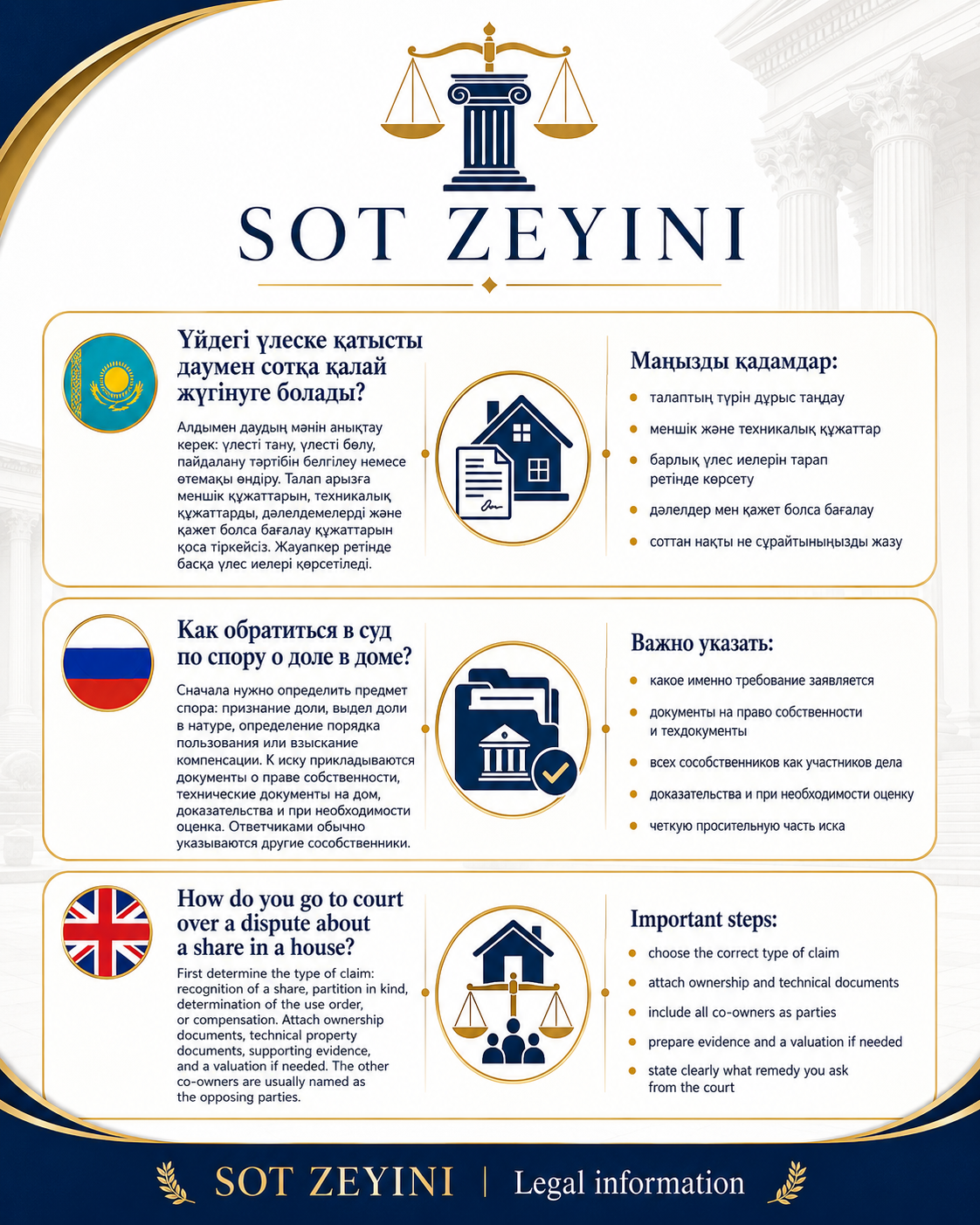
Through court, a person may request recognition of ownership of a share, determination of the size of the share, physical division of the property, monetary compensation, or establishment of the procedure for using the house.
In simple terms, if a person believes they have a legal share in the house but others refuse to recognize it, the issue should be resolved through evidence and court proceedings.
When can you file a court claim?
A court claim may be filed if:
- the house or apartment is in common ownership;
- the shares of the owners are not determined;
- one owner does not recognize another person’s share;
- heirs cannot divide the property;
- former spouses dispute the house after divorce;
- one person invested money in the purchase or construction of the house, but another person is registered as owner;
- the owners cannot agree on selling the property;
- one owner uses the entire house and prevents another from using it;
- the parties need to establish how the house will be used;
- a share was sold to a third party in violation of the pre-emptive purchase right.
If the parties can agree, the issue may be resolved by a notarized agreement. If there is no agreement, the dispute is resolved through court.
What claims can be made in court?
Different claims may be filed depending on the situation.
1. Determination of shares
If the house is in common ownership but the exact shares are not specified, the court may be asked to determine each owner’s share. For example, 1/2, 1/3, or another proportion.
2. Recognition of ownership of a share
If the house is registered in one person’s name, but another person invested money in its purchase, construction, or improvement, that person may ask the court to recognize their ownership of a share. The investment and legal basis must be proven.
3. Physical allocation of a share
If the house can technically be divided, the claimant may ask the court to allocate their share in kind. This may include a separate part of the house, a separate entrance, rooms, or part of the land plot.
4. Monetary compensation
If the house cannot be physically divided, a person may claim monetary compensation for their share. In this case, the market value of the house is usually assessed.
5. Establishing the procedure for using the house
If the co-owners cannot agree on who uses which part of the house, the court may establish a procedure for use. For example, certain rooms may be assigned to each owner.
6. Protection of pre-emptive purchase rights
If one co-owner sold their share to a third party without offering it to the other co-owners first, the affected co-owner may file a court claim to protect their pre-emptive purchase right.
Which court should hear the case?
Claims related to rights over real estate are generally filed with the court at the location of the house or apartment. For example, if the house is located in Almaty, the claim should be filed with the district court where the house is located.
Even if the dispute also includes a monetary claim, the location of the property remains important.
What should be done before filing a claim?
Before going to court, it is advisable to:
- Check who is officially registered as the owner.
- Obtain a certificate of registered rights to the property.
- Collect documents for the house and land plot.
- Decide what specific claim will be filed.
- Prepare evidence supporting the share.
- Obtain a property valuation if compensation is claimed.
- Send a written proposal or claim to the other party, if appropriate.
- Prepare the statement of claim.
In property share disputes, evidence is everything. Saying “I also invested money” is not enough. The court needs bank transfers, receipts, agreements, correspondence, and other documents.
What documents are needed?
The following documents may be attached to the claim:
- claimant’s identity document;
- documents for the house or apartment;
- certificate of registered rights;
- technical passport;
- land plot documents;
- sale and purchase agreement, gift agreement, or inheritance documents;
- marriage or divorce certificate, if the dispute is between spouses;
- documents confirming investments in purchase or construction;
- bank transfers;
- receipts;
- checks for construction materials;
- WhatsApp, SMS, or email correspondence;
- valuation report;
- state duty payment receipt;
- proof that the claim was sent to the defendant.
The exact list depends on the basis of the dispute. Inheritance disputes require one set of documents, divorce disputes another, and construction investment disputes another.
How can the right to a share be proven?
Evidence may include:
- title documents;
- sale and purchase agreement;
- inheritance certificate;
- gift agreement;
- bank transfers;
- receipts;
- construction and repair invoices;
- contractor agreements;
- correspondence between the parties;
- witness statements;
- valuation report;
- technical documents for the house.
If the house is officially registered in another person’s name, the claimant must prove why they also have a right to a share. Oral agreements alone are usually not enough.
Share dispute between spouses
If the house was acquired during marriage, it may be considered joint marital property. In many cases, spouses may claim equal shares, but the court may consider specific circumstances.
For example:
- the house was purchased before marriage;
- the house was inherited;
- the house was gifted to one spouse;
- the mortgage was paid by one spouse;
- one spouse invested personal funds;
- children remain with one parent;
- substantial improvements were made to the property.
For this reason, a property share dispute between spouses requires careful review of documents and facts.
Share dispute between heirs
If the house was inherited, the shares of heirs are determined by law or by will. If the heirs cannot reach an agreement, the dispute is resolved through court.
The court usually checks:
- who is an heir;
- whether the inheritance was accepted on time;
- whether there is a will;
- whether anyone has a mandatory share;
- how the house is registered;
- whether the rights of other heirs were violated.
Inheritance disputes can be complex, so proper document preparation is essential.
Can the sale of the house be prohibited during the court case?
Yes. If there is a risk that the defendant may sell, gift, or re-register the house before the case is completed, the claimant may file an application for interim measures together with the claim. The court may be asked to prohibit the transfer of the property.
This is important because if the property is sold during the dispute, resolving the case may become more difficult.
How is the claim value calculated?
The claim value depends on the type of claim. If the claimant asks for recognition of a share or monetary compensation, the claim value may be calculated based on the value of the disputed share.
For example, if the house is worth 40,000,000 tenge and the claimant requests a 1/2 share, the claim value may be 20,000,000 tenge. A valuation report may be needed to confirm the amount.
What should be included in the statement of claim?
The statement of claim should include:
- name of the court;
- claimant’s details;
- defendant’s details;
- address of the disputed house;
- information on who owns the property;
- why the claimant believes they have a right to a share;
- evidence supporting the claim;
- claim value;
- specific requests to the court;
- list of attachments.
The claim must be clear. For example: “recognize ownership of a 1/2 share,” “determine the shares,” “allocate the share in kind,” “recover monetary compensation,” or “establish the procedure for using the house.”
What happens after the court decision?
If the court recognizes ownership of a share or determines the shares, the court decision must be registered after it enters into legal force. The registration of rights to the property is then updated based on the court decision.
If the court awards monetary compensation, the decision may be enforced through a court enforcement officer.
Conclusion
To file a court claim over a share in a house, the claimant must first identify the legal basis for the claim and collect evidence. Then a statement of claim is prepared, the state duty is paid, and the documents are filed with the court at the location of the property.
In real estate disputes, the strongest position is not the loudest one. It is the one supported by documents, evidence, and a properly prepared claim.
FAQ
Which court should I file a claim with?
A claim over a share in a house or apartment is usually filed with the district or city court at the location of the property.
Can I claim a share if the house is registered in another person’s name?
Yes, but you must prove the legal basis for your claim, such as investment, joint ownership, inheritance, marriage, or other circumstances.
Can a share be physically allocated?
Yes, if the house can be divided technically without disproportionate damage. If division is impossible, monetary compensation may be considered.
What if another owner wants to sell the house?
You may file a claim and request interim measures to temporarily prohibit the sale or re-registration of the property.
What documents are needed?
Documents for the property, certificate of registered rights, technical passport, evidence of investment, correspondence, receipts, valuation report, and state duty receipt may be needed.
Can the dispute be resolved without court?
Yes. If the parties agree, they may sign a notarized agreement. If there is no agreement, the dispute is resolved in court.
Is a lawyer required?
A lawyer is not always mandatory, but legal assistance is useful because the correct claim wording, evidence, valuation, and interim measures are important in real estate disputes.