 +7 775 858 9294
 WhatsApp
What Contract Should Be Signed with a Measurement Specialist?
Who is a measurement specialist?
A measurement specialist is a person who visits a client’s site, takes measurements, records technical details, and provides data for calculation, production, installation, or a commercial offer.
Such specialists are often used in the fields of windows, doors, furniture, kitchens, wardrobes, stretch ceilings, repairs, construction, and interior design.
Although the work may seem simple, one measurement error can cause serious losses: the product may not fit, installation may fail, the client may complain, and the company may have to redo the order. That is why the contract with a measurement specialist should be drafted carefully.
What type of contract should be used?
The type of contract depends on how the measurement specialist actually works.
If the specialist works permanently, follows a schedule, reports to a manager, receives a monthly salary, and is part of the company’s staff, an employment contract is usually appropriate.
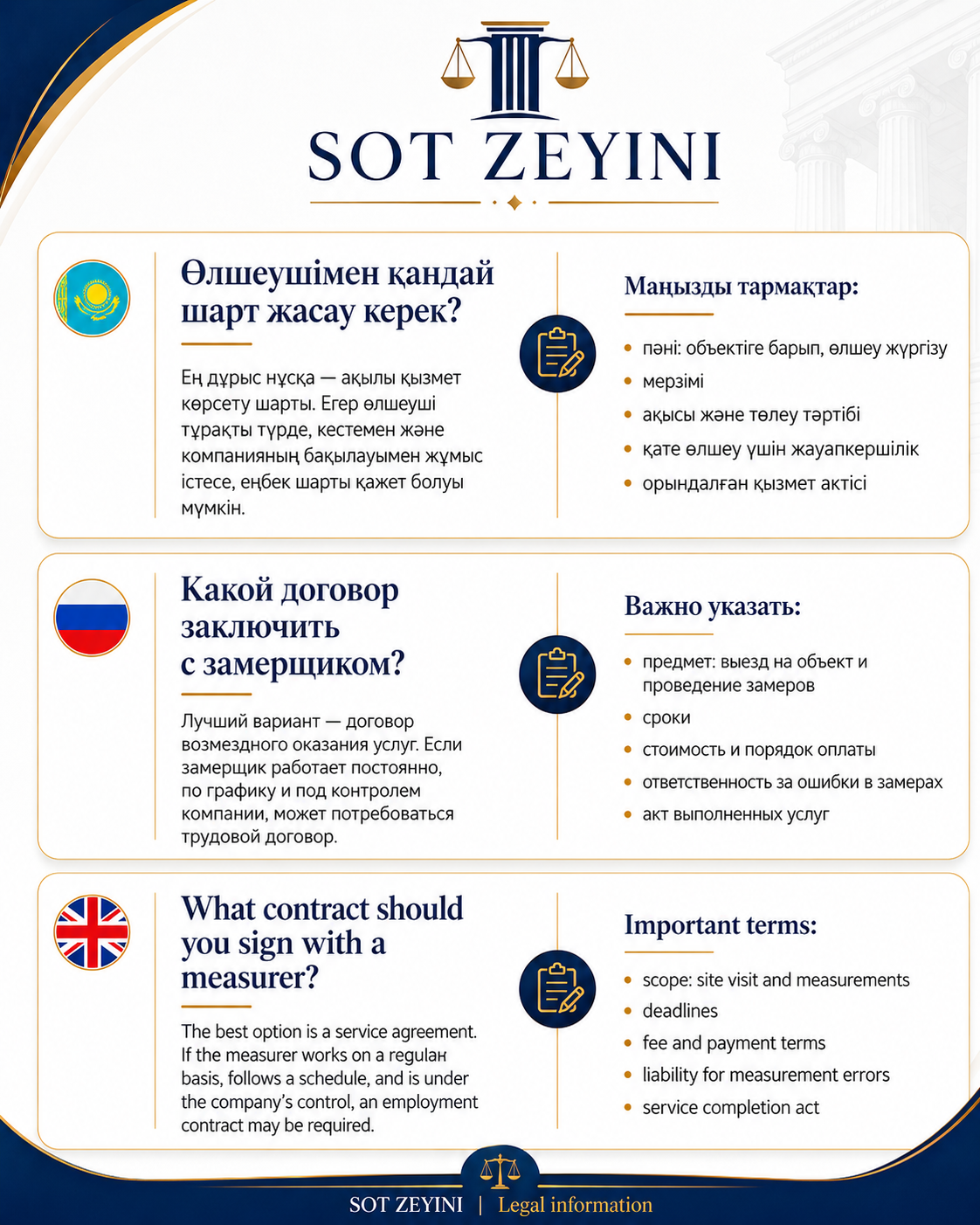
If the specialist works on separate orders, is paid for each measurement or result, has no fixed work schedule, and acts as an external contractor, a civil law contract, service agreement, or contractor agreement may be used.
The key factor is not the title of the contract, but the actual relationship between the parties.
When is an employment contract needed?
An employment contract is appropriate if the measurement specialist:
- works permanently;
- follows a fixed schedule;
- follows internal company rules;
- receives a monthly salary;
- holds a position in the company;
- follows instructions from management;
- works as a staff employee;
- has a workplace or assigned territory;
- personally performs an ongoing labor function.
If these signs are present, using a civil law contract may create legal risks. In a dispute, the relationship may be recognized as employment.
When is a civil law or service agreement suitable?
A civil law or service agreement may be suitable if the specialist:
- performs separate orders;
- does not work under a fixed schedule;
- is paid for a specific result;
- is not a staff employee;
- organizes work independently;
- uses their own tools;
- delivers the result through an acceptance act;
- may work with other clients.
For example, if the company sends a request to visit an address, take measurements, prepare a sketch, take photos, and upload the result to CRM, this is closer to a civil law model.
What can the contract be called?
Depending on the situation, the contract may be called:
- measurement service agreement;
- civil law contract with a measurement specialist;
- contractor agreement;
- technical measurement agreement;
- agreement with an external contractor;
- employment contract with a measurement specialist.
If the specialist only takes measurements and provides data, a service agreement is usually suitable. If the specialist also performs installation, manufacturing, or other work with a material result, a contractor agreement may be more appropriate.
What should be included in the contract?
The contract should include:
- Details of the parties.
- Subject of the contract.
- Specific duties of the measurement specialist.
- Procedure for visiting the site.
- Format of the result.
- Deadline for delivering the measurement data.
- Service fee.
- Payment procedure.
- Transportation expenses.
- Liability for measurement errors.
- Confidentiality.
- Client database protection.
- Prohibition on bypassing the company.
- Acceptance act.
- Penalties and damages.
- Termination procedure.
The more specific the contract, the easier it is to protect the company in a dispute.
How should the subject of the contract be drafted?
The subject of the contract should be specific. For example:
“The contractor shall, upon the customer’s requests, visit the customer’s clients, perform technical measurements of windows, doors, furniture, or other structures, record site-specific details, prepare a measurement sheet, sketch, photo report, and provide the result to the customer within the agreed period.”
It is important to state that the result is not merely a visit, but specific data: measurement sheet, sketch, photos, calculation, or technical description.
What duties should be included?
The contract may state that the specialist must:
- visit the site at the agreed time;
- take accurate measurements;
- record technical details;
- take photos;
- complete the measurement sheet;
- record client preferences;
- prepare a sketch or drawing;
- upload the result to CRM or send it to the manager;
- repeat the measurement if an error is found;
- not make personal deals with company clients;
- not use the client database;
- not disclose confidential information.
If these duties are not clearly stated, it may be harder to prove a violation.
How should the result be accepted?
The measurement result should be documented. This may include:
- measurement sheet;
- photo report;
- sketch or drawing;
- client signature on a form;
- CRM entry;
- message in a corporate chat;
- service acceptance act.
The contract may state that the service is considered completed only after the full set of data is provided.
How to define liability for measurement errors?
Liability for measurement errors is one of the key parts of the contract.
The contract may state that the specialist is responsible for:
- incorrect dimensions;
- missing technical data;
- incomplete measurement;
- late delivery of the result;
- need for a repeated visit;
- costs of re-manufacturing the product if the error was caused by the specialist.
A clause may read:
“If errors in measurement caused by the contractor result in the production of an item with incorrect parameters, the contractor shall compensate the customer for documented losses.”
Liability should apply only if the specialist is at fault. If the site changed after the measurement or the client provided false information, this should be assessed separately.
Can a penalty be included?
Yes, a civil law or service agreement may include penalties. For example, for:
- failure to visit the site;
- lateness;
- late submission of the measurement sheet;
- working with the client directly;
- transfer of the client database;
- disclosure of trade secrets;
- failure to return documents;
- misuse of logins or access credentials.
Example:
“If the contractor enters into a transaction with the customer’s client by bypassing the customer, the contractor shall pay a penalty of 300,000 tenge and compensate the losses caused.”
The penalty should be reasonable. If it is excessive, a court may reduce it.
How to protect the client database?
A measurement specialist receives access to important information: client name, phone number, address, site parameters, budget, needs, and purchase plans. Therefore, the contract should protect the client database.
It should state that:
- the client database belongs to the company;
- the specialist may not use clients for personal purposes;
- client contacts may not be transferred to third parties;
- the specialist may not work with the client directly;
- the specialist may not refer the client to a competitor;
- the obligation continues after termination of the contract.
Without such provisions, it may be difficult to make claims if the specialist starts taking clients.
What should be included about confidentiality?
The contract should define confidential information.
For example:
- client database;
- prices;
- discounts;
- contract terms;
- CRM data;
- measurement sheets;
- sketches and drawings;
- commercial offers;
- suppliers;
- logins and passwords;
- internal instructions.
The specialist should agree not to disclose, copy, transfer, or use such information outside the company’s interests.
Who pays for transport and tools?
The contract should specify:
- who provides measuring tape, laser measure, tablet, or phone;
- who pays transportation expenses;
- how out-of-city visits are paid;
- whether repeat measurements are paid;
- what happens if the client is unavailable;
- whether a false visit is paid.
If these issues are not regulated, payment disputes are likely.
Common mistakes in contracts with measurement specialists
Common mistakes include:
- no specific result is stated;
- no liability for measurement errors;
- no client database protection;
- no confidentiality clause;
- no penalties;
- no acceptance procedure;
- no transport expense rules;
- the specialist actually works as an employee but is treated as a contractor;
- no prohibition on direct work with clients;
- no procedure for returning data and access credentials.
These mistakes may lead to losses, client conflicts, and court disputes.
Employment contract or civil law contract?
If the specialist works every day, receives stable pay, reports to management, and is included in company processes, an employment contract is safer.
If the specialist performs separate orders, is paid per measurement, and provides a specific result, a civil law or service agreement may be used.
The company should choose the contract that reflects the real relationship, not only the most convenient option.
Conclusion
A company may sign an employment contract, civil law contract, service agreement, or contractor agreement with a measurement specialist. The choice depends on the actual format of work.
The contract should clearly define the subject, duties, measurement result, deadlines, payment, transportation expenses, liability for errors, confidentiality, client database protection, penalties, and acceptance procedure.
A properly drafted contract protects the company from measurement errors, client loss, and unnecessary expenses.
FAQ
What contract is best for a measurement specialist?
If the specialist works permanently, an employment contract is better. If the specialist performs separate orders, a civil law or service agreement may be suitable.
Can a civil law contract be signed with a measurement specialist?
Yes, if the specialist is not a staff employee and performs specific tasks with a deliverable result.
Can losses be recovered for an incorrect measurement?
Yes, if the contract provides liability and the company proves that the error was caused by the specialist.
Is an acceptance act needed?
Yes. It is advisable to confirm the result with an act, measurement sheet, photo report, or CRM entry.
Can the specialist be prohibited from working directly with the client?
Yes, such a clause may be included, especially if the company provides the client.
Is an NDA needed?
Yes, if the specialist has access to the client database, prices, CRM, commercial offers, or internal information.
What should be done if the specialist takes a client?
The company should collect evidence, send a demand letter, and claim penalties, damages, and termination of the misuse of the client database.