 +7 775 858 9294
 WhatsApp
How to Properly Draft a Penalty Clause in a Contract
Why is a penalty clause needed?
In any contract, the parties are expected to perform their obligations properly and on time. However, in practice, one party may delay payment, fail to perform work, miss a delivery deadline, disclose confidential information, or refuse to perform the contract.
A penalty clause is included for such situations. It creates a pre-agreed monetary liability for breach of contract.
A well-drafted penalty clause disciplines the parties and makes enforcement easier. It is not just a scary sentence in the contract. It is a practical protection tool.
What is the difference between a penalty, fine, and late payment interest?
In contract practice, these terms are often used together.
Penalty is a general concept of monetary liability for non-performance or improper performance of an obligation.
Fine is usually a fixed amount or a percentage of the contract amount. For example: “For breach of confidentiality, the guilty party shall pay a fine of 1,000,000 tenge”.
Late payment interest is usually calculated for each day of delay. For example: “For each day of payment delay, interest of 0.1% of the overdue amount shall accrue”.
It is important to clearly state which type of liability applies.
In which contracts can a penalty clause be used?
A penalty clause may be included in different types of contracts:
- service agreements;
- contractor agreements;
- supply agreements;
- lease agreements;
- loan agreements;
- civil law contracts;
- NDAs;
- confidentiality agreements;
- agency agreements;
- franchise agreements;
- partnership agreements;
- agreements with contractors or freelancers.
However, employment relationships require caution. An employer generally cannot simply include arbitrary fines in an employment contract and deduct them from salary. Employment law has separate rules for disciplinary and material liability.
What must be included in a penalty clause?
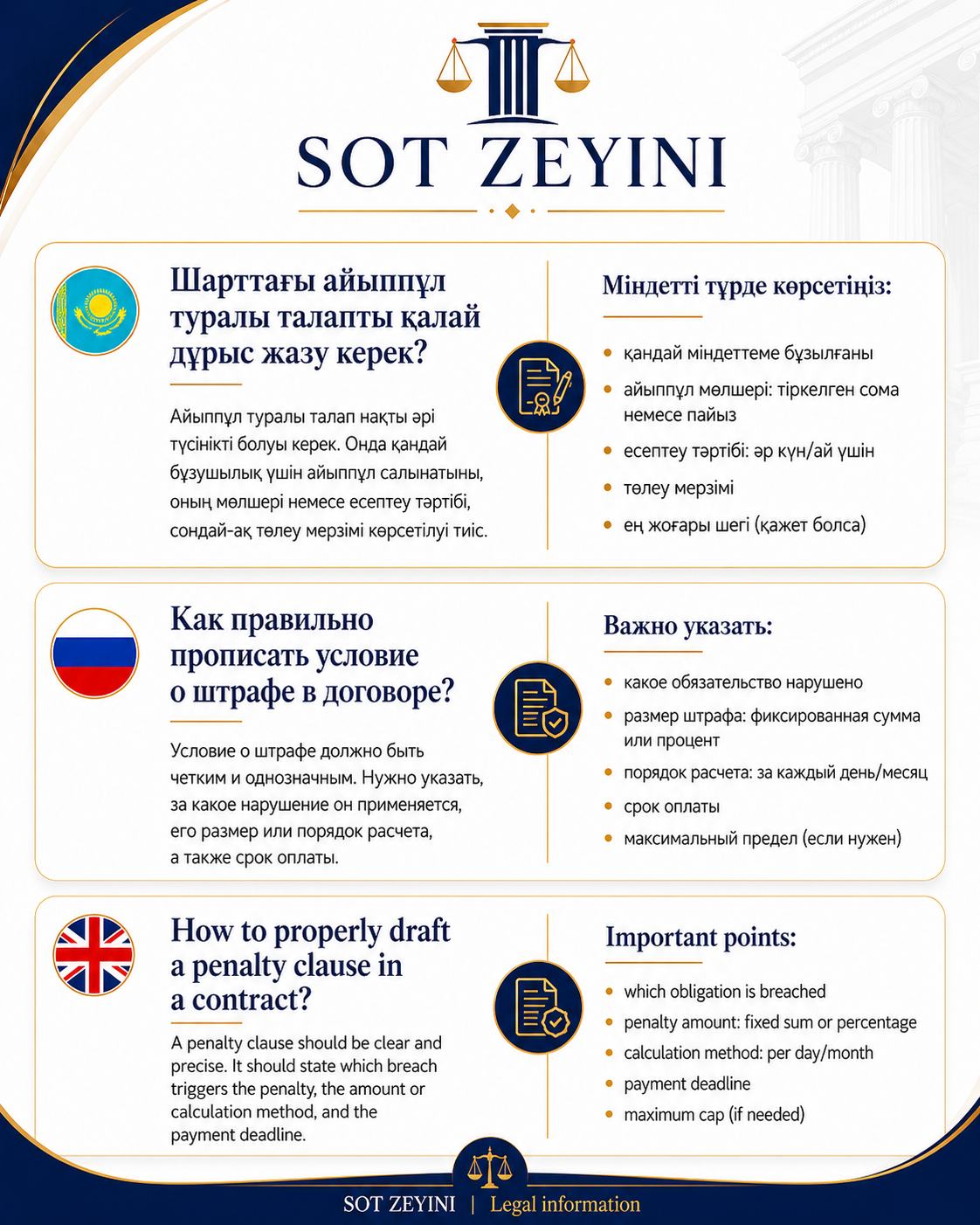
A penalty clause should be specific and clear. It is advisable to include:
- The exact breach triggering the penalty.
- The amount of the penalty.
- The calculation formula.
- The date from which late payment interest starts.
- Any maximum cap.
- Whether damages can be claimed in addition to the penalty.
- The payment deadline.
- The notice or demand procedure.
- Evidence required to confirm the breach.
- Whether liability survives termination of the contract.
The clearer the clause, the easier it is to enforce.
What breaches can trigger a penalty?
Penalties are usually set for material breaches.
For example:
- late payment;
- delay in performing work;
- late delivery of goods;
- poor-quality performance;
- disclosure of confidential information;
- use of a client database;
- failure to return documents;
- failure to return logins and passwords;
- unlawful unilateral refusal to perform the contract;
- poaching clients;
- transfer of information to a competitor;
- violation of intellectual property rights.
The breach should be described precisely. Otherwise, the parties may interpret the clause differently.
How should the penalty amount be determined?
The penalty should be reasonable and proportionate to the breach. If the penalty is excessive, a court may reduce it.
There are several ways to set a penalty.
1. Fixed amount
Example: “For disclosure of confidential information, the guilty party shall pay a fine of 1,000,000 tenge”.
This is useful for NDAs, trade secrets, client databases, and failure to return documents.
2. Percentage of the contract amount
Example: “For non-performance, the guilty party shall pay a fine equal to 10% of the contract amount”.
This is common in service, supply, and contractor agreements.
3. Daily late payment interest
Example: “For each day of delay, the guilty party shall pay late payment interest of 0.1% of the overdue amount”.
This is useful for delayed payments or missed deadlines.
4. Mixed model
Example: “For delay, the contractor shall pay a fixed fine of 100,000 tenge and late payment interest of 0.1% for each day of delay”.
This strengthens liability, but it should be used carefully to avoid an excessive total amount.
Should a maximum cap be included?
In many cases, it is advisable to include a maximum cap. For example: “The total amount of late payment interest shall not exceed 20% of the contract amount”.
This makes the contract more balanced and reduces the risk of court reduction.
Example:
“Late payment interest shall accrue at 0.1% of the overdue obligation for each day of delay, but the total amount shall not exceed 20% of the contract amount”.
This formula is clear and practical.
Can damages be claimed in addition to the penalty?
Yes, if the contract provides for it. For example:
“Payment of the penalty does not release the guilty party from the obligation to compensate damages in full”.
This strengthens the creditor’s position. However, the court will still assess the contract, penalty amount, damages, and circumstances of the breach.
Can a penalty be included in an employment contract?
Penalty clauses in employment contracts require great caution. An employer should not arbitrarily fine an employee or deduct money from salary.
In employment relationships, the following rules apply instead:
- disciplinary liability;
- material liability;
- compensation of actual damage;
- special rules for salary deductions.
Therefore, for employees, it is better to properly draft confidentiality agreements, material liability agreements, training reimbursement agreements, property return obligations, and trade secret clauses.
How to draft a penalty in an NDA?
In an NDA, a penalty may be set for:
- disclosure of the client database;
- transfer of information to third parties;
- use of information for personal purposes;
- transfer of data to a competitor;
- failure to return documents;
- keeping copies after the contract ends;
- poaching clients, if such restriction is agreed.
The NDA should clearly define confidential information. If it is unclear what is confidential, enforcing the penalty becomes harder.
Sample penalty clause
A general clause may look like this:
“In case of non-performance or improper performance of obligations under this agreement, the guilty party shall pay the other party a penalty equal to 10% of the contract amount.
In case of delay in performance of a monetary obligation, the guilty party shall pay late payment interest of 0.1% of the overdue amount for each day of delay, but the total amount of late payment interest shall not exceed 20% of the contract amount.
Payment of the penalty and late payment interest shall not release the guilty party from performance of the main obligation and compensation of damages.”
This is a general example and should be adapted to the specific contract.
Common mistakes in penalty clauses
Common mistakes include:
- no penalty amount;
- no specific breach;
- unclear calculation formula;
- unclear start date for late payment interest;
- excessive penalty;
- no maximum cap;
- no statement on damages;
- unlawful employee fines in employment contracts;
- unsigned contract;
- oral agreement on the penalty.
A penalty agreement should be in writing. Oral penalty arrangements are difficult to prove.
How can a penalty be recovered?
If the other party breaches the contract, the recommended steps are:
- Record the breach.
- Collect documents, correspondence, acts, and screenshots.
- Calculate the penalty or late payment interest.
- Send a written demand.
- Set a payment deadline.
- File a court claim if payment is not made.
- Attach the contract, evidence, and calculation to the claim.
For court, the most important elements are the signed contract, proof of breach, and correct calculation.
Can a court reduce the penalty?
Yes. If the court finds that the penalty is excessive compared to the creditor’s losses, it may reduce the amount at the debtor’s request.
That is why extremely large penalties are not always effective. For example, a penalty of 10,000,000 tenge for a contract worth 100,000 tenge may be significantly reduced.
The best approach is a reasonable, clear, and proportionate penalty.
Conclusion
To properly draft a penalty clause, the contract should clearly state the breach, penalty amount, calculation formula, payment deadline, maximum cap, and whether damages may be claimed separately.
The penalty should be written, understandable, and proportionate. If it is excessive, a court may reduce it. If it is vague, it may be difficult to enforce.
A good penalty clause is not a decorative legal phrase. It is a working tool for protecting contractual rights.
FAQ
Should a penalty clause be in writing?
Yes. A penalty, fine, or late payment interest clause should be agreed in writing.
What is the difference between a fine and late payment interest?
A fine is usually a fixed amount or percentage, while late payment interest accrues for each day of delay.
Can a court reduce a penalty?
Yes, if the penalty is clearly excessive compared to the consequences of the breach or the creditor’s losses.
Can damages be claimed in addition to a penalty?
Yes, if the contract provides for it. It is better to state this directly.
Can an employer fine an employee under an employment contract?
Arbitrary employee fines are risky. Employment law uses disciplinary and material liability rules instead.
How can a penalty be recovered in court?
The claimant must prove the signed contract, the breach, and the correct calculation of the penalty.
What if there is no penalty clause?
If the contract or law does not provide for a penalty, claiming it may be difficult. However, actual damages may still be claimed.