 +7 775 858 9294
 WhatsApp
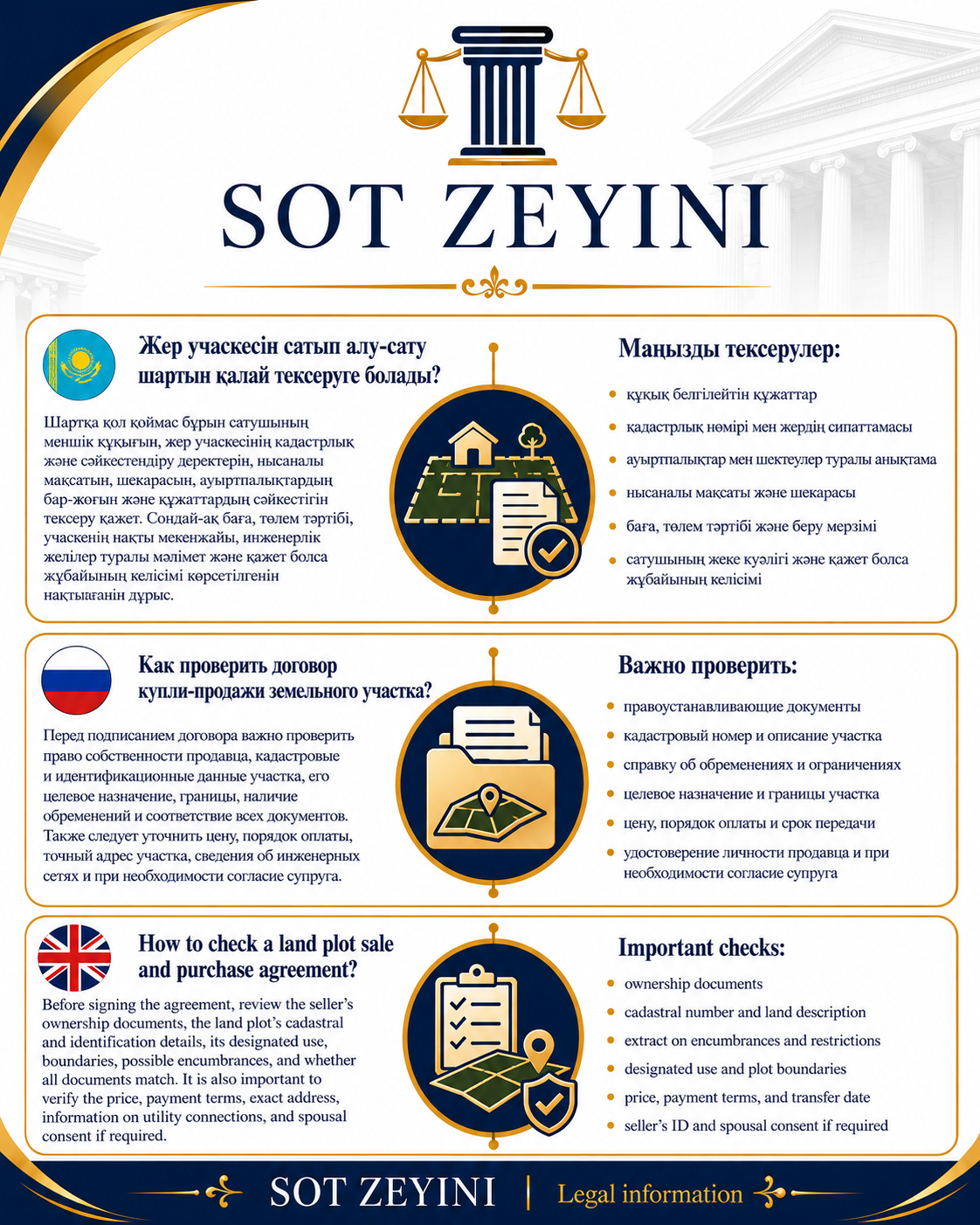
How to Check a Land Plot Sale and Purchase Agreement in Kazakhstan
How to Check a Land Plot Sale and Purchase Agreement in Kazakhstan
Learn how to check a land plot sale and purchase agreement in Kazakhstan: ownership, cadastral number, encumbrances, arrest, pledge, land purpose, spouse consent, payment, and registration.
check land sale agreement Kazakhstan, land purchase agreement Kazakhstan, land plot due diligence, cadastral number Kazakhstan, land encumbrance Kazakhstan, land arrest Kazakhstan, buy land safely Kazakhstan, land lawyer Kazakhstan
Short answer
Before signing a land plot sale and purchase agreement, the buyer should check not only the price and parties, but also the legal status of the land plot. It is important to verify ownership, cadastral number, area, designated purpose, encumbrances, arrest, pledge, registration restrictions, servitude, lease, court disputes, and other limitations.
The safest approach is simple: check first, pay later. If the buyer pays first and only later discovers that the land is under arrest, pledged, or unsuitable for construction, the transaction may become a serious legal problem.
What is a land plot sale and purchase agreement?
A land plot sale and purchase agreement is an agreement under which the seller transfers a land plot to the buyer, and the buyer accepts it and pays the agreed price.
The agreement should clearly state:
- seller and buyer details;
- cadastral number;
- address or location of the land plot;
- land area;
- designated purpose;
- type of land right;
- title documents;
- price;
- payment procedure;
- information about encumbrances;
- land transfer procedure;
- state registration procedure;
- liability of the parties.
If the agreement does not accurately describe the land plot, or if there are mistakes in the cadastral number, area, or designated purpose, registration and use of the land may become problematic.
Checking the seller
The first step is to verify that the seller has the legal right to sell the land plot.
The buyer should request:
- seller’s identity document;
- title document for the land;
- identification document for the land plot;
- certificate of registered rights and encumbrances;
- information about marital status;
- power of attorney, if a representative signs the agreement.
If the seller says “the land is mine, but it is registered to my relative,” this is a red flag. A land plot can be sold only by the owner or by a representative with proper authority.
Checking the cadastral number
The cadastral number is the unique identifier of the land plot. It should match in all documents:
- sale agreement;
- title document;
- cadastral plan;
- certificate of registered rights;
- state database.
The cadastral number helps verify location, area, boundaries, designated purpose, rights, and encumbrances.
One wrong digit may mean that the agreement refers to a different plot. In land transactions, small mistakes can become expensive.
Checking area and boundaries
The agreement should state the exact area of the land plot. It must match the cadastral documents.
Before purchasing, it is advisable to:
- check the cadastral plan;
- visit the land plot;
- compare actual boundaries;
- check fences, access roads, passages, and neighboring plots;
- call a surveyor if necessary;
- make sure neighbors have not occupied part of the land.
For example, the agreement may state 10 sotok, but in reality part of the land may be occupied by a road, ditch, or neighbor’s fence. The land should be checked both on paper and on site.
Checking the designated purpose
The designated purpose of the land must match the buyer’s plans. If the buyer wants to build a house, the land must be suitable for individual housing construction or another appropriate purpose.
Common designated purposes include:
- individual housing construction;
- personal subsidiary farming;
- agriculture;
- gardening;
- commercial use;
- production base;
- facility maintenance;
- multi-storey housing construction.
If the buyer purchases agricultural land and plans to build a house, there may be problems with permits, utilities, and registration of the building.
Checking encumbrances
Before the transaction, the buyer must check whether the land has any encumbrances.
Possible encumbrances include:
- bank pledge;
- arrest;
- registration ban;
- servitude;
- lease;
- third-party rights;
- court dispute;
- use restrictions;
- prohibition on alienation;
- interim measures;
- enforcement proceedings.
If an encumbrance exists, the buyer may be unable to register ownership or may receive land with legal problems.
Checking arrest and registration restrictions
If the land plot is under arrest or subject to a registration restriction, the transaction may not be registered.
An arrest may be imposed by:
- court;
- private bailiff;
- investigative authority;
- tax authority;
- enforcement proceedings;
- litigation involving third parties.
Before signing, the buyer should obtain an up-to-date certificate of registered rights and encumbrances. It is better to get it immediately before the transaction.
Checking pledge
If the land plot is pledged to a bank or another organization, it may be impossible to sell it without the pledge holder’s consent.
The buyer should check:
- whether there is a pledge;
- who the pledge holder is;
- amount of the secured obligation;
- whether the pledge can be removed before the deal;
- whether the bank will participate;
- payment procedure;
- when the pledge will be removed from the database.
Buying pledged land requires a carefully structured process. Otherwise, the buyer may pay but fail to register the land.
Checking servitude
A servitude is a right of limited use of another person’s land. For example, a road, engineering network, power line, or access to a neighboring plot may pass through the land.
A servitude may affect:
- construction possibilities;
- land value;
- actual land use;
- fence placement;
- passage and access;
- utility connections.
If a servitude exists, it should be disclosed and understood before the transaction.
Checking court disputes
Before buying land, the buyer should check whether there is any dispute involving the land plot.
Disputes may concern:
- ownership;
- inheritance;
- previous sale;
- division of marital property;
- plot boundaries;
- akimat decision;
- lease;
- invalidation of a transaction;
- creditor claims.
If litigation is ongoing, the buyer may become involved in future legal conflict. The seller should provide a written guarantee that the land is not subject to any dispute.
Checking spouse consent
If the seller is married, the buyer should check whether the land plot is marital property.
Spouse consent may be needed if:
- the land was acquired during marriage;
- the land is registered to one spouse but purchased with joint funds;
- there is no marital contract establishing separate property;
- the transaction involves disposal of immovable property.
Consent should preferably be notarized. If this issue is ignored, the seller’s spouse may later challenge the transaction.
If the seller acts under power of attorney
If a representative signs the agreement, the power of attorney must be carefully checked.
The power of attorney should authorize the representative to:
- sell the specific land plot;
- sign the agreement;
- agree on the price;
- receive money;
- submit documents for registration;
- sign applications;
- represent the seller before the notary and state authorities.
The term of the power of attorney should also be checked, as well as whether it has been revoked. Transactions by power of attorney require extra caution.
Checking payment terms
The agreement should clearly state the payment procedure.
Check:
- exact price;
- payment currency;
- payment method;
- payment deadline;
- moment of payment;
- bank details;
- proof of payment;
- connection between payment and registration;
- liability for non-payment;
- refund procedure if registration fails.
Payment through a bank is safer, especially with a clear payment purpose, such as “payment under land plot sale and purchase agreement.” Cash payments without a receipt are risky.
What should be included in the agreement?
A safe land sale agreement should include:
- full details of the parties;
- land plot description;
- cadastral number;
- area;
- designated purpose;
- title documents;
- price;
- payment procedure;
- land transfer period;
- seller’s guarantees;
- absence of encumbrances;
- registration procedure;
- liability of the parties;
- dispute resolution procedure.
The agreement should not be just “standard.” It should protect the buyer in the specific transaction.
Seller’s guarantees
The agreement should include seller’s guarantees that:
- the land legally belongs to the seller;
- the land has not been sold to another person;
- the land is not under arrest;
- there is no registration ban;
- there is no pledge unless expressly disclosed;
- there is no court dispute;
- there are no third-party rights;
- taxes and mandatory payments are paid;
- spouse consent has been obtained if necessary;
- documents are accurate.
These guarantees are important if hidden problems are discovered after the transaction.
Checking taxes and debts
Before purchasing, it is advisable to check:
- land tax;
- land lease debt;
- obligations to the akimat;
- fines;
- debts related to the land;
- utility payments if there is a building on the land.
The agreement may state that all debts arising before the transaction must be paid by the seller.
Checking construction possibility
If the buyer plans to build a house or commercial facility, construction possibility should be checked in advance.
Check:
- designated purpose;
- general plan;
- red lines;
- sanitary zones;
- protection zones;
- engineering networks;
- access road;
- possibility of connecting water, electricity, and gas;
- height and density restrictions;
- architecture requirements.
Sometimes land is legally clean, but the desired construction is not allowed. This should be clarified before purchase.
Notary and registration
A notary checks the parties’ documents, title documents, and the legality of transaction formalities. However, the buyer should not rely only on the notary for full due diligence.
After signing, the buyer’s right must be registered with the state. Without registration, the buyer may not become a fully protected owner.
The agreement should state:
- who submits documents for registration;
- who pays registration expenses;
- when original documents are transferred;
- what happens if registration is refused;
- when the seller receives money.
Checklist before buying land
Before signing the agreement, check:
- seller is the owner;
- identity details match;
- cadastral number is correct;
- area matches documents;
- boundaries are checked on site;
- designated purpose is suitable;
- no arrest;
- no pledge;
- no registration ban;
- no servitude or it is understood;
- no court dispute;
- spouse consent is obtained;
- power of attorney is verified;
- taxes and debts are paid;
- payment procedure is safe;
- ownership registration is possible.
If even one point is unclear, stop and verify documents further.
Common buyer mistakes
Buyers often make these mistakes:
- rely only on the seller’s words;
- do not obtain encumbrance information;
- do not check the cadastral number;
- ignore designated purpose;
- do not check boundaries on site;
- pay cash without receipt;
- do not verify spouse consent;
- do not check power of attorney;
- ignore pledge;
- do not check construction possibility;
- sign without legal review;
- do not control registration.
The most expensive mistake is rushing. One day of checking can save years of litigation.
Why a lawyer is useful
A land transaction lawyer can:
- review the agreement;
- check the seller;
- request necessary documents;
- identify encumbrances;
- assess risks;
- draft safe payment terms;
- add seller guarantees;
- check power of attorney;
- prepare amendments;
- support registration.
The cost of legal review is usually much lower than the loss from a problematic land transaction.
Conclusion
A land plot sale and purchase agreement should be checked comprehensively. The buyer should verify the seller, cadastral number, area, boundaries, designated purpose, encumbrances, arrests, pledges, servitudes, spouse consent, payment terms, and possibility of state registration.
Without such checks, the buyer risks acquiring land that cannot be registered, used, or developed.
The safest formula is: documents first, then payment, then registration. Not the other way around.
FAQ
How do I check a land sale agreement?
Check the seller, cadastral number, area, designated purpose, encumbrances, arrests, pledges, servitudes, payment terms, and registration possibility.
What is an encumbrance certificate?
It is information showing registered rights, restrictions, and encumbrances on real estate.
Can land under arrest be purchased?
It is risky. Arrest or registration restrictions may prevent ownership registration.
Is spouse consent required?
If the land was acquired during marriage and is marital property, spouse consent may be required.
What should be checked in the cadastral number?
Make sure the number in the agreement matches the documents and refers to the exact land plot being purchased.
Can land be purchased under power of attorney?
Yes, but the representative’s authority, term of the power of attorney, and right to receive money must be carefully checked.
How can payment be made safely?
Payment through a bank with a clear payment purpose and linked to ownership registration is usually safer.
What should be done after signing?
The buyer’s ownership right must be registered, and completion of registration should be verified.