 +7 775 858 9294
 WhatsApp
What does determining a child’s place of residence mean?
Determining a child’s place of residence means deciding with which parent the child will permanently live: with the mother or with the father.
This issue often arises after divorce, separation, or conflict between parents. For example, the child may live with the mother, but the father believes that living with him would better serve the child’s interests. Or the child may be staying with the father, while the mother wants the child’s place of residence to be determined with her.
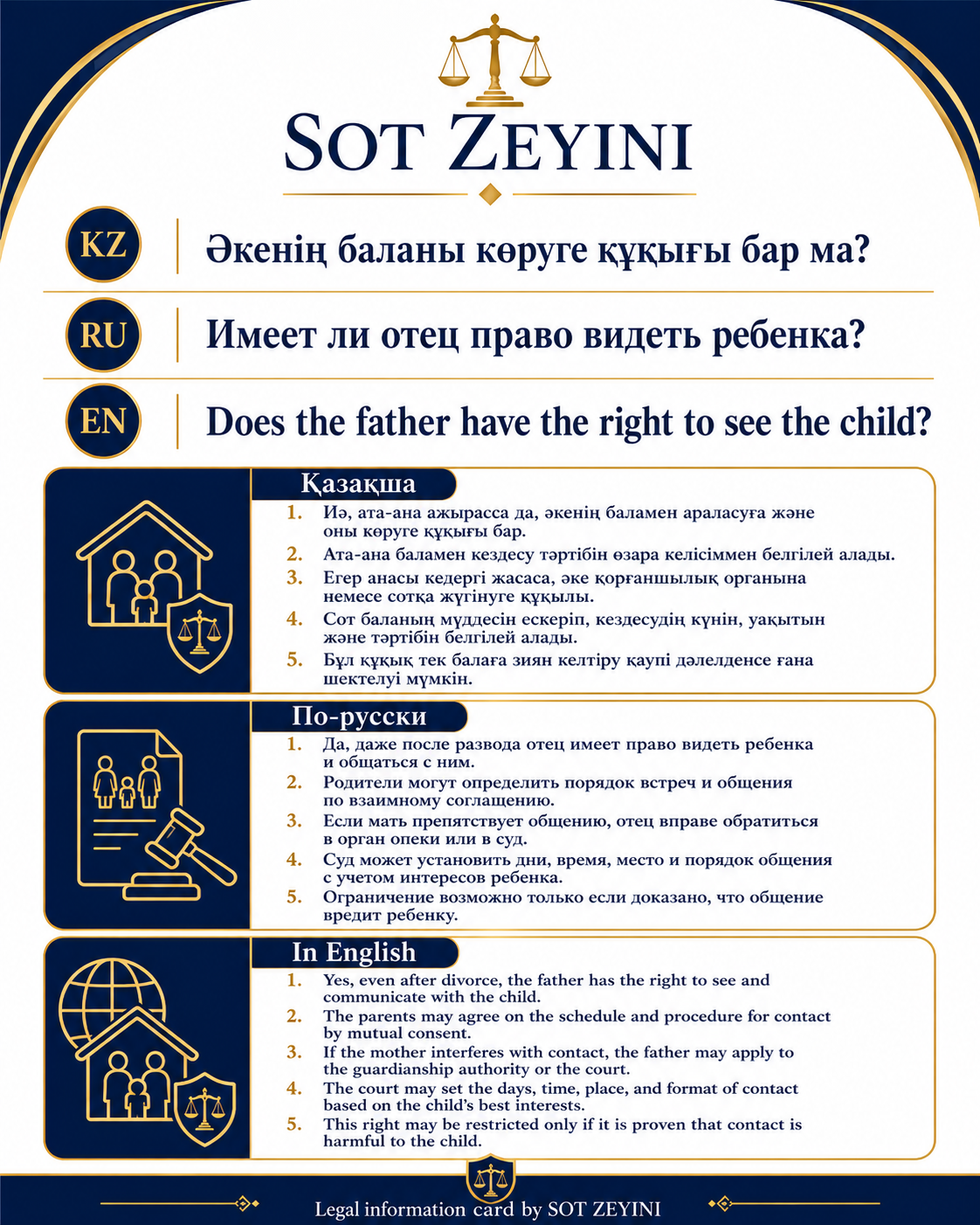
It is important to understand that determining the child’s place of residence with one parent does not deprive the other parent of the right to communicate with the child, participate in upbringing, and receive information about the child’s life.
The court does not decide which parent “wins.” The court decides where the child will be safer, more stable, and better cared for.
How is a child’s place of residence determined?
A child’s place of residence may be determined in two ways:
- By agreement between the parents.
If the parents can agree, they may decide themselves with whom the child will live. - By court decision.
If the parents cannot agree, the dispute is resolved by the court with the participation of the guardianship and custody authority.
A parental agreement may be made in writing. It may specify where the child will live, how the other parent will communicate with the child, how expenses will be paid, and how issues related to school, medical care, holidays, and travel will be resolved.
If there is no agreement, either parent may file a court claim to determine the child’s place of residence.
Does the child automatically stay with the mother after divorce?
No. There is no legal rule that a child automatically stays with the mother after divorce or automatically goes to the father.
The mother and father have equal rights and obligations toward the child. The court examines each case individually and determines which arrangement best serves the child’s interests.
In practice, very young children often remain with the mother, especially if she has been the primary caregiver. However, this is not automatic. If the father proves that he can provide safer and more stable conditions, the court may determine the child’s place of residence with the father.
What does the court consider?
The court primarily considers the best interests of the child. The wishes of the parents are relevant, but they are not decisive.
The court may consider:
- the child’s age;
- the child’s health;
- emotional attachment to each parent;
- relationship with siblings;
- who has actually cared for the child;
- who takes the child to school, kindergarten, or doctors;
- living conditions of each parent;
- parents’ work schedules;
- financial situation of each parent;
- moral and personal qualities of the parents;
- the child’s familiar environment;
- the child’s safety;
- opinion of the guardianship authority;
- the child’s opinion, depending on age and maturity.
The court does not simply choose the wealthier parent. A high income may help, but it does not decide the case by itself. The key issue is who can provide daily care, stability, safety, and proper development.
Does financial status matter?
Yes, financial status matters, but it is not the only or main factor.
For example, if the father earns more than the mother, this does not mean the child will automatically live with him. Likewise, if the mother earns less, this does not mean the child will automatically be transferred to the father.
The court evaluates the whole situation: who cares for the child, where the child is used to living, who is involved in education, health, upbringing, and daily life.
Money matters, but a child is not a spreadsheet. Income alone does not replace care, routine, and emotional connection.
Is the child’s opinion considered?
Yes. The child’s opinion may be considered if the child’s age and level of maturity allow them to express their views.
However, the child’s opinion does not automatically determine the outcome. The court evaluates whether the child speaks freely or is influenced by one of the parents.
For example, the child may say they want to live with the mother or father. The court will examine why: whether the child truly feels safer and more comfortable there, or whether the opinion was formed under pressure.
What is the role of the guardianship authority?
The guardianship and custody authority participates in cases involving the determination of a child’s place of residence.
The authority may:
- inspect the living conditions of both parents;
- establish where the child actually lives;
- speak with the parents;
- assess conditions for education, rest, and development;
- consider the child’s opinion;
- prepare an opinion for the court.
The court considers the opinion of the guardianship authority, but it is not bound by it automatically. The final decision is made by the court after reviewing all evidence.
Which court should the claim be filed with?
A claim to determine the child’s place of residence is usually filed with the specialized interdistrict court for minors.
As a general rule, the claim is filed at the place of residence of the defendant. For example, if the child lives with the mother and the father wants the child’s place of residence to be determined with him, the claim is usually filed at the mother’s place of residence.
The guardianship and custody authority must be involved in the case.
What should be included in the statement of claim?
The statement of claim should include:
- name of the court;
- claimant’s details;
- defendant’s details;
- child’s details;
- information about marriage or divorce;
- where the child currently lives;
- why the child’s place of residence should be determined with the claimant;
- what conditions are provided for the child;
- who actually takes care of the child;
- any relevant concerns regarding the other parent;
- request to involve the guardianship authority;
- specific court requests;
- list of attached documents.
The claim should focus on facts, not emotions. Instead of saying “the other parent does not care for the child,” it is better to provide specific facts: the child often misses school, does not receive timely medical care, is left without supervision, spends most of the time with relatives, while the claimant is actively involved in education, health, and daily care.
What documents are needed?
The following documents are usually attached to the claim:
- copy of ID;
- child’s birth certificate;
- marriage or divorce certificate;
- certificate of the child’s place of residence;
- housing ownership documents or lease agreement;
- employment certificate;
- income information;
- certificate from school or kindergarten;
- medical documents;
- evidence of participation in the child’s upbringing;
- correspondence, photos, videos, audio recordings, if relevant;
- witness statements;
- application to the guardianship authority and its response;
- proof of payment of the state fee, if required.
The documents should show the child’s real life: who cares for the child, who takes them to school, who handles medical issues, who helps with studies, and where the child is safe and stable.
Can the child’s place of residence be determined with the father?
Yes. The father may ask the court to determine the child’s place of residence with him.
To do this, the father should show that:
- he has a stable relationship with the child;
- he participates in the child’s upbringing, education, and medical care;
- he has safe housing;
- his work schedule allows him to care for the child;
- the child is emotionally attached to him;
- he can provide a stable routine;
- living with him is in the child’s best interests.
If the child already actually lives with the father, attends school or kindergarten nearby, and the father provides daily care, this may be important evidence.
What evidence does the mother need?
If the mother asks the court to determine the child’s place of residence with her, she may show that:
- the child has lived with her since birth or for a long time;
- she provides daily care;
- the child is emotionally attached to her;
- the child attends school or kindergarten near her home;
- she handles medical care, education, and upbringing;
- she has suitable living conditions;
- changing the child’s place of residence may disrupt stability;
- the father has previously had limited involvement in upbringing.
At the same time, the mother should not prevent the child from communicating with the father without valid reasons. If the court sees that one parent turns the child against the other, this may be assessed negatively.
What is the difference between place of residence and visitation schedule?
These are two different legal issues.
The child’s place of residence determines with which parent the child will permanently live.
The visitation schedule determines when, where, and how the other parent will communicate with the child.
For example, the court may determine that the child will live with the mother and also establish the father’s visitation schedule: every Saturday from 10:00 a.m. to 6:00 p.m., video calls twice a week, and meetings during holidays and school vacations.
What happens after the court decision?
After the court decision, the child should live with the parent whose residence was determined by the court.
The other parent retains the right to:
- meet with the child;
- communicate by phone or video call;
- participate in upbringing;
- receive information about health and education;
- take part in important decisions;
- fulfill child support obligations.
If one parent violates the court decision, the matter may be addressed through an enforcement officer and additional court applications.
Can the child’s place of residence be changed later?
Yes. A previous court decision may be changed if circumstances change.
For example:
- the child becomes older;
- the child’s opinion changes;
- one parent moves;
- living conditions change;
- safety concerns arise;
- the child actually lives with the other parent;
- the previous arrangement no longer serves the child’s interests.
In such cases, a new court claim may be filed to change the child’s place of residence.
Common mistakes parents should avoid
Parents should avoid:
- using the child as leverage;
- turning the child against the other parent;
- taking the child without consent;
- hiding the child;
- refusing to comply with a court decision;
- writing only emotional accusations without facts;
- ignoring the guardianship authority;
- pressuring the child’s opinion;
- preventing communication without legal grounds.
The strongest position in court is not loud accusations, but evidence showing that living with that parent is safer, more stable, and better for the child.
Sample court requests
In the statement of claim, the claimant may ask the court to:
- Determine the place of residence of the minor child with the claimant.
- Involve the guardianship and custody authority in the case.
- Request an opinion from the guardianship authority regarding the child’s living conditions.
- Consider the child’s opinion if necessary.
- Establish the other parent’s visitation schedule in accordance with the child’s interests.
This is only a sample. Each case must be drafted based on its specific facts.
Conclusion
Determining a child’s place of residence is not a dispute about which parent is “better.” It is a legal issue focused on where the child will live safely, stably, and comfortably.
If the parents can agree, the issue may be resolved by agreement. If there is no agreement, the court decides the dispute with the participation of the guardianship authority.
The court considers the child’s age, health, attachment to parents, familiar environment, living conditions, parental involvement, opinion of the guardianship authority, and other evidence.
The main criterion is the best interests of the child.
FAQ: Frequently Asked Questions
1. Who determines the child’s place of residence?
If the parents agree, they may determine it themselves. If there is no agreement, the court decides with the participation of the guardianship authority.
2. Does the child always stay with the mother after divorce?
No. The child does not automatically stay with the mother. The court determines which arrangement is in the child’s best interests.
3. Can the father ask the court to determine the child’s residence with him?
Yes. The father may file a claim and prove that living with him serves the child’s best interests.
4. Does the court consider the child’s opinion?
Yes, depending on the child’s age and maturity. The court also checks whether the opinion was influenced by one parent.
5. Is the guardianship authority’s opinion required?
The guardianship authority participates in such cases and provides an opinion. The court considers it, but makes the final decision independently.
6. Does higher income decide the case?
No. Higher income may be considered, but it is not decisive. The court evaluates all circumstances.
7. Does the child’s registration matter?
Registration may be evidence, but it does not automatically decide the dispute. The court examines where the child actually lives and where the child’s interests are better protected.
8. Can the court decision be changed later?
Yes. If circumstances change, either parent may file a claim to change the child’s place of residence.
9. Can the other parent still see the child after residence is determined?
Yes. Determining residence with one parent does not deprive the other parent of the right to communicate with the child.
10. What evidence is most important?
Actual care, living conditions, school or kindergarten records, medical documents, participation in upbringing, emotional connection, guardianship authority opinion, and witness statements.
11. Can the claim be filed online?
Yes. In Kazakhstan, the claim may be filed electronically through the “Court Cabinet” system with PDF documents attached.
12. What if the other parent takes the child and does not return them?
The parent should contact the guardianship authority, police, and court. If there is already a court decision, the parent may also apply to an enforcement officer.