 +7 775 858 9294
 WhatsApp
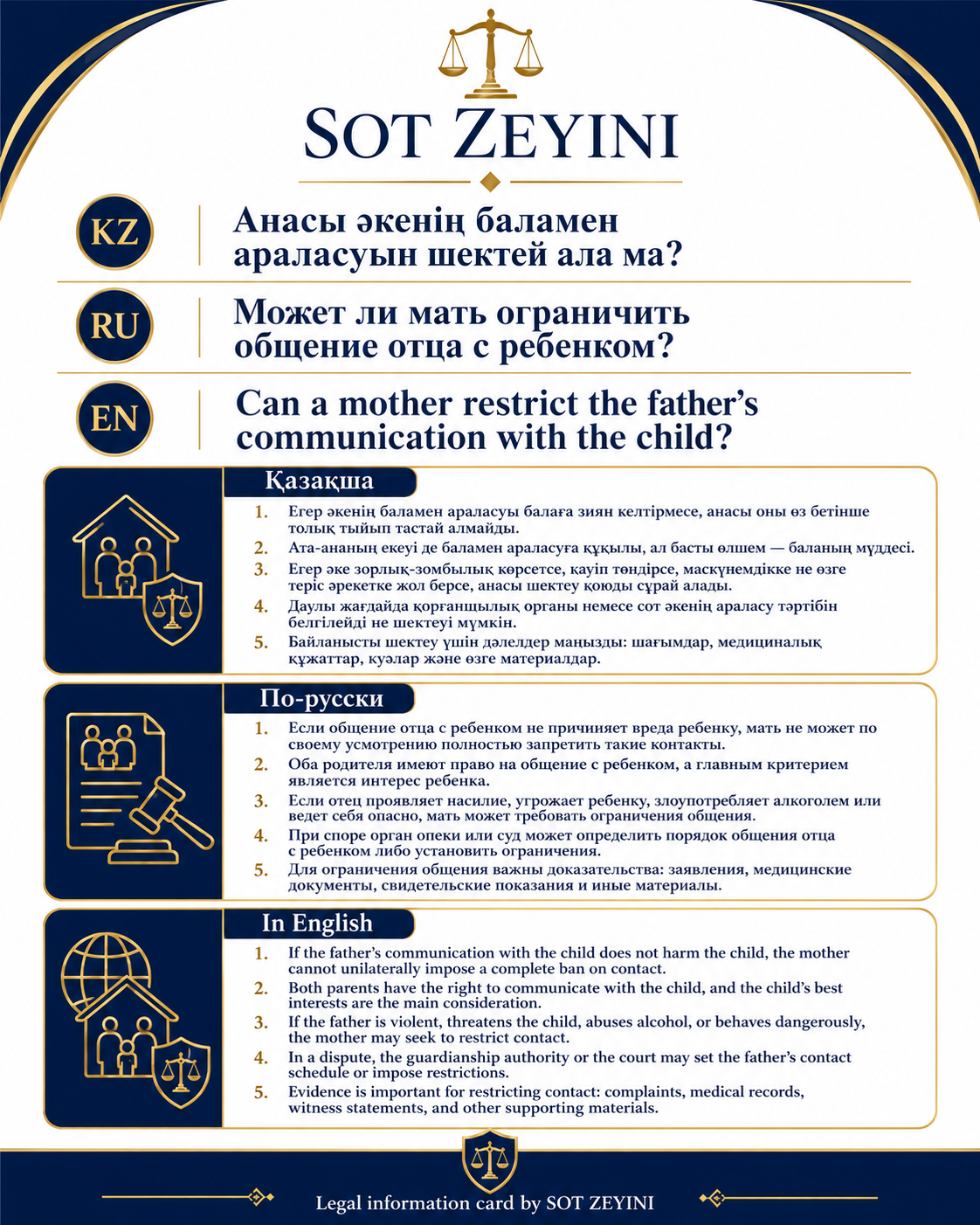
Can a mother restrict the father’s communication with the child?
A mother cannot arbitrarily and without valid reasons restrict the father’s communication with the child. If the father does not pose a risk to the child’s health, safety, psychological condition, or moral development, the mother should not prevent the child from communicating with him.
However, there are situations where restriction may be justified to protect the child. For example, if the father comes to meetings under the influence of alcohol, uses violence, puts psychological pressure on the child, does not return the child on time, or creates a risk to the child’s safety.
The main rule is simple: the mother cannot restrict visitation only because of personal resentment, divorce conflict, or child support disputes. But if there is a real risk to the child, she may apply to the guardianship authority or court and request a safe visitation arrangement.
When can restriction of visitation be lawful?
Restriction of the father’s communication with the child may be justified if the father:
- uses physical violence against the child;
- applies psychological pressure;
- comes to meetings under the influence of alcohol or drugs;
- does not return the child at the agreed or court-ordered time;
- takes the child without the mother’s consent;
- turns the child against the mother;
- violates the child’s daily routine;
- threatens the mother or the child;
- ignores the child’s health condition;
- attempts to take the child to another city or country without consent;
- repeatedly violates the established visitation schedule.
In such cases, the mother should not simply prohibit meetings verbally. She should collect evidence and apply to the proper authorities.
When is the mother’s conduct considered unlawful interference?
The mother’s actions may be considered unlawful interference if she prevents the father from seeing the child without real grounds.
For example:
- “I do not like you, so you will not see the child”;
- “If you do not pay child support, I will not give you the child”;
- “After the divorce, you are no longer the father”;
- “You have a new family, so you do not need the child”;
- “I will decide myself when you can see the child”;
- “Even if there is a court decision, I still will not allow it.”
Such reasons are not connected with the child’s interests. They reflect conflict between adults. In these cases, the court focuses not on parental emotions, but on the child’s safety, stability, and well-being.
A child should not be used as leverage. That is not a “family strategy”; it is a legal boomerang that may come back in court.
Can the mother refuse visitation because of unpaid child support?
No. Child support debt does not automatically give the mother the right to prevent the father from seeing the child.
Child support and communication with the child are separate legal issues. If the father does not pay child support, the mother may contact an enforcement officer, request calculation of the debt, seek compulsory recovery, and request legal enforcement measures.
However, independently prohibiting communication only because of child support debt may be considered interference with the child’s right to communicate with the father.
What should the mother do if the father is dangerous for the child?
If the father truly poses a danger to the child, the mother should act legally and carefully.
Recommended steps:
- Record every incident.
- Save messages, audio, video, screenshots, and other evidence.
- Contact the police if there are threats or violence.
- Obtain medical documents if the child’s health was harmed.
- Apply to the guardianship and custody authority.
- Request a review of the visitation schedule.
- Apply to court if necessary.
- Ask the court to establish a safe visitation format.
The mother may request not a complete ban, but a restricted and safe arrangement: meetings in her presence, in the presence of a third party, at a neutral location, for a shorter time, without overnight stays, or without the right to take the child outside the city.
What restrictions can the court impose?
The court may impose different restrictions if they are in the child’s best interests, including:
- reducing the duration of meetings;
- allowing meetings only on specific days;
- prohibiting overnight stays;
- prohibiting travel with the child to another city or country;
- requiring meetings in the mother’s presence;
- requiring meetings in the presence of a third party;
- temporarily allowing only phone or video communication;
- requiring the father to follow the child’s routine;
- prohibiting the father from picking the child up from school or kindergarten without consent;
- establishing a gradual increase in communication.
For example, if the child has not seen the father for a long time, the court may first establish short meetings and then gradually increase the duration of communication.
What can the father do if the mother does not allow him to see the child?
If the mother prevents communication without valid grounds, the father may:
- Send the mother a written proposal with a specific date and time for visitation.
- Save all correspondence.
- Record every refusal.
- Apply to the guardianship authority.
- File a court claim to establish a child visitation schedule.
- Ask the court to approve a specific schedule.
- If there is already a court decision, contact an enforcement officer.
The father should not ask the court in general terms to “allow him to see the child.” He should request a clear schedule: days, hours, place of handover, video calls, holidays, and school vacations.
What evidence is important?
The court may consider:
- WhatsApp and SMS correspondence;
- audio and video recordings;
- police reports;
- medical documents;
- psychologist’s opinion;
- opinion of the guardianship authority;
- witness statements;
- facts of schedule violations;
- behavior of both parents;
- living conditions of both parents;
- the child’s opinion, depending on age and maturity.
If the mother requests restrictions, she must prove the risk to the child. If the father requests a visitation schedule, he must show that the mother prevents communication and that the proposed schedule is in the child’s best interests.
Is the child’s opinion considered?
Yes, the child’s opinion may be considered depending on the child’s age and maturity. However, the court will also check whether the child’s opinion was formed under pressure from one of the parents.
If the child says that they do not want to see the father, the court should determine the reason. It may be a real fear, or it may be the result of conflict between the parents.
Can the father be completely prohibited from seeing the child?
A complete ban on communication is an extreme measure. Courts generally try not to completely break the relationship between a child and a parent unless there is a serious threat.
Instead of a complete ban, the court may establish a safe arrangement:
- short meetings;
- supervised meetings;
- meetings in the mother’s presence;
- video communication;
- gradual restoration of contact.
A full restriction may be considered only where communication truly harms the child or creates a real risk to the child’s life, health, or psychological well-being.
Common mistakes the mother should avoid
The mother should avoid:
- refusing to comply with a court decision;
- using the child as pressure against the father;
- refusing visitation because of unpaid child support;
- turning the child against the father;
- insulting the father in front of the child;
- inventing threats without evidence;
- completely blocking communication without legal grounds;
- ignoring the guardianship authority and court.
If there is a real danger, it should be proven through evidence and legal procedures.
Common mistakes the father should avoid
The father should avoid:
- taking the child without consent;
- threatening the mother;
- arguing in front of the child;
- coming to meetings in an inappropriate condition;
- violating the agreed or court-ordered time;
- returning the child late;
- turning the child against the mother;
- ignoring child support obligations;
- demanding a schedule that does not fit the child’s routine.
The court evaluates the behavior of both parents. The strongest position is calm, evidence-based, and focused on the child’s best interests.
Conclusion
A mother cannot arbitrarily and without valid reasons restrict the father’s communication with the child. If the father does not pose a danger to the child, the mother should not interfere with their communication.
However, if the father’s behavior creates a real risk to the child’s safety, health, or psychological condition, the mother may apply to the guardianship authority or court and request a safe or restricted visitation arrangement.
The main criterion for the court is not the parents’ conflict, but the best interests of the child. Therefore, any restriction must be based on facts, evidence, and concern for the child’s safety.
FAQ: Frequently Asked Questions
1. Can a mother refuse to let the father see the child?
Without valid reasons, no. If the father does not pose a danger to the child, the mother should not prevent communication.
2. When can the father’s visitation be restricted?
Visitation may be restricted if the father uses violence, threatens the child or mother, comes under the influence of alcohol or drugs, does not return the child on time, or creates a risk to the child’s safety.
3. Can the mother refuse visitation because the father does not pay child support?
No. Child support debt does not automatically prohibit communication with the child. Child support must be enforced separately through an enforcement officer.
4. What should the mother do if the father is dangerous?
She should collect evidence, contact the police if there are threats or violence, apply to the guardianship authority, and, if necessary, apply to court.
5. Can the court order visits in the mother’s presence?
Yes. If necessary for the child’s safety or adaptation, the court may order meetings in the presence of the mother or a third party.
6. Can the father be completely banned from seeing the child?
Only in serious cases where communication harms the child or creates a real danger to the child’s life, health, or psychological well-being.
7. What can the father do if the mother does not allow visitation?
The father may apply to the guardianship authority and file a court claim to establish a visitation schedule.
8. Does the court consider the child’s opinion?
Yes, depending on the child’s age and maturity. The court also checks whether the child’s opinion was influenced by one of the parents.
9. Can a previously established visitation schedule be changed?
Yes. If circumstances change, either parent may apply to court to modify the visitation schedule.
10. What if the court decision is not followed?
The parent should contact an enforcement officer and record every violation of the established visitation schedule.