
 +7 775 858 9294
 WhatsApp
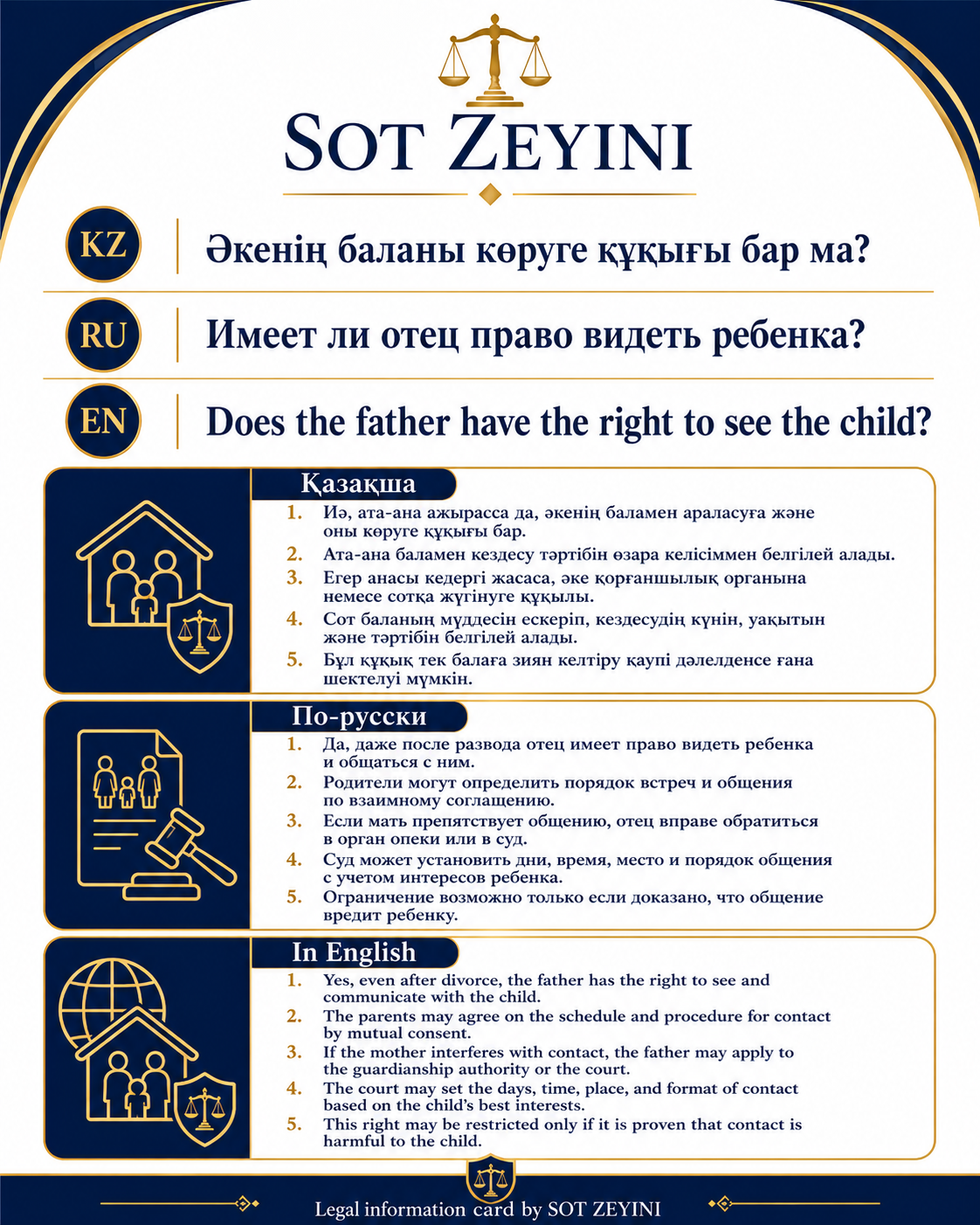
Does a father have the right to see his child?
Yes. A father has the right to communicate with his child, participate in the child’s upbringing, and take part in important decisions concerning the child’s education, development, and well-being.
Divorce or separate residence does not automatically end the relationship between father and child. The child has the right to maintain contact with both parents, unless such contact harms the child’s health, safety, or development.
If the mother does not allow the father to see the child, blocks phone calls, refuses meetings, or constantly changes the agreed schedule, the father may apply to court and request an official child visitation schedule.
When should a father apply to court?
A father may apply to court if:
- the mother refuses to let him see the child;
- meetings are constantly cancelled;
- phone calls or video calls are blocked;
- the child is turned against the father;
- the parents cannot agree on a schedule;
- the mother refuses to hand over the child for meetings;
- the guardianship authority did not resolve the dispute;
- an earlier agreement is not being followed;
- the father wants to establish a clear and enforceable visitation schedule.
In court, the father should not simply ask to “see the child.” He should request a specific schedule.
For example:
“To establish the father’s right to communicate with the child every Saturday from 10:00 a.m. to 6:00 p.m., with the right to pick up the child from the mother’s residence and return the child by 6:00 p.m. on the same day.”
A clear schedule is much easier to enforce than a general statement.
What should the father do before filing a court claim?
Before going to court, the father should collect evidence and try to resolve the issue peacefully.
Recommended steps:
- Send the mother a written request proposing a specific date and time for visitation.
- Save WhatsApp, SMS, or messenger correspondence.
- Keep evidence of refusals or ignored messages.
- Contact the guardianship and custody authority at the child’s place of residence.
- Obtain a response or opinion from the guardianship authority.
- Prepare a statement of claim for court.
- Attach evidence showing that the mother prevents communication.
A general phrase such as “I am not allowed to see my child” may not be enough. The court needs facts: dates, messages, screenshots, applications, responses, and witnesses.
Is it necessary to contact the guardianship authority?
In most cases, it is advisable. The guardianship and custody authority may consider disputes related to communication between the child and the parent living separately.
The guardianship authority may:
- review the family situation;
- listen to both parents;
- assess the child’s interests;
- examine living conditions;
- suggest a visitation schedule;
- issue a decision or opinion.
If either parent disagrees with the decision of the guardianship authority, the dispute may be resolved in court.
Which court should the father apply to?
A claim to establish a child visitation schedule is usually filed with the specialized interdistrict court for minors.
As a rule, the claim is filed at the place of residence of the defendant, meaning the mother with whom the child lives.
If the child lives with the mother in Almaty, the father usually files the claim with the court at the mother’s place of residence.
What should be included in the court claim?
The statement of claim should include:
- name of the court;
- father’s full name, identification number, address, and phone number;
- mother’s full name, address, and phone number;
- child’s full name and date of birth;
- information about marriage or divorce;
- information about where and with whom the child lives;
- how the father tried to communicate with the child;
- what obstacles the mother created;
- whether the father contacted the guardianship authority;
- the exact visitation schedule requested;
- list of attached documents.
The most important point is to ask for a specific schedule. The father should mention exact days, hours, pick-up and return procedure, video calls, holidays, and school vacations.
What visitation schedule can the father request?
The father may request, for example:
- visitation every Saturday from 10:00 a.m. to 6:00 p.m.;
- visitation every Sunday from 11:00 a.m. to 5:00 p.m.;
- the right to pick up the child from the mother’s residence;
- the obligation to return the child at a specific time;
- WhatsApp video calls twice a week;
- a meeting on the child’s birthday;
- communication during public holidays;
- several days of communication during school vacations;
- an obligation for the mother not to interfere with communication;
- participation in school, medical, and upbringing matters.
If the child is very young or has not communicated with the father for a long time, the court may establish a gradual schedule. At first, meetings may be shorter or supervised by the mother or another trusted person.
What documents does the father need?
The following documents may be attached to the claim:
- copy of the father’s ID;
- child’s birth certificate;
- marriage or divorce certificate;
- document confirming paternity, if the parents were not married;
- information about the child’s place of residence;
- application to the guardianship authority;
- response or opinion from the guardianship authority;
- correspondence with the mother;
- screenshots of refusals;
- audio, video, or photo evidence, if relevant;
- witness statements;
- documents confirming the father’s place of residence;
- information about the father’s employment and work schedule;
- evidence of safe conditions for the child;
- proof of payment of the state fee, if required.
If the mother claims that the father is dangerous for the child, the father should be ready to prove that he can provide safe and stable communication.
Can a father see the child if he has child support debt?
Yes. Child support debt does not automatically deprive the father of the right to communicate with the child.
However, the court may consider the father’s overall conduct and responsibility. If the father wants to see the child but does not provide financial support, this may negatively affect how the court assesses his position.
It is better to address child support issues: make current payments, repay the debt, agree on a payment schedule, or show evidence of participation in the child’s maintenance.
What does the court consider?
The court focuses primarily on the best interests of the child.
The court may consider:
- the child’s age;
- the child’s health;
- daily routine;
- kindergarten or school schedule;
- the child’s attachment to the father;
- the child’s relationship with the mother;
- the conduct of both parents;
- the level of conflict between the parents;
- the father’s living conditions;
- the opinion of the guardianship authority;
- the child’s opinion, depending on age and maturity;
- safety of communication.
The key question is whether the proposed schedule is safe, stable, and beneficial for the child.
What if the mother does not comply with the court decision?
If the court establishes a visitation schedule but the mother continues to prevent communication, the father may contact an enforcement officer.
The father should record every violation:
- date;
- time;
- place;
- what happened;
- correspondence;
- calls;
- witness statements.
Repeated refusal to comply with a court decision may be used as evidence in future legal proceedings.
Common mistakes fathers should avoid
A father should avoid:
- taking the child without consent or court decision;
- threatening the mother;
- arguing in front of the child;
- insulting the mother in messages;
- filing a claim without evidence;
- asking for a vague schedule;
- ignoring the child’s age and routine;
- ignoring child support obligations;
- failing to contact the guardianship authority;
- building the case only on emotions.
The strongest court position is calm, evidence-based, and focused on the child’s best interests.
Sample court requests
In the statement of claim, the father may ask the court to:
- Establish the father’s visitation schedule with the minor child.
- Allow the father to see the child every Saturday from 10:00 a.m. to 6:00 p.m.
- Allow the father to pick up the child from the mother’s residence and return the child to the same address by 6:00 p.m.
- Establish the father’s right to communicate with the child by WhatsApp video call every Tuesday and Thursday from 7:00 p.m. to 8:00 p.m.
- Oblige the mother not to interfere with the father’s communication with the child.
- Involve the guardianship and custody authority in the proceedings.
This is only a sample. Each case requires an individual schedule based on the child’s age, health, routine, residence, and family circumstances.
Conclusion
If a father cannot see his child because the mother prevents communication, he has the right to apply to court and establish an official visitation schedule.
To do this, the father should collect evidence, contact the guardianship authority, prepare a statement of claim, and propose a clear schedule.
The court does not focus on the conflict between the parents. It focuses on the best interests of the child. Therefore, the father must show that his participation in the child’s life will be safe, stable, and beneficial.
FAQ: Frequently Asked Questions
1. What should a father do if the mother does not allow him to see the child?
He should save messages, screenshots, call history, and other evidence. Then he may contact the guardianship authority and file a court claim to establish a visitation schedule.
2. Can the father go directly to court?
Yes, the father may apply to court. However, in practice, it is often useful to contact the guardianship authority first.
3. Can the father take the child for weekends?
Yes, if the court establishes such a schedule. The court will consider the child’s age, health, daily routine, and the father’s living conditions.
4. What if the child is very young?
The court may establish short visits, supervised visits, or a gradual increase in communication time.
5. Can the father see the child if he has child support debt?
Yes. Child support debt does not automatically cancel the father’s visitation rights. But the court may consider it when assessing the father’s responsibility.
6. Can the court establish video calls?
Yes. The father may request phone calls, WhatsApp calls, or video calls on specific days and at specific times.
7. What if the mother refuses to follow the court decision?
The father may apply to an enforcement officer and record each violation of the visitation schedule.
8. Can the father see the child without the mother present?
Yes, if the court finds that it is safe and in the child’s best interests. If the child is very young or not used to the father, visits may initially be supervised.
9. Does the court consider the child’s opinion?
Yes, depending on the child’s age and maturity. The court also checks whether the child’s opinion may have been influenced by one parent.
10. Can the visitation schedule be changed later?
Yes. If circumstances change, either parent may file a new claim to modify the visitation schedule.